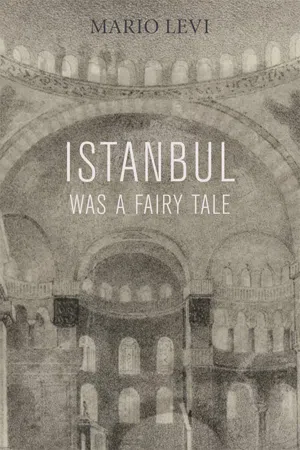
A major work of contemporary Turkish literature, Istanbul Was a Fairy Tale tells the stories of three generations of a Jewish family from the 1920s to the 1980s. Istanbul is their only home, and yet they live in a state of alienation, isolating themselves from the world around them. As witness, observer, and protagonist, the narrator—at once inside and outside of his story—records their many tales, as well as those of their friends and neighbors, creating an expansive mosaic of characters, each doing their best to survive the twentieth century.
- 672 pages
- English
- ePUB (mobile friendly)
- Available on iOS & Android
eBook - ePub
Istanbul Was a Fairy Tale
About this book
Trusted by 375,005 students
Access to over 1.5 million titles for a fair monthly price.
Study more efficiently using our study tools.
Information
TALES AND RECOLLECTIONS
Estreya’s star
As the years went by, one learned how to carry, in different guises, the burden of sorrow caused by the inevitable acts of forsaking and being forsaken. In time, one discovered the charm of hiding oneself behind a façade. Upon reaching a certain stage, there came a moment in one’s life when one felt like disclosing, even to one’s inner voice at an irreversible moment of loneliness, what one was leaving behind and where . . . even though one might feel exposed and vulnerable despite all of one’s proliferations—a feeling of nakedness despite one’s rich attire. Anyway, one had to believe in the existence of a clear path in order to be able to go on living—in a certain time and space—where one’s loneliness could not possibly define, in light of the facts, the influence of other people on one’s journey. To express it with a string of empty platitudes in the current jargon can be constrictive because the others were there. The others . . . just like those found in traditional tales . . . in different places, in different climates, at diverse latitudes of sensations, in cities where one could never live as long as one lived in one’s imagination . . . The others would be there; even though one moved away and settled elsewhere; even though they were lost to sight, they would still be visible; even though one left for somewhere else, set out for other regions of the earth carrying along one’s boundaries within, they would not relinquish their grip. The play put on the stage was your play in fact, the stage for which everybody got prepared in their respective changing rooms; the changing rooms, wherein they feared intrusion into their privacy and mirrors, and were more often than not ignored; it was a play enacted by the spectators along with the players, as they could not possibly absent themselves from it. Preparations were always made by someone for someone else, for days properly generated, for nights properly reproduced through the stage, or more precisely, for nights saved.
For the weekends one spends and shares with others through short incursions to the countryside, with short sallies in measured steps . . . through a tacit understanding known to everybody that nobody dares to question by raising his voice.
In all probability, that was how it had always been in the past. After all, nothing had changed in the real sense of the word; was it ever possible? You might ponder upon victories, defeats, disappointments, remorse, and separations that would eternally come back to you through all channels. Nevertheless, in order to have a clearer picture of the longing of Monsieur Jacques (more for Olga than for anybody else) not only should one experience all these eventualities, but one should also know how to attain the height of patience required in the telling of a convoluted tale by putting up a spirited defense against the influences of retroactive experiences and future prospects and justifications.
Attaining such heights in daring to advance toward certain people, even through cautious steps . . . gingerly, to wit somewhat unmanly . . . it was not possible for me, in my capacity as a visitor who had had access up to a certain extent to those lives in my capacity as a stage actor, to guess, during those interminable nights, who exactly was or had been associated with which particular apparition, scent, or sound, and to collate the fragments into a whole in the most perfect manner to their great satisfaction, so long as those individuals lived. It had also been my desire to descend into those labyrinths. Man watches man, but yet is an obstacle despite all his attempts at understanding him. There were also certain visions and feelings that occupied other regions in people’s lives. In time, I was to have an insight into the importance of these regions once I learned how to keep up with them, despite my occasional escapades. What remained to be done, under the circumstances, was to know how to unearth clues, how to discover them and how to live the stories concealed behind appearances, in unidentifiable corners, by trying to live them, or at least, by making as though one had lived them, and, by daring to go on as though one was in pursuit of an elusive image. That was the only way to go beyond a stage play meant to be enacted for other people with scenes performed or represented through dialogue. I believe I have already mentioned the magic of certain outcomes one encounters in other tales as well.
We had come together for the last time at Juliet’s house to commemorate Madame Estreya, who had lived elsewhere, in a different fashion, in compliance with the requirements of the path that had led her there. She died surrounded by other people, despite having reserved her last moments for herself, for herself alone. Nobody had considered her death as an ordinary death; nobody would be left cold in her absence in the proper sense of the word. Following the funeral, we had, as tradition required, come together for a repast, the procedure of which never changed, and which all the family members were supposed to attend. This was the last duty to be performed. Nobody could usurp this experience from anyone. Nobody . . . Not even life itself . . . Not even the lives that seemed a betrayal to certain people. This togetherness was at least an opportunity to experience anew those private moments we keep inside ourselves without disclosing them to others, trying to fit them into a shorter bracket of time. During the said repast, just like in all such cases, partly because of this very fact, we were face-to-face with our recollections, petty remorse, and the memory of the deceased. Although the lives were not always our own lives, the dead were our dead. This was clear enough even during the last prayer recited to commemorate them. One should bow with respect in the presence of the family members considered, or rather believed, to have ascended to heaven. The rabbi took a roll call of the departed while the congregation chanted in unison “They are in Heaven.” This was how it had been and was desired to have been over the centuries . . . At that moment the features of those deceased came from your own images, the truth which you could not always disclose just to any chance newcomer. It goes without saying that you could return to the past by recalling the people you had left behind at different times and places; you could realize this return without letting your surroundings get a hold of you, despite having seen and lived those locations. These curtailments were your own, while the stage play was being addressed to the people at large.
The funeral was conducted in a small synagogue at the cemetery. Madame Estreya had neither a large enough assembly to fill a big synagogue, nor enough money to warrant a first class funeral service. I remember her image vanishing in the din of the distant past. However, the image now looks tarnished with certain details blotted. This is the reason why I cannot communicate the legacy she must have entrusted to certain individuals whom I have not met. It seems that certain things have sunk into oblivion for good and are irretrievably lost. All the paths that had led up to her have closed, as they were meant to be. She had always been an outsider; an outsider among outsiders, condemned, if one may be allowed to qualify her as such, or maybe as someone who had chosen to be an outsider after a certain point. An outsider . . . Yet, Madame Estreya was Madame Roza’s sister, the second daughter of her family, who had preferred a thorny way of life at a heavy cost, who always wanted to be considered aloof, at a distance, although not so much a castaway as Aunt Tilda. Despite the beauties of their traditions and their conservative character, there were so many cruelties that had accompanied them, so many archaic failures. Their tale was meant for those who could remain content with very few incidents as far as plot was concerned, for those who would deem that a few sentences would be more than adequate, and for those who would prefer to remain faithful to their traditions. The tale should be an ordinary tale, not deserving to be a topic of serious discussion or to be elaborated upon, rendering it totally unrecognizable.
To the best of my judgment, Madame Estreya was the most beautiful girl belonging to the family; she had deep blue eyes, possibly inherited from a distant Thracian relative. During her high school years, she had been an introverted music lover. The high school they had enrolled her in was a distinguished establishment where young girls were brought up as ladies. At the time she had taken a fancy to Dickens and had identified her brother, Monsieur Robert, with the heroes in Dickens’ novels, which she read over and over again. When she was still a student at the Galatasaray Lycée, she had fallen in love with a young man who was also a student there. A happy coincidence must have arranged her meeting with this sensitive young man who was to figure prominently in her life, his name was Muhittin Bey. An individual who liked music, making no distinction between the songs of Salahattin Pınar and Chopin’s Polonaises, both of which he used to listen to in rapture, and who preferred to keep his love for poetry as a secret he disclosed only to a few of his companions. What had the circumstances that had led to their fatal encounter been? I have never been able to discover; nor shall I ever be able to do so henceforth. It seemed as though there was a kind of gap between themselves and others. This was one of the reasons that brought reticence, a tabooed subject never to be referred to. However, as far as I can gather, it was one of those overwhelming love stories, an ineluctable love that had to be eventually sanctioned despite all hostile reactions and barriers, in which the parties involved vowed to each other to share their lives for better or for worse, resigning themselves to all the consequences, and, according to others, the parties involved, as castaways, were determined to lead each other toward each other’s unhappiness. It looked as if they had vowed allegiance to each other with full knowledge of the fact that the whole thing was going to end up in an interminable brawl. Their domicile had been in Feriköy for a time. Then they had moved to Harem, a locality alien to them and completely removed from their families, as if they wanted to give their banishment an official identity. Harem was, at the time, a district removed from the commotion of society, where a Jew would never think of residing. As far as I know, this had been Estreya’s idea. This was a choice that could be made perhaps but once in one’s lifetime with a view to determining one’s place in the world, in full anticipation of a bright future. For a bright future, yes, but at the same time, to impart on certain people the cry of revolt, the servitude of love, the call of a true love and the determination not to turn back, by having their bridges burned once and for all; to be able to stick to one’s determination to continue on this one-way journey by taking into consideration all untoward events looming ahead, wrapped in sentiments of abandonment and the call of self-affirmation. Apparently, this change of domicile had not been easy for Muhittin Bey, as he had always considered himself part and parcel of the ‘opposite coast’ of Istanbul. He would never cease to convey his passionate attachment to that place by telling people how he had given refuge to a childhood friend, Apostol, at his house during the September Incidents; he would also narrate this to his six-year-old nephew during a trip to Beyoğlu, holding him by the hand, showing him the devastation and the rabble caused by the events referred to the day before, saying to him: “A sight which you will never again witness in your lifetime!” thus reaffirming to himself, this evil act, perhaps with a faint hope of returning to those days of yore, years after his love affair.
Yearnings, disappointments, simple joys . . . They had lived this love, in their confined space, learning in installments what forbidden love might bring or take away from them. Believing that they had earned their requited love at the cost of all the experiences they had had to face, in total disregard of other people, of traditions and of the suffering of those they had left behind, without hiding themselves behind other people and forsaking tradition. This determination explains why they had preferred to keep detached from their families. It goes without saying that patience was required in order to be able to properly understand their sentiments and lifestyle choices once seen in their proper places. Through the years, religious holidays had always been occasions of lost opportunity, visits home made tentatively, a timid attempt at reconciliation. Home, for them, was now different, having undergone a process of gradual transformation; such visits were approached with circumspection and suspicion. And so, they proved fruitless. Filling the void that had come about in the course of their absence had already become impossible. It was too late, the links forming the backbone had been severed at the base and the bridges had all been burned.
Madame Estreya, had, according to an unwarranted assumption, been converted to Islam, assuming the name Yıldız. However, in the long run, it became clear that this had been a monstrous lie. This might also have been a stratagem to cope with the difficulties encountered at the time from that remote realm. Moreover, such an undertaking might provide certain clues to other realities that lay in deeper strata. Nevertheless, such a decision would have to have been made solely by Madame Estreya, just like in those days when banishment was still practiced. As far as I know, Muhittin Bey was an indulgent man, a lenient and refined character who would be loath to espouse such trickery as a means to resolution, even in light of those circumstances.
After his retirement, he occasionally came to pay a visit to Monsieur Jacques. Those were the times when he had closed his little grocery store at Kadıköy Pazarı, the one that glanced from a distance at Balıkpazarı in Galatasaray with a plebeian look. I remember him from those days. I believe neither Madame Roza nor Madame Estreya knew anything of these visits. However, I must acknowledge I haven’t the slightest evidence to prove this. On the other hand, I may well be mistaken in my observation and be the victim of an illusion thoroughly devoid of substance. The fact is that I just feel inclined to find credence in such an unlikely scenario in order to believe once more in this improbable story, a story which I one day hope to revisit in search of the truth. This is not so bad; after all, when one thinks of the shortcuts we dare to take for the sake of those yearnings we keep postponing and patiently waiting. To experience the passion of pursuing those scraps of expectation was necessary after all for embracing a new day, yes, the dawn of a new day.
On top of that we should also take into consideration the fiery spirit that those moments held, that lay concealed somewhere, beautiful, unsoiled, and untouched, just because they had yet to be experienced. This may have been the reason why the stories never came to fruition; they just couldn’t be concluded.
As for my approach to the truth, to the things I perceived as a witness . . . Muhittin Bey was an extremist, a member of the People’s Party. He often squabbled with Monsieur Jacques who was a diehard democrat. Their altercations in the shop were a way to add color to their drab existence and ignore what was going on around them. The façade of daily events, known and discussed by everybody, were in fact the shield behind which people concealed their lives. I think there was some common ground where they could reach a brittle understanding, a sentiment I could not identify or define despite all efforts. That space had, I think, been shared at times when the harshness of the world was most sharply felt, a space where they needed no additional words or expressions. The affection that attached them to each other may have been a deep one, subliminally experienced . . . During those days of occasional visits, it had been their custom to eat at the Borsa Restaurant. I had had the opportunity to be present at one or two of those luncheons, during which Monsieur Jacques used to discourse upon the changing times, human beings, and the deterioration of Istanbul’s overall atmosphere. They felt that they were being gradually alienated from the city in which they lived. “Life is a dirty joke,” said Muhittin Bey at one of those luncheons. Life, a dirty joke . . . These seemed, at first, to be the lyrics of a cheap song . . . Yet, when one gives some thought to platitudes one can see how easily they epitomize the lives of so many. Life, a dirty joke . . . This attitude to life was familiar to Monsieur Jacques; he could not possibly feel estranged from a human being who experienced this emotion and who knew how to confront life in this way. I’m sure that there had been, there must have been, a time when he did not consider the husband of his sister as a member of his family, not as an El Turco. This was a time, I think, that lent meaning to that place, a time deeply felt, one that cannot be truly articulated to anyone.
As far as I can infer from the altercations at the shop, Madame Estreya had also become a member of the People’s Party. This was a courageous act by a Jewess who had lived under the Ismet Paşa regime. Yet, she had had many reasons for reacting against that life, against her family.
One evening, Muhittin Bey, who, while singing a song of Selahattin Pınar to the accompaniment of the lute he himself played for the woman with whom he had been living, had suddenly died, reposing his head on his lute, with a faint smile on his lips; a heart attack probably . . . This was the end of him. It was like a joke. This was perhaps Muhittin Bey’s last performance, a performance that represented his attitude to life and his position in it. This is why I never forgot his maxim: “Life is a dirty joke.” He had left his song unfinished. This perspective, this ‘moment of eternity’ suited his world well. It was Monsieur Jacques who had arranged the funeral service. To my mind this is a detail not to be overlooked.
This was the story of Muhittin Bey and Estreya. No child was born to them. Was there any particular reason for this? Pills perhaps? According to Madame Roza, there was a reason for it. According to Monsieur Jacques, this was a question that begged no explanation, a question that could not easily be explained. It was as if this had been a secret shared between two people, between him and Muhittin Bey. It was a secret of a shared life, a double-edged secret which could only have been disclosed and explained unilaterally. The secret was one of those destined to remain buried along with the departed.
Madame Estreya had not gone back to her own people after Muhittin Bey’s death; she had not even shortened the intervals between her usual visits to the house she had had to abandon years before, let alone returned. The doors had been irrevocably closed. Those two lives were no longer the same. If my memory serves me well, she herself had gone the way of all flesh, broken by the thought of a life spent alone, separated from the man with whom she wished to spend it. Her body was discovered by her neighbors. Such incidents were apparently a daily occurrence in the neighborhood, in any case.
As I brood over these things now, I ask myself now and then the reason why Monsieur Robert and Aunt Tilda had treated their elder sister with such indifference. I can still remember the turn of events which always remained a mystery to me. In such a mood, I try to believe in the existence of those days and nights that I’m no nearer understanding, but yet were experienced by others. However, if a gap in the sequence of events did occur, and if such a gap was risked with all its related consequences, Madame Estreya must have been responsible for this gap. The rest was mere fancy, resignation, and despair. For, she was one of those who knew how to close one’s doors at the right time. Otherwise, no meaning could have been elucidated or defended, at least none worthy to be defended for the sake of those days passed in exile.
Through her death, that repast in which we took as part of a duty, so to speak, Madame Estreya stayed in my life in this guise always at arm’s length; she preferred to remain aloof and was treated with a frosty silence in general; she exercised her discretion by opting for a life at home, for a life of self-annihilation, rather than setting out on a long journey. All things considered, she abided in her feminine identity as someone whose solitude had been awarded to her, not feeling ashamed in the least, always self-satisfied and alive, and—this is particularly important—meeting all the challenges she encountered on her way bravely without the least complaint. I may, perhaps, by this addition, explain the fact that there was no one left to say farewell to nor anyone from whose underclothing she could have torn a piece from on the occasion of that modest ritual (which has always thrilled me) when she returned from the realm in which she had opted to live to the land she had abandoned, by herself, or to be precise, in the image that her body had left behind. None of her relatives lived in that house anymore: Madame Roza had died; Monsieur Robert was in London and was unable to return to Istanbul; Aunt Tilda had not responded to the calls stating that her sister’s soul was in repose all alone in a synagogue with no one to pray for it. Not even the mourner’s kaddish for the deceased had been recited. Those were the days when I had acquired the fundamentals by which one could view time and suffering through the window of humor. The fact that the said prayer was left unrecited meant that I had missed an exiguous performance I would have liked to have borne witness to. This was somehow different from other rituals that called for the presence of a whole congregation. People were wont to pray together in unison without having an inkling of what they uttered, over and over again, tens of thousands of times, in the tongue of a distant world, the distance of which was hardly definable for them, for the mere sake of the perpetuation of an order alien to them. I never forgot those moments. I was sure that they did not know that the prayer they recited was not even in Hebrew, but a far cry from Babylonia, from that ancient exile. However, I cannot ignore the feeling of security that the mere fact of being together gave me while praying with heterogeneous words, that inexpressible feeling of warmth that one can’t help but experience, thus creating a place where one felt, by force of circumstances, the difference which one could not avoid. Leaving aside all these things, in case you wished to advance toward a world out of the ordinary, you might think that the desire that the function which prayer involved could be linked to an experience related to separation and an absolute remembrance.
The words had assumed different meanings in different worlds through beautiful associations . . . Such was the prayer that had not been recited for the soul of Madame Estreya. This was so characteristic of her, especially if one took into consideration the long struggle she had waged in the hope of being understood. She did not want to remain misunderstood by others even after she died. This was the poetic side of what had been experienced, certainly; it was merely a part of the role she played which I had assigned her. The actual truth was naturally different. The prayer had not been recited; at least ten individuals of the male sex had to be present in order that the said prayer might be properly executed. Male and female, we were eight in all, a family of eight at the service. That means the required quorum was lacking, those who were absent had failed to show up once more; they happened to be in places where they were not supposed to be. Madame Estreya had been abandoned to her destiny in every respect. Even in her fatal end. Estreya signified ‘star.’ But her star seemed not to have twinkled for certain people . . . for those who had opted for covenants.
To understand, to try to understand . . . This phrase must have had some relevance not only for those banished from Babylonia, but also for Monsieur Jacques who never ceased to tell me about the adventures of the prophets Abraham and Solomon and Joseph and David who are still alive in my imagination as legendary figures. Death left men face-to-face with the varying solitudes experienced in the depths of one’s soul. Monsieur Jacques was, at the time, embedded in a solitude far removed from the play that was being enacted, in a lone...
Table of contents
- COVER
- TITLE
- COPYRIGHT
- DEDICATION
- CONTENTS
- ACKNOWLEDGMENTS
- DISCLAIMER
- FOREWORD
- THE STARLINGS
- TALES AND RECOLLECTIONS
- EPILOGUE OR FAREWELL LETTER
- ABOUT THE AUTHOR
Frequently asked questions
Yes, you can cancel anytime from the Subscription tab in your account settings on the Perlego website. Your subscription will stay active until the end of your current billing period. Learn how to cancel your subscription
No, books cannot be downloaded as external files, such as PDFs, for use outside of Perlego. However, you can download books within the Perlego app for offline reading on mobile or tablet. Learn how to download books offline
Perlego offers two plans: Essential and Complete
- Essential is ideal for learners and professionals who enjoy exploring a wide range of subjects. Access the Essential Library with 800,000+ trusted titles and best-sellers across business, personal growth, and the humanities. Includes unlimited reading time and Standard Read Aloud voice.
- Complete: Perfect for advanced learners and researchers needing full, unrestricted access. Unlock 1.5M+ books across hundreds of subjects, including academic and specialized titles. The Complete Plan also includes advanced features like Premium Read Aloud and Research Assistant.
We are an online textbook subscription service, where you can get access to an entire online library for less than the price of a single book per month. With over 1.5 million books across 990+ topics, we’ve got you covered! Learn about our mission
Look out for the read-aloud symbol on your next book to see if you can listen to it. The read-aloud tool reads text aloud for you, highlighting the text as it is being read. You can pause it, speed it up and slow it down. Learn more about Read Aloud
Yes! You can use the Perlego app on both iOS and Android devices to read anytime, anywhere — even offline. Perfect for commutes or when you’re on the go.
Please note we cannot support devices running on iOS 13 and Android 7 or earlier. Learn more about using the app
Please note we cannot support devices running on iOS 13 and Android 7 or earlier. Learn more about using the app
Yes, you can access Istanbul Was a Fairy Tale by Mario Levi, Ender Gürol in PDF and/or ePUB format, as well as other popular books in Literature & Literature General. We have over 1.5 million books available in our catalogue for you to explore.