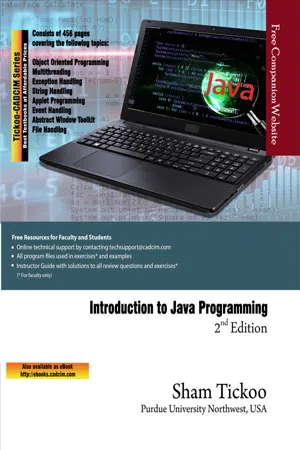
Introduction to Java Programming, 2nd Edition
eBook - ePub

Introduction to Java Programming, 2nd Edition

  1. English
  2. ePUB (mobile friendly)
  3. Available on iOS & Android
eBook - ePub

Introduction to Java Programming, 2nd Edition

About this book

Introduction to Java Programming is a textbook for software developers to familiarize them with the concept of object-oriented programming (OOP). The textbook enables the reader to understand the basic features of Java. The line-by-line explanation of the source code, a unique feature of the textbook, enables the students to gain a thorough and practical understanding of Java. The chapters in this book are structured in a pedagogical sequence, which makes this textbook very effective in learning the features and capabilities of the software.


The following are some additional features of this book: >

  • Each concept discussed in the book is exemplified by an application to clarify and facilitate better understanding.
  • This textbook introduces the key ideas of object-oriented programming in an innovative way.
  • The concepts are illustrated through best programs, covering the basic aspects of Java.
  • Additional information is provided to the users in the form of notes.
  • There is an extensive use of examples, schematic representation, screen captures, tables, and programming exercises.

Table of Contents
Chapter 1: Introduction to Java
Chapter 2: Fundamental Elements in Java
Chapter 3: Control Statements and Arrays
Chapter 4: Classes and Objects
Chapter 5: Inheritance
Chapter 6: Packages, Interfaces, and Inner Classes
Chapter 7: Exception Handling
Chapter 8: Multithreading
Chapter 9: String Handling
Chapter 10: Introduction to Applets and Event Handling
Chapter 11: Abstract Window Toolkit
Chapter 12: The Java I/O System
Index

Frequently asked questions

Yes, you can cancel anytime from the Subscription tab in your account settings on the Perlego website. Your subscription will stay active until the end of your current billing period. Learn how to cancel your subscription.
No, books cannot be downloaded as external files, such as PDFs, for use outside of Perlego. However, you can download books within the Perlego app for offline reading on mobile or tablet. Learn more here.
Perlego offers two plans: Essential and Complete
  • Essential is ideal for learners and professionals who enjoy exploring a wide range of subjects. Access the Essential Library with 800,000+ trusted titles and best-sellers across business, personal growth, and the humanities. Includes unlimited reading time and Standard Read Aloud voice.
  • Complete: Perfect for advanced learners and researchers needing full, unrestricted access. Unlock 1.4M+ books across hundreds of subjects, including academic and specialized titles. The Complete Plan also includes advanced features like Premium Read Aloud and Research Assistant.
Both plans are available with monthly, semester, or annual billing cycles.
We are an online textbook subscription service, where you can get access to an entire online library for less than the price of a single book per month. With over 1 million books across 1000+ topics, we’ve got you covered! Learn more here.
Look out for the read-aloud symbol on your next book to see if you can listen to it. The read-aloud tool reads text aloud for you, highlighting the text as it is being read. You can pause it, speed it up and slow it down. Learn more here.
Yes! You can use the Perlego app on both iOS or Android devices to read anytime, anywhere — even offline. Perfect for commutes or when you’re on the go.
Please note we cannot support devices running on iOS 13 and Android 7 or earlier. Learn more about using the app.
Yes, you can access Introduction to Java Programming, 2nd Edition by Prof. Sham Tickoo in PDF and/or ePUB format, as well as other popular books in Computer Science & Programming in Java. We have over one million books available in our catalogue for you to explore.
Chapter 1
78284.webp
78288.webp
Introduction to Java
Learning Objectives
After completing this chapter, you will be able to:
• Understand history, evolution, and features of Java
• Understand the concept of OOPS
• Understand Java complier and interpreter
• Install Java development kit
• Write, compile, set the path, and run your first Java program
• Install NetBeans IDE
• Write, build, and run Java program in NetBeans IDE
Introduction
This chapter introduces you to Java programming language and allows you to write your first program in Java. In this chapter, you will get a brief idea about history, evolution, and features of the language. Also, you will learn how to install Java and Net Beans IDE (Integrated Development Environment) on your system and run Java programs. Moreover, you will gain knowledge about the concept of object oriented programming as well as its importance in developing Java programs.

Note
1. An Integrated Development Environment (IDE) is a software application that provides comprehensive features to computer programmers for software development. It generally consists of a source code editor, build automation tools, and a debugger.
2. The examples in this book are tested on Windows platform which is itself written in Java.

HISTORY AND EVOLUTION OF JAVA
The first version of Java was developed by James Gosling at Sun Microsystems (which has since been acquired by Oracle Corporation) in USA, in the year 1991. Initially, it was named as Oak by James Gosling, but later in 1995, it was renamed to Java. The first version of the application was developed for the use of electronic devices and circuits, and the plan got successful. Later on, it was called the Green project that led to the invention of Java.
Apart from its general purpose use, it is considered as a leading web-based technology. When it was invented, nobody knew how popular it would be. It is the first object oriented programming language that is platform independent and can run on any platform. It allows the developers to follow “Write Once, Run Anywhere” (WORA) concept. Though the base syntax of Java has been taken from C and C++, s...

Table of contents

  1. Cover
  2. Preface
  3. Chapter 1: Introduction to Java
  4. Chapter 2: Fundamental Elements of Java
  5. Chapter 3: Control Statements and Arrays
  6. Chapter 4: Classes and Objects
  7. Chapter 5: Inheritance
  8. Chapter 6: Packages, Interfaces, and Inner Classes
  9. Chapter 7: Exception Handling
  10. Chapter 8: Multithreading
  11. Chapter 9: String Handling
  12. Chapter 10: Introduction to Applet and Event Handling
  13. Chapter 11: Abstract Window Toolkit
  14. Chapter 12: The Java I/O System
  15. Other Publications