Conflict on the borders of the Russian 'Empire', whatever the complexion of the government controlling it, has been a constant feature of the past 90 years, most recently with Russia's brief war with Georgia in August 2008. In 1919, as the smaller nations on Russia's borders sought self-determination while the Civil War raged between the Whites and the Bolsheviks, the Paris Peace Conference struggled with a situation complicated by mutually exclusive aims. The Baltic States of Latvia, Lithuania and Estonia were seen by both the Russians and the Western Allies as a protective buffer for their own territory, which led to the curious situation that the Peace Conference requested German troops to remain temporarily in the Baltic territory they had occupied during the First World War to block the westward spread of the Bolshevik Revolution. The ongoing civil war in Russia further complicated the issue, because if the Whites should win and restore the 'legitimate' Russian government, the Peace Conference could not divide up the territory of a power that had been one of the original members of the Entente. The US politician Herbert Hoover described Russia as 'Banquo's ghost' at the Paris Peace Conference, an invisible but influential presence, and nowhere can this be more clearly seen than in the deliberations over the Baltic States.
- English
- ePUB (mobile friendly)
- Available on iOS & Android
eBook - ePub
About this book
Trusted by 375,005 students
Access to over 1.5 million titles for a fair monthly price.
Study more efficiently using our study tools.
Information
I
The Lives and the Land
1
A Brief History
Estonia, Latvia and Lithuania lie on the eastern Baltic seaboard, between two of the 19th and 20th century’s greatest powers, Germany and Russia, and two major powers of earlier centuries, Sweden and Poland. Their history is characterised by the overlapping influence of these dominant and invasive polities. In the 20th century these three small states shared a common trajectory – escape from the Russian Empire, inter-war independence, wartime occupation, re-absorption by the Soviet Union, and renewed struggle for independence at the end of the century. They were treated as a bloc in the policies of the larger powers, and attempted to build regional alliances in the interests of their own collective security. This common fate masks the very different experiences of these states before the 20th century. The peoples and the territory of Estonia, Latvia and Lithuania differ from each other historically in terms of language, culture and religion. There are fundamental differences even between the Estonians and Latvians, while ‘almost every historical generalisation that can be made about the Latvians and Estonians has to be modified to take account of the Lithuanians’.1 Even in the early 20th century any attempt to include Lithuania along with Estonia and Latvia in a survey of the ‘Baltic states’ was regarded as to some extent arbitrary.2
The native inhabitants of Estonia, Latvia and Lithuania are descended from tribes who settled on the eastern Baltic shore as long as 4,000 years ago. Tribes speaking Finno-Ugric languages setled north of the Vaina River; they had moved there from the Volga region of Russia. Indo-European peoples, including Couronians, Zemgalians and Latgalians settled to the south. Tacitus, writing in the 1st century AD, refers to the people of this region as ‘Aesti’ – collectors of amber and energetic cultivators of crops.3 Modern Estonian belongs to the Finno-Ugric language group, is closely related to Finnish and more distantly related to Hungarian. A language close to Estonian is also spoken by the Livs, a distinct ethnic group in north-west Latvia of whom only around a thousand remain. Modern Latvian and Lithuanian are Indo-European languages. Lithuanian received a great deal of attention from mid-19th century philologists as a result of the discovery that it was the closest living language to Sanskrit.4
Geographical location differentiated the Baltic peoples in terms of trade and therefore economic development. The Lithuanians were isolated from the sea and the Nemunas River only skirted their territory to the north. In contrast, the Daugava River and viable ports on the Baltic coast meant that the Estonians and Latvians engaged actively in trade, trafficking amber to the Romans and furs to the German tribes, in exchange for metal goods, salt and textiles.
Their geographical position also exposed the Baltic peoples to the attentions of foreign powers. In the 12th century the threat was a continuation of the Viking expansion, now focused through the Kingdoms of Denmark and Sweden. In the 13th century, German merchants, missionaries and Crusaders established extensive bridgeheads in the eastern Baltic. Tied into the north German Hanseatic League, these bridgeheads turned into an enduring colonial complex of trading cities, bishops who were often territorial princes, and religious and military orders like the Sword Brethren, the Livonian Order, and most famously the Teutonic Knights.
This medieval colonisation engulfed almost the whole southern and eastern Baltic coast from Lübeck to Narva: only the Lithuanians escaped conquest and Christianisation. During the 13th century they acquired political coherence, notably under Grand Duke Mindaugas (1236–63). Not only did they hold off the Teutonic Knights, they expanded into the ruined Russian principalities as the power of their Tatar overlords declined. Under Grand Prince Gediminas (1316–41) Vilnius became Lithuania’s capital, a commercial centre with a large Jewish, as well as Lithuanian, population. Vilnius remained notorious for its international character – Johann David Wunderer, a late 16th-century visitor, claimed it would be difficult to find ‘a place in Christianity where more strange nations and more unusual clothes come together’.5 By the late 14th century, the Grand Duchy extended from the Baltic to the Black Sea, taking in much of modern-day Ukraine and Belarus. In 1386 Grand Duke Jogaila married Jadwiga, child Queen of Poland, with far-reaching consequences. The ideological basis of the Crusader threat was removed as the Lithuanians began to Christianise more or less on their own terms – or at least those of the ruling prince – and Jogaila’s dynasty became one of the great powers of medieval Christendom. The much more institutionally developed Kingdom of Poland introduced new forms of administration into Lithuania. In the 15th century, Poland-Lithuania contained and then neutralised the German Crusader threat in the north. The price for the Lithuanians was not only Christianisation, but also Polonisation: its nobility were becoming Polish in customs, manners and language long before the formal union of the Polish-Lithuanian Commonwealth in 1569.
The German Crusader states on the Baltic from Danzig to Narva stabilised, and then with the coming of the Reformation went Lutheran and secularised themselves as principalities. In the 1530s aristocratic warrior monks became a territorial nobility – but remained a German elite dominating largely non-German peasant societies. Their grip was strong enough to repulse Tsar Ivan the Terrible’s attempts to conquer the Baltic coast between 1558 and 1584, but their independence did not survive the attentions of the Danes and Swedes from the mid-16th century. In the early 17th century the Swedes established themselves on the Baltic littoral, despite local resistance and Polish and Danish competition. They went on to occupy many Prussian and north German cities and to intervene militarily deep inside Germany. Swedish dominance in the Baltic beat off all challengers until it eventually collapsed during the Great Northern War with Russia in 1700–21.
The Treaty of Nystad in 1721 formalised Russia’s breakthrough to the Baltic. Peter the Great incorporated Estonia and Livonia, Ingria and Karelia. With Sweden in retreat, there was no other great power to bar the rise of Russia in the region: Poland-Lithuania’s bankrupt elective monarchy made it an ineffective and incoherent polity, increasingly vulnerable to predatory neighbours. Prussia, Russia and Austria-Hungary combined against her in the Partition of 1772. When internal reforms looked as though they might succeed, the further Partitions of 1793 and 1795 eliminated the Polish-Lithuanian Commonwealth completely. Russia absorbed the Duchy of Courland and most of Lithuania in 1795. Its grip on the eastern Baltic coast was complete.
2
The Baltic Region and the Russian Empire
Great variations in the social, economic, cultural and religious makeup of the Baltic region persisted under Russian rule. Peter the Great confirmed the dominant position of the Baltic German nobility and of the Lutheran Church in Estonia and Livonia shortly after the signature of the Treaty of Nystad in August 1721. The German nobility owned the land, and German merchant elites dominated trade. Administration and education in the region were conducted in German. The Baltic Germans came to be valued by Peter the Great as loyal and effective administrators and over time gained positions in the central bureaucracy of the Russian Empire and in the Russian army. It was therefore not surprising that the Baltic Germans also remained dominant in Courland after its absorption in 1795. In Lithuania the Polonised aristocracy and the Roman Catholic Church retained their position, although the Russian government treated them with greater suspicion. The Russian period therefore saw a reinforcement of the division between the Baltic provinces – Estonia, Livonia and Courland – and the Polish-Lithuanian provinces, of which by the mid-19th century Vilnius, Kaunas, Grodno and Suwalki contained the bulk of the Lithuanian population.
Under the influence of ‘enlightened’ German landowners striving for agricultural efficiency and looking also to secure their own position in the region, serfdom was abolished in Estonia in 1816, in Courland in 1817 and in Livonia in 1819. This was 40 years ahead of emancipation in Lithuania and the rest of the Russian Empire, but the restrictions on movement and the purchase of land that accompanied this emancipation limited any further alterations to the traditional social structure. There were educational opportunities for Latvians and Estonians, but those that took advantage of them tended to rise into the local elites and become Germanised. When nationalist movements emerged in the 19th century, they therefore focused on the need for national languages to transcend class and status boundaries. During the course of the 19th century local Russian authorities became aware of the dangers of having native inhabitants of these areas educated in German, rather than Russian, especially after the unification of Germany. At the same time they were becoming more confident in their ability to roll out Russian administrative models and culture across the Empire, freeing them from reliance on traditional elites to govern in the borderlands. The policies of ‘Russification’ that were applied both in the Baltic and Polish-Lithuanian provinces were therefore targeted initially at the dominant elites (Germans and Poles) rather than the nascent native national movements (Estonian, Latvian and Lithuanian). For parallel reasons these national movements developed in opposition to German and Polish domination, but not necessarily in opposition to a Russian Empire which seemed to share an interest in eroding traditional power structures in the region.
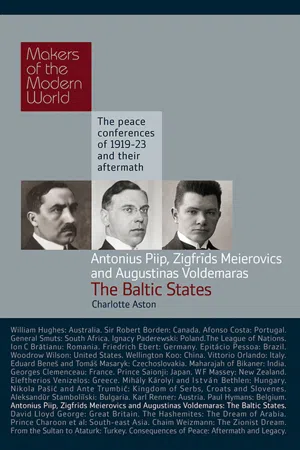
These developments gave native Estonians, Latvians and Lithuanians opportunities they might not have had a generation earlier. This is illustrated by the early careers of the three protagonists of this book, Augustinas Voldemaras, Ants Piip and Zigfrīds Meierovics. All were born in the 1880s. None came in any sense from the traditional land-owning or mercantile elites. All originated in small towns or rural society. Two were academic high achievers who transcended provincial origins to study in St Petersburg and then abroad, and the other might have done so but for his difficult family circumstances.
Augustinas Voldemaras, who was born in 1883 in the Vilnius district in eastern Lithuania, did not come from a wealthy or well-educated family – his father was a small farmer – but he was able to attend the University of St Petersburg, where he studied history and philosophy to Masters level, receiving his Masters Degree in 1910. The gold medals he received for both his undergraduate and Masters work meant that he was awarded a scholarship for Doctoral study at the university.1 He studied in Italy and Sweden before joining the faculty of the University of St Petersburg, as a Lecturer in History, in 1915.
Ants Piip was born in 1884 in Tuhalaane, in Estonia, also the son of a small independent farmer. He studied at a teaching college in Kuldīga (Goldigen) in Latvia, and at Kuressaare State High School. He went on to study law at St Petersburg University between 1908 and 1913, and held a variety of teaching and administrative posts in Alūksne (Alulinn, Marienburg), Kuressaare and St Petersburg. He held a research scholarship at St Petersburg University between 1913 and 1916, but also worked for the Russian government, first in the Ministry of Justice and then in the Ministry of the Interior. Like Voldemaras, Piip also spent time outside the Russian Empire, studying briefly at Berlin University in 1912.
Zigfrīds Meierovics was a few years younger, being born in 1887 in Durben near Liepāja (Libau). Although he was born into a ‘Germanised’ Latvian family, his educational opportunities were more limited than those of Piip and Voldemaras. Meierovics’ mother died in childbirth, and his father, a converted Jewish doctor, suffered from mental illness. From a young age Meierovics was brought up by his mother’s brother, who was a schoolteacher in Sabile in western Latvia. He was educated at the Riga Polytechnic Institute, and forged a career for himself in agrarian banking.2 He appears to have been the only one of the three not to have left the Russian Empire before the Revolution.
By the turn of the century, all three men would become involved in their countries’ nationalist movements. These emerged from the 1860s, and like most other European national movements, revolved initially around the rediscovery and promotion of native languages and folklore. This led to the publication of newspapers, the establishment of nationalist societies and song festivals (forms which would re-emerge in the late 1980s and early 1990s). As the movements developed, so did many of the ideas which would provide foundations for more overtly political rhetoric concerning autonomy and independence in the early 20th century.
From the 1860s onwards more public use began to be made of the terms ‘Estonia’ and ‘Estonian’, ‘Latvia’ and ‘Latvian’. J V Jannsen’s newspaper Eesti Postimees (The Estonian Courier) for example was one of the first publications to address its readers as Estonians.3 A group of Latvians at the University of Dorpat (Tartu), the only higher education institution in the Baltic provinces and very Baltic German in character, called themselves the ‘Young Latvians’ in imitation of the Young Italy and Young Germany movements.4 The Riga Latvian Association, founded in 1868, promoted Latvian language and culture. It was still going strong in the 1910s when Zigfrīds Meierovics was a member. A market for Baltic language publications developed, helped by the exceptionally high literacy rate – over 90 per cent in Estonia and Livonia in comparison to 30 per cent in other parts of the Russian Empire – and by the growth of the cities.5 Riga is a particularly notable example: as Latvians flocked there from the countryside they created a market for Latvian theatre, art and publications. There was an increase in interest in national folklore – the Estonian epic Kalevipoeg, compiled by Friedrich Reinhold Kreutzwald on the model of the Finnish Kalevala, was published in 1857–61. Baltic history was reinterpreted in the light of nationalist ideology, with the era before German colonisation and the advent of Christianity being presented as an era of flourishing national culture and ideals. The conquest and colonisation of the region by Baltic German overlords, in contrast, was a period of darkness and serfdom which still continued. Only when free nations were born in which Estonians and Latvians reclaimed their land would a new age arrive. All of these motifs are present, for example, in Andrejs Pumpurs’ Latvian national epic, The Bearslayer, written in 1888. Much of this rhetoric was directed against the Baltic German elites, and not necessarily against the Russian Empire, which may not have been supremely popular but did offer some prospects for Baltic advancement and autonomy. Krišjānis Valdemārs, a prominent Young Latvian, supported the extension of Russian administrative models in the hope that they would give greater scope to the replacement of traditional German administrators by educated and aspirant Latvians. In 1905 Jaan Tönisson wrote that ‘Estonia and Latvia are living borders of Russia against the West’: the pattern of Baltic history meant that it was still the Germans, not the Russians, who were seen as the greater potential threat.6

The nationalist movement diversified from the 1880s, when a second generation of nationalists began to challenge the primacy of existing institutions. In Latvia this ‘New Current’ saw the existing movement, including vehicles of nationalist activism like the Young Latvians and the Riga Latvian Association, as broadly representative of Latvian merchants and property owners. The New Current sought to transcend these older bodies and to speak for the whole of the Latvian nation, including the working class and landless peasantry.7 In Estonia the later movement was split between those who wished to cooperate with Baltic German liberal elements, and those who wanted to use the structures of the Russian Empire to promote Estonian autonomy. The second grouping, known as the ‘Saint Petersburg Patriots’, wanted the extension of Russian administrative reforms, like the zemstva (regional governing bodies equivalent to county councils) to the Baltic provinces to break the power of the Baltic German landowners. In 1881 Carl Robert Jakobson, a nationalist writer, politician and newspaper editor, led an Estonian delegation to St Petersburg to ask for the reorganisation of all ethnic Estonians into one administrative unit within the Russian Empire. These competing positions were represented in the early 20th century by two of the leaders of the national movement, Jaan Tönisson and Konstantin Päts. Tönisson was editor of Postimees from 1896, and continued to advocate co-operation with liberal elements amongst the Baltic Germans. He saw the Baltic as a historically distinctive world. Although he felt that conflict with the Russian central government was pointless, he believed that Estonians should be concerned with their own affairs, and not with all-Russian problems.8 Päts edited Teataja (The Herald), based in Tallinn, from 1901 to 1905. He took Jakobson’s line on the extension of Russian institutions into the Baltic provinces in order to create more opportunity for Estonians.
Lithuania’s history of independent statehood and empire meant that, when national consciousness began to develop in the late 19th century, progress towards the idea of an independent state (rather than emphasis on cultural identity or political autonomy) was rapid. One of the first to put forward this idea was Jonas Basanavičius, editor of the first Lithuanian language newspaper, Aušra (The Dawn), which began publication in 1883. Although it had no specific political programme, it called for greater use of and respect for the Lithuanian language, and for an independent Lithuanian state, on the model of newly independent Bulgaria, in which Basanavičius had spent some time. Other national newspapers developed in the wake of Aušra – Varpas (The Bell), and Tevynes Sargas (The Guardian of the Homeland).9 Lithuanian nationalists abroad tended to be even more strident – a Lithuanian-language newspaper was actually published in America several years before publication of Aušra began.
The Lithuanian national movement also had a complicated relationship with Polish natio...
Table of contents
- Antonius Piip, Zigfrīds Meierovics and Augustinas Voldemaras: The Baltic States
- Contents
- Introduction
- Part I: The Lives and the Land
- 1. A Brief History
- 2. The Baltic Region and the Russian Empire
- 3. War, Revolution and Independence
- Part II: The Peace Conferences
- 4. Early Allied Contacts
- 5. The Baltic Delegations in Paris
- 6. Baltic Co-operation in Paris
- 7. The Baltic Commissions
- 8. Settlement of Territorial Questions, and Recognition
- Part III: The Legacy
- 9. The Inter-war Legacy
- 10. Loss of Independence
- 11. Return to Europe
- Notes
- Chronology
- Bibliographical Essay
- Picture Sources
Frequently asked questions
Yes, you can cancel anytime from the Subscription tab in your account settings on the Perlego website. Your subscription will stay active until the end of your current billing period. Learn how to cancel your subscription
No, books cannot be downloaded as external files, such as PDFs, for use outside of Perlego. However, you can download books within the Perlego app for offline reading on mobile or tablet. Learn how to download books offline
Perlego offers two plans: Essential and Complete
- Essential is ideal for learners and professionals who enjoy exploring a wide range of subjects. Access the Essential Library with 800,000+ trusted titles and best-sellers across business, personal growth, and the humanities. Includes unlimited reading time and Standard Read Aloud voice.
- Complete: Perfect for advanced learners and researchers needing full, unrestricted access. Unlock 1.5M+ books across hundreds of subjects, including academic and specialized titles. The Complete Plan also includes advanced features like Premium Read Aloud and Research Assistant.
We are an online textbook subscription service, where you can get access to an entire online library for less than the price of a single book per month. With over 1.5 million books across 990+ topics, we’ve got you covered! Learn about our mission
Look out for the read-aloud symbol on your next book to see if you can listen to it. The read-aloud tool reads text aloud for you, highlighting the text as it is being read. You can pause it, speed it up and slow it down. Learn more about Read Aloud
Yes! You can use the Perlego app on both iOS and Android devices to read anytime, anywhere — even offline. Perfect for commutes or when you’re on the go.
Please note we cannot support devices running on iOS 13 and Android 7 or earlier. Learn more about using the app
Please note we cannot support devices running on iOS 13 and Android 7 or earlier. Learn more about using the app
Yes, you can access Piip, Meierovics & Voldemaras by Charlotte Alston in PDF and/or ePUB format, as well as other popular books in History & Political Biographies. We have over 1.5 million books available in our catalogue for you to explore.