eBook - ePub
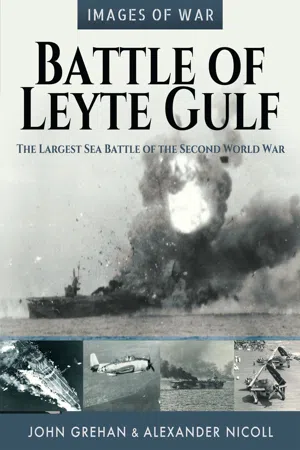
Battle of Leyte Gulf
The Largest Sea Battle of the Second World War
- 200 pages
- English
- ePUB (mobile friendly)
- Available on iOS & Android
eBook - ePub
About this book
A photographic history of World War II's largest naval battle, in which the Japanese and Americans squared off in the Philippines.
On October 20, 1944, the U.S. Sixth Army began landing on Leyte's eastern coast, supported by the U.S. Navy's 3rd and 7th fleets, which were assisted by ships from the Royal Australian Navy. The Japanese were aware that the Americans were poised to attack the Philippines and planned to draw the American warships into one last great battle to try and stave off the otherwise inevitable defeat. Over the course of the following three days, the two naval forces had four separate engagements. Involving more than 360 ships and 200,000 naval personnel, the battle was the greatest naval encounter of World War II—and possibly the largest naval battle in history.
The result was disastrous for the Japanese, who lost three battleships, four aircraft carriers, ten cruisers, and eleven destroyers, along with almost 300 aircraft—the greatest loss of ships and crew the Japanese had ever experienced. In Battle of Leyte Gulf, the actions of the warships as well as the accompanying amphibious landings on Leyte by the U.S. Sixth Army are vividly revealed through a dramatic collection of photographs depicting the ships, sailors, airmen, and soldiers who made history.
On October 20, 1944, the U.S. Sixth Army began landing on Leyte's eastern coast, supported by the U.S. Navy's 3rd and 7th fleets, which were assisted by ships from the Royal Australian Navy. The Japanese were aware that the Americans were poised to attack the Philippines and planned to draw the American warships into one last great battle to try and stave off the otherwise inevitable defeat. Over the course of the following three days, the two naval forces had four separate engagements. Involving more than 360 ships and 200,000 naval personnel, the battle was the greatest naval encounter of World War II—and possibly the largest naval battle in history.
The result was disastrous for the Japanese, who lost three battleships, four aircraft carriers, ten cruisers, and eleven destroyers, along with almost 300 aircraft—the greatest loss of ships and crew the Japanese had ever experienced. In Battle of Leyte Gulf, the actions of the warships as well as the accompanying amphibious landings on Leyte by the U.S. Sixth Army are vividly revealed through a dramatic collection of photographs depicting the ships, sailors, airmen, and soldiers who made history.
Information
Chapter 1
THE LEYTE LANDINGS
The first landings to mark the liberation of the Philippines were made on three small islands which guarded the eastern approaches to Leyte Gulf. ‘Despite cyclonic storms and heavy seas,’ noted MacArthur’s General Staff, ‘elements of the 6th Ranger Battalion, augmented by one company of the 21st Infantry, went ashore on Suluan and Dinagat Islands on 17 October 1944. Heavy mists shrouded their approach and they were opposed only by the rough surf and battering winds. Homonhon Island was occupied the next day.’3
All three islands were quickly cleared of their small enemy garrisons and radio installations. At the same time, mine sweepers and demolition teams co-operated to sweep the waters and the beaches of all obstacles potentially dangerous to the main operation.

At 08.00 hours on 17 October 1944, the light cruiser USS Denver was the first to open fire on a Japanese-held island, Suluan Island, at the entrance to Leyte Gulf. At the time, Denver was acting in support of a US Army Ranger operation to seize enemy-held positions covering the approaches to Leyte. (USNHHC)

The action by USS Denver was followed by minesweeping operations and, on 18 October, the battleship USS Pennsylvania and two cruisers commenced bombardment of the southern Leyte beaches. Pennsylvania was armed with twelve 14-inch guns mounted three to a turret – and it is these guns that can be seen here firing on Leyte on 20 October. (USNHHC)
On 20 October 1944, the largest armada of naval assault craft and warships ever concentrated in the Pacific sailed boldly into Leyte Gulf itself. The landing beaches and tactically important rear areas had already been softened by a continuous two-day ship and aircraft bombardment. After an additional morning barrage, the landing troops were ready to go ashore.
The main assault on the east coast of Leyte began at 10.00 hours in the morning of what was referred to as A-Day. Landings were duly made along an eighteen-mile front between the two small villages of Dulag and San Jose. X Corps, comprising the 1st Cavalry and the 24th Divisions, covered the right flank of the landings to the north; XXIV Corps, consisting of the 7th and 96th Divisions, secured the left flank.
With Japanese opposition at the landing beaches negligible, the US forces were able to advance and by the middle of the afternoon the men of the 1st Cavalry Division, supported by tanks, had secured Tacloban airfield, the most important of the early objectives. For MacArthur, this meant that he was now able to fulfil the promise he had made way back in the dark days of 1942.

As preparations for the landings intensified, during the afternoon of 18 October the destroyer-transport USS Goldsborough was participating in the shore-bombardment of concealed Japanese positions at Dulag in an effort to provide covering fire for underwater demolition teams that were heading for the shore. During this task she was straddled by two 75mm shells, before a third hit her No.1 stack. Two members of the crew were killed and a further sixteen wounded. (USNHHC)

Part of the Leyte landing force at sea as it bears down upon the Philippines. As the original caption states, “it’s tenting tonight in the old Pacific’ as this Coast Guard-manned LST moves toward the Philippines under a mighty shield of American sea-power. Tarpaulins are used to pitch crude shelters on the deck, packed with trucks and fighting equipment. Under these shelters, the battle-bound troops and Coast Guardsmen escape the hot quarters below decks.’ (US Coast Guard Archives)

Just after midnight on 19 October, the destroyer USS Ross was covering the minesweepers when she struck a mine in the swept channel, followed soon after by a second. Although badly damaged, with twenty-three of her crew killed, Ross gained the distinction of being the only destroyer in the Pacific to survive hitting two mines in quick succession.
Taken onboard USS Pennsylvania four days later, this picture depicts the burial at sea for one of those killed on Ross by the mines. (National Museum of the US Navy)

As H-Hour approached on 20 October, the main US invasion fleet entered Leyte Gulf and commenced the amphibious assault by General Douglas MacArthur’s Sixth Army on the designated northern and southern beaches. Here, a convoy of Landing Craft, Infantry (LCI) can be seen approaching Leyte just before the landings, the waters in the Gulf being ‘glassy calm’. (USNHHC)

The destroyer USS Hutchins pictured bombarding the beach on 20 October, during the initial landings. (USNHHC)

An aerial view of the landing craft running for the shore, giving some indication of the scale of the amphibious operation. Initial Japanese resistance to the Leyte landings was relatively light, and most of the Japanese ground troops on the island were out of position and soon to be overwhelmed...
Table of contents
- Cover
- Title
- Copyright
- Contents
- Acknowledgements
- Introduction – The Invasion of the Philippines
- Chapter 1 The Leyte Landings
- Chapter 2 The Japanese Naval Forces
- Chapter 3 Battle of the Sibuyan Sea: 24 October 1944
- Chapter 4 Battles of the Sulu Sea and the Surigao Strait: 24-25 October 1944
- Chapter 5 The Battle off Samar: 25 October 1944
- Chapter 6 Battle off Cape Engaño: 25-26 October 1944
- Chapter 7 Consequences and Controversies
- References and Notes
Frequently asked questions
Yes, you can cancel anytime from the Subscription tab in your account settings on the Perlego website. Your subscription will stay active until the end of your current billing period. Learn how to cancel your subscription
No, books cannot be downloaded as external files, such as PDFs, for use outside of Perlego. However, you can download books within the Perlego app for offline reading on mobile or tablet. Learn how to download books offline
Perlego offers two plans: Essential and Complete
- Essential is ideal for learners and professionals who enjoy exploring a wide range of subjects. Access the Essential Library with 800,000+ trusted titles and best-sellers across business, personal growth, and the humanities. Includes unlimited reading time and Standard Read Aloud voice.
- Complete: Perfect for advanced learners and researchers needing full, unrestricted access. Unlock 1.4M+ books across hundreds of subjects, including academic and specialized titles. The Complete Plan also includes advanced features like Premium Read Aloud and Research Assistant.
We are an online textbook subscription service, where you can get access to an entire online library for less than the price of a single book per month. With over 1 million books across 990+ topics, we’ve got you covered! Learn about our mission
Look out for the read-aloud symbol on your next book to see if you can listen to it. The read-aloud tool reads text aloud for you, highlighting the text as it is being read. You can pause it, speed it up and slow it down. Learn more about Read Aloud
Yes! You can use the Perlego app on both iOS and Android devices to read anytime, anywhere — even offline. Perfect for commutes or when you’re on the go.
Please note we cannot support devices running on iOS 13 and Android 7 or earlier. Learn more about using the app
Please note we cannot support devices running on iOS 13 and Android 7 or earlier. Learn more about using the app
Yes, you can access Battle of Leyte Gulf by John Grehan,Alexander Nicoll in PDF and/or ePUB format, as well as other popular books in History & Japanese History. We have over one million books available in our catalogue for you to explore.