eBook - PDF
From #RhodesMustFall Movements to #Human
Movements in the Age of the Trans-humanist Geographies of Death
- 528 pages
- English
- PDF
- Available on iOS & Android
eBook - PDF
From #RhodesMustFall Movements to #Human
Movements in the Age of the Trans-humanist Geographies of Death
About this book
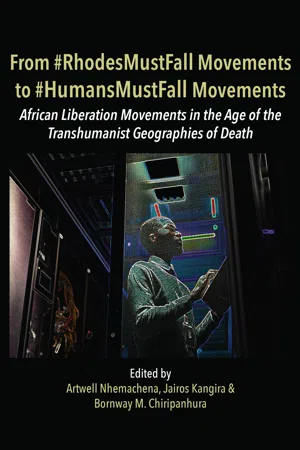
Might it be possible that the world is being migrated into an era where the imperial periphery will be increasingly governed through Artificial Intelligence (AI) and robotics designed to replace human beings? Celebrated as efficient, strong, unfailing, tireless, precise and beyond corruption, AI and robots are set to replace African leaders who are imperially deemed to be and consistently condemned as corrupt, failed, weak and inefficient. But, if these AI and robots are neo-imperial tools and machinations, the million-dollar question is whether empire is not returning to recolonise the [supposedly inefficient] Africans via the new technologies and machinism? Where Africans once celebrated their liberation war movements, empire has emplaced what it calls liberation technologies designed to supposedly liberate African youths from their own states and governments led by liberation movements. Where Africans once celebrated their liberation war movements, empire has placed its own NGOs/CSOs spewing liberal ideologies designed to ostensibly liberate African youths from their own supposedly failed and corrupt states and government leaders. With African youths/citizens allying not with their liberation movements but with the liberation technologies and liberal NGOs/CSOs, it is not surprising why African citizens oppose their states-led Fast-Track Land Redistribution Programmes while ironically they happily celebrate Fast-Tracked COVID-19 Vaccines. Positing the notion of #HumansMustFall movements, this book underscores ways in which empire is in a process of eternal return to 21st century Africa. The book is crucial for scholars and activists in political science, government studies, sociology, anthropology, cultural studies, history, languages and communication studies, security studies, military studies and development studies.
Information
Table of contents
- Cover
- Title page
- Copyright page
- About the Authors
- Contents
- Preface
- Keynote Address - Humanisation of Research in the Fourth Industrial Revolution? Implications of a Posthuman / Postanthropocentric Turn on Africa
- Chapter One - #HumansMustFall Movements and the Transhumanist Future of African Liberation without African Liberation Movements: A Decolonial Introduction
- Chapter Two - COVID-19 and the Eternal Return of Empire? Fast-Tracking Nothing Else But Vaccines
- Chapter Three - African Liberation Movements and Discourses of State Weakness, Failure, Corruption and Collapse
- Chapter Four - African Liberation Movements and the Youth’s Landlessness/Unemployment Time-Bomb in Southern Africa
- Chapter Five - Compensating War Veterans in a Semi-Liberated Country: The Case of Zimbabwe
- Chapter Six - Rhetoric and National Liberation Movements’ Choral Groups: Preparing Zimbabwe for Resistance to Foreign Hegemony in the 21st Century
- Chapter Seven - Muchongoyo Dance and its Role in the Liberation of Contemporary Zimbabweans
- Chapter Eight - Ubuntu , African Renaissance and the Disruptive Effects of Western Music
- Chapter Nine - Challenges and Opportunities for Pan-Africanism in the 21st Century: The Roles of African Liberation Movements in Promoting Pan-Africanism
- Chapter Ten - ‘Seek Ye First the Political Kingdom’: South African Liberation Movements and ‘Post-Apartheid’ Socio-economic Conditions
- Chapter Eleven - Deconstructing the Zimbabwean Liberation War Heroine Narratives? An Analysis of The Herald’s Framing of the Expulsion of Joice Teurai Ropa Mujuru from ZANU PF and Government
- Chapter Twelve - Beyond Western and Eastern “Investors”: African National Liberation Movements and the National Investment Question
- Chapter Thirteen - ‘Makwerekwerisation’ and the Quest for African Renaissance: South African Film and Perceptions on ‘Foreigners’ Before May 2008
- Chapter Fourteen - Culture: A Platform and Prime Mover of African Revolutions
- Chapter Fifteen - Autonomy and Sovereignty in Pre-colonial Namibia: A Case of Aawambo People
- Chapter Sixteen - Colonial Ethnic Divisions and Implications for Unity: Forging the Way Forward for Nigerians
- Chapter Seventeen - Building a Nation, Suppressing Ethnicity: The Case of Post-independence Tanzania
- Chapter Eighteen - The Fourth Industrial Revolution and the Imperatives of African States’ Sovereignty over Natural Resources
- Chapter Nineteen - The Relevance of the African Union in the African Liberation Agenda
- Back cover
Trusted by 375,005 students
Access to over 1.5 million titles for a fair monthly price.
Study more efficiently using our study tools.
Frequently asked questions
Yes, you can cancel anytime from the Subscription tab in your account settings on the Perlego website. Your subscription will stay active until the end of your current billing period. Learn how to cancel your subscription
No, books cannot be downloaded as external files, such as PDFs, for use outside of Perlego. However, you can download books within the Perlego app for offline reading on mobile or tablet. Learn how to download books offline
Perlego offers two plans: Essential and Complete
- Essential is ideal for learners and professionals who enjoy exploring a wide range of subjects. Access the Essential Library with 800,000+ trusted titles and best-sellers across business, personal growth, and the humanities. Includes unlimited reading time and Standard Read Aloud voice.
- Complete: Perfect for advanced learners and researchers needing full, unrestricted access. Unlock 1.5M+ books across hundreds of subjects, including academic and specialized titles. The Complete Plan also includes advanced features like Premium Read Aloud and Research Assistant.
We are an online textbook subscription service, where you can get access to an entire online library for less than the price of a single book per month. With over 1.5 million books across 990+ topics, we’ve got you covered! Learn about our mission
Look out for the read-aloud symbol on your next book to see if you can listen to it. The read-aloud tool reads text aloud for you, highlighting the text as it is being read. You can pause it, speed it up and slow it down. Learn more about Read Aloud
Yes! You can use the Perlego app on both iOS and Android devices to read anytime, anywhere — even offline. Perfect for commutes or when you’re on the go.
Please note we cannot support devices running on iOS 13 and Android 7 or earlier. Learn more about using the app
Please note we cannot support devices running on iOS 13 and Android 7 or earlier. Learn more about using the app
Yes, you can access From #RhodesMustFall Movements to #Human by Artwell Nhemachena, Jairos Kangira, Artwell Nhemachena,Jairos Kangira,Bornway Mwanyara Chiripanhura, Artwell Nhemachena, Jairos Kangira, Bornway Mwanyara Chiripanhura in PDF and/or ePUB format, as well as other popular books in Social Sciences & Cultural & Social Anthropology. We have over 1.5 million books available in our catalogue for you to explore.