- 368 pages
- English
- ePUB (mobile friendly)
- Available on iOS & Android
eBook - ePub
About this book
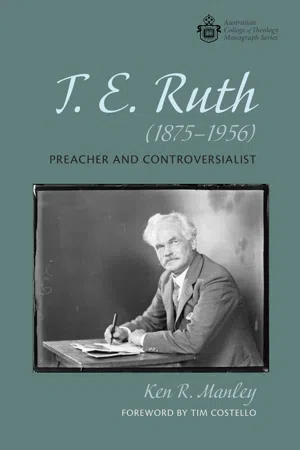
T. E. Ruth (1875-1956) was one of the most controversial Baptist ministers ever to serve in Australia. After a successful career in England as preacher, pastor, and writer, Ruth came to the significant Collins Street Baptist Church in Melbourne in 1914. During the tumultuous years of the World War, Ruth cared for the bereaved and bewildered people in his congregation and in the city. He also led public debates about conscription, engaging in intense platform clashes with his Catholic opponent, Archbishop Daniel Mannix. He later moved to the Pitt Street Congregational Church in Sydney where he was soon involved in public opposition to the Labor premier J. T. Lang as well as becoming a popular columnist in the secular press.
To his critics he was a "sectarian bigot" and was mocked as "Ruthless Ruth"; to others, he was an ardent Empire loyalist, an admired and successful Protestant defender. Some critics accused him of being a Christian spiritualist and others have suggested that he formulated a theology for fascism. Ruth denounced millennial Adventism and hellfire eschatology as he affirmed universalism and a continuing spiritual development after death.
This fascinating study of a progressive thinker, public theologian, and controversialist illuminates one of the more divisive and formative periods in Australian religious and political life.
Trusted by 375,005 students
Access to over 1.5 million titles for a fair monthly price.
Study more efficiently using our study tools.
Information
Topic
Theology & ReligionSubtopic
Religious Biographies1
“A Brilliant Son of Devon”
The arrival of a new minister for the Collins Street Baptist Church in Melbourne aboard the RMS Orama on March 9, 1914, was what would today be called “a media event.” Representatives of the church and the denomination jostled with reporters from the daily press to assure the young minister of a warm welcome. Under the heading “Rev. T. E. Ruth Arrives,” the Argus told readers that Ruth was “a little under average height, of slight build, dark complexioned with a very quiet manner, which is roused to emphasis under the stress of ideas held with strong conviction.”1 Ruth was frequently likened in physical appearance and oratorical style to Lloyd George, the British Prime Minister, a comparison that Ruth enjoyed.2 On a return visit to England in 1922, he was hailed as “a brilliant son of Devon.”3
The Forming of a Baptist Preacher
Thomas Elias Ruth was born in the small Devon village of Aveton Gifford on December 17, 1875, the eldest son of George William Saunders Ruth (1852–89) and Mary Ann Elson (1856–1911), who had six children.4 George was a stonemason, and members of the Ruth family had been present in the village for many generations. George Ruth died on December 26, 1889, when Tom was only fourteen.

St. Andrew’s Church, Aveton Gifford
Ruth was baptized at St. Andrew’s parish church on February 6, 1876: “I do not remember it, but there is documentary evidence to that effect. I did not believe in it. Indeed, I have been told that I vehemently protested. But neither for the privilege nor for the protest was I responsible.” He was under twelve years old when he was confirmed in that church: “I am certain that I did not intelligently apprehend the meaning of the broken baptismal vows of my forgotten godparents,” and confirmation “did not prevent my joining some other boys in raiding an orchard the next day.”5
Years later, as he was writing about how his understanding of faith had changed across the generations, Ruth imagined that the ghost of his grandfather (Charles Ruth) had appeared to accuse him.
Now, my grandfather had never lived outside a lovely little village nestling in a little Devonshire valley. On Sundays he acted as “clerk” at the parish church. In the absence of a choir and a choral service, he led the responses. And he said several times at every service, “As it was in the beginning is now and ever shall be, world without end, Amen.” . . . He told me he’d been a dreadful heretic in his own day, but being parish clerk, he hadn’t said so, so that if he lived on the earth today he would probably believe pretty much what I believe.6
On several occasions he told how he came to reject the traditional evangelical belief in hell.
Into our little Devon village when I was a boy, there came, week by week, the published sermons of one of the greatest evangelical preachers of the nineteenth century, and I vividly remember how often my soul was stirred by his powerful word-pictures of hell, how my childish imagination made of the weirdest imagery the most literal reality; sometimes making sleep a dreadful experience through fear of waking in never-dying flames; sometimes making me cry out in agony of soul, asking God to have mercy on a little boy of ten who had sinned unto death; at other times producing a period of philosophic calm when I would compare my chances with the chances of other boys with whom I had stolen apples and indulged in boyish pranks which assumed such diabolical importance in the lu...
Table of contents
- Title Page
- Foreword
- Preface and Acknowledgements
- Abbreviations
- Introduction
- Chapter 1: “A Brilliant Son of Devon”
- Chapter 2: A Baptist Pastor in Melbourne: The Early Years (1914–15)
- Chapter 3: Imperial Protestant
- Chapter 4: Wake up, Australia!
- Chapter 5: Ruth and the Catholics in Tumultuous Times (1918)
- Chapter 6: “The Commonwealth Constitutes His Congregation”
- Chapter 7: Ruth: A Public Theologian?
- Chapter 8: The Eschatology of T. E. Ruth
- Chapter 9: Becoming a Sydney Identity (1923–30)
- Chapter 10: A Political and Social Crisis (1930–32)
- Chapter 11: “The Little Napoleon” of Pitt Street (1933–38)
- Chapter 12: “A Good Secular Pulpit”
- Chapter 13: Adelaide and Retirement Years (1939–56)
- Chapter 14: Tom and Herbert: “A Religion of Loyalty”
- Conclusion: “Remember Me at My Best”
- Bibliography
Frequently asked questions
Yes, you can cancel anytime from the Subscription tab in your account settings on the Perlego website. Your subscription will stay active until the end of your current billing period. Learn how to cancel your subscription
No, books cannot be downloaded as external files, such as PDFs, for use outside of Perlego. However, you can download books within the Perlego app for offline reading on mobile or tablet. Learn how to download books offline
Perlego offers two plans: Essential and Complete
- Essential is ideal for learners and professionals who enjoy exploring a wide range of subjects. Access the Essential Library with 800,000+ trusted titles and best-sellers across business, personal growth, and the humanities. Includes unlimited reading time and Standard Read Aloud voice.
- Complete: Perfect for advanced learners and researchers needing full, unrestricted access. Unlock 1.5M+ books across hundreds of subjects, including academic and specialized titles. The Complete Plan also includes advanced features like Premium Read Aloud and Research Assistant.
We are an online textbook subscription service, where you can get access to an entire online library for less than the price of a single book per month. With over 1.5 million books across 990+ topics, we’ve got you covered! Learn about our mission
Look out for the read-aloud symbol on your next book to see if you can listen to it. The read-aloud tool reads text aloud for you, highlighting the text as it is being read. You can pause it, speed it up and slow it down. Learn more about Read Aloud
Yes! You can use the Perlego app on both iOS and Android devices to read anytime, anywhere — even offline. Perfect for commutes or when you’re on the go.
Please note we cannot support devices running on iOS 13 and Android 7 or earlier. Learn more about using the app
Please note we cannot support devices running on iOS 13 and Android 7 or earlier. Learn more about using the app
Yes, you can access T. E. Ruth (1875–1956) by Ken R. Manley in PDF and/or ePUB format, as well as other popular books in Theology & Religion & Religious Biographies. We have over 1.5 million books available in our catalogue for you to explore.