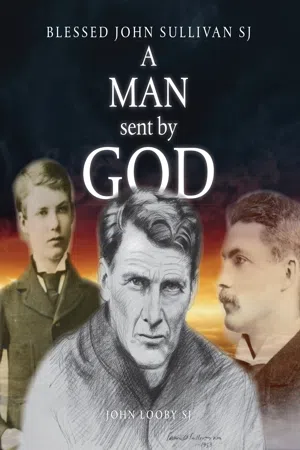
A Man Sent by God is a fascinating account of the life and times of one of Ireland's most revered holy men. The reader is guided through the various stages of John Sullivan's life from his childhood in Dublin, secondary school at Portora, university education at Trinity College, and his call to the bar in London. This is followed by an account of the second part of his life when he converted to Catholicism, entered the Jesuit order, and lived an ascetic and spiritual life in his various ministries, but most especially at his ministry in Clongowes Wood College in County Kildare. It is his work here, especially with the poor and the sick, which has led to his beatification by Pope Francis. John Sullivan SJ was beatified in May 2017.
- 88 pages
- English
- ePUB (mobile friendly)
- Available on iOS & Android
eBook - ePub
About this book

CHAPTER ONE
Youthful Promise of life
Infant Years
The story of Blessed John Sullivan aptly begins with his baptism in St George’s Church in Dublin on 15 July 1861. The little baby boy was two months old when his family brought him from their home in 41 Eccles Street to St George’s which was nearby. Recently, since his beatification, I find myself wondering if his father at the door of the church was asked the traditional question: what he wanted for his son. Wouldn’t it be wonderful if he had answered that he wanted him to be a saint? For whatever reason we do not presume to ask for so special a gift, even though in this case that was the gift God was to give John Sullivan. Edward Sullivan did indeed have great plans for this his fourth son, and he was to take great care with his education so that he, like his brothers, would follow him in the legal profession.
In the same year that John was baptised the family moved to 32 Fitzwilliam Place. This was to be home for him until he joined the Jesuits in the autumn of 1900. There were periods when he was away from home, of course – at school in Portora, and later in London where he studied for the English Bar – but Fitzwilliam Place was always home. It seems to have been a loving home, maybe especially for John, as he was the youngest and was particularly close to his brother William who was only a year older. They were to remain close, and it was William who was with John when he was dying.

41 Eccles Street, Dublin, where John Sullivan was born.

The house on the left is 32 Titzwilliam Place, home of the Sullivan family from John’s early days
A Privileged Childhood
Edward Sullivan had a very successful career at the Bar and, around the time John was born, his meteoritic rise in the legal profession began with promotions following in rapid succession: Solicitor-General in 1865, Attorney-General and later Master of the Rolls in 1868, culminating in his elevation to the Lord Chancellorship in 1883. It was said that no person exercised more authority in the administration of Ireland in his day than this able lawyer. Latterly he was made a baronet. For his first twenty-four years this was the background of John’s life.

There were four boys and a girl in the Sullivan family. The eldest was Annie, seen here standing at the back. John’s oldest brother, also at the back, was Edward. In the front, left to right, are Robert, John and William. Robert died in a sailing accident when John was sixteen.

Photograph: Shutterstock / © Everett Historical
William Gladstone (1809-1898), Prime Minister of Great Britain.
Sir Edward and Lady Sullivan entertained most of the great and good of Dublin society at their home in Fitzwilliam Place, including William Gladstone, then the British Prime Minister on a private visit to Dublin. There is a story told about this visit that the great man unbent sufficiently to perch young William Sullivan on one knee and his younger brother John on the other. In later life, John would never recount any incident from his youth, but his niece Mrs Wilmot Lloyd recalled hearing him relate the story when he was a student.
Before her marriage to Edward Sullivan in 1850, John’s mother was Elizabeth Josephine Baily, the daughter of a wealthy property owner from Passage West in County Cork. They were a Catholic family; her brother Robert was a great friend of Father Mathew, the temperance apostle, and one of her sisters was the wife of a Member of Parliament and founder of the Cork Examiner. They were among the many guests at Fitzwilliam Place, as were some Jesuit priests who lived in nearby communities: Fr James Cullen, the founder of the Sacred Heart Messenger and later the Pioneer Total Abstinence Association, and the three Kelly brothers: Frs Edward, Tom and William. They were all outstanding classical scholars, as was Sir Edward. He was also familiar with many continental literatures. They were lively evenings as the guests were gifted with prodigious memories and took pleasure in out-quoting each other. Lady Sullivan was a cheerful hostess, and her afternoon teas were very popular with the younger ladies.

Edward Sullivan, John Sullivan’s father.
It was a lively house to have grown up in, and John, being the youngest, ‘with the most winning ways, always smiling and contented,’ may have been something of a pet. The residents of Fitzwilliam Square had the exclusive privilege of using the park at its centre. Many years later, Mother Dunne, then a Sacred Heart nun, remembered playing with the Sullivan children there, and as a nine-year-old girl being delighted when John’s nurse entrusted her with the pram of little John.
There were five children in the family: Annie, Edward, Robert, William and John. As was common at that time in an inter-church marriage, the boys followed the religion of the father and the girls the religion of the mother. Lady Sullivan must have been sad that only one of her children, Annie, as a girl, was a Catholic. The four boys were brought up as members of the Church of Ireland. It was a happy family, and the children knew that they were greatly loved – but they knew sadness too. The great tragedy of their childhood was the death by drowning of the second brother, Robert, in Dublin Bay near Killiney. He was twenty-four at the time. With him in the boat were two younger friends, John Exham and his sister Constance. When a sudden squall capsized their boat the two men each caught hold of an oar but, seeing Constance in trouble, Robert gave his oar to her. It took a rescue boat from Bray some time to get to the scene of the disaster, and by then Constance was lying dead across her oar while her brother John, clinging to the other oar, was unconscious but still alive. The family was terribly upset, and mourned these deaths for a long time. Robert’s body was never recovered, and his mother grieved his loss for the rest of her life.

Lady Sullivan (Elizabeth Josephine Baily), John Sullivan’s mother.

Portora Royal School, Enniskillen, Co. Fermanagh.
Schooldays at Portora
Sir Edward Sullivan judged wisely when he sent his four sons to Portora Royal School in Enniskillen. William and John Sullivan followed in the footsteps of their two older brothers, and entered Portora in 1873. I am not alone in believing that it was a decision that would have an importance, maybe even a supreme importance, for the whole of John’s future life. The school was founded in the early years of the seventeenth century, and in 1770 had moved out of the streets of Enniskillen to a wonderful site on a green hill overlooking the town on one side and a lovely stretch of Lough Erne on the other. It was a world that John Sullivan would have found very congenial, being a relatively small school with only seventy pupils at that time and a liberal tradition.
There were probably no organised games at all during John’s time in Portora, but then, as now, rowing was a popular sport with the boys. Whether by boat or on foot the boys were free to wander over a wide stretch of some of the most attractive countryside to be found in Ireland. John enjoyed trips out to the many wooded islands on the lake, where he and his friends spent whole days and cooked their meals. His favourite island seems to have been the holy island of Devenish. There, among the ruins of a medieval church and the broken walls of an old monastery, local people had been buried in the past. According to tradition the boats carrying the dead to their burial place on the holy island departed from the grounds of Portora College. The name Portora probably derives from an original Irish name meaning the Port of Tears.

John Sullivan as a teenager.
John probably expressed his love for Portora best when he wrote, ‘Into this Port of Tears I came, bathed in tears, as a boy of eleven years, in the January of 1873, but it was with more plentiful tears I left in October of 1879’. Just as his home in Dublin had been a good place for him in his childhood years, so too was Portora a good place for the adolescent to grow in wisdom, age and grace. The school and John Sullivan owed much to the one he called ‘the noble person of the headmaster, Dr William Steele’. He was a great Christian divine, an excellent administrator, just and fearless in his dealings, an admirable teacher of many subjects, but especially of the Greek and Latin languages. ‘To his inspiration’, John later remarked, ‘many a distinguished scholar in Trinity College Dublin owed his great love and appreciation of the Classics.’
I might add that John Sullivan probably also owed his great love and appreciation of Scripture to Dr Steele. Scripture seems to have been John’s favourite subject, as substantiated by the three volumes he won as prizes for Sacred Scripture in 1875, 1876 and 1877. In later life it has been said that he was able to identify without hesitation any scriptural quotation. John’s regard for Dr Steele was not based solely on his undoubted scholarship, however; the headmaster was also a man of devotion who preached to the boys each Sunday in the local church, taking his text from Scripture.
Given that John Sullivan hardly ever spoke of his past, it is significant that when he wrote about his beloved Portora in the months just before he died, he recalled a cherished memory of Sunday mornings, when Dr Steele took the boys of the highest classes to the library, where he expounded to them the Epistle of the Sunday. It is surely significant that John picked one particular memory. ‘I can never forget,’ he wrote, ‘his masterful exposition of the famous Epistle of the Sunday taken from the Second Chapter of St Paul’s Epistle to the Philippians: “For let this mind be in you, which was also in Christ Jesus; Who being in form of God thought it not robbery to be equal with God; but emptied Himself…” He had the Greek Testament before him, and I remember how he dwelt on what he called the remarkable expression, “He emptied Himself”.’
These reflections appear in the preface John Sullivan wrote to a book about another old pupil of Portora, John Steele, the son of Dr Steele. There is a certain similarity in their lives: both were educated at Portora, both were called by Christ to follow him in the priesthood and to have that mind which was also in Christ Jesus. Both, ...
Table of contents
- Cover
- Copyright
- Title
- Dedication
- Contents
- ACKNOWLEDGEMENTS
- INTRODUCTION
- CHAPTER ONE: Youthful Promise of life
- CHAPTER TWO: Restless Years
- CHAPTER THREE: A Momentous decision
- CHAPTER FOUR: Jesuit Formation
- CHAPTER FIVE: Priestly Ministry
- CHAPTER SIX: When the Grain of Wheat Dies
- POSTSCRIPT: Making Sense of his Life
Trusted by 375,005 students
Access to over 1.5 million titles for a fair monthly price.
Study more efficiently using our study tools.
Information
Publisher
Messenger PublicationsYear
2021Topic
Theology & ReligionPrint ISBN
9781910248409
Subtopic
Christian DenominationseBook ISBN
9781788123686
Frequently asked questions
Yes, you can cancel anytime from the Subscription tab in your account settings on the Perlego website. Your subscription will stay active until the end of your current billing period. Learn how to cancel your subscription
No, books cannot be downloaded as external files, such as PDFs, for use outside of Perlego. However, you can download books within the Perlego app for offline reading on mobile or tablet. Learn how to download books offline
Perlego offers two plans: Essential and Complete
- Essential is ideal for learners and professionals who enjoy exploring a wide range of subjects. Access the Essential Library with 800,000+ trusted titles and best-sellers across business, personal growth, and the humanities. Includes unlimited reading time and Standard Read Aloud voice.
- Complete: Perfect for advanced learners and researchers needing full, unrestricted access. Unlock 1.5M+ books across hundreds of subjects, including academic and specialized titles. The Complete Plan also includes advanced features like Premium Read Aloud and Research Assistant.
We are an online textbook subscription service, where you can get access to an entire online library for less than the price of a single book per month. With over 1.5 million books across 990+ topics, we’ve got you covered! Learn about our mission
Look out for the read-aloud symbol on your next book to see if you can listen to it. The read-aloud tool reads text aloud for you, highlighting the text as it is being read. You can pause it, speed it up and slow it down. Learn more about Read Aloud
Yes! You can use the Perlego app on both iOS and Android devices to read anytime, anywhere — even offline. Perfect for commutes or when you’re on the go.
Please note we cannot support devices running on iOS 13 and Android 7 or earlier. Learn more about using the app
Please note we cannot support devices running on iOS 13 and Android 7 or earlier. Learn more about using the app
Yes, you can access A Man Sent by God by John Looby in PDF and/or ePUB format, as well as other popular books in Theology & Religion & Christian Denominations. We have over 1.5 million books available in our catalogue for you to explore.