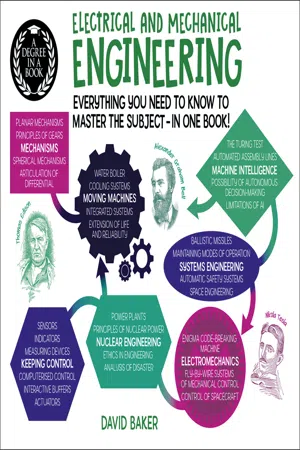
A concise introduction to all the key tenets of electrical and mechanical engineering degree course, written by former NASA engineer Dr David Baker. A Degree in a Book: Electrical and Mechanical Engineering is presented in an attractive landscape format in full-color. With timelines, feature spreads and information boxes, readers will quickly get to grips with the fundamentals of electrical and mechanical engineering and their practical applications.Covering Newtonian mechanics, nuclear engineering, artificial intelligence, 3D printing and more, this essential guide brings clarity to complex ideas. David Baker delves into the history and development of this far-reaching subject as well as the challenges of the future such as environmental responsibility. Complete with a useful glossary of key terms, this holistic introduction will equip students and laypeople alike with the knowledge of an engineering graduate. ABOUT THE SERIES: Get the knowledge of a degree for the price of a book with Arcturus Publishing's A Degree in a Book series. Written by experts in their fields, these highly visual guides feature handy timelines, information boxes, feature spreads and margin annotations, allowing readers to get to grips with complex subjects in no time.
Invention and discovery have gone hand in hand from the dawn of abstract thinking – activities buried deep in the ancient past. From the Palaeolithic stone toolmakers of more than 3 million years ago to the application of known principles of engineering and science in the 21st century, the observation and use of natural laws and mechanical practicalities have underpinned all aspects of modern society. The collective application of laws, principles and ideas have forged new ways of working through a process of test and evaluation. In fact, for several millennia that was the only way of fashioning natural materials into tools and working machines.
Long before the scientific application of calculation and extrapolation, hand tools were shaped to improve the ability of primitive humans to survive the rigours of a hostile environment and outwit predators. In fact, defence against a wide range of aggressive animals must have played a significant part in the development of those parts of the brain responsible for nurturing creative thinking. In turn, that would lead to a level of cognitive development where observation, experimentation and evaluation served as a prerequisite for stored learning. And when that was achieved, humanity put its running shoes on!
Stone tools from Skorba in Malta show the diversity of creative ingenuity.
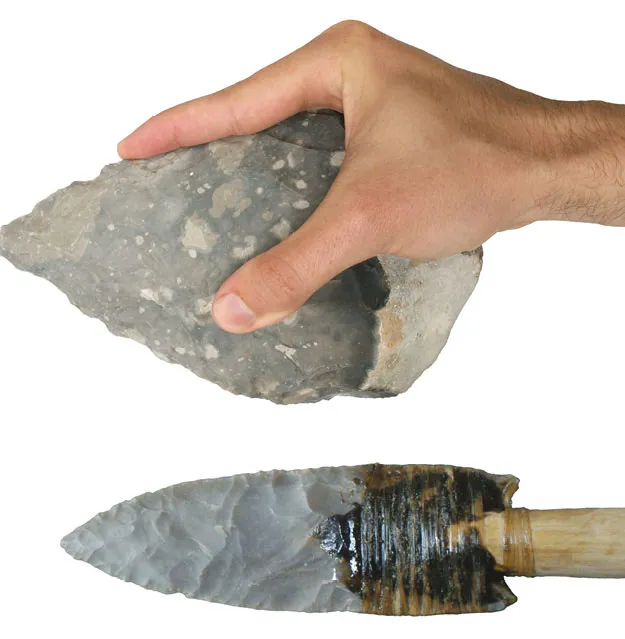
A stone axe head and Clovis spear point, perhaps the earliest examples of refashioned natural materials.
However, the development of engineered structures – and engineering per se – relied on need: the necessity to improve all aspects of the human condition, including the need for food, water, warmth, protection and a means of defence against predators and other humans. In no specific order or sequence, six essential tools, or engineered items, were developed.
The precise order of application of these in terms of time is unknown, although some were given functional attributes as machines more than 2,500 years ago.
1. The wedge or ramp
2. The wheel and the central axle
3. The screw
4. The lever
5. The pulley
6. The crane
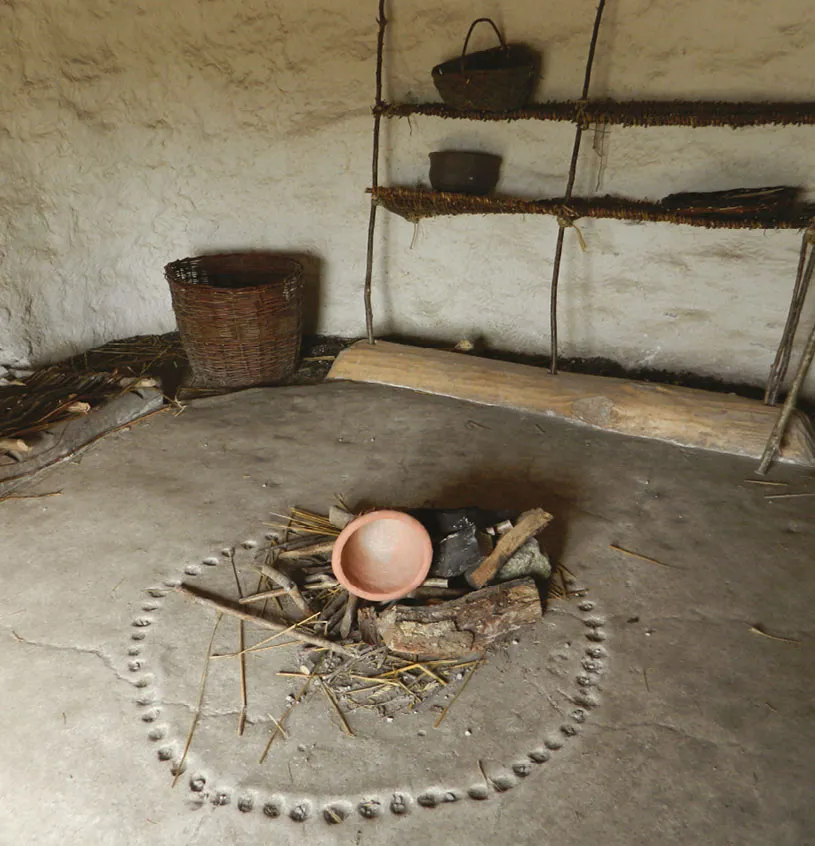
Neolithic farmers designed for a new and more settled existence.
The rudimentary tools and goods found in roundhouses fabricated from wattle and daub – techniques developed through abstract thinking.
Archimedes and his legacy
The best known architect of one of the earliest machines was Archimedes (288–212 bc) and his famous screw, developed in the 3rd century bc. This was applied to a wide range of tasks throughout the world and, in some countries, remains to this day the primary means of lifting water from one level to another. Archimedes bequeathed a device that was directly responsible for the replacement of sail with steam, through propelling ships through one fluid – water – and propelling aeroplanes through another – air. Thus did the Archimedean screw connect the 3rd century bc to the 21st century ad and in so doing aid in the development of machines, albeit ones with limits defined by the balance of forces and not the application for work, defined as the trade between force and distance.
What Archimedes also did was to explore the opportunities in mechanical advantage offered by the lever – work that inspired later Greeks to further define the various applications with a lever, windlass, pulley, wedge and screw. But all of these applications avoided the dynamics of working machines and merely defined and exploited the static balance of force in simple machines.
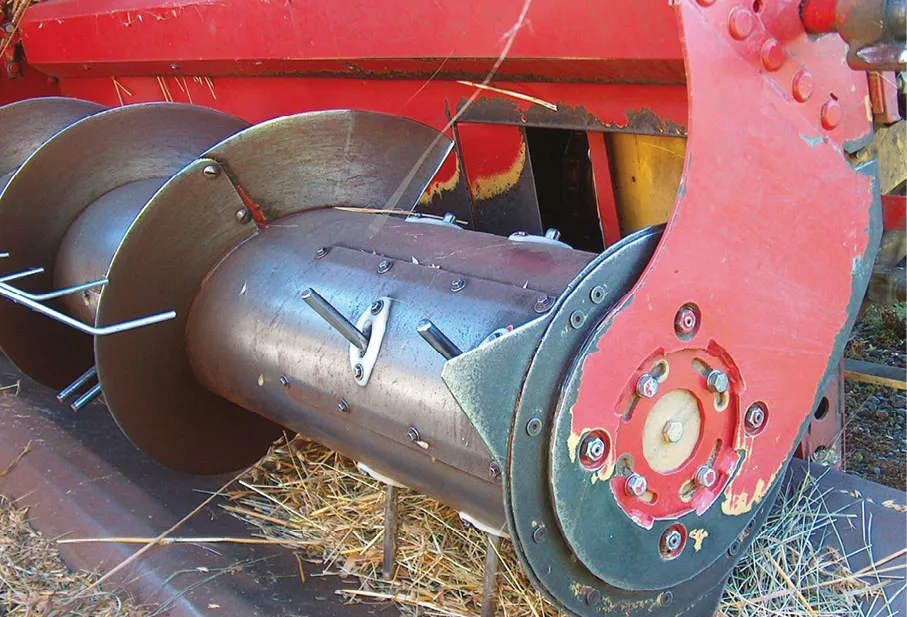
The Archimedean screw as applied to a combine harvester in an integrated machine built on empirical principles.
Names to Know: Creators Of The First Machines
Archimedes (288–212 bc)
Hero of Alexandria (ad 10–70)
Zhang Heng (ad 78–139)
What is a machine?
The technical definition of a simple machine is one in which the amount of power coming out (Fout) is equal to the force applied going in (Fin) and can be no greater. The mechanical advantage is frequently obtained in such simple machines by multiplying the magnitude of force by a specific factor: MA = Fout/Fin.
Clearly, a simple machine does not itself contain a source of energy other than that applied to input a force, and this defines the amount of work that it can do; without friction (or elasticity), this is known as an ideal machine. In these, due to the conservation of energy, the power output (Pout), as defined through a rate of energy output, is equal to the power input (Pin). The power output equals the velocity of the load (νout) multiplied by the load force (Pout = Foutνout-) just as the input from the power side of the applied force is also equal to the velocity of the input point (νin) multiplied by the applied force: Pin = Foutνin-. Therefore, Foutνout = Finνin.
Machines and monuments
While we benefit from having Greek text to explain motivations and draw conclusions for defining essential principles of force and work, previous civilizations a thousand years earlier exercised their own applications; people of the ancient Near East and city states such as Mesopotamia and Babylon applied levers and balances. Indeed, applications date back 5,000 years as the first examples of machines were made to work in ways that had previously been impossible. In Britain, 4,500 years ago, these machines constituted levers and probably pulleys – perhaps even the yet-to-be invented Archimedean screw. The complex geometry of megalithic monuments in the British Isles of the Neolithic and the Bronze Age testify to the universal application of these simple machines during the dawn of the empirical age.
Tools developed with surprising sophistication were employed for complex shaping tasks, gouging mortise cavities for tenon joints fashioned in quartz sandstone, or the silcrete (sarsen) blocks now seen on a grand scale at Stonehenge. Other stone tools were used to fashion tongue and groove joints to stabilize lintel blocks that were slotted together. The application of stone tools to shape and fashion blocks weighing up to 25 tonnes invokes the use of mauls, hammer-stones, levers and ramps – all applications of the simple machine – and may have involved cranes and pulleys.
We cannot know for sure the level of machine application to the construction of giant structures but we do know that, 4,500 years ago, the Egyptians used levers, pulleys, wheels on axles, cranes, rollers and ramps, together with wedges, tooled shaping of natural materials and perhaps other machines to build the pyramids. And in fact, beginning around the time Stonehenge was being erected in the grand finale of its multi-faceted form, almost all the simple machines were either in use or were being introduced tentatively in dispersed civilizations across the known world.
Mechanical principles underpinned the establishment of large megalithic monuments such as Stonehenge, with the movement and erection of multi-tonne boulders seemingly standard practice.
Shaping and fashioning for aesthetic and purposeful applications, be it calendar or astronomical alignment, is a fine example of early empirical thinking.
Machines and metalworking
Simultaneous with the development of advanced tools and simple machines – which coalesced around farming and the need for irrigation, architectural constructions and military engines for warfighting purposes – ancient city-states in the Middle East began working in metals and other exotic materials. This was paralleled by the emergence of the Bronze Age in central and north-western Europe, from which would flow the Iron Age and the eventual manufacture of materials never found in nature. Such materials played an equally vital role in the development of advanced machines and shaped tools fabricated from the new materials.
Indeed, the use of metals was significant in the fabrication of tools and simple machines. Noted for its dominance in Mesopotamia for more than 2,500 years, before its demise early in the 7th century, the Assyrian Empire is also known for its fine metalwork and use of iron weapons. The Assyrian people were the first to build war machines of a type that would endure into the European medieval period, most notably battering rams, siege engines and large catapults. These developments were paralleled by the Roman Republic and the later Roman Empire, which introduced a significant metalworking industry that accompanied their forces as they invaded foreign lands, and remain ...
Table of contents
Title
Contents
Introduction
Chapter 1: The Dawn of Ideas – the Empirical Age
Chapter 2: Understanding Forces – the Scientific Age
Chapter 3: Manipulation of Forces
Chapter 4: Mechanisms
Chapter 5: A Choice of Materials
Chapter 6: Keeping the Machines Moving
Chapter 7: Engineering the Systems
Chapter 8: What is Reliability?
Chapter 9: Nuclear Engineering
Chapter 10: Electrical and Electronic Engineering
Chapter 11: Power Production and Generation
Chapter 12: Electromechanics
Chapter 13: Computing Machines and Artificial Intelligence
Glossary
Suggested Reading
Copyright
Frequently asked questions
Yes, you can cancel anytime from the Subscription tab in your account settings on the Perlego website. Your subscription will stay active until the end of your current billing period. Learn how to cancel your subscription
No, books cannot be downloaded as external files, such as PDFs, for use outside of Perlego. However, you can download books within the Perlego app for offline reading on mobile or tablet. Learn how to download books offline
Perlego offers two plans: Essential and Complete
Essential is ideal for learners and professionals who enjoy exploring a wide range of subjects. Access the Essential Library with 800,000+ trusted titles and best-sellers across business, personal growth, and the humanities. Includes unlimited reading time and Standard Read Aloud voice.
Complete: Perfect for advanced learners and researchers needing full, unrestricted access. Unlock 1.4M+ books across hundreds of subjects, including academic and specialized titles. The Complete Plan also includes advanced features like Premium Read Aloud and Research Assistant.
Both plans are available with monthly, semester, or annual billing cycles.
We are an online textbook subscription service, where you can get access to an entire online library for less than the price of a single book per month. With over 1 million books across 990+ topics, we’ve got you covered! Learn about our mission
Look out for the read-aloud symbol on your next book to see if you can listen to it. The read-aloud tool reads text aloud for you, highlighting the text as it is being read. You can pause it, speed it up and slow it down. Learn more about Read Aloud
Yes! You can use the Perlego app on both iOS and Android devices to read anytime, anywhere — even offline. Perfect for commutes or when you’re on the go. Please note we cannot support devices running on iOS 13 and Android 7 or earlier. Learn more about using the app
Yes, you can access A Degree in a Book: Electrical And Mechanical Engineering by David Baker in PDF and/or ePUB format, as well as other popular books in Technology & Engineering & Electrical Engineering & Telecommunications. We have over one million books available in our catalogue for you to explore.