In this practical guide, Barrington Barber reveals the skills required to meet the demands of drawing in colour using a range of media, from coloured pencil and pastel to ink and watercolour.
With the author's customary blend of expertise and encouragement, providing examples and exercises at every stage, The Fundamentals of Drawing in Colour takes aspiring artists step-by-step, teaching them to observe, compose and record a variety of subjects. After a straightforward introduction to colour theory, still-life studies are presented as the bedrock of drawing practice and, from this basis, the book goes on to deal in detail with landscape, animals and finally, the human figure and portraiture.
The pace of modern life and the countless images we see every day discourage us from looking with true perception. The Fundamentals of Drawing in Colour shows how we can adjust our focus to take an absorbing, creative approach to the world around us.
eBook - ePub
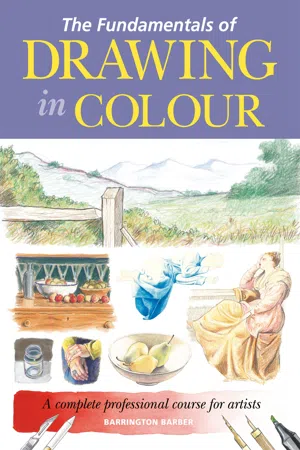
The Fundamentals of Drawing in Colour
A complete professional course for artists
- English
- ePUB (mobile friendly)
- Available on iOS & Android
eBook - ePub
About this book
Trusted by 375,005 students
Access to over 1 million titles for a fair monthly price.
Study more efficiently using our study tools.
Information
Topic
ArtSubtopic
Art TechniquesGetting started
To start drawing in colour is to take a step into the area of painting, although in this volume we will mainly be looking at colour as an adjunct to drawing. There are various methods and media to explore, beginning with the materials and how to get used to them through a series of exercises. We will be concerned mostly with drawing in coloured pencil, pastels, coloured inks and watercolour.
So we start with a list of the materials that will be useful to your work. You may not want to use them all but it is a good idea to try them out, if only in a limited way. Then your choice of which medium to use will be based on knowledge and experience rather than mere guesswork. This is a much more practical way of ensuring that you have some control over your medium.
Go through all the exercises shown here because they will familiarize you with a range of mediums and also provide you with practice, which every artist needs. You may even find you can invent a few exercises of your own, which is a sign that you are engaging with the medium in depth. It is also more fun for you when you play around with different mediums. Most of the exercises are simple enough but don’t be misled into thinking that therefore they are not worth trying out. In fact, simple repetition of straightforward technical practices is the bedrock of all artistic expertise. When you see a young artist doodling with patterns and repetitive marks on a sheet of paper, he or she is in the process of learning the manual dexterity that is so important for any artist.
Drawing is always drawing, whether in colour or not. So do not be put off if you know nothing or little about it. The way to learn is by experimentation and experiencing both success and failure. When you are drawing easily without any problems, it is only because previously you have overcome difficulties of some sort. And remember, when you appear to be having difficulties, that is when you are learning most. It will become easier if you persevere.
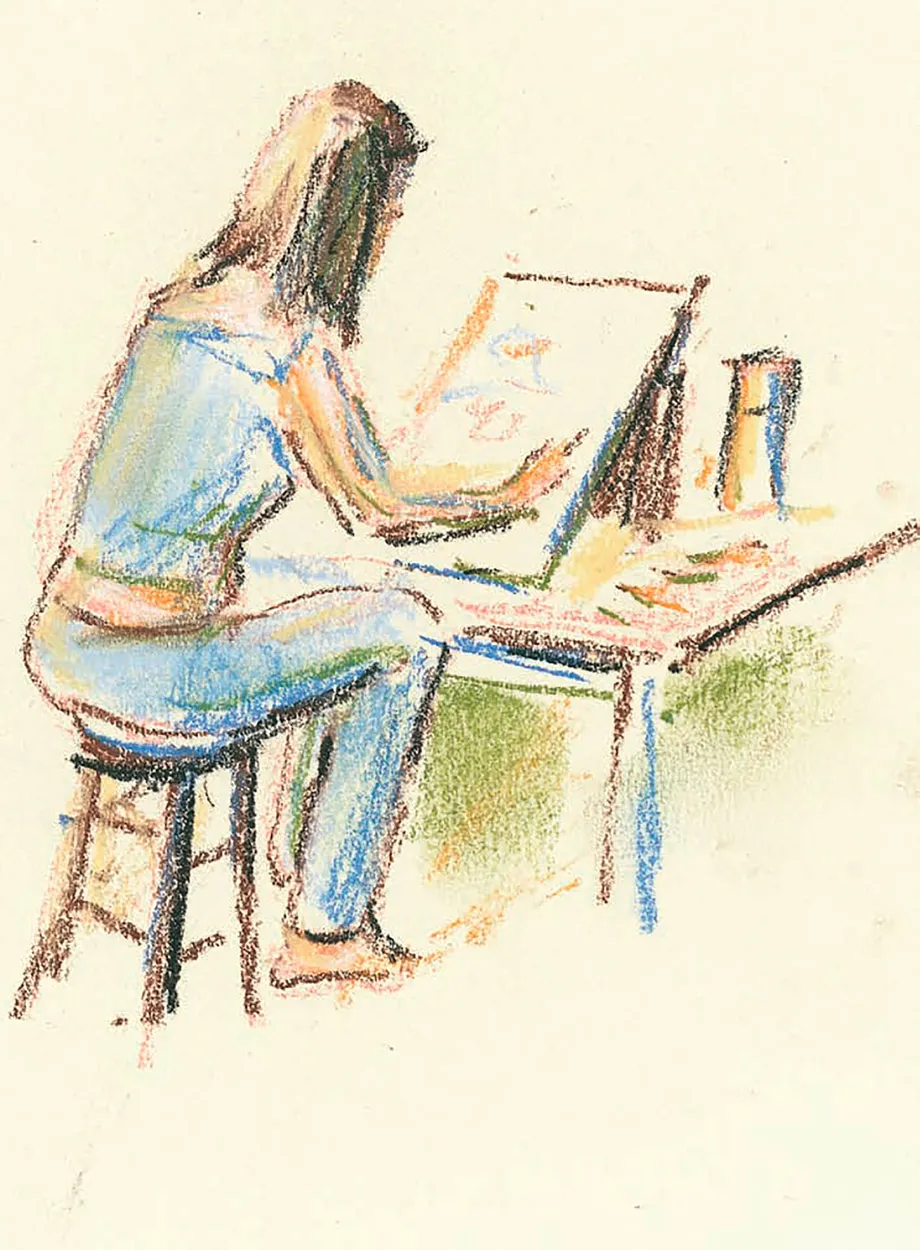
Materials and mediums
Here is a selection of the materials required for drawing in colour. I have chosen those most easily obtained from art or stationery shops. As an artist you will always want to use the best, but occasionally less specialized materials can be just as good.

1. Coloured pencils – don’t concern yourself too much with the brand, although some are better than others. Go for as many variations in colour as you can find. Thinner pencils can be of superior quality but not always. Try them out and make your own judgement. Watercolour crayons are similar to ordinary coloured pencils but you can use a brush with water to spread their colour over larger areas. There are several brands available.

2. Fineline graphic pens – these pens are good for drawing and behave similarly to a coloured pencil but with a more intense colour value.

3. Brushes – the best are sable but there are many varieties of hair and synthetic fibre. You will only need two or three brushes, especially if they come to a fine point. A size 0, one 3 and perhaps one 7 or 8 would be sufficient. For extending pastels you might need a hog hair or some other stiff brush.

4. Soft pastels – these tend to be expensive. They come in a wide range of colours but get used up quickly. However, for some work they can be essential.

5. Hard pastels – also known as conté crayons, these are essentially the same material as the soft ones but bound together in a compressed form. Hard pastels are square in section whereas the soft ones are round. The range of colours is again enormous, they last longer and are easier to manipulate.

6. Stumps – these are just rolls of paper in a compressed form, pointed at both ends and very useful for extending the tones of your pastels. They come in several sizes, but usually you will only want two, a large fat one and a thin one.

7. Scalpel – the best knife for sharpening pencils, crayons, pastels or anything, but they are extremely sharp and not advisable for students under 16 years. A craft knife is almost as good and safer to use.

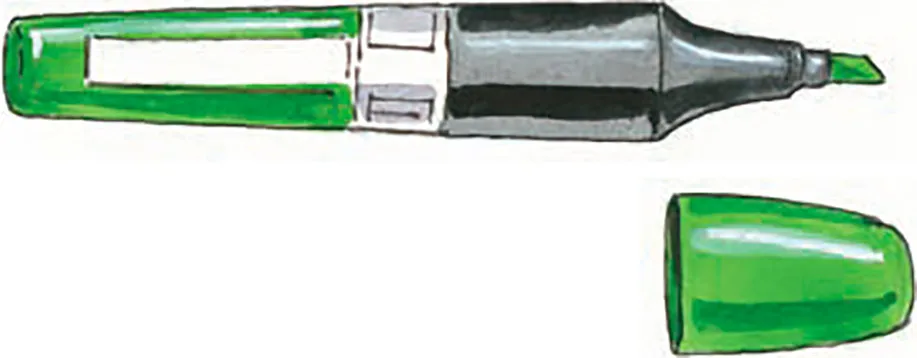
8. Felt tip pens and illuminators – these pens allow thicker, more solid areas of colour to be put on quickly and are useful for larger drawings.

9. Watercolour box – watercolours are easiest to use from a box but they can be bought in small tubes...
Table of contents
- Title Page
- Contents
- Introduction
- Getting started
- Drawing still life in colour
- Landscape
- Animals
- The human figure
- Portraits
- Drapery
- Composition and colour
- Significant colours
- Copyright
Frequently asked questions
Yes, you can cancel anytime from the Subscription tab in your account settings on the Perlego website. Your subscription will stay active until the end of your current billing period. Learn how to cancel your subscription
No, books cannot be downloaded as external files, such as PDFs, for use outside of Perlego. However, you can download books within the Perlego app for offline reading on mobile or tablet. Learn how to download books offline
Perlego offers two plans: Essential and Complete
- Essential is ideal for learners and professionals who enjoy exploring a wide range of subjects. Access the Essential Library with 800,000+ trusted titles and best-sellers across business, personal growth, and the humanities. Includes unlimited reading time and Standard Read Aloud voice.
- Complete: Perfect for advanced learners and researchers needing full, unrestricted access. Unlock 1.4M+ books across hundreds of subjects, including academic and specialized titles. The Complete Plan also includes advanced features like Premium Read Aloud and Research Assistant.
We are an online textbook subscription service, where you can get access to an entire online library for less than the price of a single book per month. With over 1 million books across 990+ topics, we’ve got you covered! Learn about our mission
Look out for the read-aloud symbol on your next book to see if you can listen to it. The read-aloud tool reads text aloud for you, highlighting the text as it is being read. You can pause it, speed it up and slow it down. Learn more about Read Aloud
Yes! You can use the Perlego app on both iOS and Android devices to read anytime, anywhere — even offline. Perfect for commutes or when you’re on the go.
Please note we cannot support devices running on iOS 13 and Android 7 or earlier. Learn more about using the app
Please note we cannot support devices running on iOS 13 and Android 7 or earlier. Learn more about using the app
Yes, you can access The Fundamentals of Drawing in Colour by Barrington Barber in PDF and/or ePUB format, as well as other popular books in Art & Art Techniques. We have over one million books available in our catalogue for you to explore.