eBook - ePub
Painting Flowers
Create Beautiful Watercolour Artworks With This Step-by-Step Guide
- English
- ePUB (mobile friendly)
- Available on iOS & Android
eBook - ePub
About this book
What could be more satisfying than producing a beautiful painting of a flower? Jill Winch is an award-winning botanical artist and has been teaching people to paint and draw flowers for many years. In this delightful book, she teaches the key skills for making successful paintings of flowers in watercolor, the medium of choice for botanical artists. She breaks the process down into manageable steps, taking examples from a wide range of flowers. Throughout the book, Jill's own beautiful paintings provide inspiration and guidance.
Trusted by 375,005 students
Access to over 1 million titles for a fair monthly price.
Study more efficiently using our study tools.
Information
Topic
ArtSubtopic
Art GeneralChapter 1
GETTING STARTED WITH DRAWING
In this chapter we shall start by drawing basic flower shapes in pencil, observing where light falls and applying shadow – in other words, creating form in preparation for translating this information into colour. We shall look in detail at flower centres and how dissecting a flower head can be useful in helping you to understand the structure of your flower.
A sketchbook is invaluable, as this is where you can record information on your subject in the form of notes, illustrations, colour matching and dissections, before going on to paint your final piece. This initial stage should not be underestimated in its importance, for the practice you will gain here will make all the difference to your results later.

Practice exercises
To start with, I have created some simple geometric shapes based on the different forms you find in flowers: cone-shaped (for example bluebells), bowl-shaped (peonies), cup-shaped (tulips), round (pansies) and tubular shapes for stems. Try drawing these shapes using either an H or HB pencil, then apply shading (tone) to create three-dimensional structures, working from the darkest areas through to light. Notice particularly where the lightest and darkest areas are, as these will later be translated into watercolour, again working from dark through to light.


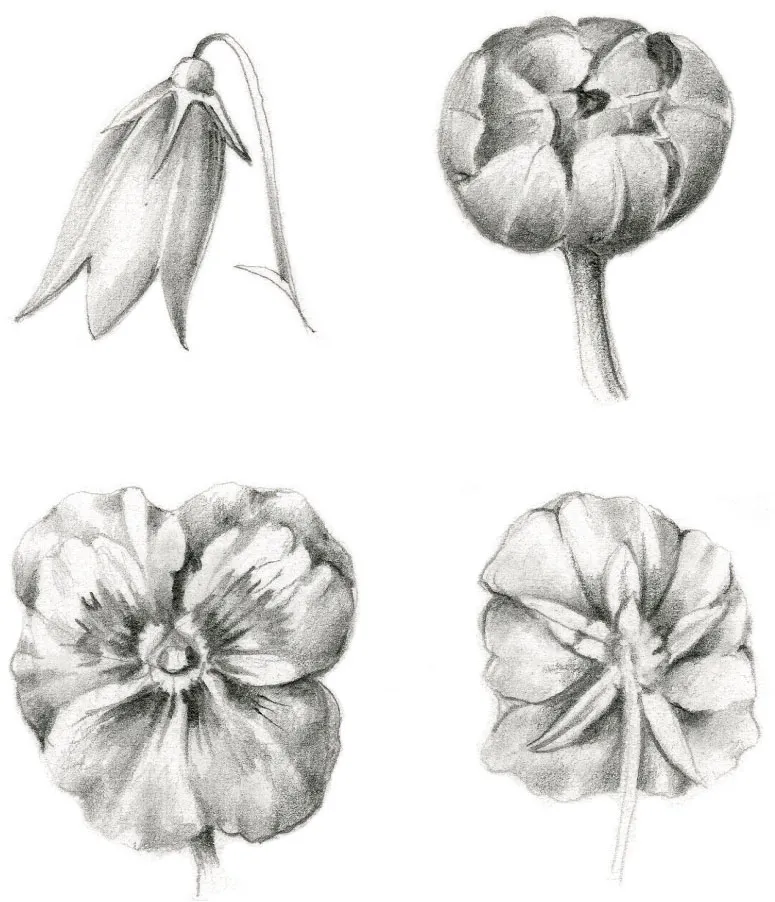
Taking some flower heads, now practise the same technique, using darker tones where one petal overlaps another and referring back to your basic flower shapes to observe where the lightest areas will occur. You can pick your own flowers or copy the examples I have drawn here of a bluebell, a peony and the front and back view of a pansy. If you are drawing a real flower head it is important to observe what is in front of you but you may find it harder to identify the highlights and dark areas. This is why the exercises in tonal modelling above are so important, as they give you an understanding of how to use light and dark to create the convincing form of a flower head.
Flower head detail
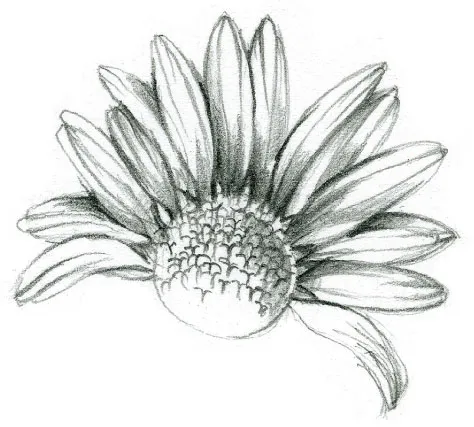
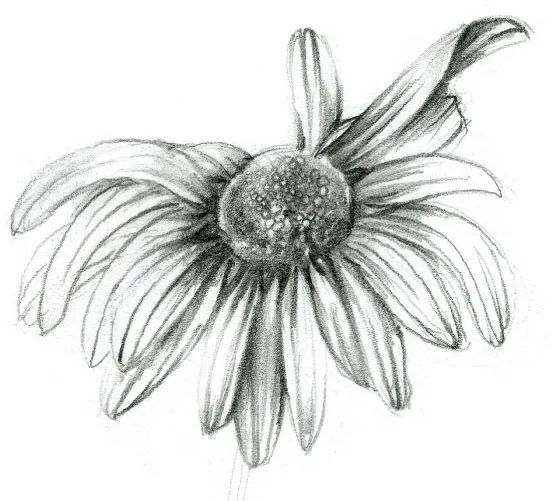
Here I have drawn the flower head of the marguerite, with its many overlapping petals. I drew it from different angles and also removed some petals so that I could observe the centre. The many small anthers in the centre were depicted by drawing tiny circles and surrounding each one with shadow. Try this exercise yourself and practise applying shadow where one petal overlaps another, leaving lighter areas on the open area of the petals.
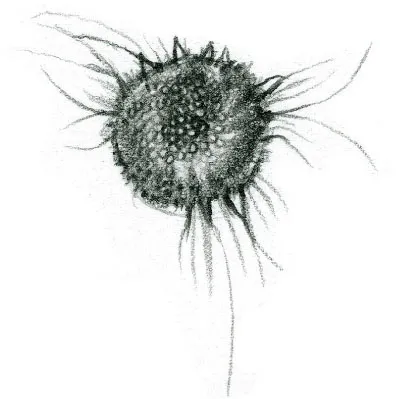
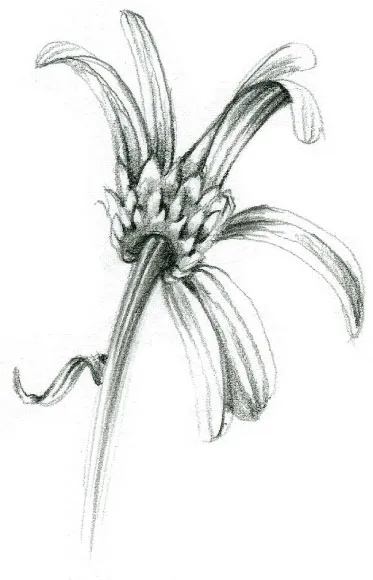
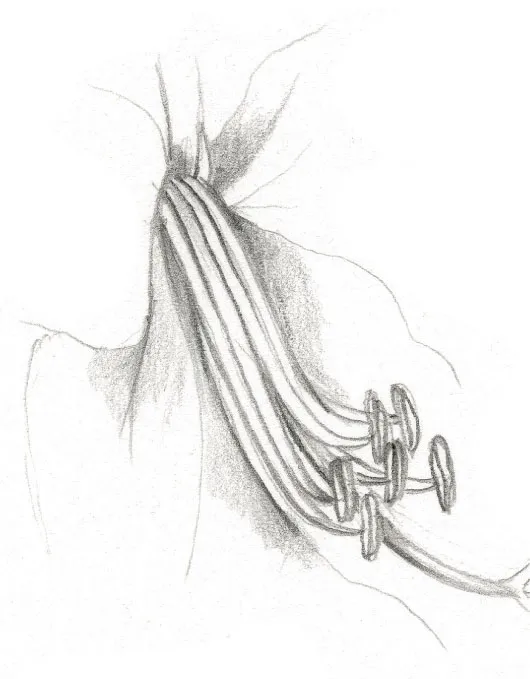
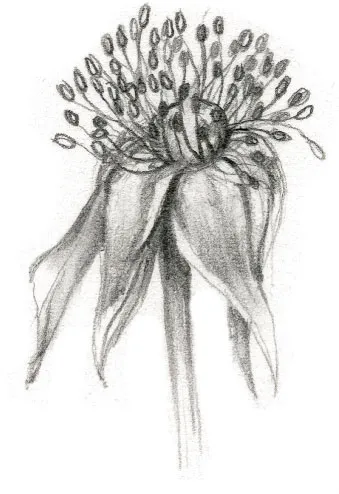
Next, I drew the centres of three very different flowers: amaryllis, with its impressive curving filaments and stamens, a rose and a hellebore. Observe the centres of flowers very closely before you try to draw them. You will find a magnifying lens helpful as some of the detail is quite minute.

Flower heads: three tonal studies
I drew these flower heads on tracing paper before transferring them to the HP watercolour paper, using a light box – you can lay your paper against a window if you don’t have one of those (see p. 96). I like to use watercolour paper for drawing, as it has a smooth surface and is of a better quality than cartridge paper.
After drawing the outlines in pencil, I rolled over the image with my putty rubber to remove excess graphite, leaving me with a pale grey line. I then proceeded to add tone, using an HB pencil to make small circular ellipses, working from the darkest areas through to the lightest. This enables you to achieve ...
Table of contents
- Cover
- Title
- Contents
- Introduction
- Materials and Equipment
- Chapter 1 Getting Started with Drawing
- Chapter 2 Introducing Watercolour
- Chapter 3 Painting Leaves
- Chapter 4 Plant Studies
- Chapter 5 Different Painting Techniques
- Chapter 6 Composition
- Copyright
Frequently asked questions
Yes, you can cancel anytime from the Subscription tab in your account settings on the Perlego website. Your subscription will stay active until the end of your current billing period. Learn how to cancel your subscription
No, books cannot be downloaded as external files, such as PDFs, for use outside of Perlego. However, you can download books within the Perlego app for offline reading on mobile or tablet. Learn how to download books offline
Perlego offers two plans: Essential and Complete
- Essential is ideal for learners and professionals who enjoy exploring a wide range of subjects. Access the Essential Library with 800,000+ trusted titles and best-sellers across business, personal growth, and the humanities. Includes unlimited reading time and Standard Read Aloud voice.
- Complete: Perfect for advanced learners and researchers needing full, unrestricted access. Unlock 1.4M+ books across hundreds of subjects, including academic and specialized titles. The Complete Plan also includes advanced features like Premium Read Aloud and Research Assistant.
We are an online textbook subscription service, where you can get access to an entire online library for less than the price of a single book per month. With over 1 million books across 990+ topics, we’ve got you covered! Learn about our mission
Look out for the read-aloud symbol on your next book to see if you can listen to it. The read-aloud tool reads text aloud for you, highlighting the text as it is being read. You can pause it, speed it up and slow it down. Learn more about Read Aloud
Yes! You can use the Perlego app on both iOS and Android devices to read anytime, anywhere — even offline. Perfect for commutes or when you’re on the go.
Please note we cannot support devices running on iOS 13 and Android 7 or earlier. Learn more about using the app
Please note we cannot support devices running on iOS 13 and Android 7 or earlier. Learn more about using the app
Yes, you can access Painting Flowers by Jill Winch in PDF and/or ePUB format, as well as other popular books in Art & Art General. We have over one million books available in our catalogue for you to explore.