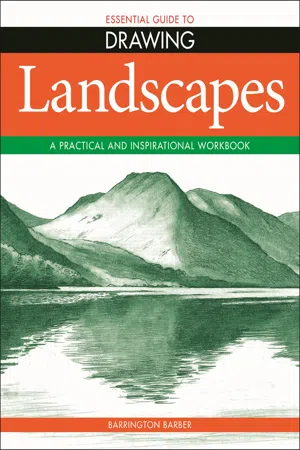
Landscape presents endless possibilities for artists, from simple garden views to mountainous panoramas, seascapes and urban scenes. This handy guide shows how to create successful landscape drawings, with advice on choosing your composition and rendering elements of the natural world such as water, trees and rocks. Whether you are an experienced draughtsman or a complete beginner, the inspiring examples and step-by-step exercises in this book will help you achieve the best results.
ABOUT THE SERIES: The Essential Guides to Drawing are practical books for artists who wish to improve their skills in a particular subject area. The series covers Animals, Landscapes, Perspective & Composition, Portraits, Still Life and Landscapes.
- English
- ePUB (mobile friendly)
- Available on iOS & Android
eBook - ePub
Essential Guide to Drawing: Landscapes
About this book
Trusted by 375,005 students
Access to over 1 million titles for a fair monthly price.
Study more efficiently using our study tools.
Information
Topic
ArtSubtopic
Art TechniquesElements of Landscape
Having looked at the ways in which the structure and format of a landscape can be approached, we now take the closer view, focusing on the major elements that make up the natural world and how they can be drawn to build up convincing scenery.
Earth
When drawing the solid rocks that make up the surface of the world, it can be instructive to think small and build up. Pick up a handful of soil or gravel and take it home with you for close scrutiny, then try to draw it in some detail. You will find that those tiny pieces of irregular material are essentially rocks in miniature.
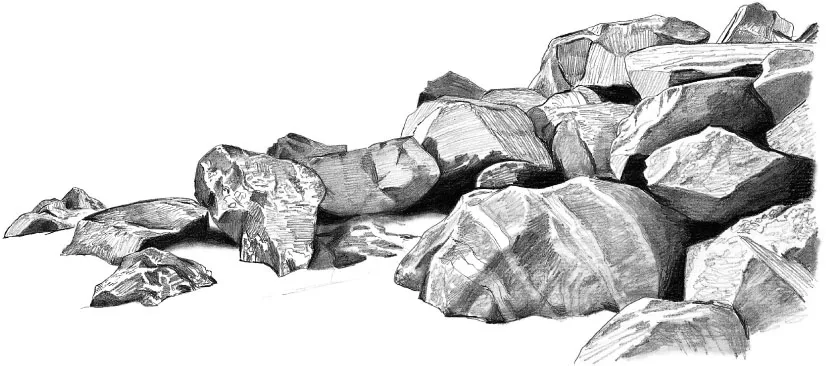
If we attempt to draw a rocky outcrop or the rocks by the sea or along the shore of a river, it is really no different from drawing small pieces of gravel, only with an enormous change of scale. It is as though those pieces of gravel have been super-enlarged and you will find a similarly random mixture of shapes, sizes and forms.
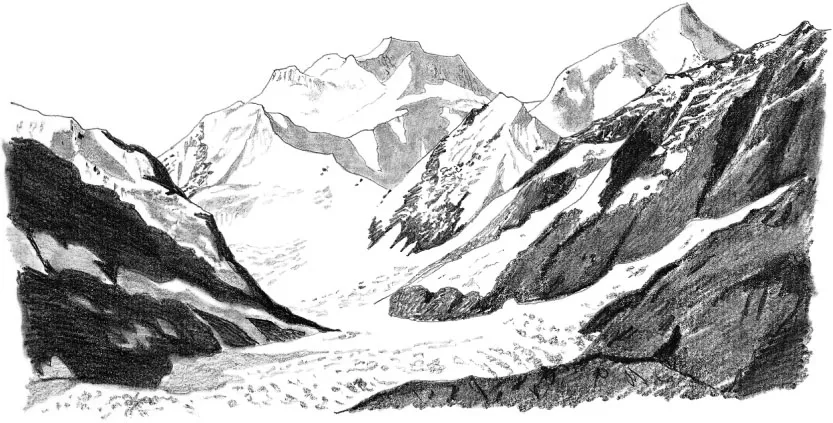
One more step is to visit a mountainous area and look at the earth in its grandest, most monumental form. This example has the added quality of being above the snowline, showing marvellously simplified icy structures against contrasting dark rocks.
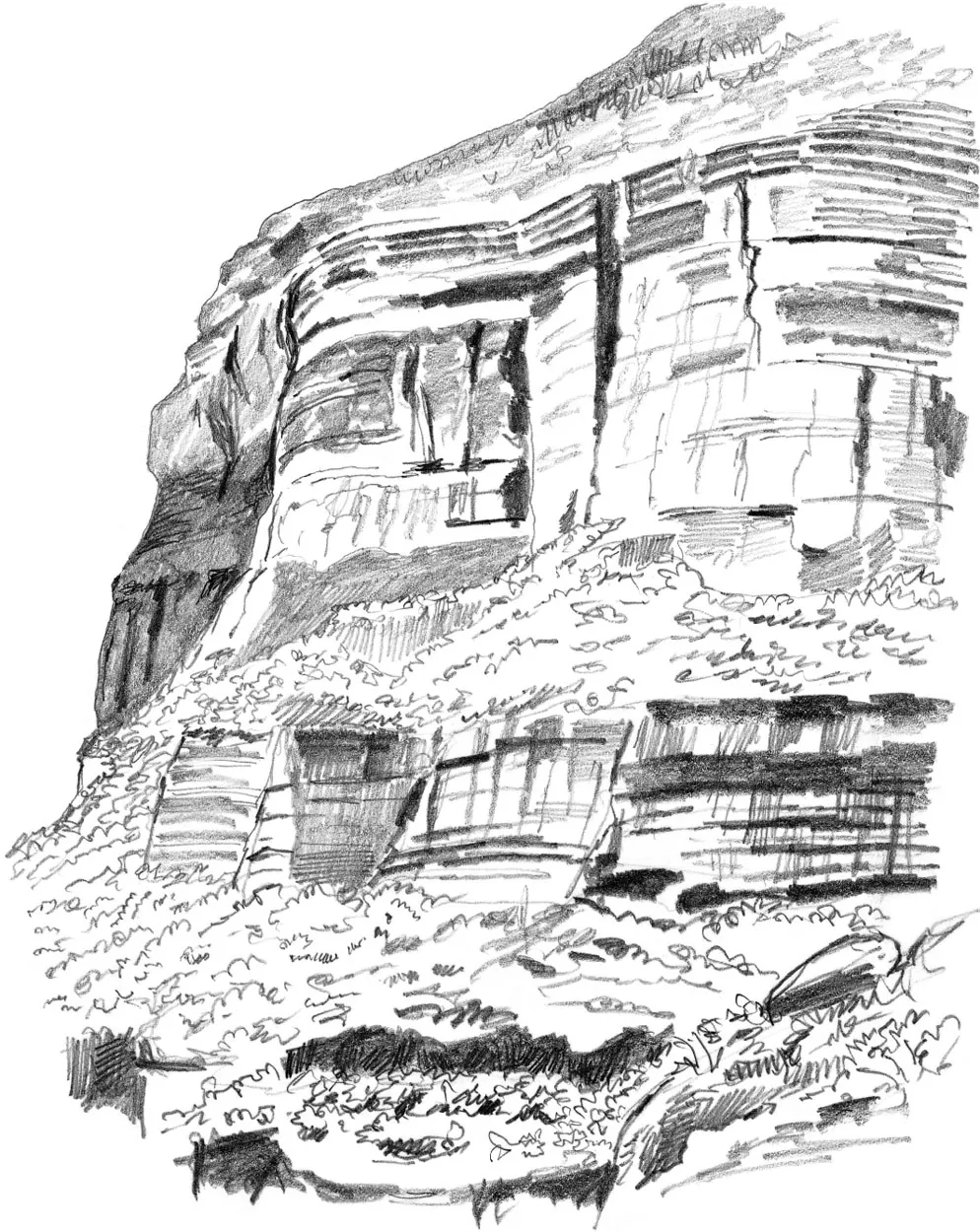
Now look at a large cliff-face, with its cleavages and striations of geological layering, some of it, no doubt, partially hidden by plants, but nevertheless showing the structure very clearly.
Water
The character and mood of water changes depending on how it is affected by movement and light. Here we look at water in various forms, which present very different problems for artists and very different effects on viewers. To understand how you can capture these effects requires first-hand study, supported by photographic evidence and persistent looking and recording.
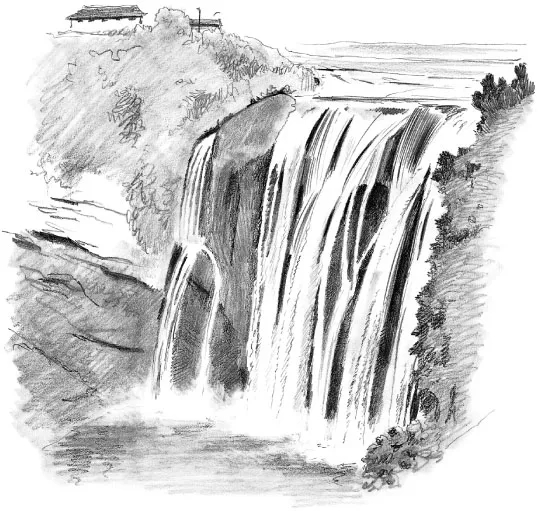
A waterfall is an immensely powerful form of water. Most of us don’t see such grand works of nature as this magnificent example. Of course, you would need to study one as large as this from a distance to make some sense of it. This drawing is successful largely because the watery area is not overworked, but has been left almost blank within the enclosing rocks, trees and other vegetation. The dark tones of the vegetation throw forward the negative shapes of the water.
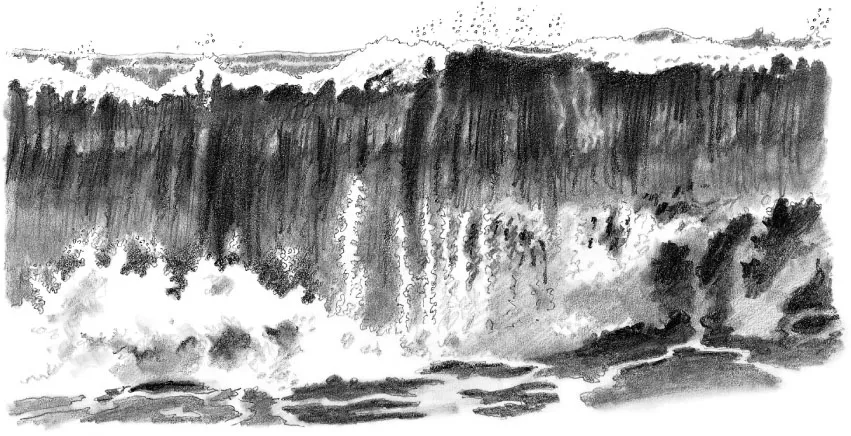
Unless you were looking at a photograph, it would be almost impossible to draw with any detail the effect of an enormous wave breaking towards you.
Leonardo da Vinci made some very good attempts at describing the movement of waves in drawings, but they were more diagrammatic in form.

This is water as most of us who live in an urban environment see it, still and reflective. Its surface may look smooth, but usually there is a breeze, or currents causing small, shallow ripples. Seen from an oblique angle these give a slightly broken effect along the edges of any objects reflected in the water. When you draw such a scene you need to gently blur or break the edges of each large reflected tone to simulate the rippling effect of the water.
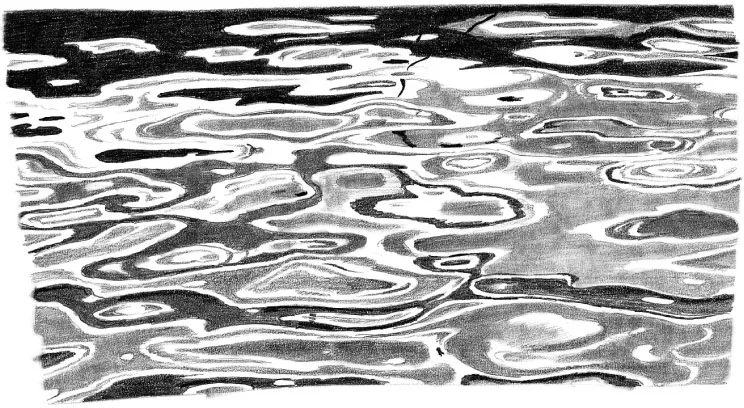
In this very detailed drawing of a stretch of water rippling gently, there appear to be three different tones for the smooth elliptical shapes breaking the surface. This is not an easy exercise but it will teach you something about what you actually see when looking at the surface of water.
The Sky: Using Space
The spaces between clouds as well as the shapes of clouds themselves can alter the overall sense we get of the subject matter in a landscape. The element of air gives us so many possibilities, we can find many different ways of suggesting space and open views. Compare these examples.
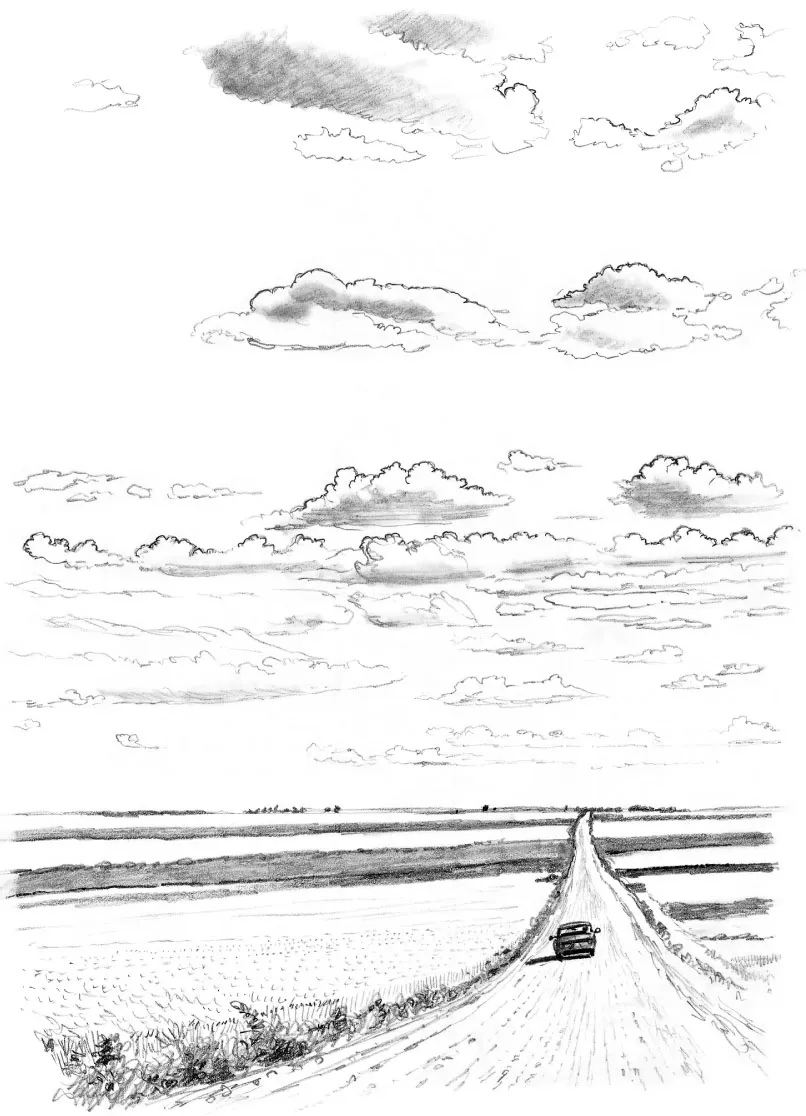
This open flat landscape with pleasant softlooking clouds gives some indication of how space in a landscape can be inferred. The fluffy cumulus clouds floating gently across the sky gather together before receding into the vast horizon of the prairie. The sharp, single-point perspective of the long, straight road and the car in the middle distance show us how to read the space of the great outdoors.

Another vision of air and space is illustrated here: a sky of ragged grey and white clouds, and the sun catching distant buildings on the horizon of the flat, suburban heathland below. Note particularly the low horizon, clouds with dark, heavy bottoms and lighter areas higher in the sky.

Despite the presence of dark, dramatic clouds in this scene at sunset the atmosphere is not overtly gloomy or brooding. The bright sun, half-hidden by the long flat cloud, radiates its light across the edges of the clouds, which shows us that they are lying between us and the sun. The deep space between the dark layers of cloud gives a slightly melancholic edge to the peacefulness.
...Table of contents
- Cover
- Title
- Contents
- Introduction
- Materials
- The World Around Us
- Framing a View
- Choosing a Size
- Landscape Formats
- Types of Perspective
- Viewpoints
- A Scene Close to Home
- Dividing a Panorama
- Elements of Landscape
- Pencil Techniques
- Pen Techniques
- Chalk
- Mixed Media
- Sea in the Landscape: Brush and Wash
- A Landscape Project
- Copyright
Frequently asked questions
Yes, you can cancel anytime from the Subscription tab in your account settings on the Perlego website. Your subscription will stay active until the end of your current billing period. Learn how to cancel your subscription
No, books cannot be downloaded as external files, such as PDFs, for use outside of Perlego. However, you can download books within the Perlego app for offline reading on mobile or tablet. Learn how to download books offline
Perlego offers two plans: Essential and Complete
- Essential is ideal for learners and professionals who enjoy exploring a wide range of subjects. Access the Essential Library with 800,000+ trusted titles and best-sellers across business, personal growth, and the humanities. Includes unlimited reading time and Standard Read Aloud voice.
- Complete: Perfect for advanced learners and researchers needing full, unrestricted access. Unlock 1.4M+ books across hundreds of subjects, including academic and specialized titles. The Complete Plan also includes advanced features like Premium Read Aloud and Research Assistant.
We are an online textbook subscription service, where you can get access to an entire online library for less than the price of a single book per month. With over 1 million books across 990+ topics, we’ve got you covered! Learn about our mission
Look out for the read-aloud symbol on your next book to see if you can listen to it. The read-aloud tool reads text aloud for you, highlighting the text as it is being read. You can pause it, speed it up and slow it down. Learn more about Read Aloud
Yes! You can use the Perlego app on both iOS and Android devices to read anytime, anywhere — even offline. Perfect for commutes or when you’re on the go.
Please note we cannot support devices running on iOS 13 and Android 7 or earlier. Learn more about using the app
Please note we cannot support devices running on iOS 13 and Android 7 or earlier. Learn more about using the app
Yes, you can access Essential Guide to Drawing: Landscapes by Barrington Barber in PDF and/or ePUB format, as well as other popular books in Art & Art Techniques. We have over one million books available in our catalogue for you to explore.