Anatomy Made Simple for Artists is designed to bring the complex subject of anatomical art to beginners, presenting a dynamic visual record of the fundamental characteristics and creative possibilities of the human form.For hundreds of years artists have developed their skills by drawing the human body. Although bones and muscles are largely hidden from view, all artists need to understand how these structures affect movement and posture, creating character and making what are general physical attributes entirely personal.No unnecessary medical jargon is included in this concise and accessible book, only visually stunning artworks and essential labels, showing what you need to know in order to bring the human form to life. Anatomy Made Simple for Artists is a visual treat that every artist, no matter their level of skill, will value.
NOWHERE MORE THAN WITH THE HEAD DO THE BONES SO obviously shape the surface form. There is also nowhere else in the body that has such a high concentration of muscle action. Each facial expression requires a combination of many minor and major facial muscles.
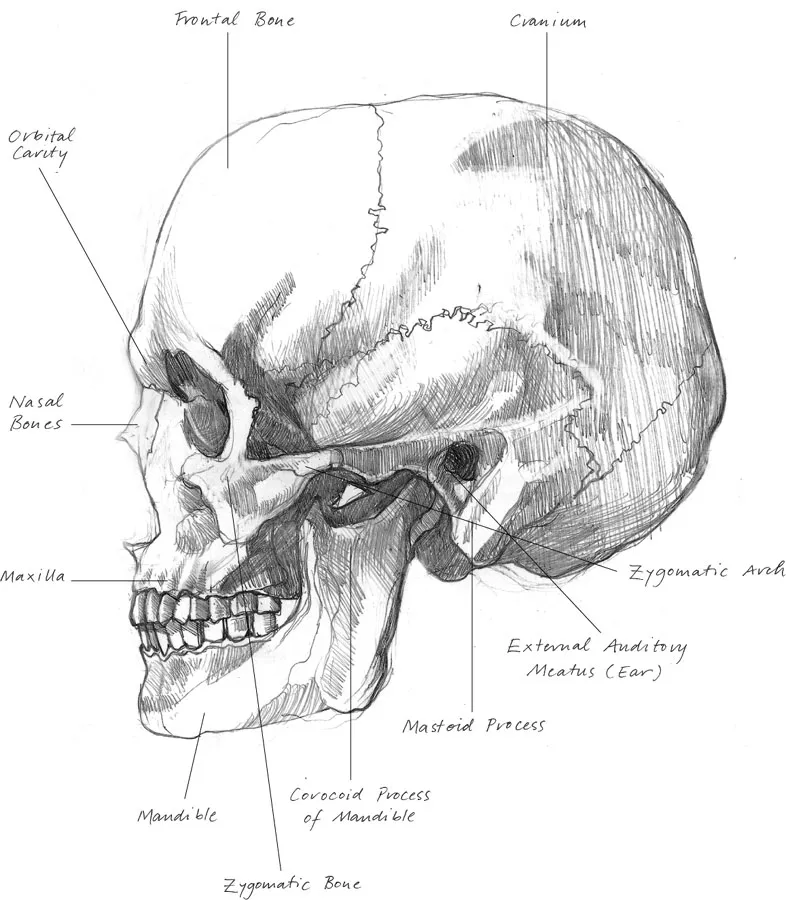
There is only one movable joint in the head however, the jaw. The jaw is completely separate from the skull and joins at the mastoid process.
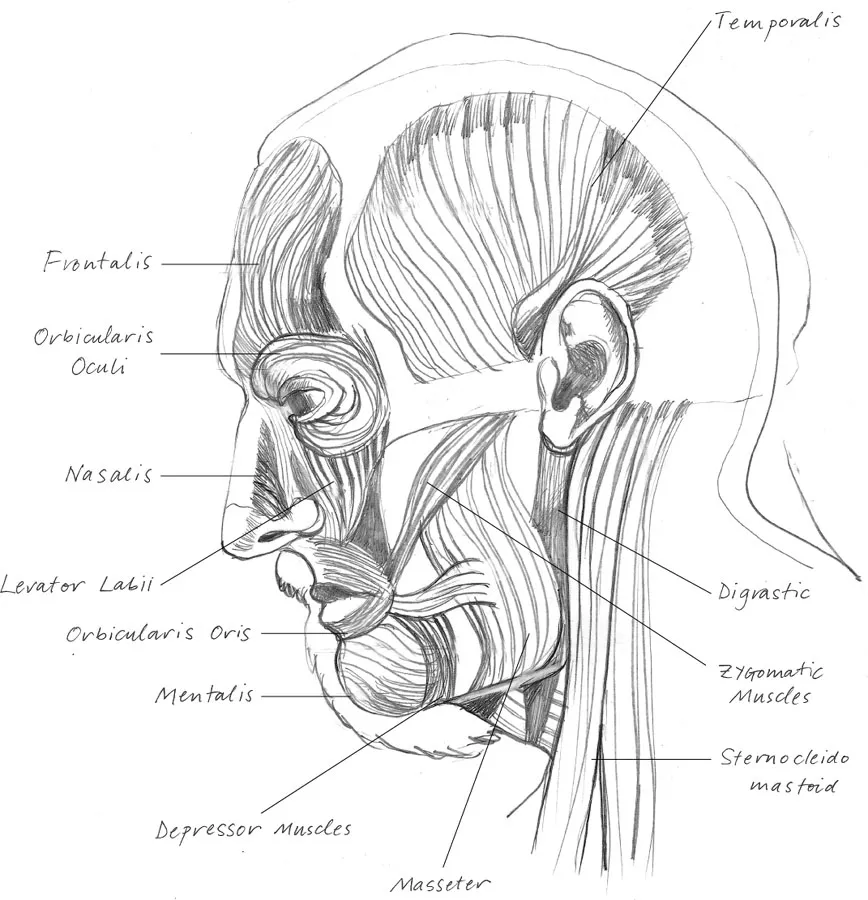
The movement of the jaw is controlled largely by a muscle called the masseter. This powerful muscle not only holds the lower jaw, but is also used for chewing. We can often feel the masseter tire or stiffen when we have been chewing excessively on something.
Two other vital muscles are those that control the opening and closing of the eyes and mouth. These muscles form a complete circle and can therefore contract considerably. This contraction is important since muscles control the opening of two vulnerable points where the inner body is exposed to the surface. These muscles are known as Oibicularis Oculi (eye) and Orbicularis Oris (mouth) and are termed sphincters due to the function they perform.
The contraction of the frontalis muscle that covers the frontal bone results in the raising of the eyebrows and the folding of the skin on the forehead. When we are surprised or shocked, the expression we assume will often involve these muscles, hence we say, ‘to raise an eyebrow.’
Certain other facial muscles are known for the main expression for which they are responsible. The grinning muscle or risorius pulls the orbicularis oris (mouth) muscle towards the ear and hence causes what we know as a grin.
The smiling muscles or zygomaticus, major and minor, pull the corner of the mouth diagonally upwards towards the top of the ear. These muscles work with the risorius to create a smile.
When the muscles controlling the movement of the lower lip during contraction are combined with the flanking movement in the depressor labii, a frown is created. The movement of lips and mouth also has the fundamental function of articulating sound and speech. All of the previously mentioned muscles are used for this as are the levator muscles (levator labii, levator angulious and levator labii alaeque nasi), which pull upwards on the top lip.
When drawing the eyes it is very important to remember that they are essentially balls in a socket (a mistake often made when drawing eyes is the tendency to make them look flat).
This socket is the orbital cavity. The ball of the eye rests in this socket and is protected by it. The eye is then covered by the obicularis oculi muscle, which controls the opening and closing of the lid over the eye.
The ridge that runs just below the eyes, popularly called the cheekbones (zygomatic arch) is another subterranean landmark worth nothing when drawing the face. On certain people it is more pronounced or angular whilst on others it is less so, although it remains a distinctive feature on each individual nevertheless.
Housing the mainframe of the senses, (sight, smell, hearing, taste and touch) the skull has a rather important function to perform. There is a real beauty in the formation of bones that create the skull. Many of these bones are clearly visible on the surface of the head, contributing crucially to what we call the ‘appearance’ of a person.
The substructure of the face is made up of a wide range of major and minor, deep and surface muscles, all of which contribute to the remarkable range of expression possible with the human face. Although every face is different the muscles underneath the skin are all of the same make up. In different people different muscles will be more or less developed. Muscles have ‘memory’ so if a certain movement is repeated often enough the muscle will remain fixed in that position. Hence we have ‘happy’ looking people and ’moody’ people for example.
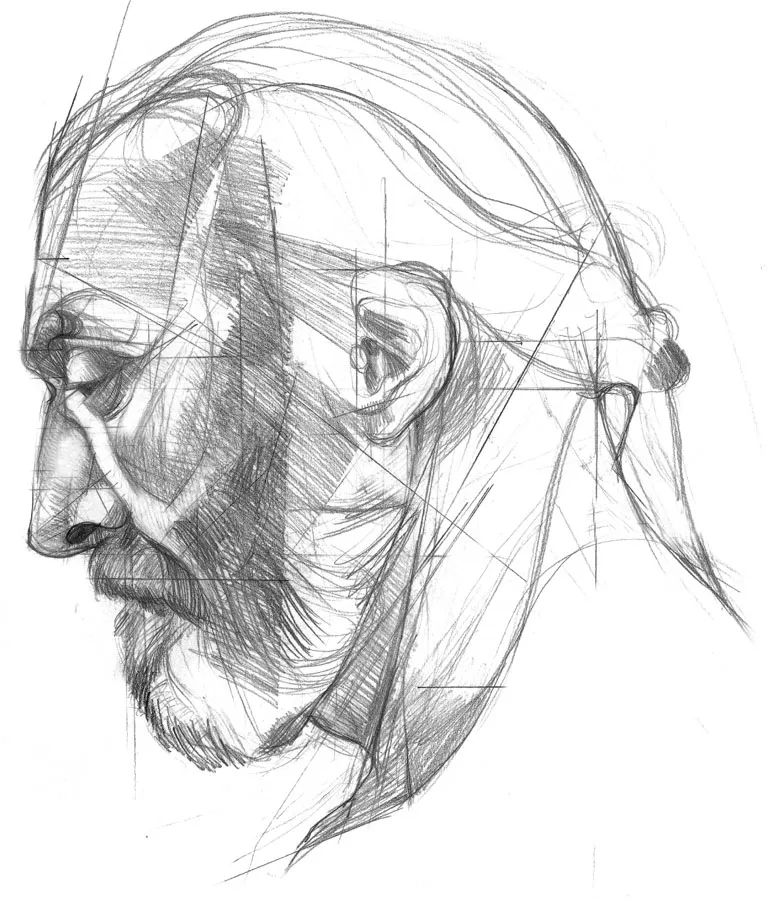
In this drawing of an older man the face is in repose and most of the muscles are relaxed. Using your own face feel what happens when you clench your teeth from a position of repose. Not only does the Masseter tighten but the Temporalis – which is connected to the Masseter – tightens too. If you look in the mirror whilst doing this you will be able to observe the effect this simple muscular movement has on one’s facial expression.
The Neck
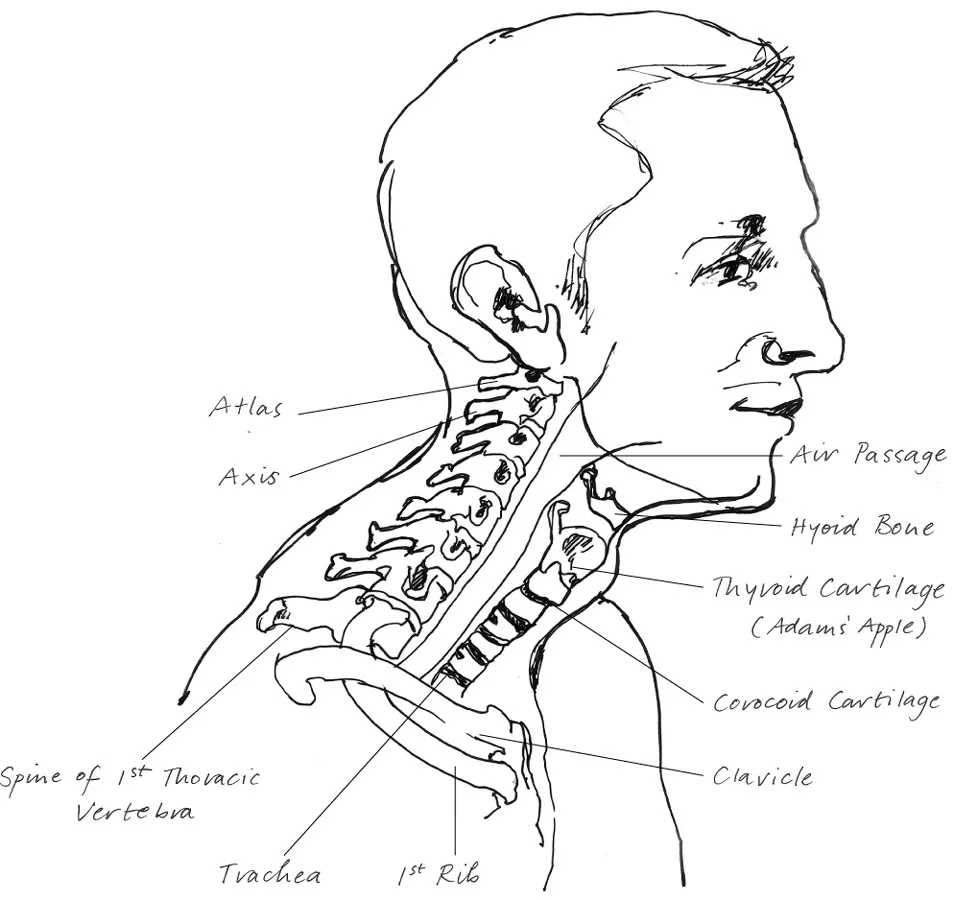
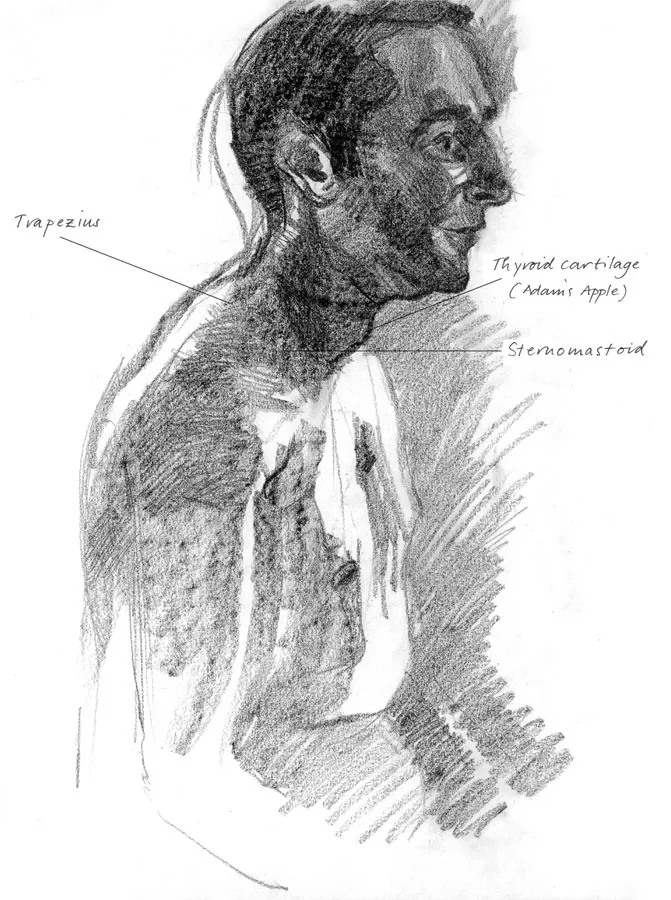
THE MOST PRONOUNCED MUSCLE VISIBLE ON THE SURFACE OF THE neck is also the most powerful of the neck muscles, the sternomastoid. Running along the front of the neck is a column containing the air passage. Within this column are the thyroid bone, the thyroid cartilage, the coricoid cartilage and the trachea. The thyroid cartilage and the muscles around it contain the vocal cords. This also forms what we know as the Adam’s apple, which is more pronounced in the male.
The name originates from the story of Adam and Eve where Adam eats the apple given to him by Eve from the forbidden tree of the knowledge of good and evil. Some of this apple became lodged in Adam’s throat, creating a lump.
The spinal vertebrae in the neck are smaller than in the rest of the spine to allow for more versatility of movement. They curve to create the forward thrust of the head. This curve is called the cervical curve.
The vertebrae are held firmly together by strong ligaments, which in the neck are called ligamentum nuchae. These ligaments are also attached to the rear base of the skull and form the tough fibrous sheet at the back of the neck casing the muscle of this area – postvenor triangle.
Although there is great strength in the neck, it is also an area of considerable vulnerability.
Within the neck are the vocal cords. The tone or pitch of the voice changes according to the length of these cords. These cords resonate in the wind passage (with its origin in the lungs) to create sound. This sound is then regulated and given articulation by the movement of the tongue, mouth and lips. This is the miracle process that allows us to speak, sing, laugh and scream.
There are two very powerful muscles dominating the make up of the neck – the trapezius and the sternomastoid. The trapezius is clearly visible at the back of the neck and the sternomastoid is found running along the sides of the neck. These two muscles are largely responsible for the movement and strength of the neck.
The Spinal Column and Rib Cage
THE SPINE IS MADE UP OF FIVE SECTIONS OF VERTEBRAE. IN TOTAL the spine consists of twenty-four vertebrae which are divided thus: the ...
Table of contents
Cover
Title
Contents
Introduction
A Brief History
Basic Anatomical Structure
Anatomy in Practice
Using Anatomy
Conclusion
Copyright
Frequently asked questions
Yes, you can cancel anytime from the Subscription tab in your account settings on the Perlego website. Your subscription will stay active until the end of your current billing period. Learn how to cancel your subscription
No, books cannot be downloaded as external files, such as PDFs, for use outside of Perlego. However, you can download books within the Perlego app for offline reading on mobile or tablet. Learn how to download books offline
Perlego offers two plans: Essential and Complete
Essential is ideal for learners and professionals who enjoy exploring a wide range of subjects. Access the Essential Library with 800,000+ trusted titles and best-sellers across business, personal growth, and the humanities. Includes unlimited reading time and Standard Read Aloud voice.
Complete: Perfect for advanced learners and researchers needing full, unrestricted access. Unlock 1.4M+ books across hundreds of subjects, including academic and specialized titles. The Complete Plan also includes advanced features like Premium Read Aloud and Research Assistant.
Both plans are available with monthly, semester, or annual billing cycles.
We are an online textbook subscription service, where you can get access to an entire online library for less than the price of a single book per month. With over 1 million books across 990+ topics, we’ve got you covered! Learn about our mission
Look out for the read-aloud symbol on your next book to see if you can listen to it. The read-aloud tool reads text aloud for you, highlighting the text as it is being read. You can pause it, speed it up and slow it down. Learn more about Read Aloud
Yes! You can use the Perlego app on both iOS and Android devices to read anytime, anywhere — even offline. Perfect for commutes or when you’re on the go. Please note we cannot support devices running on iOS 13 and Android 7 or earlier. Learn more about using the app
Yes, you can access Anatomy Made Simple for Artists by Jonathan Freemantle in PDF and/or ePUB format, as well as other popular books in Art & Art General. We have over one million books available in our catalogue for you to explore.