Pierre-Auguste Renoir was one of the foremost Impressionist artists, known for his en plein air scenes of middle-class leisure. But Renoir's primary interest lay indoors, in depictions of sensuous female nudes and intimate domestic scenes, painted in a warm, bright palette. This book explores the life and work of this leading light of Impressionism, showcasing his best-loved artwork alongside fascinating biographical detail. It also examines the development of his artistic practices, which began to diverge from many other Impressionist painters as he incorporated some elements of a classical style into his work. ABOUT THE SERIES: The Great Artists series by Arcturus Publishing introduces some of the most significant artists of the past 150 years, looking at their lives, techniques and inspirations, as well as presenting a selection of their best work.
Odalisque, 1870. A reclining woman in surroundings which suggest an exotic harem was a traditional subject for artists. The pose appears to have been influenced by Delacroix’s Women of Algiers in Their Apartment, 1834. When he painted this, Renoir had never been to Algiers. The model was Lise Tréhot, daughter of a French postmaster. Renoir used Islamic-inspired textiles and ceramics to create a sultry, slightly decadent atmosphere.
Chapter 1
From Artisan to Artist
While many of the Impressionists could trace a noble lineage back through the centuries, Renoir’s genealogy was shrouded in mystery. His grandfather, a foundling, had been left on the steps of the cathedral in Limoges in 1773. Adopted by the local Renouard family, who named him François, he received little education and grew up to be a craftsman – a maker of wooden shoes. When he married in 1796, at the age of twenty-three, he could neither read nor write so had to speak his name to the official scribe, who wrote it down phonetically as ‘Renoir’.
In time, François Renoir had his own family. His oldest child, Leonard, was born in 1799 and became a tailor in Limoges; he eventually married a dressmaker’s assistant. Leonard and his wife had seven children, five of whom survived infancy. Pierre-Auguste was the fourth of the five, born on 25 February 1841.
When Pierre-Auguste (known simply as ‘Auguste’) was four years old, François died and the Renoir family moved to Paris. Leonard set up a tailoring business at their home in the heart of the city. Its location, just a short walk from the Louvre where free admission was available to the general public at weekends, may have played a part in shaping Auguste Renoir’s future.
A developing talent
Renoir attended the local Catholic school, but left in 1854 at the age of thirteen to become apprentice to a porcelain painter. He learned to copy floral designs on to plates and cups, but lost his job when the mechanization of porcelain decoration arrived. He soon found employment doing other kinds of decorative painting on fans, and on screens for shops, restaurants and private homes; he also painted religious hangings for churches.
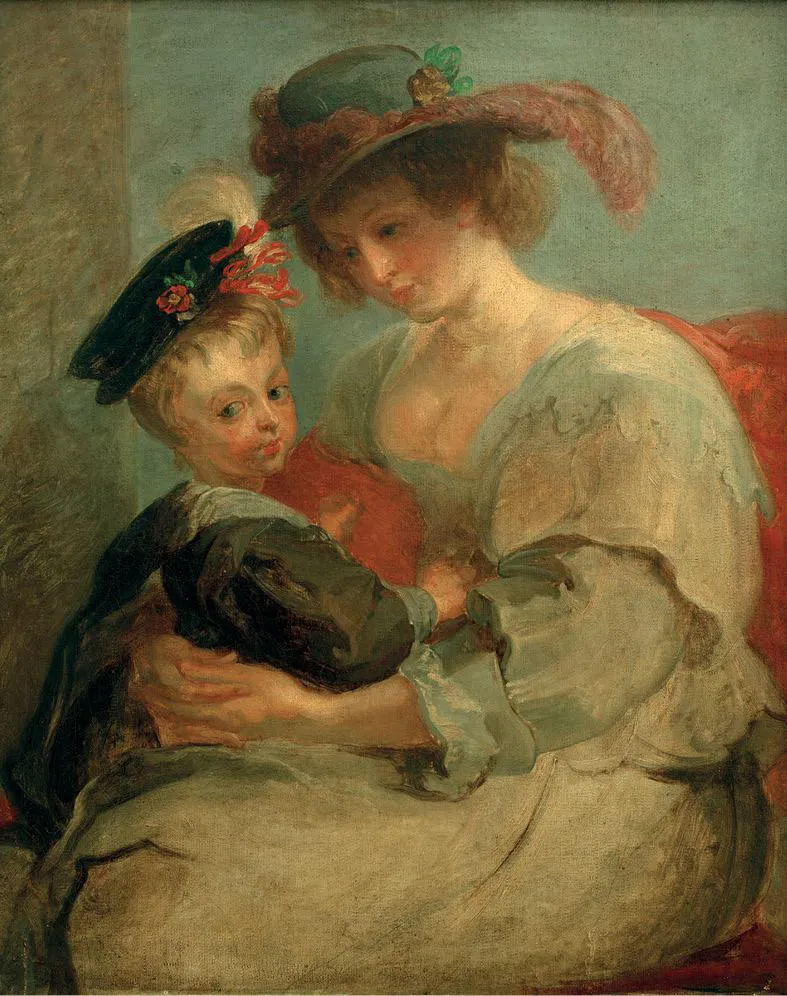
Renoir enrolled for free drawing classes at a city-sponsored art school run by Louis-Denis Caillouette, a sculptor. Caillouette taught his students the fundamentals of art by encouraging them to make copies of works of the great masters. In 1860, Renoir began to study and reproduce some of the great works hanging in the Louvre. He spent much of his time browsing the galleries, sketchbook in hand, studying the art and honing his skills. Some of his paintings from these early years survive, most notably a copy of Peter Paul Rubens’ portrait of his wife, Hélène Fourment and Her Children, made between 1860 and 1864. Renoir also produced still lifes and portraits, including one of his mother in 1860, and painted some fleeting scenes of Parisians at leisure that hint at the style and content of his later, more famous Impressionist works.
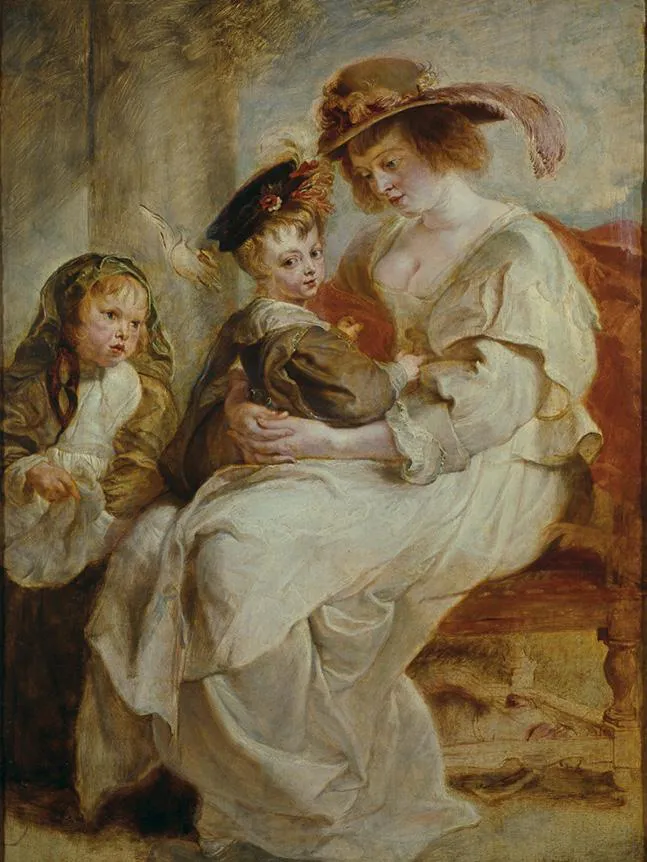
Hélène Fourment and Her Children, Peter Paul Rubens, c.1636. Rubens (1577–1640) remained a highly influential artist long after his death. From a privileged background, he became court page to a countess at the age of thirteen, but turned instead to art and travelled to Italy and Spain to learn from the works of Renaissance and classical masters. He became a court painter in the Netherlands and later combined his work with a diplomatic career. During some months spent in England, he fulfilled a number of commissions for King Charles I. Helena Fourment was Rubens’ second wife and she is portrayed here with her son Frans (b.1633) and daughter Clara Johanna (b.1632).
Art school and the Salon
At the age of twenty-one, Renoir entered the studio of the Swiss artist Charles Gleyre, who had been a student of Neoclassical painter Jean-Auguste-Dominique Ingres (1780–1867). Gleyre’s academic teaching style did not suit Renoir at the time, so he sought out kindred spirits and found them in fellow students Frédéric Bazille, Alfred Sisley and Claude Monet. Through Monet, Renoir also encountered Paul Cézanne and Camille Pissarro, who were studying at the Académie Suisse, a similar teaching atelier to Gleyre’s.
In 1862, Renoir enrolled at the École des Beaux-Arts, the government-funded art school of Paris, where he studied drawing and anatomy. ‘I was a very diligent student . . . ’ Renoir would later say, ‘but I never obtained the slightest honourable mention.’ According to some sources, Renoir had no fixed address during his early career; he lodged with friends and sought out commissions for portraits, but often didn’t earn enough money to buy paint or food.
At that time, success for aspiring artists depended on being accepted by the Salon, the official art exhibition of the Académie des Beaux Arts in Paris. First held in 1667, the Salon was the most prestigious art exhibition in France and possibly in all of Europe. Artists who won a Salon medal were likely to forge successful careers and win high-paying commissions from government and upper-class patrons, but those who didn’t win were left to the mercy of the critics, whose reviews could be unsparing. As Renoir put it in 1881: ‘There are hardly fifteen connoisseurs in Paris capable of liking a painter without the Salon. There are 80,000 of them who won’t even buy a nose [of a painting] if the painter is not in the Salon.’
Portrait of Hélène Fourment with Her Son, 1860–64. Renoir’s careful reworkings of paintings in the Louvre taught him much in the way of technique. He later turned away from Impressionism towards a more classical style. Rubens remained a lifelong influence.
In 1864, Renoir won acceptance by the Salon and exhibited his painting La Esmeralda, inspired by Victor Hugo’s The Hunchback of Notre Dame. But unlike modern galleries, where paintings are given equal prominence, the Salon displayed only the best-regarded pictures at eyeline. Renoir found that his painting was tucked away, as he put it: ‘My poor canvas was put under the moulding or under awning, so it would go as unnoticed as possible.’
Renoir and his contemporaries soon discovered that the juries making the awards and the critics writing the newspaper reviews were very conservative in their tastes. This resistance to art that was new or challenging would ultimately prompt the young artists to set up their own rival, more forward-thinking exhibition.
Meeting Manet
The same year, Renoir met an artist who was to have a profound influence on his work. Édouard Manet was nine years older than Renoir and had come to national attention in 1863 when, along with a number of other artists including Camille Pissarro, James McNeill Whistler and Gustave Courbet, he had his work rejected by the Salon. Every year the Salon dismissed over two-thirds of the paintings it received, and the dejected artists went away and tried again. But this year was different – the artists challenged the rejection. Their protests eventually reached the ears of Emperor Napoleon III, whose concern about the public reaction to the situation prompted him to decree that there would be a second exhibition for the rejected works – the so-called Salon des Refusés (‘Exhibition of Rejects’).
It was at the Salon des Refusés, amid much public ridicule, that Manet had exhibited Le Déjeuner sur l’Herbe in 1863. This large painting shows a picnic in a wooded glade. Two fully dressed men lounge alongside a naked woman whose gaze is turned casually yet curiously towards the viewer. In the background, another semi-naked woman bathes in a stream. The depiction of a naked female figure sitting with fully dressed men caused a scandal when the painting was first shown. But the writer Émile Zola described it as Manet’s ‘greatest work’ and it inspired imitations by other artists, including Claude Monet and Pablo Picasso.
Le Déjeuner sur l’Herbe, Édouard Manet, 1862–3. The public were unaccustomed to encountering nudes outside a classical setting, and the sight of a female figure entirely unashamed in the company of men in modern dress met with a shocked reaction. Manet’s comparative lack of perspective and abrupt contrasts, rather than the more conventional subtle graduations of tone, were also unfamiliar and caused further criticism.
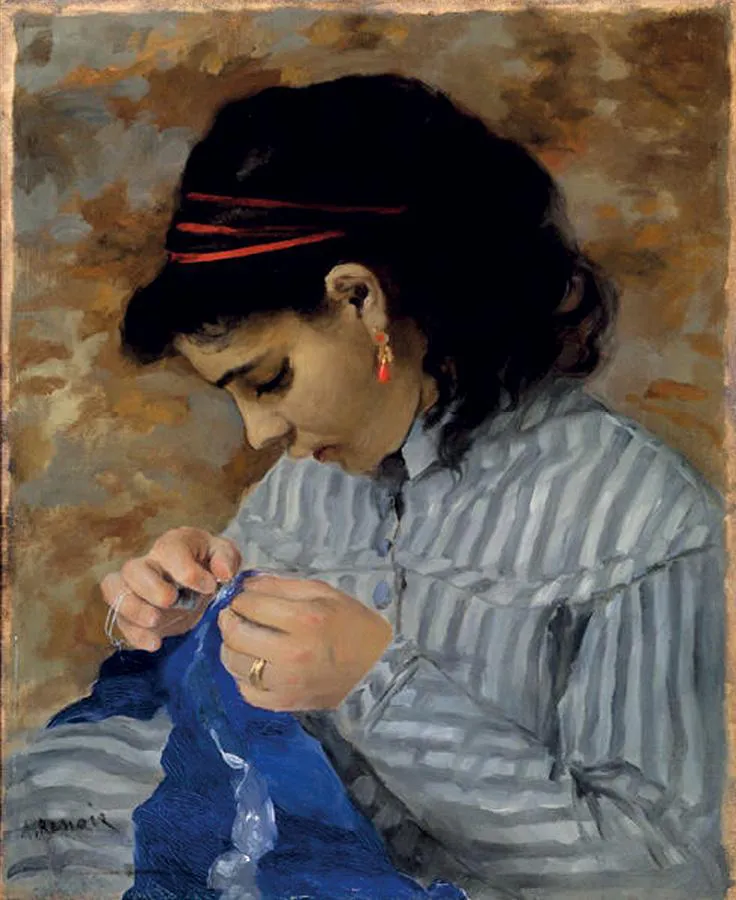
Lise Sewing, c.1866. In this apparently unposed portrait, Renoir shows his model totally absorbed in her work. The details of her clothing, red earring and red-striped ribbon in her hair are set against a background made up of loose brushstrokes in blue, brown and grey.
While the painting’s insouciant tone and the clothed/unclothed nature of its subject matter sparked controversy, Renoir and his contemporaries were impressed by Manet’s artistic risk-taking. Here a casual ‘everyday’ scene was presented at a size and scale usually reserved for religious or historical works. It was outwardly realistic yet much of it seemed artificial. The skewed perspective makes the woman in the background appear too large, there is an absence of shadow and detailing, and much of the paint has been roughly applied with obvious brushstrokes.
This was a modern painting, both in style and content, though it clearly owed a debt to the great masters, particularly to Titian’s Pastoral Concert painted around 1509, where naked, nymph-like women are accompanied by men in courtly dress. Le Déjeuner sur l’Herbe exerted a huge influence on Renoir. This, he decided, was what he wanted to do – paint everyday life in a way that acknowledged great art from history but which was also entirely new.
Of course, artists had always painted everyday scenes, but they tended to be formally composed and rigidly stylized. Renoir and his contemporaries wanted to capture the moment as it really happened, naturalistically, with blurred movement and no great distinction between subject and background.
Over the next few years Manet would become the unofficial leader of the group later dubbed the Impressionists. A number of Renoir’s paintings from this period are heavily influenced by Manet in terms of their casual subject matter, composition and approach.
Although he was regarded as a major talent by his contemporaries...
Table of contents
Title Page
Contents
Introduction
Chapter 1. From Artisan to Artist
Chapter 2. Capturing Reality
Chapter 3. The Classical Period
Chapter 4. A New Century
Chapter 5. The Final Years
Epilogue
Timeline
Further Information
List of Illustrations
Copyright
Frequently asked questions
Yes, you can cancel anytime from the Subscription tab in your account settings on the Perlego website. Your subscription will stay active until the end of your current billing period. Learn how to cancel your subscription
No, books cannot be downloaded as external files, such as PDFs, for use outside of Perlego. However, you can download books within the Perlego app for offline reading on mobile or tablet. Learn how to download books offline
Perlego offers two plans: Essential and Complete
Essential is ideal for learners and professionals who enjoy exploring a wide range of subjects. Access the Essential Library with 800,000+ trusted titles and best-sellers across business, personal growth, and the humanities. Includes unlimited reading time and Standard Read Aloud voice.
Complete: Perfect for advanced learners and researchers needing full, unrestricted access. Unlock 1.4M+ books across hundreds of subjects, including academic and specialized titles. The Complete Plan also includes advanced features like Premium Read Aloud and Research Assistant.
Both plans are available with monthly, semester, or annual billing cycles.
We are an online textbook subscription service, where you can get access to an entire online library for less than the price of a single book per month. With over 1 million books across 990+ topics, we’ve got you covered! Learn about our mission
Look out for the read-aloud symbol on your next book to see if you can listen to it. The read-aloud tool reads text aloud for you, highlighting the text as it is being read. You can pause it, speed it up and slow it down. Learn more about Read Aloud
Yes! You can use the Perlego app on both iOS and Android devices to read anytime, anywhere — even offline. Perfect for commutes or when you’re on the go. Please note we cannot support devices running on iOS 13 and Android 7 or earlier. Learn more about using the app
Yes, you can access Pierre-Auguste Renoir by Thomas Stevens in PDF and/or ePUB format, as well as other popular books in Art & Artist Biographies. We have over one million books available in our catalogue for you to explore.