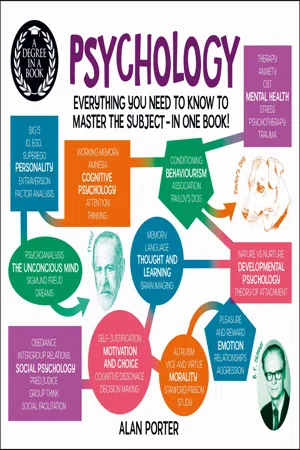
A perfect introduction for students and laypeople alike, A Degree in a Book: Psychology provides you with all the concepts you need to understand the fundamental issues.Filled with helpful diagrams, suggestions for further reading, and easily digestible features on the history of psychology, this book makes understanding the human mind easier than ever. Including the theories of Francis Galton, Sigmund Freud, Ivan Pavlov, and many more, it covers the whole range of psychological research.By the time you finish reading this book, you will be able to answer questions such as: • How do we learn? • Do groups make better decisions than individuals? • How do we study the living brain? • What are the components of personality?
The Scope of Psychology – History of Psychology – Wilhelm Wundt and the Institute for Experimental Psychology
Academics and professionals
Psychology is a body of knowledge, an academic discipline and a profession. As a body of knowledge, psychologists have contributed to our understanding of phenomena as diverse as child development, the treatment of phobias, differences in sociability and how we remember lists of names. As an academic discipline, its place in the university has grown remarkably over the last hundred and thirty or so years. It started with a few specialists trying to study their own experiences systematically. It has now become one of the most popular degree subjects across the world, attracting millions of dollars of funding and educating tens of thousands of students in psychological theory and psychological research methods. With the growth of academic psychology, we have also seen a huge rise in the number of professional psychologists. These draw on psychological research to advise, treat and counsel children and adults in medical settings, schools, work places and private practice.
ACADEMIC PSYCHOLOGY
► Theory
► Research Methods
↕
PROFESSIONAL PSYCHOLOGY
► Advice
► Treatment
► Counselling
The Scope of Psychology
It’s very difficult to provide a quick summary of psychology or even to give a useful definition of the term ‘psychology’ itself. This is because there are many different kinds of psychology and these all have different starting points and different methodologies. A typical psychology degree will cover the most important approaches and methods but will still leave out a lot of interesting material. Typically, in a three-year degree, students study social psychology, biological psychology, individual differences (intelligence and personality), cognitive psychology, psychology of learning and developmental psychology. After studying these basic areas, students are then introduced to specialisms that might include clinical psychology, educational psychology, occupational psychology, health psychology and forensic psychology. Completing an undergraduate degree is just the first step to becoming a professional psychologist. For example, to become a clinical or educational psychologist you must complete a three-year professional doctorate before you’re qualified to work with patients or pupils. That’s after you’ve completed your degree. This is an important point to bear in mind if you intend to study psychology at university because an undergraduate degree is just the beginning of a long journey to professional qualification.
Plan of This Book
Most undergraduate degrees in psychology require students to attend hundreds of hours of lectures and seminars. Students are also required to read, in their own time, many thousands of pages of textbooks, monographs and scientific journal articles (journal articles are how scientists communicate their research findings). It is not possible to summarise all of this material in a short book like this. What is possible is to select some topics from the main areas of psychology in order to illustrate the kind of psychological knowledge you can hope to gain over the course of a degree. ‘Suggested reading’ sections for each chapter at the end of the book will point you to sources that will help you to extend and deepen your knowledge of psychology.
A Brief Note on the History of Psychology
It’s worth taking a brief look at the history of contemporary psychology in order to get a sense of the scope of the field. Psychology is still a relatively young science, emerging as an academic discipline in its own right only in the last quarter of the nineteenth century. In 1908, the German experimental psychologist Hermann Ebbinghaus stated, at the beginning of his Psychology: An Elementary Text-book (1908), that: ‘Psychology has a long past, yet its real history is short’. This is a phrase that has become important in describing how psychologists understand their discipline. What Ebbinghaus was getting at is that questions about human nature had long been asked by philosophers, theologians and pedagogues (educationalists) and also by physicians, surgeons and biologists. In the course of their work they had often run up against questions about the relationship between mind and body. Psychology’s ‘long past’ comprised, at best, a rich source of anecdotal observations and, at worst, mere armchair speculation with no objective grounding. The ‘short history’ of psychology began when a generation of thinkers and researchers began to conceive of psychology as a systematic and empirical science that could produce objective and reliable theories and data. (We look at how Ebbinghaus conducted the first systematic studies of memory in Chapter 3).
Willhelm Wundt and the Institute for Experimental Psychology
According to Ebbinghaus, the short history of psychology began when Gustave Fechner (1801–87), Ebbinghaus (1850–1909) himself and, most importantly, Wilhelm Wundt (1832–1920) began to conduct empirical research (that is, when they got out of their armchairs and began to collect and analyse data systematically). We will return to the work of Fechner and Ebbinghaus in later chapters.
EMPIRICAL RESEARCH ► the systematic collection and analysis of data.
One of Wundt’s key contributions was to set up the first Institute for Experimental Psychology at the University of Leipzig in 1879 and to oversee the supervision of a whole generation of PhD students from around the world. These students went back to their homelands and founded their own laboratories of experimental psychology in the USA, UK, France and Italy.
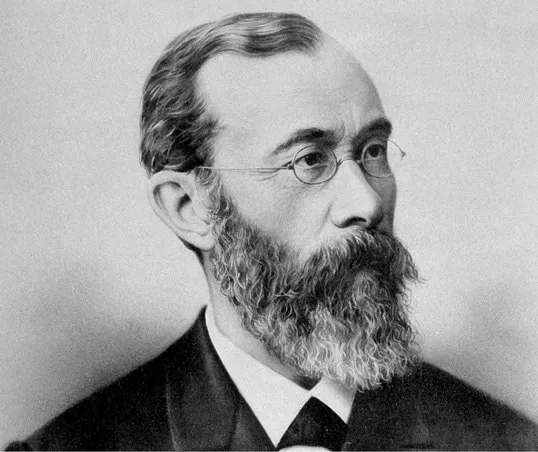
Wilhelm Wundt set up the Institute for Experimental Psychology at the University of Leipzig in 1879.
NAMES TO KNOW: THE FOUNDERS OF PSYCHOLOGY
Gustave Fechner(1801–87)
Wilhelm Wundt(1832–1920)
Hermann Ebbinghaus(1850–1909)
Oswald Külpe(1862–1915)
Psychology as the study of conscious experience
The subject matter of Wundt’s psychology was conscious experience. He realised that studying conscious experience was problematic because it required a conscious observer to become conscious of their own observing, leading to dizzying complexities. For example, in the case of self-observation (introspection), does the very fact that the observer is observing his or herself change what he or she is observing?
Wundt’s way of approaching the problem of self-observation was to develop a systematic and controlled method of introspection that, he argued, was as objective as the methods of chemists and physicists. Wundt believed that the methods of introspection that made up a lot of the accounts of human nature were flawed because they relied on memory and the particular choices of phenomena on which to introspect. This might be introspecting on the experience of something rather general and abstract, like happiness, or something very specific, like the experience of hearing a pin drop.
INTROSPECTIVE PSYCHOLOGY ► the study of simple sensory processes.
Wundt limited introspective psychology to the study of simple sensory processes such as auditory tones and insisted that introspection was carried out in the present. The participants in these experiments, usually Wundt himself or his PhD students, were highly trained so that they could concentrate intensely on the stimuli that were presented to them. These stimuli (they might be auditory tones or coloured patches) were carefully measured and were repeated with variations again and again to ensure the results were reliable.
Wundt’s account of how we make sense of the world
Despite Wundt’s best intentions to make his science of consciousness reliable and systematic, controversy followed almost as soon as he had set up his laboratory and started publishing his results. Despite his warnings, his followers and other psychologists who took up his methods extended the scope of the new psychology to include not just simple sensory stimuli but also higher cognitive functions, such as problem solving. For example, Oswald Külpe (1862–1915) asked his experimental participants at the University of Würzburg to introspect on their experience of being asked the question in the context of a laboratory session ‘Where are we going afterwards?’ One participant reported that after being asked the question the following passed through his mind: ‘Acoustic-motor pronunciation of the words “To the cafe”. But the words “Wherever you want” competed. State of consciousness which can be called doubt.’
Even more problematic than app...
Table of contents
Title Page
Contents
Introduction
Chapter One • What is Psychology?
Chapter Two • The Psychology of Learning
Chapter Three • Cognitive Psychology
Chapter Four • Biological Psychology
Chapter Five • Developmental Psychology
Chapter Six • Social Psychology
Chapter Seven • The Psychology of Intelligence
Chapter Eight • Personality Psychology
Chapter Nine • Clinical Psychology
Chapter Ten • Professional Psychology
Chapter Eleven • Future Directions
Glossary
Suggested Reading
Picture Credits
Copyright
Frequently asked questions
Yes, you can cancel anytime from the Subscription tab in your account settings on the Perlego website. Your subscription will stay active until the end of your current billing period. Learn how to cancel your subscription
No, books cannot be downloaded as external files, such as PDFs, for use outside of Perlego. However, you can download books within the Perlego app for offline reading on mobile or tablet. Learn how to download books offline
Perlego offers two plans: Essential and Complete
Essential is ideal for learners and professionals who enjoy exploring a wide range of subjects. Access the Essential Library with 800,000+ trusted titles and best-sellers across business, personal growth, and the humanities. Includes unlimited reading time and Standard Read Aloud voice.
Complete: Perfect for advanced learners and researchers needing full, unrestricted access. Unlock 1.4M+ books across hundreds of subjects, including academic and specialized titles. The Complete Plan also includes advanced features like Premium Read Aloud and Research Assistant.
Both plans are available with monthly, semester, or annual billing cycles.
We are an online textbook subscription service, where you can get access to an entire online library for less than the price of a single book per month. With over 1 million books across 990+ topics, we’ve got you covered! Learn about our mission
Look out for the read-aloud symbol on your next book to see if you can listen to it. The read-aloud tool reads text aloud for you, highlighting the text as it is being read. You can pause it, speed it up and slow it down. Learn more about Read Aloud
Yes! You can use the Perlego app on both iOS and Android devices to read anytime, anywhere — even offline. Perfect for commutes or when you’re on the go. Please note we cannot support devices running on iOS 13 and Android 7 or earlier. Learn more about using the app
Yes, you can access A Degree in a Book: Psychology by Alan Porter in PDF and/or ePUB format, as well as other popular books in Psychology & Movements in Psychology. We have over one million books available in our catalogue for you to explore.