The Story of Codebreaking
eBook - ePub

The Story of Codebreaking

  1. English
  2. ePUB (mobile friendly)
  3. Available on iOS & Android
eBook - ePub

The Story of Codebreaking

About this book

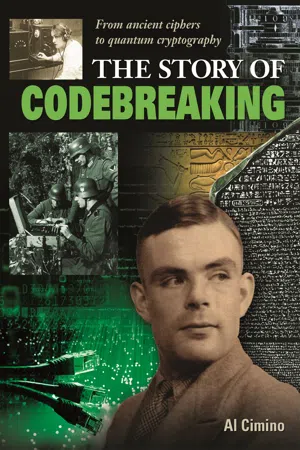
To break a code, you have to put yourself in the mind of your enemy in order to probe the strengths and weaknesses of their systems. It's a game of bluff and doublebluff. The Story of Codebreaking describes undercover operations, power struggles, secret alliances, and brilliant feats of teamwork. Those who invent codes and those who break them are remarkable, indefatigable characters. Find out how Mary Queen of Scots smuggled cryptic messages to her accomplices when she was plotting against her cousin Elizabeth I, or discover the methods used by codebreakers during World Wars I and II, most significantly those who cracked Enigma and intercepted Japanese naval messages prior to Pearl Harbor. The sheer doggedness of those who unraveled the Enigma code is thought to have shortened World War II by almost two years. Topics include:
• Ancient ciphers and the art of encoding
• Early spies, subterfuge and skytales
• The making and breaking of Enigma
• Japanese naval codes in World War II
• Cold War cryptography

Frequently asked questions

Yes, you can cancel anytime from the Subscription tab in your account settings on the Perlego website. Your subscription will stay active until the end of your current billing period. Learn how to cancel your subscription.
No, books cannot be downloaded as external files, such as PDFs, for use outside of Perlego. However, you can download books within the Perlego app for offline reading on mobile or tablet. Learn more here.
Perlego offers two plans: Essential and Complete
  • Essential is ideal for learners and professionals who enjoy exploring a wide range of subjects. Access the Essential Library with 800,000+ trusted titles and best-sellers across business, personal growth, and the humanities. Includes unlimited reading time and Standard Read Aloud voice.
  • Complete: Perfect for advanced learners and researchers needing full, unrestricted access. Unlock 1.4M+ books across hundreds of subjects, including academic and specialized titles. The Complete Plan also includes advanced features like Premium Read Aloud and Research Assistant.
Both plans are available with monthly, semester, or annual billing cycles.
We are an online textbook subscription service, where you can get access to an entire online library for less than the price of a single book per month. With over 1 million books across 1000+ topics, we’ve got you covered! Learn more here.
Look out for the read-aloud symbol on your next book to see if you can listen to it. The read-aloud tool reads text aloud for you, highlighting the text as it is being read. You can pause it, speed it up and slow it down. Learn more here.
Yes! You can use the Perlego app on both iOS or Android devices to read anytime, anywhere — even offline. Perfect for commutes or when you’re on the go.
Please note we cannot support devices running on iOS 13 and Android 7 or earlier. Learn more about using the app.
Yes, you can access The Story of Codebreaking by Al Cimino in PDF and/or ePUB format, as well as other popular books in History & Science History. We have over one million books available in our catalogue for you to explore.

Information

Publisher
Arcturus
Year
2017
eBook ISBN
9781788880589
Illustration
A coded tablet was found at Seleucia, a city in ancient Mesopotamia (now Iraq).

CHAPTER 1

ANCIENT CIPHERS

‘The art of understanding writing in cypher, and the writing of words in a peculiar way. . . . The art of speaking by changing the forms of words. It is of various kinds. Some speak by changing the beginning and end of words, others by adding unnecessary letters between every syllable of a word, and so on.’
Kama Sutra
3rd century AD
In the ancient world, the art of secret writing was cultivated in the same way that certain professions develop their own jargon and gangs use slang – as a badge of identity and to exclude outsiders. But as warfare grew more sophisticated, code and ciphers became an essential weapon used to communicate strategy and other vital information without tipping your hand to the enemy.
Illustration
Chinese ideograms make the language unsuitable for ciphers, but the Chinese military made extensive use of codes.

The art of encoding

Inscriptions on the tomb of nobleman Khnumhotep II in the town of Menet Khufu in Egypt substitute unusual symbols for ordinary hieroglyphs. Dating from around 1900BC, this is the oldest known example of a substitution cipher. However, it was not done for the sake of secrecy, but rather to lend kudos to the work and its subject, and to enable the scribe to demonstrate his skill.
As Egyptian civilization progressed, scribes competed with one another to make substitutions like this more complex. Eventually, encoding became so arcane that the inscriptions seemed to be endowed with magical powers. The reader was supposed to be able to figure out the meaning in a reasonably short time, if they were clever enough.

China

In Ancient China, secret messages would be written on very thin silk or paper, then rolled into a ball and covered with wax. This would be hidden about the person, perhaps even inserted in the anus or swallowed. Hiding a message in this way is known as steganography.
‘When these five kinds of spy are all at work, none can discover the secret system. This is called “divine manipulation of the threads”. It is the sovereign’s most precious faculty.’
Sun Tzu, The Art of War
The book Wujing Zongyao, known in English as the Complete Essentials for the Military Classics, outlines a simple code. The first 40 ideograms of a poem correspond to a list of messages ranging from the report of a victory to a request for bows and arrows. The ideogram required would be placed in a specified place in a regular dispatch. The recipient could reply with the same ideogram stamped with their seal, if it was approved, or without their seal, if denied. Even if the dispatch were intercepted, it is unlikely that the enemy would realize the significance of the extra ideogram.
Otherwise the ideographic Chinese alphabet made it unsuitable for ciphers. However, it has been pointed out that, in a country where the literacy rate is low – as it was in the Northern Song Dynasty (970–1127) when Wujing Zongyao was written – writing itself is a form of code.
Illustration
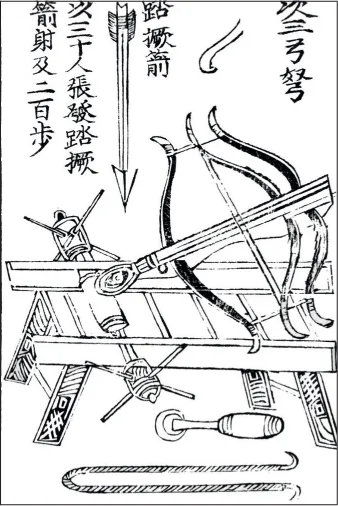
A Chinese triple bow crossbow for use by a four-man team, taken from an illustration in the Wujing Zongyao, AD 1044.

India

The Arthashastra, a treatise on statecraft compiled in the 3rd and 2nd centuries BC, contains a section on spying which extols the use of secret writing. The Kama Sutra also mentions that secret writing is one of the 64 arts a woman should know.
While the Kama Sutra does not describe the methods used, a commentary on the work written by Yasodhara gives details of two ciphers. One is the Kautilya, named after the author of the Arthashastra, in which vowels become consonants according to a chart:
a ā i ī u ū e a
i
o a
u
ñ ś s i r l u
k
h
g g
h
c
h
j j
h
ñ t
h
d
h
t
h
d d
h
n p
h
b b
h
n y r l v
Other letters are left unchanged. There is also a simplified version of the cipher, known as the Durbodha.
The second system was called the Muladeviya, when spoken, and Gudhalekhya, when written. It was used by royal spies and traders, as well as thieves. The following letters are exchanged:
...
a k
h
g
h
c t ñ n r l y
k g p n

Table of contents

  1. Cover
  2. Title
  3. Contents
  4. Introduction: Codemakers versus Codebreakers
  5. Chapter 1: Ancient Ciphers
  6. Chapter 2: Arabic Anagramming
  7. Chapter 3: European Encipherers
  8. Chapter 4: Breaking the Unbreakable
  9. Chapter 5: Room 40
  10. Chapter 6: The Birth of Mechanization
  11. Chapter 7: Making Enigma
  12. Chapter 8: Breaking Enigma
  13. Chapter 9: Bletchley Park
  14. Chapter 10: Red and Purple
  15. Chapter 11: The Japanese Naval Codes
  16. Chapter 12: Cryptology Strikes Back
  17. Chapter 13: Computer Cryptanalysis
  18. Chapter 14: Cold War Cryptography
  19. Chapter 15: Computers Take Over
  20. Chapter 16: The End of Codebreaking as We Know It?
  21. Glossary
  22. Index
  23. Picture Credits
  24. Copyright