Barrington Barber's The Complete Introduction to Drawing is the perfect start-up book for those who wish to learn how to draw, covering all essential introductory techniques to shading, line, perspective, composition and more.
Beginning with the basics, Barrington leads you step by step, from simple mark making through to carefully thought-out exercises on composing and drawing still life, landscapes, portraits and figures.
Throughout the book his hints and tips, gleaned from a lifetime of teaching and creating art, will give you real insight into the art of learning to draw. This is an indispensable reference source for anyone on the challenging but rewarding path to becoming a fully fledged artist.
eBook - ePub
The Complete Introduction to Drawing
A Professional Course for Every Artist
- English
- ePUB (mobile friendly)
- Available on iOS & Android
eBook - ePub
About this book
Trusted by 375,005 students
Access to over 1.5 million titles for a fair monthly price.
Study more efficiently using our study tools.
Information
Topic
ArteSubtopic
Arte generale
BASIC MARK MAKING
When you draw, you are not creating the objects you draw; you are merely making marks on paper that represent some kind of visual experience that we recognize as something familiar in our view of the world: the drawings are illusions of form and shapes that we see. So mark making is important and we need to practice improving and extending our ability to do it easily and effectively.
Probably the first thing to consider when you begin to draw is exactly how you are going to organize yourself. So, in this section we will examine whether you sit or stand to draw; the way you hold your drawing implements; how you assume your viewpoint; and even the size of the image that you draw. It is well worth spending time over these matters, although much of it is a matter of common sense.
We will look at various ways of practising drawing with simple exercises to encourage confidence in your methods. There will also be a consideration of mechanical devices and their usage, designed to help you produce naturalistic drawing.
POSITIONS AND GRIPS
Here we consider ways of standing or sitting to draw and ways of holding the drawing implement to get the best results.
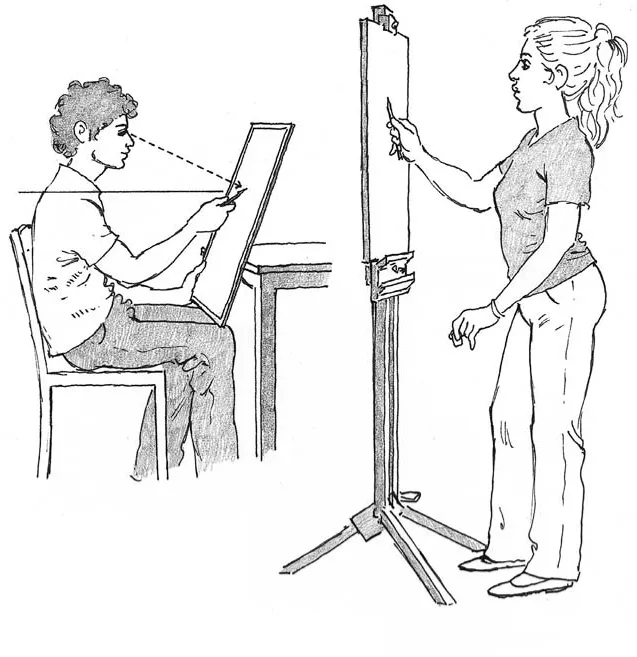
When drawing things laid out upon a table, you can sit and work on a large enough drawing board to take the size of paper you are using, which will be attached with clips, drawing pins or masking tape. Of these, I prefer the latter as it is easier to change the paper and it doesn’t matter if you lose the bits of masking tape.
To draw standing up, which is much the best way, you will need some kind of easel, and this will be your first serious expense. However, they last for ever if you are careful with them, and make drawing so much easier. There are several types, such as portable easels, radial easels (my own favourite), and large studio easels, which you should buy only if you have sufficient space and are intent upon a career in art.
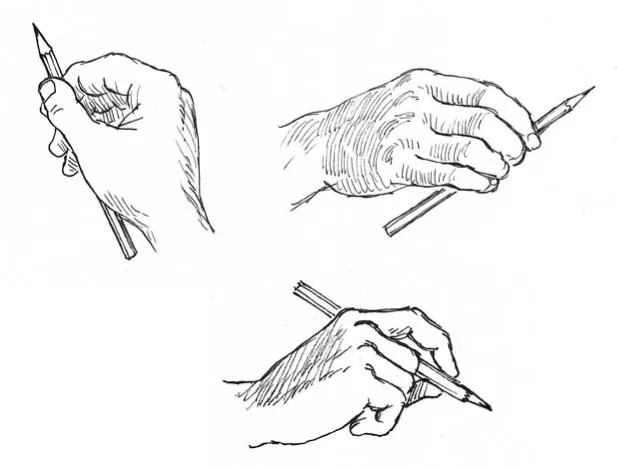
The way that you hold your drawing implement has a great bearing on your drawing skill. Don’t hold the pencil too tightly: try to relax your hand and wrist and hold the implement loosely so that there is no unnecessary tension; the quality of your line should improve immediately.
Also, try out different ways of holding it, for instance more like a stick or sword than a pen. The pen-holding method is not wrong but often too constrained for really effective drawing.
SKETCHING
Going to a place that you know, and simply drawing what you see to the best of your ability, is one of the best exercises that you can perform. Rather than loose sheets of paper, consider keeping a bound sketch book to record your immediate impressions of a scene. You will need a small one (A5), and another one a bit larger (A4 or A3). There are many versions with various types of binding and you just have to choose those that suit your particular needs.
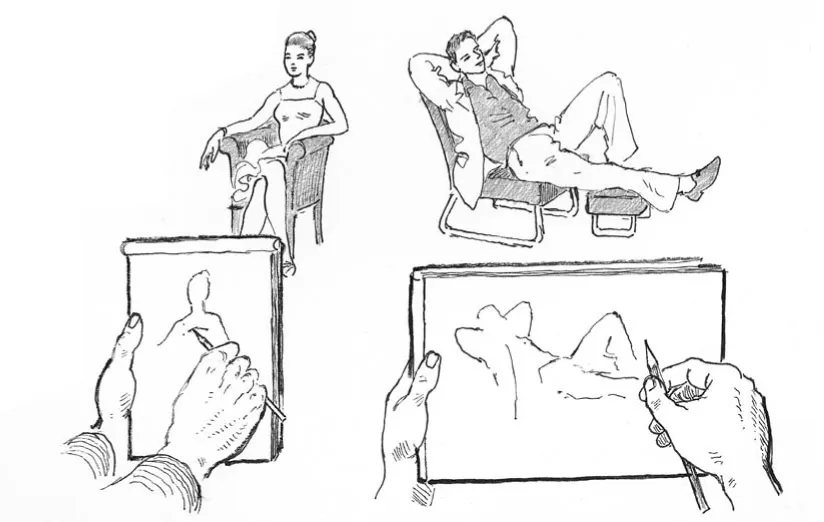
When you make sketches of things, people and places, you will need to draw them from several viewpoints to become really familiar with them. And don’t forget to include as many details as you can, because this information is often useful later on.

MEASURING AND FRAMING
There are ways of measuring the subjects of your drawings and this one is called ‘sight size’ drawing, where you reproduce everything the size that it appears to you from your point of view. This system is very useful where you have a large area to draw, however it is often difficult to correct when you go wrong because the difference between the correct and the incorrect marks on the paper can be very small.
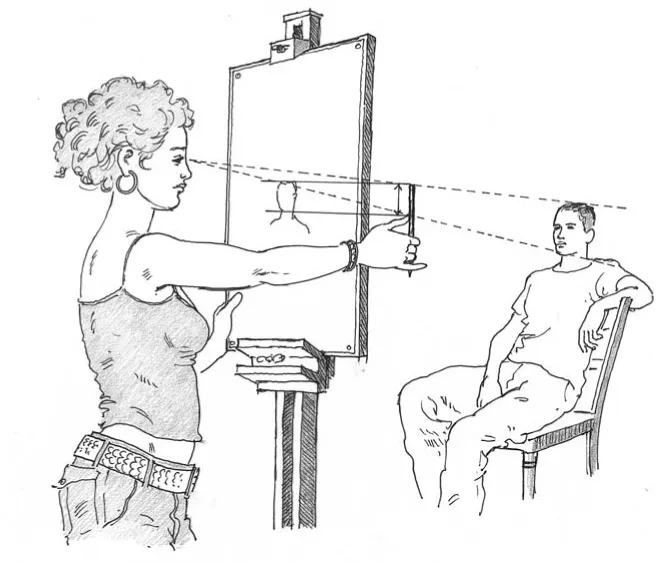
When portraying smaller subjects take measurements to get the proportions right, but draw the item up larger in order to make correction easier. It is most important to correct your drawings rigorously in order to learn to draw well. It doesn’t matter if the final work looks a bit of a mess, the habit of continual correcting will lead you to draw much better as you go on. One day you will get it right.
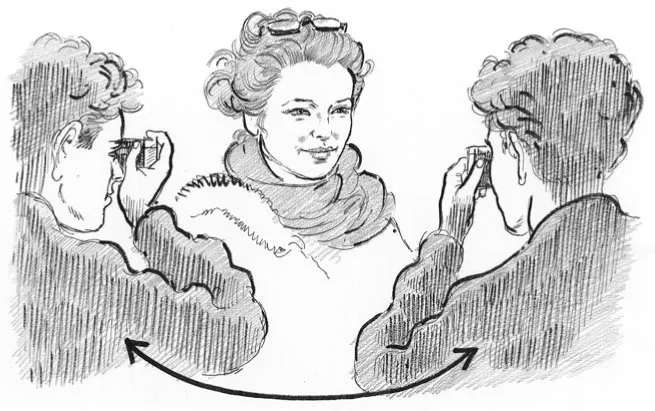
If, for some reason, you cannot find the time to draw your subject, or even if you can, it is always a good idea to take photographs as well, to supplement your sketches. The information you require to work further on your drawings cannot be too detailed. And don’t forget to take the subject from more than one angle, exactly as you would if you were sketching it.
Another thing that you should consider before deciding on your finished piece, is whether your composition is to be a vertical (‘portrait’) or horizontal (‘landscape’) picture. Make sure you try out both possibilities before you get too involved.
A framing device is very useful and often helps towards the better composition of the drawing that you are about to work on. From any small sheet of paper or card, cut out a rectangle that seems roughly the same proportion as your working surface. Then you can hold it up to your eye and view the subject matter through it. This will give you some idea of how your drawing should look on the paper. And it also eliminates ...
Table of contents
- Cover
- Title
- Contents
- Introduction
- Chapter 1 Basic Mark Making
- Chapter 2 Drawing Objects and Still Life
- Chapter 3 Materiality, Lighting and Perspective
- Chapter 4 The Natural World
- Chapter 5 Life Drawing – The Human Figure
- Chapter 6 Geometry in Composition
- Chapter 7 Setting up a Landscape
- Chapter 8 Setting up a Still Life
- Chapter 9 Setting up a Portrait
- Chapter 10 Setting Up a Figure Drawing
- Chapter 11 Learning From the Past
- Chapter 12 Styles and Influences
- Index
- Copyright
Frequently asked questions
Yes, you can cancel anytime from the Subscription tab in your account settings on the Perlego website. Your subscription will stay active until the end of your current billing period. Learn how to cancel your subscription
No, books cannot be downloaded as external files, such as PDFs, for use outside of Perlego. However, you can download books within the Perlego app for offline reading on mobile or tablet. Learn how to download books offline
Perlego offers two plans: Essential and Complete
- Essential is ideal for learners and professionals who enjoy exploring a wide range of subjects. Access the Essential Library with 800,000+ trusted titles and best-sellers across business, personal growth, and the humanities. Includes unlimited reading time and Standard Read Aloud voice.
- Complete: Perfect for advanced learners and researchers needing full, unrestricted access. Unlock 1.5M+ books across hundreds of subjects, including academic and specialized titles. The Complete Plan also includes advanced features like Premium Read Aloud and Research Assistant.
We are an online textbook subscription service, where you can get access to an entire online library for less than the price of a single book per month. With over 1.5 million books across 990+ topics, we’ve got you covered! Learn about our mission
Look out for the read-aloud symbol on your next book to see if you can listen to it. The read-aloud tool reads text aloud for you, highlighting the text as it is being read. You can pause it, speed it up and slow it down. Learn more about Read Aloud
Yes! You can use the Perlego app on both iOS and Android devices to read anytime, anywhere — even offline. Perfect for commutes or when you’re on the go.
Please note we cannot support devices running on iOS 13 and Android 7 or earlier. Learn more about using the app
Please note we cannot support devices running on iOS 13 and Android 7 or earlier. Learn more about using the app
Yes, you can access The Complete Introduction to Drawing by Barrington Barber in PDF and/or ePUB format, as well as other popular books in Arte & Arte generale. We have over 1.5 million books available in our catalogue for you to explore.