This book traces the history of the world's great religions from their foundation to the present day. Their development is shown in interesting visuals - such as maps and photographs - as well as informative yet concise text. Also included are short biographies of major figures, statistics, calendars of festivals and timelines.
The religions included are: Buddhism, Christianity, Hinduism, Islam, Judaism and Sikhism.
- English
- ePUB (mobile friendly)
- Available on iOS & Android
eBook - ePub
About this book
Trusted by 375,005 students
Access to over 1.5 million titles for a fair monthly price.
Study more efficiently using our study tools.
Information
Topic
Theology & ReligionSubtopic
ReligionCHAPTER 1
JUDAISM
JUDAISM is not just a religion. The Jewish people are an ethnic group: everyone who has a Jewish mother is considered Jewish, whether they practise the religion or not. Consequently, the history of the Jewish religion is also the history of the Jewish people. Jews believe they are descended from a tribe of people that lived in the ancient land of Canaan, which encompasses most of modern Israel, Palestine, Jordan and Syria. The story of the origins of the Jews, who were also known as Israelites or Hebrews in ancient times, is found in the Torah, a sacred text containing the first five books of the Bible. According to the first book, Genesis, the original ancestor of the Jewish people was a man called Abraham.

Abraham and the Israelites In around 1800 BCE, Abraham and his clan left Ur in Mesopotamia (modern-day Iraq) and travelled to Canaan. Abraham had a son, Isaac, who in turn fathered Jacob. Jacob’s twelve sons founded the twelve tribes of Israel. Owing to a severe famine in Canaan, some of the tribes settled in Egypt, where they were enslaved. Several generations later, according to the Book of Exodus, a great leader called Moses led the Israelites out of slavery and to freedom in Canaan.
There is some archaeological evidence for the biblical account of Abraham’s migration. Between 2000 and 1500 BCE, a nomadic group called the Amorites invaded Mesopotamia, which led to the decline of Ur. This may have prompted Abraham’s departure from the region. Scholars disagree about the flight from Egypt to Canaan, however. While some believe that the Israelites left Egypt in one mass migration, as stated in the Bible, others argue that a more gradual settlement of Canaan was more likely.
The mitzvoth and the Halacha The Israelites gradually formed one nation with a set of strong religious principles. They were united by their belief in an all-powerful God who created the universe. They believed that Moses received the Torah directly from God and that the Israelites had a covenant with God: God would look after them if they followed the mitzvoth (commandments) in the Torah.
The mitzvoth lay down the rules of behaviour for all areas of Jewish religious and daily life. For example, Jews must eat kosher food – food that has been prepared so that it is suitable under Jewish law. Jews must also keep Shabbat, or the Sabbath, as a day of prayer and rest. God also gave Moses the Halacha, the oral Torah, which explained how the commandments were to be kept. The Halacha was handed down the generations by word of mouth.
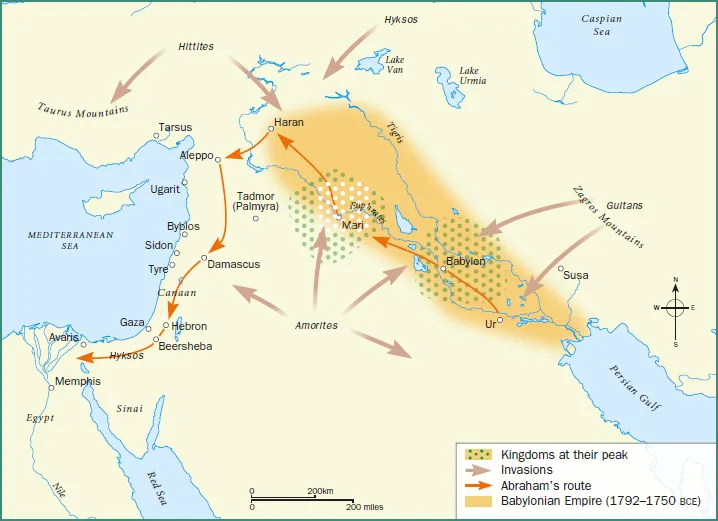
This map shows the emergence of the Jewish people between around 2000 and 1000 BCE. According to the Bible, Abraham, Isaac and Jacob lived in Beersheba, in modern-day southern Israel.
The kingdom of Israel The Torah describes how the twelve Israelite tribes in Canaan were ruled by councils of elders in peacetime. During wartime, each tribe was led by a judge, who was a tribal chieftain. Many wars were fought. The most powerful enemies of the Israelites were the Philistines, who had established themselves in the southern coastal plain of Canaan by the end of the 11th century BCE. They frequently attacked the Israelite tribes. As separate tribes, the Israelites proved too weak to repel the Philistine threat. They eventually united into one kingdom, the kingdom of Israel.
HEBRON, HOLY CITY
According to Genesis, Abraham’s wife Sarah died in Hebron.
Abraham purchased a cave and the surrounding field as a burial place for her. The tomb is also believed to be the burial place of Abraham, Isaac, Jacob and their wives (except for Jacob’s wife Rachel, who was buried near Bethlehem). The site, near the modern city of Hebron in the West Bank, is holy to Jews, Christians and Muslims, who all see Abraham as their ancestor.
So Ephron’s field in Machpelah near Mamre – both the field and the cave in it, and all the trees within the borders of the field – was legally made over to Abraham as his property in the presence of all the Hittites [a local clan] who had come to the gate of the city. Afterwards Abraham buried his wife Sarah in the cave in the field of Machpelah near Mamre (which is at Hebron) in the land of Canaan.
Genesis 23:17–19
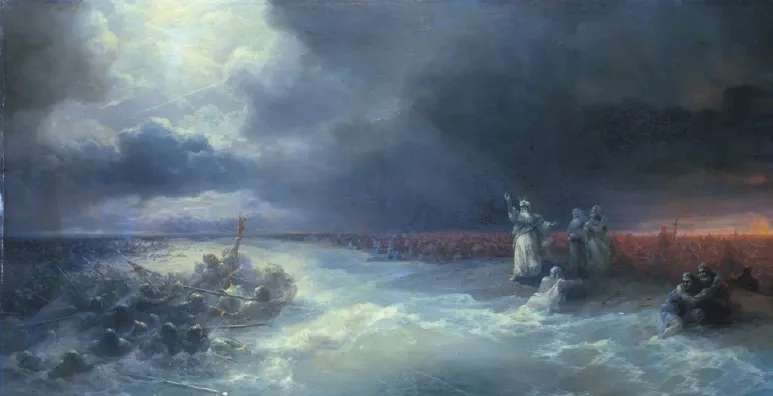
According to the Book of Exodus, Moses parted the waves of the sea so that the Israelites could escape from Egypt.
The Israelites under the kings The kingdom of Israel lasted from around 1000 BCE to 586 BCE. The first king was Saul, who defeated many enemies and checked the advance of the Philistines. Saul was succeeded by David, who crushed the Philistines and conquered the city of Jerusalem, which he made his capital. Jerusalem became the spiritual focus of the Jewish religion. David’s successor, Solomon, created a powerful kingdom and brought peace and prosperity. He built fortified towns and the magnificent First Temple in Jerusalem.
Despite having a reputation for wisdom, Solomon sowed the seeds of division in the kingdom, for example, by taxing all the tribes except his own tribe of Judah. After his death in 928 BCE, the northern tribes rebelled and set up their own kingdom, named Israel, while the southern tribes stayed loyal to Solomon’s son and established the kingdom of Judah.
This description of Solomon’s kingdom at its height is from the Bible:
Judah and Israel were many, as the sand which is by the sea, in multitude, eating and drinking, and making merry. And Solomon reigned over all kingdoms from the river [Euphrates] unto the land of the Philistines, and unto the border of Egypt: they brought presents, and served Solomon all the days of his life…. For he had dominion over all the region on this side of the river … and he had peace on all sides around him…. And Solomon’s wisdom excelled all the wisdom of all the children of the east country, and all the wisdom of Egypt … and his fame was in all nations round about.
1 Kings 4:20–31
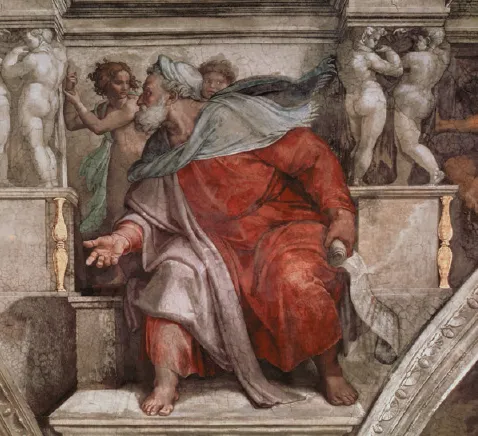
This detail from a fresco by Michelangelo in the Sistine Chapel in Rome depicts the Prophet Ezekiel. Ezekiel was one of the Israelites exiled to Babylonia after the Babylonians conquered Judah in 586 BCE. He prophesised that the Israelites would return to their homeland.
Destruction of the kingdoms In 722 BCE, the Assyrians (from Mesopotamia) captured Samaria, the capital of Israel. Israel was absorbed into the Assyrian Empire and its population was deported to Mesopotamia. The exiled people became known as the ten lost tribes of Israel. During the following century, the Assyrian Empire declined, and Babylon, a city in Mesopotamia, grew stronger. In 586 BCE, the Babylonians conquered Jerusalem, destroyed Solomon’s Temple and ended the kingdom of Judah. The Israelites were captured or sent into exile in Babylon, where they formed an organized community and preserved their Jewish identity.
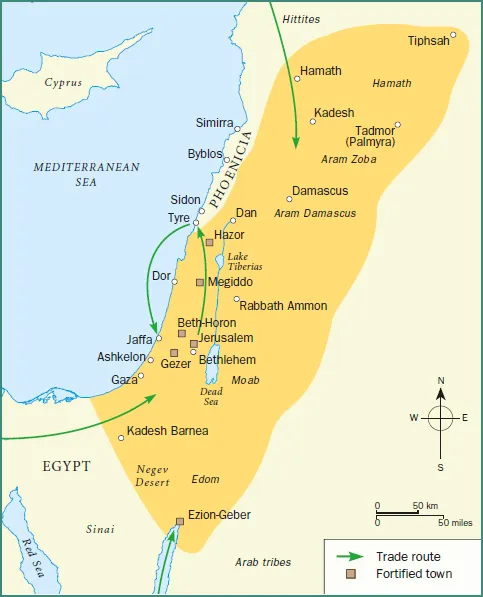
The shaded area of this map shows the kingdom of Israel under King Solomon in around 970–928 BCE. King Solomon built the fortified towns, including Megiddo, Hazor, Gezer and Beth-Horon, to withstand sieges and protect his kingdom. Under his rule, trade with neighbouring lands increased.
Under the Persian Empire In 538 BCE, King Cyrus the Great of Persia (modern-day Iran) conquered Babylonia (southern Mesopotamia). He allowed all the people exiled by the Babylonians to return to their homelands, including the Jews. Most Jews chose to stay in Babylon, where they are thought to have enjoyed a fairly prosperous life. Around 50,000 Jews returned, in several waves, to Jerusalem. They rebuilt the city and, in 516 BCE, began reconstructing the Temple.
There was friction between the returning Israelites and those who had remained. The returning exiles found that the Jews in Jerusalem had become lax – they were not following the Torah laws and many had married non-Jews. Around the fifth century BCE, the religious leaders Ezra and Nehemiah reinstated Jewish law in Judah. The Jews renewed their covenant with God, vowing not to work on the Sabbath, to pay a tax to support the Temple and not to marry non-Jews.
Hellenism The next major upheaval in the fortunes of the Israelites occurred when Alexander the Great defeated the Persians in 333 BCE, then conquered Judah the following year. Alexander was from Macedonia in northern Greece, and he and his successors promoted Greek culture within their empire. Many Jews became attracted to Hellenic ways. They started to speak Greek and abandoned their traditions. Hostility developed between Hellenist and traditional Jews.
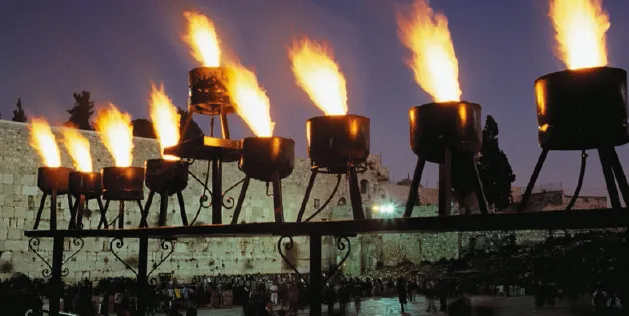
A hanukiah (nine-branched candlestick) at the Western Wall in Jerusalem, lit for the festival of Hanukkah, which celebrates the restoration of the Jewish Temple in 164 BCE.
The Maccabees The tensions between Greek and Jewish traditions led to a revolt in the second century BCE. At this time, the Seleucid kings (descended from Alexander the Great’s general Seleucus) dominated Judah, and tried to Hellenize Jerusalem. Between 175 and 163 BCE, Seleucid king Antiochus IV robbed the Temple, banned the Jewish practice of circumcision and forbade Jews from observing the Sabbath and reading the Torah. Antiochus announced that the Temple would be rededicated to the Greek god Zeus, and that animals – including pigs, which were considered unclean by Jews – would be sacrificed there. Led by Judah the Maccabee, the Jews rebelled. In 164 BCE, they recaptured Jerusalem and restored the Temple, an event celebrated at the festival of Hanukkah. Judah’s family, the Hasmoneans, founded a dynasty that ruled for the following one hundred years.
The Romans In 63 BCE, the Romans conquered the land of Israel. At first they allowed the Hasmoneans to continue to rule in Judah. However, in 37 BCE, Herod, whom the Romans had appointed king of Judea (the Roman name for Judah) three years earlier, laid siege to Jerusalem and destroyed the Hasmonean dynasty. He executed many Jewish leaders who had been loyal to the Hasmoneans. Although Herod rebuilt the Temple in Jerusalem, he was still hated as a cruel foreign ruler.
In 6 CE, Judea came under direct Roman rule. Between 66 and 73 CE, Jewish rebel groups fought the Roman authorities. In 70 CE, the Romans regained control over Jerusalem, and burned down the Second Temple (which had replaced the first). All that remained was the Western Wall.
A final Jewish revolt led by Simon Bar Kochba in 132 CE drove the Romans out of Jerusalem. But in 135 CE, they reconquered the city and enslaved its population. By this time, most of the Jews had left Judea, which the Romans had renamed Palestine. They had dispersed to different lands in what became known as the diaspora, a Greek word meaning ‘scattering’.
Judaism after the Temple The destruction of the Temple was a disaster for the Jewish people. They lost the central focus of their religious practice. Yet wherever Jewish people went, they maintained their traditions. After the fall of Jerusalem in 70 CE, a group of scholars living in Yavneh, in modern-day central Israel, re-established the Sanhedrin. Formerly in Jerusalem, this was the supreme Jewish legal and religious council for Palestine and the diaspora. The scholars began to develop a Jewish legal tradition. Scholars called rabbis interpreted the Torah and the Halacha. Many of the old Temple r...
Table of contents
- Cover Page
- Title Page
- Copyright
- Contents
- Introduction The Roots of Faith
- Chapter 1 : Judaism
- Chapter 2 : Christianity
- Chapter 3 : Islam
- Chapter 4 : Hinduism
- Chapter 5 : Buddhism
- Chapter 6 : Sikhism
- Timeline
- Index
- Back Cover
Frequently asked questions
Yes, you can cancel anytime from the Subscription tab in your account settings on the Perlego website. Your subscription will stay active until the end of your current billing period. Learn how to cancel your subscription
No, books cannot be downloaded as external files, such as PDFs, for use outside of Perlego. However, you can download books within the Perlego app for offline reading on mobile or tablet. Learn how to download books offline
Perlego offers two plans: Essential and Complete
- Essential is ideal for learners and professionals who enjoy exploring a wide range of subjects. Access the Essential Library with 800,000+ trusted titles and best-sellers across business, personal growth, and the humanities. Includes unlimited reading time and Standard Read Aloud voice.
- Complete: Perfect for advanced learners and researchers needing full, unrestricted access. Unlock 1.5M+ books across hundreds of subjects, including academic and specialized titles. The Complete Plan also includes advanced features like Premium Read Aloud and Research Assistant.
We are an online textbook subscription service, where you can get access to an entire online library for less than the price of a single book per month. With over 1.5 million books across 990+ topics, we’ve got you covered! Learn about our mission
Look out for the read-aloud symbol on your next book to see if you can listen to it. The read-aloud tool reads text aloud for you, highlighting the text as it is being read. You can pause it, speed it up and slow it down. Learn more about Read Aloud
Yes! You can use the Perlego app on both iOS and Android devices to read anytime, anywhere — even offline. Perfect for commutes or when you’re on the go.
Please note we cannot support devices running on iOS 13 and Android 7 or earlier. Learn more about using the app
Please note we cannot support devices running on iOS 13 and Android 7 or earlier. Learn more about using the app
Yes, you can access The Story of Religion by John Hawkins in PDF and/or ePUB format, as well as other popular books in Theology & Religion & Religion. We have over 1.5 million books available in our catalogue for you to explore.