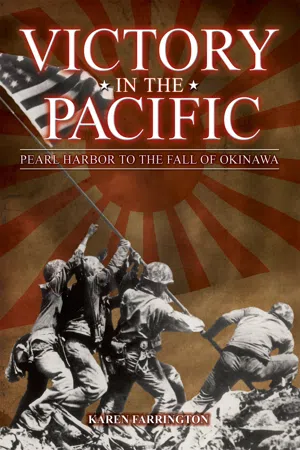
- English
- ePUB (mobile friendly)
- Available on iOS & Android
eBook - ePub
About this book
On 7 December 1941, the Japanese navy attacked Pearl Harbour. Simultaneously, they launched all-out assaults on Malaya, Hong Kong and the Philippines. Japan's sphere of influence spread at a phenomenal rates and it seemed the their dream of empire was about to be realized. Featuring remarkable photographs and useful maps, Victory in the Pacific examines how the tide of Japanese victory was turned. Following pivotal battles such as the Battle of Guadalcanal, the Battle of Leyte Gulf and the Battle of the Coral Sea, Karen Farrington describes and how the Allies fought their way the length and breadth of Burma and from island to island on their way to achieving final victory in the East.
Information
CHAPTER ONE
The Coral Sea and Midway
Had the Battle of Midway gone the other way, America’s Pacific war would have been considerably prolonged.
For Winston Churchill, the news of America’s entry into the war was all good and he was flooded with a sense of relief and well-being. On 9 February 1941 he had appealed for American help with the words ‘give us the tools and we will finish the job’. In reality Britain was already under great strain – as was Churchill himself – and victory was far from assured. His nightmare scenario was that Japan would attack British and perhaps Dutch interests in the Pacific region and still the US would stay out of the conflict. He strongly felt that ‘the great crescent’ of colonial possessions in the Far East – between India, Burma and Singapore – belonged firmly inside the boundaries of the British empire. Churchill was aware that American intervention would secure a triumph, given its immense industrial output and seemingly inexhaustible supply of men. He embarked for a meeting with Roosevelt in Washington on 12 December with his tail up in the knowledge that, with diplomatic issues simplified and mostly resolved, America was in the war ‘up to the neck and in to the death’. They had declared war on Japan almost in unison and together Britain and the States would tackle the militarist menace of the east.
Since 27 September 1940 Japan had been in the Tripartite Agreement with Hitler and Mussolini, an agreement which now bound the fate of those three countries. It ruled that the signatories recognized each other’s plans for expansion and would come to the aid of one another if attacked. Hitler made his second catastrophic mistake of 1941 when he declared war on the US as a perverse gesture of support for Japan. (His first immense error of judgement was to invade Russia in June that year.)
Japan continued to make itself aggressively busy at various Pacific pit stops during the ensuing weeks while America took a few moments to analyse its position. Until some of the resources lost at Pearl Harbor were replaced it would be severely restricted in its activities, fighting defensive or delaying actions rather than going on the offensive. And despite a seemingly ceaseless string of Japanese success stories, the Allied Combined Chiefs of Staff decided the war against Germany had to be given priority. Roosevelt said: ‘Germany is the greater enemy; once we’ve defeated Germany we shall be able to deal with Japan.’ Once that important decision was made it was never up for negotiation. Britain’s anxieties about the fate of India, a cash cow for the empire, were noted by the Americans, but the defence of the subcontinent was not made a priority. The Americans, never great sympathizers with imperial aims other than their own, believed pure self interest was driving Britain’s concerns. Six US field armies were sent to Europe compared to three – the Sixth, the Eighth and the Tenth – that were destined for the Pacific.
US Resolve
There was, however, a strong resolve in the US navy that matters were in hand in the Pacific to combat the spiralling influence of the Japanese. There was a part to be played by Allied forces too, particularly the Australians and New Zealanders in the arena. However, the weight of numbers came out of the United States of America and consequently it was largely left to call the shots.
American commanders were Fleet Admiral Ernest King, who made it his business to funnel as much military hardware into the Pacific as possible despite the priority given to Europe and the Atlantic, Admiral Chester Nimitz and General Douglas MacArthur, Commander in Chief of the South West Pacific Area, based in Melbourne, Australia.
In common with the armed services of other nations involved in the conflicts, there was competition between the US army and navy for territory and influence. In the vast waters of the Pacific there were no great swathes of land to conquer as there were in Europe and little need for heavily-armed ground forces, putting the army at an immediate disadvantage. Thus, the start of World War II as far as the Americans were concerned was very much a naval affair, with the ships complemented for the first time by carrier-borne aircraft. Only later did the emphasis switch to amphibious assault.
The Doolittle Raid
In the spring of 1942 America began to exercise its muscle with raids by planes based on aircraft carriers against the Gilbert and Marshall Islands. This inspired sufficient confidence for the Doolittle raid to take place against the Japanese mainland, the most daring exploit by the Americans in the war to that date.
On 18 April, 16 B-25 bombers from the Army Air Corps under the command of Lieutenant Colonel James Doolittle, each carrying one ton of bombs and ferried into the Pacific by the USS Hornet, set out for Japan, some 600 miles distant.
Later mission commander and pilot Doolittle explained the intention of the raid: ‘It had three real purposes. One purpose was to give the folks at home the first good news that we’d had in World War II. It caused the Japanese to question their warlord. And, from a tactical point of view, it caused the retention of aircraft in Japan for the defence of the home island when we had no intention of hitting them again seriously in the near future. Those planes would have been much more effective in the South Pacific where the war was going on.’
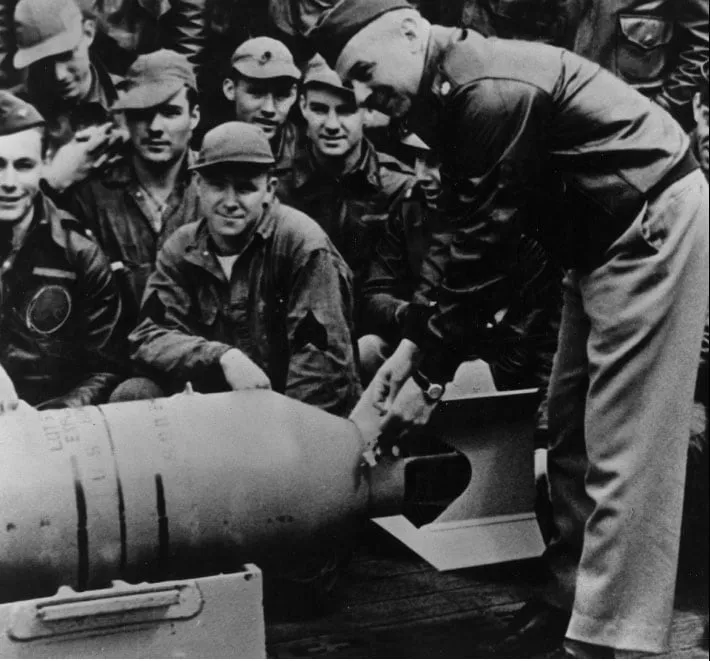
Bombs Away: Lieutenant Colonel James H. Doolittle, of the US Army Air Force, wires a Japanese medal to a 500-pound bomb, shortly before his force of sixteen B-25B bombers took off for Japan on what became known as the Doolittle Raid, 18 April 1942.
Doolittle had carved a reputation for himself by teaching aerial combat tactics during World War One. He returned to the air corps in 1940 when it seemed war was imminent, helping to convert the car manufacturing facilities in the States to military production. The science of aerial warfare had changed but Doolittle proved himself up to the challenge by embracing the task of mounting a raid on Japan. Training had been rigorous. Although the aircraft carrier was in many ways ideal for the task, the pilots had to practice take off on a ship’s runway nearly half the size previously used.
Hopes that the ship could spring the planes from a point even closer to their target were dashed when the aircraft carrier unexpectedly encountered Japanese patrol boats en route. The small boats were duly sunk – but not before warnings had been radioed back about the approaching American force.
Rather than abandon the raid, it was brought forward, in the hope of preempting a Japanese response to the presence of the Hornet. The cities hit included Tokyo, Kobe and Yokohama. The intention was then to fly towards China, at war with Japan for some five years already and now benefiting from US aid. But now the pilots were wrestling with fuel shortages caused by their fast start. One of the planes came down near Vladivostock and its crew was jailed by the surprised Russians who were not yet at war with Japan. Two planes and eight men fell into Japanese hands. All were made prisoners of war, with three ultimately being shot. Two men drowned after their plane came down in the sea. However, a hearteningly large percentage of the crew survived, although some suffered serious injuries, among them Ted Lawson, who lost a leg. Within the year he would collaborate on a book about the raid that was quickly made into a film called 30 Seconds Over Tokyo.

Battle of the Coral Sea: Japanese aircraft carrier Shoho is torpedoed by US Navy carrier aircraft in the late morning of 7 May 1942, during the Battle of the Coral Sea.
Although damage in Japan was comparatively slight the embarrassment factor for the country’s high command was indeed huge as it no longer seemed bombproof as previously believed by the populace. No one was expecting the home islands to be hit – at least, not so soon in the conflict.
Until then the Japanese were at odds about the direction in which to channel their war efforts. One faction favoured pressing west towards Fiji and Samoa while another believed the key to success was a drive northwards into Russia. For his part, Yamamoto was insistent that the Midway Islands were the essential ‘pin prick’ landfalls that were pivotal to Japanese success in the war. His cause was assisted immeasurably following the Doolittle raid as a sense of urgency about the need to destroy US naval might now prevailed.
The Battle of the Coral Sea
The first stand-off between Japanese and US navies occurred at the Battle of the Coral Sea on 7 and 8 May 1942, the first of six key battles between the two. It took place in the waters that are bordered by the Solomon Islands, Papua New Guinea, Australia and, to the south, New Caledonia.
Through diligent monitoring of enemy communications, the Americans discovered a plan to capture Port Moresby, on New Guinea’s south eastern coast and troublingly close to Australia. (As if to confirm their intentions, the Japanese carried out a limited number of small raids against the northern coast of Australia.)
The upshot was a long-distance confrontation between the Japanese aircraft carriers Shokaku and Zuikaku, and their assorted escort craft, and the USS Lexington and the USS Yorktown, also with support craft including some from Australia. Although the action was crucial the major craft on both sides never came closer than 70 miles to one another and were generally much further apart than that. It was carrier-borne aircraft that were key. Sea battles had never been fought like this before, with the ships failing to exchange a shot. This fact, coupled with a lack of exact intelligence on the precise whereabouts of the prize enemy targets, led to the sinking of secondary vessels in great numbers.
On 7 May 1942 Japanese spy planes reported that a carrier and a cruiser were at a certain location and a substantial force of attack planes was dispatched to deal with them. In fact, it was a US oil cargo ship and an escorting destroyer. Both were wrecked by enemy action.
In turn America dished out similar treatment to a light carrier, Shoho, and four cruisers. While all were targeted by a volley of bomber and fighter planes they were in fact second rate objectives. The Japanese, however, had no idea where the American planes had come from.
The following day the serious business of aircraft carrier destruction got underway. Almost simultaneously each side’s planes attacked the other’s water-borne targets. If the action was to be judged in terms of winners and losers then the Japanese edged a marginal victory. The American aircraft carrier Lexington was torpedoed and bombed and after being abandoned by the crew she sank the same day. Yorktown was also badly damaged and had to withdraw. In reply American planes wreaked sufficient damage on Shokaku to ensure her departure for safer waters. Many more Japanese aircraft were lost than American. But benefiting from low cloud cover, the Zuikaku was undamaged. However, over-extended Japan was in no position to capitalize on these small gains and their forward movement had been halted. Its navy, although undefeated, had pulled out of a battle and that was by itself a boost for the Americans and their allies.

Dauntless: Dauntless dive bombers from USS Hornet approaching the already fatally-damaged Japanese heavy cruiser Mikuma in the third set of attacks on her, during the early afternoon of 6 June 1942.
The Battle of Midway
A month later came the Battl...
Table of contents
- Cover
- Title
- Contents
- Prologue
- Chapter One: The Coral Sea and Midway
- Chapter Two: Guadalcanal
- Chapter Three: New Guinea
- Chapter Four: Retreat and Reorganization
- Chapter Five: The Arakan Campaign
- Chapter Six: The Chindits
- Chapter Seven: The Gilbert and Marshall Islands
- Chapter Eight: The Marianas
- Chapter Nine: The Battle of Leyte Gulf
- Chapter Ten: Kohima and Imphal
- Chapter Eleven: Through the Central Hills
- Chapter Twelve: Recapturing Rangoon
- Chapter Thirteen: Iwo Jima and Okinawa
- Chapter Fourteen: Little Boy and Fat Man
- Chapter Fifteen: Surrender
- Copyright
Frequently asked questions
Yes, you can cancel anytime from the Subscription tab in your account settings on the Perlego website. Your subscription will stay active until the end of your current billing period. Learn how to cancel your subscription
No, books cannot be downloaded as external files, such as PDFs, for use outside of Perlego. However, you can download books within the Perlego app for offline reading on mobile or tablet. Learn how to download books offline
Perlego offers two plans: Essential and Complete
- Essential is ideal for learners and professionals who enjoy exploring a wide range of subjects. Access the Essential Library with 800,000+ trusted titles and best-sellers across business, personal growth, and the humanities. Includes unlimited reading time and Standard Read Aloud voice.
- Complete: Perfect for advanced learners and researchers needing full, unrestricted access. Unlock 1.4M+ books across hundreds of subjects, including academic and specialized titles. The Complete Plan also includes advanced features like Premium Read Aloud and Research Assistant.
We are an online textbook subscription service, where you can get access to an entire online library for less than the price of a single book per month. With over 1 million books across 990+ topics, we’ve got you covered! Learn about our mission
Look out for the read-aloud symbol on your next book to see if you can listen to it. The read-aloud tool reads text aloud for you, highlighting the text as it is being read. You can pause it, speed it up and slow it down. Learn more about Read Aloud
Yes! You can use the Perlego app on both iOS and Android devices to read anytime, anywhere — even offline. Perfect for commutes or when you’re on the go.
Please note we cannot support devices running on iOS 13 and Android 7 or earlier. Learn more about using the app
Please note we cannot support devices running on iOS 13 and Android 7 or earlier. Learn more about using the app
Yes, you can access Victory in the Pacific by Karen Farrington in PDF and/or ePUB format, as well as other popular books in History & World War II. We have over one million books available in our catalogue for you to explore.