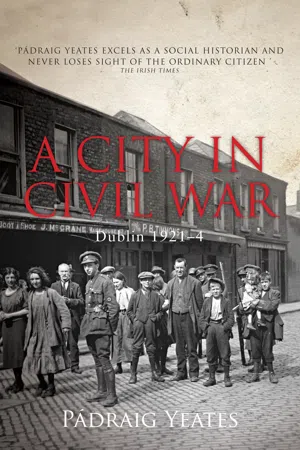
The long-awaited concluding volume of Pádraig Yeates' 'Dublin at War' trilogy In A City in Civil War: Dublin 1921–1924, acclaimed historian Pádraig Yeates turns his attention to Ireland's bloody and hard-fought Civil War and its impact on the capital city and its inhabitants.The fascinating A City in Civil War tells the story of Dublin's troubled passage to independence amidst the acrimony and upheaval of the Civil War, a period in which Dublin became the capital city of an independent Irish state for the first time.Once again, conflict raged on Dublin's streets, but this time the combatants were Irishmen – neighbours, friends, families – fighting each other. For a great many Dubliners, life remained a cycle of grinding poverty, but for many southern Unionists, ex-servicemen and anti-Treaty republicans, the city became a hostile environment. And all the while, the Catholic Church strengthened its grip on Irish cultural life, supplying many of the vital social services an embattled government was too poor and too preoccupied to provide its citizens.In his distinctive and engaging style, Pádraig Yeates uncovers unknown and neglected aspects of the Irish Civil War in the capital and their impact on the rest of the country. 'Pádraig Yeates excels as a social historian and never loses sight of the ordinary citizen.' The Irish Times 'A powerful social history … reminds us that for all the headline grabbing events, putting bread on the table was still the most important priority for most' Professor Diarmaid Ferriter, The Irish Independent 'Reminds the reader of how daily life went on side by side with the great events of history. In short, this is an excellent addition to the current literature.' Irish Literary Supplement
Trusted by 375,005 students
Access to over 1.5 million titles for a fair monthly price.
‘IT WOULD BE ONLY … RUSSIA WHERE A WOMAN WHO SERVED HER KING WOULD BE ALLOWED TO DROP TO SUCH AN EXISTENCE’
Dublin suffered from a severe shortage of good-quality hotels in the summer of 1921. Hardly had the Truce between the Irish and British forces been declared on 11 July than public attention was directed to the demands of peace. ‘One of the effects of the war and the rebellion of 1916 has been to put out of action eleven city hotels …’ the Irish Times commented. ‘All of these were catering for the public in 1913, the year of the last pre-war Horse Show.’ The Horse Show was to be resurrected in all its former glory at the Royal Dublin Society grounds in three weeks’ time, and crowds of visitors were expected not alone from all parts of Ireland but from Britain and the Continent.
The newspaper called for the ‘living-in’ quarters of workers in shops, warehouses and pubs to be converted into temporary hotel rooms. It urged the owners of ‘large, well furnished, houses to let them advantageously in view of the pleasant prospect that presents itself.’ The city’s leading draper, Edward Lee, was commended for his enterprise in establishing the Avenue Hotel in Kingstown (Dún Laoghaire) to meet expected demand, for ‘a little enterprise and foresight now would mean much in attracting people to the city.’
The sudden concern of the Irish Times that the city should look its best was born of the ‘optimism prevalent everywhere … since the political truce began and hopes are high that Dublin will regain some of its former glory as the Irish capital.’ Only the previous day the President of the Irish Republic, Éamon de Valera, had arrived in London for talks with the British Prime Minister, David Lloyd George, to be met by rapturous crowds of London-Irish. For the vast majority of Irish people at home, relief at an end to the fighting had transformed itself into a belief that peace was imminent.
Still fixated on the Horse Show, the Irish Times leader mused that ‘three weeks hence the Royal Dublin Society will open its gates at Ballsbridge to all and sundry. The London Conference may not have come to an end by that time, but in all probability the issue will have ceased to be in doubt.’ It looked forward to the ‘large amount of money’ that would be spent in Dublin ‘to compensate our traders for some of the losses of the dismal period of Civil War.’1 That the Irish Times could characterise the conflict as a civil war while many of the combatants saw it as a war of independence suggested that the gap was wider than the newspaper’s leader-writer realised.
Meanwhile, authorisation of a return to normal train schedules by the military on the day before the editorial was published, and the lifting of restrictions on the use of motor transport on the day of publication, reinforced the impression that the years of conflict were over. Work was nearing completion on the restoration of the southern half of O’Connell Street, destroyed during the 1916 Rising, and new wage rates were struck for the building trade to usher in an era of industrial peace. Craftsmen could expect to earn between 1s 10d and 2s 2d an hour, while labourers were entitled to at least three-quarters of the relevant craft rate. These were vast increases on the old pre-lockout rates of 1913, when a craft worker might earn 6s a day and a labourer 3s 4d.
The physical regeneration of the city extended to ‘some talk in Municipal circles regarding the erection of a new City Hall which would afford accommodation for all Corporation departments and staff, and also a large public hall for the use of citizens.’ This was a pipe dream, given the parlous state of the finances of Dublin Corporation (as Dublin City Council was called at the time). In fact a political settlement offered ‘the only hope of escape from the crushing burden of compensation for malicious injuries’ imposed as a collective punishment on the community for rebel activities.2 It is unlikely that there would have been any discussion at all about building a new City Hall if the British army had not remained in occupation of the old one, along with adjoining Corporation offices in Castle Street.
Nor did the early release of a handful of leading Republicans, such as Alderman Michael Staines, a member of the Dáil for St Michan’s constituency, herald an end to the troubles.3 Staines was despatched immediately to Galway to act as an IRA liaison officer with British forces in the west. Another Dublin deputy, Éamonn Duggan, acted as chief liaison officer for Ireland and for the capital.4 Meanwhile almost 4,500 IRA suspects remained in internment camps, including more than a thousand Dubliners, among them the Corporation’s secretary, the veteran Fenian Fred Allan. There were another 1,600 convicted Republican prisoners. All were hostages to fortune and the peace process.
——
An ominous sign that peace was far from imminent was the fact that prisoners arrested immediately before the Truce were still being processed through the courts-martial system. The terms of the Truce had specifically left this issue for resolution at a later date.5 In Dublin eight men tried by military courts in the days after the Truce came into effect faced the death penalty for being arrested in possession of weapons or being in the company of armed men, while two more were charged with the attempted murder of a military police sergeant. Most of those arrested refused to recognise the jurisdiction of the court. These included James Doyle of 263 Clonliffe Road, arrested on 2 July with a revolver and fourteen rounds of ammunition, as well as three men arrested on 21 June in South Richmond Street by a patrol of Auxiliaries. John Aloysius Haslam was charged with carrying a loaded Smith and Wesson revolver, James Cluskey had a grenade, and Martin Haugh carried nothing and at first denied to the patrol that he knew his companions; but when he appeared with them before the military court he sealed his fate by refusing to recognise the proceedings.
On 2 July, John O’Connor was arrested in Great Britain Street (Parnell Street) with an unloaded revolver. While he declined to recognise the court or to defend himself, he did offer evidence in support of Michael Kerrigan, who had the misfortune to bump into him when a military patrol arrived on the scene. Kerrigan recognised the court, was carrying neither a weapon nor ammunition and had no known political affiliations. Nevertheless he too now faced the prospect of the gallows.
Two men, Robert Butler and John Richmond Church, were charged with the attempted murder of a sergeant in the Royal Garrison Artillery on the night of 18/19 April. The sergeant was not identified in court, because he was working under cover for the intelligence service. He had shot one of his attackers, whose fate was unknown. Butler and Church strenuously denied involvement in the attack or any interest in politics. They also produced witnesses stating that they were at home at the time of the attack; but because the sergeant was on active service they had no prospect of trial in a civilian court. The fact that both men recognised the court and the nature of their testimony suggests that the incident may not have been politically motivated.
Not that political crime was always of an elevated nature. Patrick Keogh and James Doyle of Malahide were charged with ‘depriving two private soldiers of their boots’ at Cloghran, Co. Dublin, on 29 May. The soldiers said they were enjoying a drink in a public house when a group of armed men held them up. They had no weapons—and, after the brief encounter, no boots either. Keogh refused to recognise the court but Doyle pleaded not guilty, perhaps feeling that a pair of boots was not worth dying for.
The jurisdiction of the court-martial system, which sentenced most of those appearing before it to internment or terms of imprisonment rather than death, was already under appeal to the House of Lords. A case had been taken on behalf of two Cork prisoners, Patrick Clifford and Michael O’Sullivan, sentenced to death in April for unlawful possession of arms, and the proceedings were keenly watched as they dragged on through July and into August 1921. The appeal proved unsuccessful. As Lord Shaw put it, ‘the King’s law is for the King’s lieges and other people cannot claim protection if they forswear allegiance.’ The Law Lords found that the field courts-martial were not courts at all but ‘committees’ established by the local officer commanding British forces to make sure martial law was enforced in areas under his control. As they were not courts, they did not fall under the jurisdiction of the law.
Like the IRA, the Law Lords were refusing to recognise the courts-martial, with the same potentially lethal results.
The balance of terror was not entirely one-sided. Hostages of war were held by Republicans, albeit far fewer in number. The release of loyalist prisoners, such as Lord Bandon, a leading Southern unionist, and P. S. Brady, a resident magistrate in Cork, was welcomed as part of the peace dividend but posed questions about the fate of others still missing, such as seventy-year-old Mary Lindsay. It later emerged that she had been executed for aiding the enemy, along with her chauffeur, James Clarke. Rebels cited lack of facilities for holding and trying prisoners as mitigation for summary justice.
Another sign that much unfinished business remained a hostage to fortune was the decision of the government to suspend the Irish Land Bill then wending its way through the House of Lords. Despite protests from some Irish peers, it was decided that there was little point in trying to resolve the land question until it was clear which regime would be responsible for administering any new scheme for redistributing farms and compensating landlords.6
——
Dáil Éireann’s Irish Bulletin was still in war mode in July, with its latest issue publishing ‘stirring stories’ of the heroism of Volunteers in the concluding hours of the conflict, and there were continuing reports of death and injury from Ulster. Unfortunately, what Ulster loyalists denounced as ‘the farcical Truce’ had come on the eve of the Twelfth, and there were twelve funerals in Belfast alone on 14 July for the latest casualties of sectarian violence in the Northern capital.7 Anyone who doubted the true state of affairs received a sharp reminder in a public appeal from the Irish Republican Dependants’ Fund for help in supporting the families of political prisoners, who included thirty-eight women. It pointed out that a ‘Truce is not Peace’: it ‘is only a suspension of hostilities, rights no single one of our wrongs, and provides no cure for the suffering of our country.’8 Even the optimistic Irish Times conceded that, should the talks fail, the loss of the Horse Show would prove ‘a minor calamity’ in the general scheme of things.9
Fortunately, some progress was made on the vexed issue of hostages well before then, when the British government decided at the beginning of August to release thirty-six of the thirty-seven Dáil deputies in custody. The exception was Commandant Seán Mac Eoin, deputy for Longford and Westmeath, who had been condemned to death by field court-martial on 14 June for the murder of an RIC district inspector who was killed in a skirmish at Ballinalee, Co. Longford, the previous February. The Republic’s leaders responded with a warning that a meeting of Dáil Éireann convened for 16 August would not take place if Mac Eoin could not attend, and the Truce itself would be put in jeopardy.
Within three days the British side climbed down and the field court-martial system was suspended. As Austen Chamberlain told the House of Commons, the decision to release a prisoner condemned to death ‘was based solely upon the existing situation in Ireland and the importance at the present time of avoiding conflict.’10
——
It was against this happier backdrop that the Dublin Horse Show finally went ahead. More than 55,000 people attended, far more than in the troubled years of 1919 and 1920 but still not as many as flocked to the pre-war events. Still, a new national assertiveness was in the air. The IRA threatened to stop proceedings if the Union Jack was flown or other manifestations of Empire allowed. Dublin’s ubiquitous Lord Mayor, Laurence O’Neill, appealed to de Valera, only to be advised ‘to be very careful not to give any offence to the Army.’ O’Neill, a dedicated peace-maker, negotiated an agreement whereby only the RDS’s own flag would be flown, no anthems would be played, and the traditional reception for the Lord Lieutenant would be cancelled.11
Widespread dissatisfaction was also expressed at the majority of judges being English. The society defended itself by stating that outsiders were needed to ensure that there would be ‘no suggestion of favouritism’ in the decisions made, though the Irish Independent commented that ‘Irishmen are surely as good judges of horseflesh as any Englishman.’
The show at least provided an opportunity to display Irish manufactures, which included presentation boxes of Gallaher’s cigarettes provided by Clondalkin Paper Mills and matches made of cardboard. Other domestic products included Longford wool and dolls from Co. Mayo. No heavy industry or light engineering products were in evidence, but then the boycott of Belfast goods in retaliation for the pogroms remained part of the political landscape of the South.
The ubiquity of organised religion further tainted hopes for the future. Cardinal Michael Logue expressed the hope of many when he told a novitiate of the Fathers of Charity in Omeath, Co. Louth, that ‘the people, thank God, amidst their present sufferings, are good and fervent Catholics.’
——
The same month another gathering took place in the Mansion House in Dublin whose participants shared the cardinal’s confidence in the future. The Irish Labour Party and Trade Union Congress could look back on a period of enormous growth since the employers’ pyrrhic victory in the Dublin Lockout of 1913. In 1913 its affiliated unions had 100,000 members; now the figure stood at 300,000.12 In fact the strength of the m...
Table of contents
Cover
Praise for Pádraig Yeates
Title Page
Dedication
Contents
Preface and Acknowledgements
Chapter 1: ‘It would be only … Russia where a woman who served her King would be allowed to drop to such an existence’
Chapter 2: ‘We would not recognise the court, because the Government that does not redress our grievances is not worth recognising’
Chapter 3: ‘Goodnight, Mr O’Malley’
Chapter 4: ‘The girls come from Ireland to England to hide their shame’
Chapter 5: ‘You would not shoot me, Christy’
Chapter 6: ‘I knelt on one knee to pray for courage; then I sat on the end of the bed, revolver in my hand, listening in the darkness’
Chapter 7: ‘The social gospel of the German Jew, Karl Marx, was here, installed in Ireland’s place of honour’
Chapter 8: ‘Paudeen … When you are coming up to shoot me, won’t you bring me a drink’
Chapter 9: ‘People thought it was courageous to take a gun or a mine and use it, but it required more courage to speak the truth’
Chapter 10: ‘The NCOs believed that the officers were afraid they would lose their well-paid positions in the event of failure’
Chapter 11: ‘A barbarism of which the most pitiless savage would be ashamed’
Abbreviations
Terminology
Notes
Select Bibliography
Images
Copyright
About the Author
About Gill & Macmillan
Frequently asked questions
Yes, you can cancel anytime from the Subscription tab in your account settings on the Perlego website. Your subscription will stay active until the end of your current billing period. Learn how to cancel your subscription
No, books cannot be downloaded as external files, such as PDFs, for use outside of Perlego. However, you can download books within the Perlego app for offline reading on mobile or tablet. Learn how to download books offline
We are an online textbook subscription service, where you can get access to an entire online library for less than the price of a single book per month. With over 1.5 million books across 990+ topics, we’ve got you covered! Learn about our mission
Look out for the read-aloud symbol on your next book to see if you can listen to it. The read-aloud tool reads text aloud for you, highlighting the text as it is being read. You can pause it, speed it up and slow it down. Learn more about Read Aloud
Yes! You can use the Perlego app on both iOS and Android devices to read anytime, anywhere — even offline. Perfect for commutes or when you’re on the go. Please note we cannot support devices running on iOS 13 and Android 7 or earlier. Learn more about using the app
Yes, you can access A City in Civil War – Dublin 1921–1924 by Padraig Yeates in PDF and/or ePUB format, as well as other popular books in History & 20th Century History. We have over 1.5 million books available in our catalogue for you to explore.