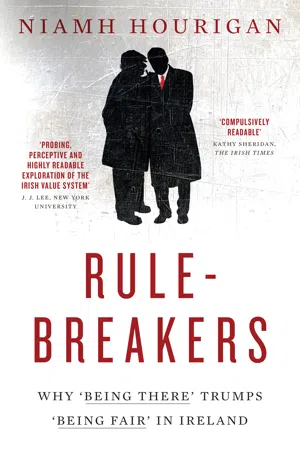
Ireland is a nation on a value system that equates 'being good' with 'being there for each other'. As a society we favour 'minding our own' over 'doing what we're told'. So far, so Irish.It's become a commonplace to refer to the excesses of the Celtic Tiger years as an aberration, the product of a short-lived and inexplicable mania for cheap credit and unregulated consumption. But what if the roots of Ireland's economic crisis ran far deeper than the property boom or the hubris of the establishment elites who enabled it?In this, a ground-breaking survey of the Irish national character from its colonial history to its current day dramas, acclaimed sociologist Niamh Hourigan draws on a wealth of new and compelling research to reveal the fundamental conflict at the heart of the Irish society: that between our traditional faith in the politics of intimacy, all handshakes and favours, and the ruling systems in which we've invested power.The Ireland that emerges from her research is a country where outcomes are decided by who rather than what you know, and where – for good or for bad – rules are very much made to be broken.'Probing, perceptive and highly readable exploration of the Irish value system'J. J. Lee, New York University'Compulsively readable'Kathy Sheridan, The Irish Times'Lucid, engaging and persuasive … every politician should read this – and so should every voter'Colin Murphy, The Guarantee
Frequently asked questions
Yes, you can cancel anytime from the Subscription tab in your account settings on the Perlego website. Your subscription will stay active until the end of your current billing period. Learn how to cancel your subscription.
No, books cannot be downloaded as external files, such as PDFs, for use outside of Perlego. However, you can download books within the Perlego app for offline reading on mobile or tablet. Learn more here.
Perlego offers two plans: Essential and Complete
Essential is ideal for learners and professionals who enjoy exploring a wide range of subjects. Access the Essential Library with 800,000+ trusted titles and best-sellers across business, personal growth, and the humanities. Includes unlimited reading time and Standard Read Aloud voice.
Complete: Perfect for advanced learners and researchers needing full, unrestricted access. Unlock 1.4M+ books across hundreds of subjects, including academic and specialized titles. The Complete Plan also includes advanced features like Premium Read Aloud and Research Assistant.
Both plans are available with monthly, semester, or annual billing cycles.
We are an online textbook subscription service, where you can get access to an entire online library for less than the price of a single book per month. With over 1 million books across 1000+ topics, we’ve got you covered! Learn more here.
Look out for the read-aloud symbol on your next book to see if you can listen to it. The read-aloud tool reads text aloud for you, highlighting the text as it is being read. You can pause it, speed it up and slow it down. Learn more here.
Yes! You can use the Perlego app on both iOS or Android devices to read anytime, anywhere — even offline. Perfect for commutes or when you’re on the go. Please note we cannot support devices running on iOS 13 and Android 7 or earlier. Learn more about using the app.
Yes, you can access Rule-breakers – Why 'Being There' Trumps 'Being Fair' in Ireland by Niamh Hourigan in PDF and/or ePUB format, as well as other popular books in Politics & International Relations & British History. We have over one million books available in our catalogue for you to explore.
Forgiving does not erase the bitter past. A healed memory is not a deleted memory.1
Louis B. Smedes
One of the few bright spots in the rather grim year of 2011 was the visit to Ireland by Queen Elizabeth II in May. The visit, which was both a popular and a political success, seemed to promise that even if Ireland was in a dire financial mess, at least something was going well. The peace process in Northern Ireland remained on track, and the Queen’s visit to the Republic provided a moment, many thought, for healing Ireland’s bitter colonial history. However, as the pastor Louis B. Smedes succinctly notes, a history healed is not a history deleted. Even as the Queen visited the Garden of Remembrance, some commentators were wondering how far the roots of the financial crisis could be traced to Ireland’s colonial past. In his contribution to the website ‘Ireland after NAMA’, Cian O’Callaghan commented:
The legacy of colonialism played a key role in Celtic Tiger Ireland and its catastrophic aftermath. Nowhere is this more apparent than in the IMF/ECB bailout. Here Ireland draws closer to its spiritual neighbours in the post-colony than perhaps ever before … as the Queen visits these shores, rather than drawing divisions between those who have ‘moved on’ and those ‘living in the past’, perhaps we should be asking what this past really means for our present.2
Certainly, the memory of Ireland’s painful colonial past appeared to have been actively shaping how both public figures and ordinary citizens responded to the crisis. When the Troika team arrived in Dublin to negotiate the terms of the bailout agreement, the 2FM DJ Hector Ó hEochagáin played the rebel song ‘The Foggy Dew’, especially, he said, for team leader A.J. Chopra. The implied message to the Troika contained in the song’s lyrics, which describe Irish resistance to British colonialism, was not lost on Ó hEochagáin’s audience even if the IMF official did not hear the programme.
This post-colonial perspective on the crisis was also evident in a political spat the following week. During a Dáil debate on the national recovery plan, Fianna Fáil TD Mattie McGrath accused his own party leader, Taoiseach Brian Cowen, of being ‘worse than Cromwell’. Martin Mansergh, one of Cowen’s ministers, rushed to his defence. In response, a national newspaper pointed out that Mansergh’s own ancestor, Bryan Mansergh, had benefited from the Cromwellian invasion, having been given a castle by Cromwell’s forces.3 After the change of government in 2011, McGrath, who had left Fianna Fáil, continued to draw comparisons between austerity and colonialism. In a radio debate on the introduction of septic tank charges as part of the austerity programme, he commented, ‘God, we got rid of the Black and Tans and Cromwell, not a bother. I don’t want to wake up some morning and see two or three gentlemen in my back yard, peeping into my septic tank like the Peep O’Day boys out doing searches.’4
As the new taxes inflicted under austerity increased in 2012, politicians on the left of the Irish political spectrum also invoked Ireland’s colonial past to justify protests. In January of that year, Clare Daly TD commented that the household charge issue ‘may be the one that changes the view of the Irish from one of passive compliance with any amount of austerity thrown our way, to a reawakening of the traditions of a nation that coined the term “boycott” in the first place.’5 Launching a campaign against austerity, socialist republican Dublin councillor Louise Minihan characterised the bailout process as a form of neo-colonialism: ‘[T]he goal of those who are pushing this treaty6 is to force the further erosion of our national and economic sovereignty. Their aim is to remove our hard fought economic rights. Ireland is now in a position of total colonial occupation. We are a colony.’7 Although this perspective might be considered extreme, popular historian Tim Pat Coogan also saw the public response to austerity in neo-colonial terms. In his blog, he commented, ‘In the case of the Famine and in today’s Ireland, people are either accepting whatever burdens have been placed upon them with varying degrees of despair or they are getting out.’8 Publicly at least, Irish government officials seemed to resist these neo-colonial parallels, but behind the scenes, the legacy of colonialism also seemed to influence their perspective. Journalist Pat Leahy of the Sunday Business Post described a senior government official musing in early 2013 about his ideal bailout exit scenario: ‘My plan is to get the jeep that Michael Collins arrived in to Dublin Castle to accept the handover from the British in 1922. We’ll put Enda and Eamonn in the back!’9
As the mortgage arrears crisis worsened in 2013, the fear of banks repossessing homes raised the spectre of evictions, a common feature of the colonial period. Describing legislation passed to facilitate bank repossession, Liam MacNally wrote in the Mayo News, ‘For those of us, outside the well-paid loop and mindset of politicians and bankers, the legislation reminds us of colonialism. It transports us back on the plains of the pale ghost of history where eviction was the order of the day, Irish families ousted by the foreigner, aided and abetted by Irishmen.’10 The Land League also cast a long shadow in County Meath, where in 2013 Jimmy McEntee, the brother of a deceased Fine Gael politician, launched a movement he described as a new ‘Land League’ to resist bank repossessions.11
International commentators on the Irish crisis also saw parallels between the austerity process and colonialism. In the Huffington Post, for instance, Ellen Brown commented:
The Irish have a long history of being tyrannized, exploited and oppressed – from the forced conversion to Christianity in the Dark Ages, to slave trading of the native in the 15th and 16th centuries, to the mid-nineteenth century ‘potato famine’ that was really a holocaust. The British got Ireland’s food exports, while at least one million Irish died from starvation and related diseases, and another million or more emigrated. Today, Ireland is under a different form of tyranny, one imposed by the banks and the Troika – the EU, ECB and IMF. The oppressors have demanded austerity and more austerity, forcing the public to pick up the tab for bills incurred by profligate private bankers.12
Given the parallels between colonialism and the loss of economic sovereignty, it is not surprising that Ireland’s bitter past came alive again during this period. Memories of the colonial period were much less evident between 2003 and 2007, although it is arguable that historical conflicts over land may have contributed to the public appetite for owning property, which in turn fuelled the spending bubble that led to Ireland’s economic implosion. Official and media analyses of the causes of the crisis tended to shy away from references to the Irish colonial experience, focusing instead on the immediate failure of regulating systems and the dominance of insider intimacy linked to the weak rules/strong relationships balance. However, the repeated references to Ireland’s colonial past in public discussion of the crisis suggest that colonialism may have had a particularly profound role in shaping this balance. The goal of this chapter is to search for historical evidence of this process.
COLONIALISM, RULES AND TRAUMA
At the very least, one would expect that colonisation would inform a popular distrust of rules in Irish society. In colonised societies, the rules that govern society are designed to promote the political, military and economic interests of the coloniser. In his research on British colonialism and the law, Nasser Hussain highlights that ‘rules’ were central to the British model of colonialism in the eighteenth and nineteenth centuries. He says: ‘Government by rules became the basis for conceptualisation of the “moral legitimacy” of British colonial rule. The applicability of rules to all was understood as the distinguishing feature of British rule and counterpoint to “personal discretion”.’13 However, British colonisers were fairly clear that it was their rules that mattered. Hussain quotes James Fitzjames Stephen, a legal member of the Indian Colonial Council in the 1870s, who exemplified this perspective when he stated that establishing the ‘British’ rule of law:
… constitutes in itself, a moral conquest more striking, more durable and far more solid than the physical conquest which renders it possible.… Our law is in fact the sum and substance of what we have to teach them. It is, so to speak, the gospel of the English and it is a compulsory gospel which admits of no dissent and no disobedience.14
The majority Catholic population in nineteenth-century Ireland had several problems with this viewpoint. First, many of the rules established under British colonial rule, particularly after the Act of Union in 1801, were viewed as unfair. These rules included legislation that entirely excluded Catholics from voting until 1829. They also deeply resented rules on tithing, which forced them to pay a proportion of their income for the upkeep of the Protestant Church of Ireland.15 Arbitrary rent increases imposed by absentee landlords, and state support for evicting tenants who could not pay these rents, did little to reinforce popular confidence in the fairness of the rules.16
Aside from the perception that the rules were unfair, there was a widespread view that British colonial administrators were operating the rules in a corrupt fashion. Donnchadh Ó Corráin notes that the Act of Union itself was only passed because:
Peerages, jobs and pensions were liberally promised. In Ireland, members of the Parliament were returned by boroughs which were mostly corrupt and by counties where results were almost always determined by the landlords. … Castlereagh set out to win every possible vote by promises, threats, and bribes. Support for the Union was made a pre-condition for any Government office or favour. As Castlereagh put it, his job was ‘to buy out, and secure to the Crown forever’, the fee simple of Irish corruption.17
Popular Irish resentment of unfair rules and corruption became increasingly evident towards the end of the nineteenth century, when members of the Irish Parliamentary Party were openly criticised for accepting patronage from British governments, a perception which was to contribute to the Party’s downfall during the 1914–1916 period.18
While a popular distrust of rules is an unsurprising outcome of colonialism, the wounds of colonial oppression played a much deeper role in shaping the balance between rules and relationships in Ireland. As Hussain highlights, the process of establishing colonial rules only happens after indigenous populations have been suppressed by force. This suggests that colonialism operates, first and foremost, as a violent and abusive process of oppression. In the 1990s, historians began to draw on theories of trauma which outline the impact of abuse on individuals to understand how whole societies respond to traumatic and abusive processes such as colonisation. Historian David Lloyd comments:
Trauma entails violent intrusion and a sense of utter objectification that annihilates the person as subject or agent. This is no less apt as a description of the effects and mechanism of colonization.… It would seem that we can map the psychological effects of trauma on to the cultures that undergo colonization. By the same token, the after-effects of colonization for a culture could be held to be identical with those for the traumatized individual.19
By applying this model to Irish history, we can identify a range of elements that can be considered part of the cultural trauma of colonialism which may have shaped the balance between rules and relationships in Ireland.
First, the physical violence experienced by Irish Catholics during British colonial rule, particularly during the Cromwellian era, remains a feature of Irish post-colonial memory – as evinced by Mattie McGrath’s comments in late 2010. During the Cromwellian invasion in the middle of the seventeenth century, half a million Catholics died or emigrated from Ireland; and many of those who remained were dispersed to the less fertile land in the western half of the country. In Cromwell’s conquest of Drogheda, four thousand people – including women and children – were killed, while two thousand were killed in Wexford. An English visitor to Ireland provided a stark image of the scale of devastation generated by this violence in the London Chronicle in 1652. He said, ‘you may ride 20 miles and scarce discern anything or fix your eye upon any object, but dead men hanging on trees and gibbets.’20 While scholarly debate rages as to whether the Cromwellian violence was ‘unexceptional by contemporary standards’,21 or genocide,22 Irish popular memory of this period is far less ambiguous. For instance, in his 1965 autobiography, Brendan Behan says of Cromwell:
His actions in Drogheda and Wexford were those of a Heydrich and Himmler combined. In the town of Wexford, he massacred 200 women grouped round the Cross of the Redeemer and delighted his soldiers with the slow process of individual murder, stabbing one after another. When his soldiers were running their pikes through little babies, in between psalms, they would shout ‘kill the nits and there will be no lice’.23
This hatred for the abuses perpetrated by Cromwellian soldiers runs right through to contemporary internet ...
Table of contents
Cover
Title Page
Contents
Introduction: Ireland’s Crisis and Social Bonds
Chapter 1: A History of Rules and Relationships in Ireland
Chapter 2: Change and the Ties that Bind
Chapter 3: Rules, Relationships and Belonging
Chapter 4: The Parallel Worlds of Rules and Relationships in Ireland