eBook - ePub
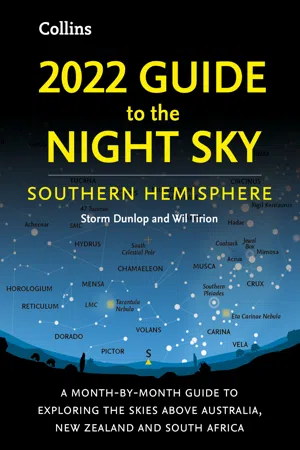
2022 Guide to the Night Sky Southern Hemisphere
A month-by-month guide to exploring the skies above Australia, New Zealand and South Africa
- English
- ePUB (mobile friendly)
- Available on iOS & Android
eBook - ePub
2022 Guide to the Night Sky Southern Hemisphere
A month-by-month guide to exploring the skies above Australia, New Zealand and South Africa
Trusted by 375,005 students
Access to over 1.5 million titles for a fair monthly price.
Study more efficiently using our study tools.
Information
Topic
Physical SciencesSubtopic
Photography
January – Looking South
January 01 | 11 p.m. (12 p.m. DST) |
January 15 | 10 p.m. (11 p.m. DST) |
February 01 | 9 p.m. (10 p.m. DST) |

February – Looking South
February 01 | 11 p.m. (12 p.m. DST) |
February 15 | 10 p.m. (11 p.m. DST) |
March 01 | 9 p.m. (10 p.m. DST) |
February – Looking South
The whole of Centaurus is now clear of the horizon in the southeast, where, below it, the constellation of Lupus is beginning to be visible. Triangulum Australe is now higher in the sky and easier to see. Both Crux and the False Cross are also higher and more visible. The Large Magellanic Cloud (LMC) and brilliant Canopus are now almost due south, with the constellation of Puppis at the zenith. Both Hydrus and the Small Magellanic Cloud (SMC) are lower in the sky, as is Phoenix, which is much closer to the horizon in the west. Next to it, the constellation of Tucana is also lower although the globular cluster 47 Tucanae remains readily visible as does Achernar (α Eridani). The constellation of Grus and bright Fomalhaut (α Piscis Austrini) have disappeared below the horizon. Peacock (α Pavonis) is skimming the horizon in the south and is not easily seen at any time in the night.
Meteors
The Centaurid shower, which actually consists of two separate streams: the α- and β-Centaurids, with both radiants lying near α and β Centauri (Rigil Kentaurus and Hadar, respectively), continues in February, reaching a low maximum (around 5 meteors per hour) on February 8, when the Moon is a waxing crescent, just before First Quarter. Another weak shower, the γ-Normids, begins to be active in late February (February 25), but the meteors are difficult to differentiate from sporadics. It reaches its weak (but sharp) maximum on March 14–15.

Parts of Carina and Vela. The ‘False Cross’ is indicated with blue lines. The red blurry spot near the bottom-left corner is the Eta (η) Carinae Nebula. To the right, and a little lower, is an open cluster that surrounds Theta (ϑ) Carinae. This cluster (IC 2602) is also known as the Southern Pleiades.

February – Looking North
February 01 | 11 p.m. (12 p.m. DST) |
February 15 | 10 p.m. (11 p.m. DST) |
March 01 | 9 p.m. (10 p.m. DST) |
February – Looking North
The constellation of Gemini, with the pair of stars Castor and Pollux (α and β Gem...
Table of contents
- Title Page
- Copyright
- Note to Readers
- Contents
- Introduction
- The Constellations
- The Moon and the Planets
- Introduction to the Month-by-Month Guide
- Month-by-Month Guide
- Dark Sky Sites
- Glossary and Tables
- Acknowledgements
- Further Information
- About the Publisher
Frequently asked questions
Yes, you can cancel anytime from the Subscription tab in your account settings on the Perlego website. Your subscription will stay active until the end of your current billing period. Learn how to cancel your subscription
No, books cannot be downloaded as external files, such as PDFs, for use outside of Perlego. However, you can download books within the Perlego app for offline reading on mobile or tablet. Learn how to download books offline
Perlego offers two plans: Essential and Complete
- Essential is ideal for learners and professionals who enjoy exploring a wide range of subjects. Access the Essential Library with 800,000+ trusted titles and best-sellers across business, personal growth, and the humanities. Includes unlimited reading time and Standard Read Aloud voice.
- Complete: Perfect for advanced learners and researchers needing full, unrestricted access. Unlock 1.5M+ books across hundreds of subjects, including academic and specialized titles. The Complete Plan also includes advanced features like Premium Read Aloud and Research Assistant.
We are an online textbook subscription service, where you can get access to an entire online library for less than the price of a single book per month. With over 1.5 million books across 990+ topics, we’ve got you covered! Learn about our mission
Look out for the read-aloud symbol on your next book to see if you can listen to it. The read-aloud tool reads text aloud for you, highlighting the text as it is being read. You can pause it, speed it up and slow it down. Learn more about Read Aloud
Yes! You can use the Perlego app on both iOS and Android devices to read anytime, anywhere — even offline. Perfect for commutes or when you’re on the go.
Please note we cannot support devices running on iOS 13 and Android 7 or earlier. Learn more about using the app
Please note we cannot support devices running on iOS 13 and Android 7 or earlier. Learn more about using the app
Yes, you can access 2022 Guide to the Night Sky Southern Hemisphere by Storm Dunlop, Wil Tirion, Collins Astronomy in PDF and/or ePUB format, as well as other popular books in Physical Sciences & Photography. We have over 1.5 million books available in our catalogue for you to explore.