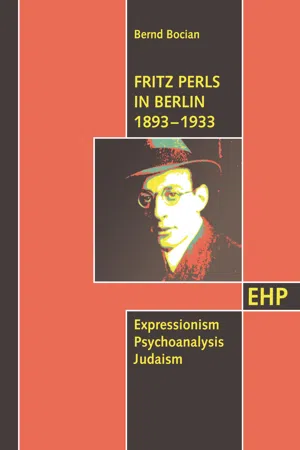
Using Fritz Perls as an example, this book recalls the representatives of an urban avant-garde culture who were driven out of Europe, emigrated, and for the most part found a new homeland in the USA. Many an element of the lost avant-garde spirit later found its way back to Europe in an enriched form. This monograph is the first to focus in greater depth on the German-European roots of Gestalt therapy. It thereby bridges the continents at the same time.
eBook - ePub
Fritz Perls in Berlin 1893 - 1933
Expressionism Psychoanalysis Judaism
- 319 pages
- English
- ePUB (mobile friendly)
- Available on iOS & Android
eBook - ePub
About this book
Trusted by 375,005 students
Access to over 1.5 million titles for a fair monthly price.
Study more efficiently using our study tools.
Information
I. BIOGRAPHICAL COMPONENTS
1. Formative Life Contexts. War – Expressionism – Psychoanalysis
Friedrich Salomon Perls was born in Berlin in the year 1893 as the third child and only son of a Jewish family from the Eastern part of the German Empire. This date and origin place him in a certain social and historical context. In answer to the question of which formative social influences Perls’s generation assimilated, I would like to cite the following important spheres of influence – naturally, from a focused perspective based on my knowledge of the later course of his life.
1) Fritz Perls was a member of the so-called »front generation,« those born in the 80s and 90s of the 19th century. During their youth, these people experienced the euphoric upswing and anxiety about the future that was part of the years leading up to the First World War, and they numbered among the age group »that was most frequently posted to the front lines, spent the longest amount of time there, and were therefore a ›front generation‹ in a special sense« (Peukert 1987, 30). As a rule, it was only after completing their military service that these young men gathered experience with politics, started families, or launched their careers which were generally delayed until they returned home from the war (see Peukert ibid.).
Moreover, the experience of war surely allowed virtually none of the soldiers to return home without traumatic experiences from the bulletriddled trenches that were glutted with corpses. But after the revolution and collapse of the emperor’s ancient imperial world, »home« no longer consisted of the accustomed social order and its specific values. The majority of young men who served in the war and stemmed from middle class backgrounds reacted to the experience of war, the experience of defeat, their disappointed fantasies of grandeur, and the loss of time-honored social and human orientations by seeking and finding new support in right-wing »volkish«1 ideologies. Perls’s mode of reaction took a different course, with his socialization in the bohemian circles of Berlin playing a decisive role.
2) Many representatives of avant-garde culture in the Weimar Republic stemmed from the front generation. This movement of innovators created works of lasting effect along the sidelines of established institutions, and it was »a place where genuine alliance took place between Jews and Germans as they encountered one another on the terrain of a common revolt« (Traverso 1993, 53). The underlying influence was that of Expressionism, which was already exerting an effect during the days of the empire. As a designation of an epoch, it comprised the period from 1910 to 1925, at the latest (see Vietta 1994). The so-called Expressionist generation was »chaotically torn by its experience of destroyed tradition and lost identity« (Glaser 1976, 200). After the First World War, this part of the front generation regained its identity through revolt; it searched for the »new man« in a socialist »brotherhood« that lay beyond the patriarchal social order and the struggle against the patriarchal father, beyond the self-constraint mechanisms of the super-ego and a mentality of social subservience.
Here, I attach importance to the interpretational approach suggested by Vietta (1994) who attempted to grasp the manifold artistic styles and phenomena of the age by filtering out an inner cohesiveness. For Vietta, the hallmark of the Expressionist epoch is the dialectic between the personal experience of ego-dissociation and the yearning for a renewal of humanity, or, between the experience of alienation and the messianic call for individual transformation (see ibid., 22). Seen in this light, the core of Expressionism is not the actual artistic act, but rather a specific experience of the self and the world.2 As I will demonstrate, this experience can also be found in Perls who moved in the artistic and bohemian circles implied here during the years in question.
In this milieu, philosophy and epistemology were often not studied in the actual sense but rather assimilated through »osmosis« to a large extent and »existentially anticipated« (ibid, 151). The philosophical foundation of the Expressionist groups (and indeed of all oppositional circles from left to right) was Lebensphilosophie, which was synonymous, particularly in its Nietzschean form, with an anti-bourgeois position and criticism of the Wilhelminian value system. This philosophical foundation will require our attention, as will the most succinct expression of the avant-garde movement with its anti-bourgeois self-image, to the extent it transpired within the field of lived art or philosophical action. Here, I am referring to Dadaism in Berlin, with which Perls was affiliated through Salomo Friedlaender/Mynona, his first »guru« (see Erlhof in Hausmann, 228; Exner 1996, 264 f.). Perls, who was truly a follower of Diogenes, a neo-kynic, in terms of Sloterdijk (1983b, 711 f.), was one of the few people to retain the spirit of Dada until the end of his life. For Raoul Hausmann, the most important representative of the Dada group in our context, Dada was »a state of being, more a form of inner mobility than an art movement« (Hausmann 1982b, 229). I will posthumously proclaim Perls the first and only Gestalt-Dada.
3) Furthermore, Perls belonged to the very small faction of »Freudian psychoanalysts with a leftist political orientation« (Jacoby 1990, 65), whom I would like to term the »Berlin character analysts« based on their innovative treatment techniques.3 This was another group whose members were born around the turn of the century and found themselves in the midst of their professional training when National Socialism drove them into exile. Along with these individuals, Freudian psychoanalysis lost its culturally and socially critical element for years, and its center of gravity now shifted from Europe to America.4 In this regard, I would like to recall the anarchistic psychoanalyst Otto Gross. He was a forerunner of the leftist Freudians and was responsible for the influence of psychoanalysis, although in a radical culturally critical form, in the bohemian circles of Munich and Berlin prior to the First World War. We will show how much this almost forgotten man’s thinking continued to have an effect – even on Gestalt therapy. In my opinion, the blueprint for Gestalt therapy that was mutually developed with anarchist writer Paul Goodman at the end of the 1940s, in some respects represented a continuation of attempts begun in Berlin to develop a socially critical, active, emotion-oriented psychoanalysis which also incorporated body language to a greater degree.
The course of Perls’s life in Germany passed through all of the formative stages that were typical for the left-leaning urban intelligentsia that thought of itself as anti-bourgeois: rebellion against the suffocating domestic and social patriarchy of Wilhelminian society; the traumatic experiences of the First World War; the German »November Revolution« and the gory counter-revolution; the years of success for the cultural avant-garde; political radicalization and, finally, emigration. His participation in the small leftist Freudian movement in connection with his professional training must be added to the list.
For Perls and many of the protagonists with this background, all of these influence factors must be complemented by the fact that he was born in Germany as the child of Jewish parents. Due to the subsequent course of German history, this influence factor must also be examined, regardless of the respective identities of the individuals depicted. In this context, I would like to undertake this examination in relative detail, not only because Perls’s German-Jewish background is absolutely key to understanding him and has been generally neglected, but also because I consider it important to remember this world and its significance for Germany and European culture.
2. The Jewish Context and the Educational Ideal of Classical Humanism
An obscure lower middle class Jewish boy. (F. Perls 1977, 1)
Roses are reddish, violets are blueish.
If it wasn’t for Christmas,
we’d all be Jewish. (F. Perls in Kogan 1976)
we’d all be Jewish. (F. Perls in Kogan 1976)
In the question of whether Perls was a Jew, I follow the argumentation of Leon Botstein. Viewing a person as a Jew and labeling him one, even though he himself did not fundamentally feel like a Jew or define himself as such, is to apply an »extremely racist definition« (Botstein 1991, 15). Botstein argues:
The only legitimate reason for using the maximal definition – which is to say, everyone who had one or two generations of Jewish forebears was a Jew – lies in the fact that it constitutes an objective historical reality which was created through widespread anti-Semitism beginning at the end of the 18th century. Assimilation notwithstanding, the majority of people, either in the German-speaking countries or in Russian and Polish circles, never let it slip their mind if someone had Jewish ancestry. (ibid., 17)
On the first page of his autobiographical outline, Fritz Perls calls himself a »lower middle class Jewish boy« (Perls 1977, 1), and the collection of memories published by Gaines contains reports that even in his final years he continued to come out with Yiddish sayings and rabbi stories (see Gaines 1979, 338 f.). His grandparents were religious, as was his mother and possibly also his oldest sister, Elisabeth, who worked as a secretary for the Jewish community in Berlin. His father appears to have been an emancipated and enlightened assimilated Jew whose sole orientation was the abstract religious humanism of the Free Mason movement. As a boy, Fritz Perls learned Hebrew in preparation for his Bar Mitzvah, a ceremony through which he came of age in a religious sense at thirteen. The preparatory instruction at the synagogue was »impersonal« (Perls 1977, 249) and the ceremonies in the synagogue remained »strange and peculiar« to him (ibid.). Yet by being bar mitzvahed, Perls received more instruction in the Jewish religion than Sigmund Freud, for example, (see Gay 1988, 131) although like the latter he remained an »unbelieving Jew« (Freud in Gay ibid., 133).
Since the Jewish context5 of Perls’s life has not received close attention until now, I would like to begin this monograph by providing basic information on the situation of Jews in the German Empire up until the time that Perls was born.
2.1 Jews in the German Empire. Between Anti-Semitism and German-Jewish Cultural Chauvinism
When the German Empire was founded in 1871, Jews in the entire empire obtained full legal emancipation. In the following years, anti-Semitic propaganda campaigns were launched. The German Empire, created essentially by Bismarck through diplomacy and war, was a latecomer among the major European powers and remained an insecure entity. There was a vision of a strong, cohesive nation. The goal was homogeneity, as it was in the nationalization of other European states, and consequently there was cultural intolerance and an unwillingness to accept or abide diversity.6 Those who differed, the »enemies« of unity, threatened from within and without to thwart the process of creating a community which had only just been set in motion. Numbering among the social groups designated as Reichsfeinde (enemies of the empire) were the social democrats, and democrats altogether, Roman Catholics, the Poles, and the Jews. Anti-Semitism was a solidarization factor during a time when the nation was as yet unconsolidated and this was perceived as a deficiency. It became increasingly dispensable during the subsequent period of economic success and imperialistic growth, only to grow more significant again after the empire lost its position of power at the end of the First World War. This was not a specifically German phenomenon. Anti-Semitism had also gone hand in hand with national chauvinism during the 1890s in France, where it represented an attempt to compensate for the taint of defeat in the war against Prussian Germany (see Battenberg 1990b, 232). The struggle against the putative enemies of German unity increasingly was no longer seen exclusively against a backdrop of a territory that was now under unified rule and dominated by religious Protestants. Rather, the sense of unity progressively derived its »material« basis from the myth of a common origin that was bestowed by nature and could not be acquired (see Bauman 1995, 141 f.). As a German nation proceeded to emerge out of a multitude of minor German states with various religions and cultures, a metaphor became increasingly important, namely, that of identical »pure German blood« pulsing through a body without which each individual organism would not be part of the German volk, would not belong to the German volk-body. Jews were too different, so to speak, and therefore could not be assimilated. They were repeatedly identified as foreign elements within the volk-organism and expelled. Confluent incorporation into the new organism was not possible. I am intentionally drawing on a mixture of historical and Gestalt-therapy terminology here, because I assume that the topic of assimilation, which is so important for the development of Gestalt therapy, and the terms used in this connection arise in part from Perls’s experience as a Jew in Germany.
The wave of anti-Semitic sentiment against those who were »alien to the volk« reached its apogee in the Berlin Antisemitism Dispute of 1879-1881, with the diatribes of the Protestant court chaplain in Berlin, Adolf Stoecker, and the dispute between Berlin university professors Treitschke und Mommsen occupying central roles. The term anti-Semitism itself also belongs in this context. Coined in Berlin in 1879, it gained acceptance and was adopted by other European languages. In 1893, the year Perls was born, the »Centralverein der deutschen Staatsbürger jüdischen Glaubens« (Central Association of German Citizens of Jewish Faith) was founded as a countermeasure. It was the first time since their emancipation that Jews had entered the public arena to defend themselves against discrimination and stand up for their rights in an organization of their own. The Centralverein developed into the most important advocacy group for assimilated Jews, who were in the majority in the German Empire. The association’s core message was »We are not German Jews but rather German citizens of the Jewish faith. We are firmly grounded in German nationality. We have as much in common with Jews in other countries as German Catholics and Protestants have with Catholics and Protestants of other countries« (in Adler 1988, 117).
During the course of its history in exile, the Jewish people endured horrible suffering in all of the European countries. In Wilhelminian Germany, anti-Semitism was limited to verbal and written attacks, and for the most part did not pose an immediate personal threat to Jewish lives or property. Up until the end of the First World War, the point at which anti-Semitism was in a sense »rediscovered« (Battenberg 1990b, 232) as a political tool, the situation remained relatively calm. Attempts at violence were stifled immediately by the police, and the safety of Jewish citizens in the empire was protected. With respect to the period under discussion here, the last violent incidents had been the unrest in Pomerania in 1881, and German Jews took reassurance in the aversion of most middle class citizens against »rowdy antisemitism.« At the same time, however, the civilizing process that anti-Semitism underwent provided support for its acceptance at the higher levels of society. This was particularly true of the new pseudo-scientific form of »race science« that was emerging in Europe during these years, with strong German participation, and was based on traditional Christian anti-Semitism. Anti-Semitism penetrated into all of the upper classes and also into middle-class agricultural organizations and trade associations. Granted, it had not become a dominant politcal force, but it had bonded inseparably to nationalistic and imperialistic ideas as they spread. Thus, anti-Semitism had penetrated deep into the bourgeoisie and altered it.
When anti-Semitism in the Wilhelminian Empire is described as a movement within the educated and leadership levels of society, the reference is to the scope of its influence. This extended from the military caste, representing the very top of the prestige ladder, and reached far into other social groups such as teachers, students, university professors, and the Protestant clergy (see ibid., 32). As a »social code« (Vulkov 1994, 120), anti-Semitism belonged to the ideological core of the right-wing conservative and radical right-wing parties and organizations. The liberal and socialist party programs did not have an anti-Semitic orientation, which is why the political orientation of many Jews tended in this direction. If right-wing organizations had not fused inseparably with anti-Semitism, there would have been an influx of nationally minded Jewish Germans here as well, for they definitely did exist, occasionally even acting as leading figures in nationalistic and anti-Semitic organizations (see Hepp 1999, 283).
During the Wilhelminian years, anti-Semitism found no great resonance within the working classes. Yet the massive dissemination of propaganda and the incitement of the proletariat by the educated lower and upper middle classes, with the national chauvinistic sentiments they had adopted in the meantime, would come to fruition decades later. The German Social Democrats, who were Marxists at the time and the only party to consistently oppose anti-Semitism, were attractive – as was socialism in general – to the segment of the German Jews who hoped for social change. Important activists of Jewish origin included the social democratic politicians Ferdinand Lassalle and Eduard Bernstein, the later communists Rosa Luxemburg and Eugen Leviné, and the liberal socialists Kurt Eissler and Gustav Landauer. But these well known names must not obscure the fact that the majority of German Jews, much like the other Germans who were doing quite well, had a conservative political orientation and were not interested in s...
Table of contents
- Cover
- The Author/The Translator
- Title
- Copyright
- Contents
- Dedication
- Deutsche Vereinigung für Gestalttherapie: Greeting
- European Association for Gestalt Therapy: Greeting
- Preface to the English Edition
- Preface and Acknowledgements (from the First German Edition)
- THE WORK OF REMEMBERING AND TOPICALITY
- I. BIOGRAPHICAL COMPONENTS
- II. THE EXPERIENCES OF THE GERMAN-JEWISH AVANT-GARDE. THEIR TOPICALITY TODAY
- Annotations
- APPENDIX
- Index
- Advertisement
Frequently asked questions
Yes, you can cancel anytime from the Subscription tab in your account settings on the Perlego website. Your subscription will stay active until the end of your current billing period. Learn how to cancel your subscription
No, books cannot be downloaded as external files, such as PDFs, for use outside of Perlego. However, you can download books within the Perlego app for offline reading on mobile or tablet. Learn how to download books offline
Perlego offers two plans: Essential and Complete
- Essential is ideal for learners and professionals who enjoy exploring a wide range of subjects. Access the Essential Library with 800,000+ trusted titles and best-sellers across business, personal growth, and the humanities. Includes unlimited reading time and Standard Read Aloud voice.
- Complete: Perfect for advanced learners and researchers needing full, unrestricted access. Unlock 1.5M+ books across hundreds of subjects, including academic and specialized titles. The Complete Plan also includes advanced features like Premium Read Aloud and Research Assistant.
We are an online textbook subscription service, where you can get access to an entire online library for less than the price of a single book per month. With over 1.5 million books across 990+ topics, we’ve got you covered! Learn about our mission
Look out for the read-aloud symbol on your next book to see if you can listen to it. The read-aloud tool reads text aloud for you, highlighting the text as it is being read. You can pause it, speed it up and slow it down. Learn more about Read Aloud
Yes! You can use the Perlego app on both iOS and Android devices to read anytime, anywhere — even offline. Perfect for commutes or when you’re on the go.
Please note we cannot support devices running on iOS 13 and Android 7 or earlier. Learn more about using the app
Please note we cannot support devices running on iOS 13 and Android 7 or earlier. Learn more about using the app
Yes, you can access Fritz Perls in Berlin 1893 - 1933 by Bernd Bocian, Philip Schmitz in PDF and/or ePUB format, as well as other popular books in Psychology & History & Theory in Psychology. We have over 1.5 million books available in our catalogue for you to explore.