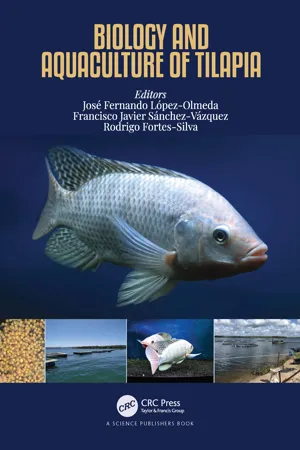
This book reviews up-to-date knowledge on the biology and aquaculture of tilapia, with special focus on the Nile tilapia (Oreochromis niloticus). Tilapia are a group of fish species that have become one of the most cultured worldwide, currently having a big economic impact on both developed and developing countries. The first 12 chapters of the present book cover different aspects of tilapia biology such as genetics, nutrition, osmoregulation, pathology, reproduction and development. Each chapter includes both basic knowledge and its application to tilapia culture. The last 3 chapters are devoted to cutting-edge techniques for the industry of tilapia aquaculture. Experts from both academia and research institutes provide their expertise on the present book.
eBook - ePub
Biology and Aquaculture of Tilapia
- 318 pages
- English
- ePUB (mobile friendly)
- Available on iOS & Android
eBook - ePub
Biology and Aquaculture of Tilapia
About this book
Trusted by 375,005 students
Access to over 1.5 million titles for a fair monthly price.
Study more efficiently using our study tools.
Information
Subtopic
BiologiaCHAPTER 14
Biofloc Technology (BFT) in Tilapia Culture
1 CSIRO Agriculture and Food, Livestock & Aquaculture Program, Bribie Island Research Centre, Woorim, QLD, Australia
2 Department of Soil Water and Environmental Science, University of Arizona, Tucson, AZ, USA
3 Sonora State University (UES), Navojoa Unit, Navojoa, SO, Mexico
4 Federal University of Pampa, Uruguaiana, RS, Brazil
5 Animal Science and Biological Sciences Department, Federal University of Santa Maria (UFSM), Palmeira das Missões, RS, Brazil
6 The Northwestern Center for Biological Research (CIBNOR), La Paz, BCS, Mexico
7 São Paulo State University (UNESP), Aquaculture Center of Unesp (CAUNESP), Jaboticabal, SP, Brazil
8 Mathematical and Statistical Methods (Biometris), Wageningen University, Wageningen, The Netherlands
1. History and basic aspects of BFT
The biofloc technology (BFT) was proposed as an alternative to the conventional extensive and semi-extensive aquaculture production systems. In terms of expansion, conventional systems face serious challenges such as competition for land and water and environmental regulations related to discharge of effluents which contain excess organic matter, nitrogenous compounds and other toxic metabolites that might compromise the adjacent culture areas and boost the spread of disease (Browdy et al. 2012). Currently, BFT is used in the cultivation of commercial species such as penaeid shrimp and tilapia (Figure 1), and more recently, as a management tool during early cultivation during nursery phases. In recent times, as the aquaculture industry has faced diverse issues, in terms of diseases and reduced production yields, BFT was considered (and still is) the new “blue revolution” (Stokstad 2010). Such system originated in the 1970s for shrimp at the French Research Institute for Exploitation of the Sea (IFREMER), located in Tahiti, and in partnership with private companies from the U. S. (Emerenciano et al. 2013, Anjalee-Devi and Madhusoodana-Kurup 2015). At this time, BFT was called a “moulinette” system (Emerenciano et al. 2012) due to the vortex created as a result of constant water aeration and movement. It was later expanded to commercial shrimp farms in both Tahiti and the U.S.

In the 1980s Steve Serfling, at his tilapia farms in Southern California and the Jordan River Valley, Jordan, developed an Organic Detrital Algal Soup System, (ODASS), which is called BFT today. At roughly the same time, researchers in Israel and China began experimenting with similar systems using heavy aeration and water motion to encourage vast production of bacterial and algae biomass to process fish or shrimp wastes in situ (Avnimelech 2015). In the 1990s, the Waddell Mariculture Center, in the United States of America, and at the Technion-Israel Institute of Technology initiated deep scientific studies and commercial pilot-scale trials. In the mid-2000s, the Texas A&M University (Corpus Christi campus, USA), and the Federal University of Rio Grande (FURG, Brazil), two major research centers in North and South America, respectively, began several studies that formed a baseline to the development of BFT technology. Thanks to the diverse research projects and training of human resources, various professionals have spread BFT knowledge, implemented and managed commercial farms regionally and also globally.
Since the early 2000s, there has been a significant increase in number of scientific publications on BFT worldwide. According to Scopus database, this number has increased from less than 20 in 2009 to more than 150 publications in 2018 (Scopus 2019). For Google Scholar, this number increased to more than 4,900 publications in March 2021 (Google Scholar 2021). The majority of such studies were carried out in Mexico, Brazil, USA, China, and India helping to spread and strengthen the technology, as well as boost the industry. The wide range of courses and lectures offered in both scientific and commercial events for the academia and farmers were also important factors for such progress.
But how does BFT work? Microorganisms play a key role in BFT systems (Martínez-Córdova et al. 2015). Similar to an activated sludge water treatment system, fecal and nitrogenous wastes are oxidized to small organic compounds, CO2 and NO3 which are then assimilated by bacteria and algae. The bacteria and algae tend to form flocs. These flocs (Figure 2) are maintained in the water column by limited or zero water exchange and vigorous water motion/aeration (Emerenciano et al. 2013), making the floc available for consumption by detritivores like shrimp and tilapia. In addition, a high carbon to nitrogen ratio (C:N) is maintained since nitrogenous by-products can be easily taken up by heterotrophic bacteria (Avnimelech 1999). In the beginning of the culture cycles, these high ratio are required to guarantee optimum heterotrophic bacteria growth, while the chemoautotrophic bacterial community (i.e. nitrifying bacteria) stabilizes after approximately ~25–50 days (Avnimelech 2015). In addition, a minimum fish/shrimp biomass per cubic meter is required (>300 g/ m3) for a proper system to develop and the establishment of the bacteria population (Emerenciano et al. 2012). In the late stages, the nitrifying community might be responsible for 2/3rds of the ammonia assimilation (Emerenciano et al. 2017); thus, the addition of external carbon should be reduced or even eliminated, and alkalinity consumed by the microorganisms must be continuously replaced by different carbonates/bicarbonates sources (Furtado et al. 2015).

The water quality stability will depend on the dynamic interaction among communities of bacteria, microalgae, fungi, protozoans, nematodes, rotifers etc. that will occur naturally (Martínez-Côrdova et al. 2016), and suitable levels of various parameters such as dissolved oxygen, pH, alkalinity and suspended solids (Emerenciano et al. 2017). Besides the oxygen levels, excess of particulate organic matter and toxic nitrogen compounds (pH related) are the major concern in the BFT system. In this context, three pathways occur for the removal of ammonia nitrogen: at a lesser rate (i) photoautotrophic removal by algae, and at a higher rate (ii) heterotrophic bacterial conversion of ammonia nitrogen directly to microbial biomass; and (iii) chemoautotrophic bacterial conversion from ammonia to nitrate (Martínez-Côrdova et al. 2015).
In BFT, the nutrients are continuously recycled and reused in the culture medium as a result of the in situ microorganism production and the minimum or zero water exchange (Avnimelech 2015). The microbial aggregates (bioflocs) are a natural protein-lipi...
Table of contents
- Cover
- Title Page
- Copyright Page
- Preface
- Table of Contents
- Tilapia Genetic Resources: Conservation and Use for Aquaculture
- Selective Breeding of Farmed Tilapia
- Structure and Physiology of the Gastrointestinal Tract
- Current Improvements in Tilapia Nutrition
- Feeding Practices and Their Determinants in Tilapia
- Osmoregulation in Tilapia: Environmental Factors and Internal Mechanisms
- Pathologies in Farmed Tilapia and the Use of Immunostimulants and Vaccines to Prevent or Treat Diseases: An Overview
- Sex Determination and Differentiation of Tilapia
- Reproductive Physiology of Tilapia
- Embryonic and Larval Development of Tilapias
- Tilapia Larviculture
- Biological Rhythms in Tilapia
- Tilapia Production in Aquaponics
- Biofloc Technology (BFT) in Tilapia Culture
- Tilapia Processing Relevant Aspects Pointing to Promising Horizons
- Index
Frequently asked questions
Yes, you can cancel anytime from the Subscription tab in your account settings on the Perlego website. Your subscription will stay active until the end of your current billing period. Learn how to cancel your subscription
No, books cannot be downloaded as external files, such as PDFs, for use outside of Perlego. However, you can download books within the Perlego app for offline reading on mobile or tablet. Learn how to download books offline
Perlego offers two plans: Essential and Complete
- Essential is ideal for learners and professionals who enjoy exploring a wide range of subjects. Access the Essential Library with 800,000+ trusted titles and best-sellers across business, personal growth, and the humanities. Includes unlimited reading time and Standard Read Aloud voice.
- Complete: Perfect for advanced learners and researchers needing full, unrestricted access. Unlock 1.5M+ books across hundreds of subjects, including academic and specialized titles. The Complete Plan also includes advanced features like Premium Read Aloud and Research Assistant.
We are an online textbook subscription service, where you can get access to an entire online library for less than the price of a single book per month. With over 1.5 million books across 990+ topics, we’ve got you covered! Learn about our mission
Look out for the read-aloud symbol on your next book to see if you can listen to it. The read-aloud tool reads text aloud for you, highlighting the text as it is being read. You can pause it, speed it up and slow it down. Learn more about Read Aloud
Yes! You can use the Perlego app on both iOS and Android devices to read anytime, anywhere — even offline. Perfect for commutes or when you’re on the go.
Please note we cannot support devices running on iOS 13 and Android 7 or earlier. Learn more about using the app
Please note we cannot support devices running on iOS 13 and Android 7 or earlier. Learn more about using the app
Yes, you can access Biology and Aquaculture of Tilapia by José Fernando López-Olmeda, Francisco Javier Sánchez-Vázquez, Rodrigo Fortes-Silva, José Fernando López-Olmeda,Francisco Javier Sánchez-Vázquez,Rodrigo Fortes-Silva in PDF and/or ePUB format, as well as other popular books in Tecnologia e ingegneria & Biologia. We have over 1.5 million books available in our catalogue for you to explore.