An elite guide for building an exclusive distinctive career.
Key Features ? In-depth practical demonstration of Solution Architecture concepts with examples. ? Incorporates graphical illustrations and visual explanations for architecture methods. ? Cloud-to-Cloud migration techniques, High-level, and Low-Level Design, and Emulation Tools.
Description Enterprise Solution Architecture - Strategy Guide takes you through all the essential concepts, strategies, workflows, documentation, and process maps that guide you in designing solutions that meet your existing enterprise architecture. Anyone who thinks about designing a strategy, defining and implementing a project, or transforming the project from poor execution to new techniques are the most opportunistic readers of this book. It will streamline what needs to be prepared in terms of documentation. You will learn to develop documentation for different stages, various project phases, and how to use them effectively. This book will enable anyone looking to switch into the architecture forum by grabbing all the deep concepts and laying out strategies. They will be aided by all the visual implants in the book. Furthermore, this book highlights all the industry-specific processes which are required to be followed during any solution architecture-based project.
What you will learn ? Learn to formulate strategies and design solutions for every business challenge. ? Get handy with the Visio tool and design interactive representations of business solutions. ? Build a solid foundation on the basics of Solution Architecture. ? Understand and develop strong proficiency in IT Transformation and IT Migration projects.
Who this book is for This book caters to all IT administrators, developers, and IT-specific students who want to build sound proficiency in the IT Solution Architect field. Possessing basic knowledge about Information Technology and Solution Architecture concepts would be good, although not mandatory for all the readers.
Table of Contents 1. Solution Architecture: The Astonishing Quotient 2. Solution Architecture: The Logics Behind 3. The Transformations Project: Lets Usher 4. The Transformations Project: Lifecycle & Process Flowchart 5. The Transformations Project: Tools & Executions 6. The Transformations Project: Add-Ons 7. The Migrations: Introduction & Lets Usher 8. The Migrations: Application Stacks & Move Groups 9. The Migrations: Process Flowchart 10. The Migrations: Topology, Milestone, Legacy OS-Hardware, and Documents 11. The Migrations: Deliverables, Testing, and Rollbacks 12. Summary
About the Authors Nitesh Garg: The author has been working in the field of IT Technology for the last 19 years as a Sr. Enterprise Solution Architect. He has been in customer-facing roles right from the start and has worked across industry domains and clients. Technical Proficiency: His technical area of expertise has been Enterprise Solution Architecture/Pre-Sales/Solutions and Designs/Cloud Technologies/ Virtualization Technologies /Datacenter Technologies and DevOps Technologies. LinkedIn Profile: https://www.linkedin.com/in/niteshgargsa/ Blogs: https://www.antwak.com/author/2350-nitesh-garg Atul Sharma: Atul is currently working as a Senior DevOps & Cloud Solution Architect. He has rich experience of over 17 years in the field of the IT industry. He has been handling customers across the globe right from the start of his career as an enterprise architect. Education/Certifications: He has completed B. Tech (Mechanical) and has been certified in many Cloud/DC/DevOps technologies such as:, Google Cloud Architect, Microsoft Azure Cloud Certified Architect, Amazon Cloud, Kubernetes Containerization Certification, Terraform Coding Certification, LinkedIn Profile: https://www.linkedin.com/in/atul7696
Defining solution architecture: So, what is solution architecture? Let us get cracking…
Solution architecture is a piece of the Information Technology (IT) environment. It is that piece of IT that deals with defining or proposing a solution to host a new system or to upgrade it. A solution normally would consist of or will include various sections of an IT world as per the requirements.
In general, solution architecture is the process of designing an application (or applications) or to design the underlying infrastructure that hosts the designated application. It is the process that is responsible for the design of one or more applications or services within an organization or for an external client.
Structure
In this chapter, we will cover the following topics:
Overview
The astonishing quotient
Different pieces of IT
The journey and evolution
What is the worth
Objective
The primary objective of this chapter is to highlight the following:
A complete overview of the solution architecture
Understanding as to why solution architecture is called as astonishing
Understand various components of the IT world
Journey of IT and its evolution
And lastly, what is the value of solution architecture and IT
Overview
The main focus of any solution architecture process or a project is always on the technical decisions being made regarding the solution and how they are actually going to make an impact on the outcomes of the project in terms of business and its continuity.
Solution architecture is applied to those projects/programs of the IT world where in there is a requirement to:
Greenfield requirement
Upgrade the existing environment
Sneak in a new system that will fit into the existing environment
Migrate or move existing environment to a new location/environment
Repair or remove existing environment
Do consult to suggest ways to upgrade the environment
Resolve business-impacting issues and many more
Solution architecture is actually the initial step taken when an organization starts building a solution (for its end client) to create a set of enterprise-based solutions or designs, applications, and their associated processes that collaborate and integrate with each other. This is being done so as to address specific needs and requirements of the required solution and being carried out through the software architecture and its associated IT application architecture work which are integrated components of solution architecture.
Solutions and designs that are crafted through processes of solution architecture are jotted down in documents. These solutions highlight a great deal of insights and vision for all current and future solutions, applications, and processes that the organization has. They act as guidelines and as a baseline to ensure that they conform to set standards that make integration and communication easier and make the tracking of problems and inconsistencies between solutions easier as well.
All the solutions and designs documented in the solutions document along with all the instructions are then being carried over for POCs/implementations/builds/migrations, and so on.
Solution architecture, in simple terms, is the process of creating and developing new and innovative solutions, which are based on the parameters defined by the parent organization, associated guidelines along with industry best practices cum instructions. Overall objective is to fit a solution that matches and is feasible enough with the levels of enterprise architecture and is acceptable to a client in terms of incurring cost and return of investment, information architecture, system portfolios, integration requirements, and many more.
Solution architecture processes can also be termed as concatenation and combination of various internal and external (client based) processes, amalgamation of many roles (to implement and execute the plans), and a lot of documents which includes SIPs, SOPs, design documents, and so on.
Solution architecture is an art in itself. It is an art being exercised and practiced by solution architect(s) to formulate respective solutions. It is an art because a solution architect needs to possess:
Technologies know-how (All)
Deep technical skills
Problem solving
A vibrant and positive attitude
Leadership skills
Decision making
Negotiation and objection handling
Customer conversation skills
Industry awareness and knowledge
Stakeholder management and much more
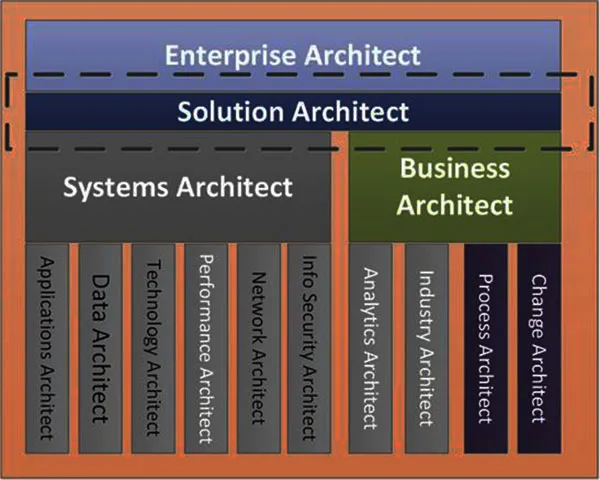
Solution architecture paves the way for a project as it forms the baseline and acts as a foundation stone. Each project is a result of a well-planned and well-executed solution architecture strategy. This is where solution architecture scores over all other processes and is considered to be a critical component and hence it is termed as an elite entity. Same has been depicted in the following figure:
Figure 1.1: Solution architecture
An important point to be noted here is, a solution architect needs specific and significant skills to address various categories of people, technology, and processes. He has to be well versed with all the technologies, be it network, storage, security, database, cloud, DC, wintel, citrix, and even telecom technologies. This is where a solution architect scores over others.
Not only does he need to possess technical skills related to all relevant domains, while preparing a solution, he has to assume, think and assess the number of processes being pursued in his parent organization and importantly, in the client organization. A solution architect must exhibit a balanced mix of technical and business skills and will often work with an enterprise architect for strategic direction and decisions.
Additionally, an architect has to design tools to furnish and model the design. He then has to provide architectural inputs and views of the solution based on that model, thus, enabling solution views to different stakeholder groups and enabling impact assessment for future design changes.
The astonishing quotient
So, it is a piece of IT environment. Then why and where is the astonishing quotient? Let us break this myth as well…
The base model of the architecture is the key to all kinds of delivery models and the entire project’s success relies on this very base model itself. This very architecture model itself provides much more value than a static design diagram. That is why solution architecture phase and all associated activities become very critical. Very often you will find that all the stakeholders that include your very own top management, Vendors along with client management which may include top business heads/CTOs or even CEOs sometimes, are anxiously and eagerly awaiting design inputs and draft version of the solution.
Thus, it makes the job of a solution architect very critical and very important indeed. A moment of lapse in concentration or a silly mistake here and there may end up costing millions or even the entire project. At the same time, a successful solution will bring in loads of accolades, name, fame, and glory. A careful examination of all available statistics and artifacts, discussions, and workshops to gain more information and an eye on the strategic roadmap will help a SA tremendously to hit bull’s eye.
However, as I mentioned, delivering a successful solution in today’s fast changing and highly complex and distributed IT environments requires a lot of thinking in terms of architecture and designs. The SA has to focus on shaping and defining the overall solution and all its associated structures, all integrated components, their dependencies and responsibilities and precisely (and minutely) making core decisions related to impending design and all its associated aspects.
Lastly, a solution architect also needs to address various categories of people. In almost all the projects that a solution architect handles, they will need to do front ending in front of client and their own management to address, elaborate, and suggest a solution for any small or a complex in the simplest of words. problem in laymen's terms. They have to innovate and improvise many a times and find different ways to avoid repeating and convey the same message using a variety of words for different sections of stakeholders and audiences. Thus, it makes it imperative for them to have a deep understanding of all business process, technological depth, people management skills, time management, efficiency, acute preciseness, and a cohesive vision to create a reliable product.
That is how solution architecture and all the solution architects attain the coveted Astonishing Quotient.
Thus, the ultimate goal with each project comprised of solution architecture processes is to successfully address specific business needs, requirements, or problems through the design and development of applications and information systems. A solution architect has to pay attention to below mentioned key aspects:
Provide a solution that must evolve to meet all future requirements
Provide a baseline that is easy to understand and well-crafted in such a way that it defines all the requirements, principles, guidelines, patterns as well as all the constraints
Provides a solution and design which clearly highlights any and every dependency
Provides insights as to which all process changes will have to be accompanied to get the solution validated and executed
Last but not the least provides a solution that is robust, scalable, feasible, efficient, highly available, and economical
Different pieces of IT
IT is a world of Information in itself. It is such a vast field that it cannot be run via a single entity or a single department. Thus, IT is divided into various pieces in terms of roles and entities. In terms of technology, IT is again segregated into numerous sections which sum up various fields. Let us have a look at them one by one.
Segregation in terms of roles and entity
In terms of roles and entity, infrastructure technology has been segregated mainly into below mentioned various fields:
Management
Sales/Pre-sales
Solution development
PMO
IT operations
Support functions (Finance – HR – Administration - Internal IT Support – Learning)
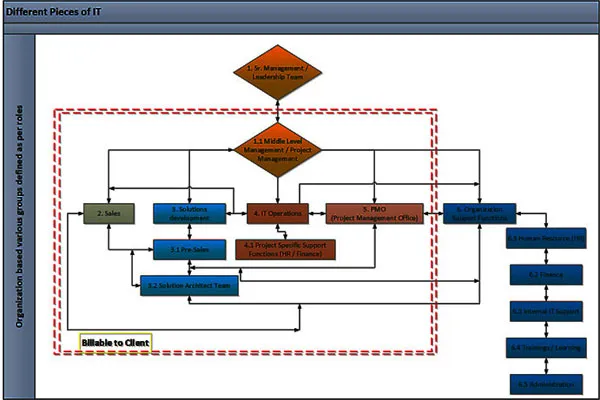
The following representation illustrates all the pieces of IT:
Figure 1.2: Different pieces of IT – roles and entity
As is evident, there are six main sections that primary control all the functions of the entire IT sector.
Management: It starts with management which sits at the top (which is always the case, is not it - pun intended). The management piece is segregated into two various sections. There is Senior Management or Leadership Team which generally includes the likes of Chairman/Director/CEO/CTO/CFO/BU Heads/MD/VPs, and so on. This piece generally owns or controls the firm and is directly responsible for managing all internal and external affairs end-to-end which includes funding, media, handling client top brass, and so on. This layer is the decision-maker and controls funding and lays down policies and guidelines for the organization.
This layer has a sub-piece that is often called as the mid-level or middle level or the high-level or the project management. This layer normally includes Practice Heads/Business Unit Heads/Project Heads/Delivery Unit Heads/Senior Managers, and so on. This layer of management is responsible for running projects or program of projects, bring more business, align with sales to find new opportunities, handle client(s) for their respective project(s) and manage teams and resources with respect to all the relevant domains or tracks as per their project. One important aspect associated with this layer is to control the funding and maintain compliance to service levels that have been agreed with the client. Any deviations from the SLAs or funding gets escalated to the main management layer.
Sales: Sales is one of the most pivotal parts of any organization. They play a very important and critical part in the success of any organization. The success of any organization is mainly dependent on as to how their Sales team perform or how efficient they are. It is the Sales team that help an organization achieve and meet their revenue and fiscal targets.
It is the Sales team which helps to sell a business product or a service to an end user or a client. I...
Table of contents
Cover Page
Title Page
Copyright Page
Dedication Page
About the Authors
About the Reviewers
Acknowledgement
Preface
Errata
Table of Contents
1. Solution Architecture – The Astonishing Quotient
2. Solution Architecture – The Logics
3. The Transformations Project – Lets Usher
4. The Transformations Project – Lifecycle and Process Flow Chart
5. The Transformations Project – Tools and Executions
6. The Transformations Project – Add-Ons
7. The Migrations – Introduction and Lets Usher
8. Migrations Types – Application Stacks – Move Groups
9. The Migrations Project – Process Flow-Chart
10. The Migrations Project –Topology, Milestone, Legacy OS-Hardware and Documents
11. The Migrations Project – Deliverables, Testing, and Rollbacks
12. The Epilogue
Index
Trusted by 375,005 students
Access to over 1.5 million titles for a fair monthly price.
Study more efficiently using our study tools.
Frequently asked questions
Yes, you can cancel anytime from the Subscription tab in your account settings on the Perlego website. Your subscription will stay active until the end of your current billing period. Learn how to cancel your subscription
No, books cannot be downloaded as external files, such as PDFs, for use outside of Perlego. However, you can download books within the Perlego app for offline reading on mobile or tablet. Learn how to download books offline
Perlego offers two plans: Essential and Complete
Essential is ideal for learners and professionals who enjoy exploring a wide range of subjects. Access the Essential Library with 800,000+ trusted titles and best-sellers across business, personal growth, and the humanities. Includes unlimited reading time and Standard Read Aloud voice.
Complete: Perfect for advanced learners and researchers needing full, unrestricted access. Unlock 1.5M+ books across hundreds of subjects, including academic and specialized titles. The Complete Plan also includes advanced features like Premium Read Aloud and Research Assistant.
Both plans are available with monthly, semester, or annual billing cycles.
We are an online textbook subscription service, where you can get access to an entire online library for less than the price of a single book per month. With over 1.5 million books across 990+ topics, we’ve got you covered! Learn about our mission
Look out for the read-aloud symbol on your next book to see if you can listen to it. The read-aloud tool reads text aloud for you, highlighting the text as it is being read. You can pause it, speed it up and slow it down. Learn more about Read Aloud
Yes! You can use the Perlego app on both iOS and Android devices to read anytime, anywhere — even offline. Perfect for commutes or when you’re on the go. Please note we cannot support devices running on iOS 13 and Android 7 or earlier. Learn more about using the app
Yes, you can access Enterprise Solution Architecture - Strategy Guide by Nitesh Garg; Atul Sharma in PDF and/or ePUB format, as well as other popular books in Computer Science & Information Technology. We have over 1.5 million books available in our catalogue for you to explore.