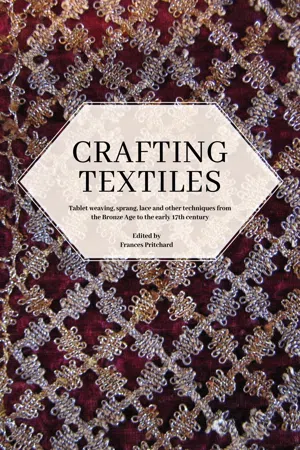
New research into the techniques of tablet weaving, sprang, braiding, knotting and lace is presented in this lavishly illustrated volume written by leading specialists from Austria, Canada, Denmark, France, Germany, Sweden, Switzerland, the UK, and USA. Drawing inspiration from the pioneering work of Peter Collingwood, this publication explores aspects of these craft skills in the prehistoric, Roman, and medieval world through scientific, object-based analysis and 'research through making'. Chapters include the growth of patterned tablet weaving for trimming garments in prehistoric Central Europe; recently identified styles of headdress worn in the Roman Rhineland and pre-Islamic Egypt; Viking-age Dublin as a production center for tablet-woven bands; a new interpretation of the weaving technique used to make luxurious gold bands in the twelfth to late thirteenth centuries; and the development out of plaiting of bobbin lace borders in gold and silver threads from the fifteenth to early seventeenth centuries. Practical experiments test methods of hand spinning and the production of figure-hugging hose in ancient Greece and Renaissance Italy. A typology of braid and knotting structures in late medieval Europe is also set out for the first time. Diagrams, illustrations, and photographs enrich each chapter with a wealth of visual source material. The work is the outcome of recent discoveries of archaeological textile finds from excavations as well as fresh examination of material recovered in the past, or preserved in treasuries. Early textiles form an increasingly popular subject of interest and this publication, which is a landmark in the study of various specialized textile techniques, aims to provide the reader with a better understanding of these virtuoso craft skills in antiquity.
eBook - ePub
Crafting Textiles
Tablet Weaving, Sprang, Lace and Other Techniques from the Bronze Age to the Early 17th Century
- 240 pages
- English
- ePUB (mobile friendly)
- Available on iOS & Android
eBook - ePub
Crafting Textiles
Tablet Weaving, Sprang, Lace and Other Techniques from the Bronze Age to the Early 17th Century
About this book
Trusted by 375,005 students
Access to over 1.5 million titles for a fair monthly price.
Study more efficiently using our study tools.
Information
Subtopic
Fashion DesignIndex
Social SciencesSection III
Braiding and lace making
Chapter 8
Braided strings and Turk’s head knots on European secular and religious textiles
Joy Boutrup
Introduction
Braided strings and Turk’s head knots are part of a larger group of textiles which today is called passementerie. They are often present together on medieval and renaissance purses, bags, bookmarks, seal strings as well as on many religious textiles. Both were made by the same artisans and often of the same materials. These parts of textile objects have until recently been studied very little and are often not analysed or even described in detail in the records of church collections and museums. This paper aims to point out the lack of information in these fields at present and to show some examples of analysis and description.
The organisation of the professional makers and the trade has been researched to some extent mainly based on the guild records and regulations in the different countries in Europe (Braun-Ronsdorf 1956, 26−30; Heutte 1972, 12−35). The guilds have changed and merged over time in most countries so that these artisans have not always been in a separate guild but often part of other guilds. It is remarkable though that women were allowed in the guilds and often were masters of workshops themselves (Depping 1837, 382−86). Even outside the guilds many women were actively producing and selling passementerie in market places, and a certain more or less professional production probably took place in cloisters and monasteries all over Europe.
There is no written evidence from the professional workshops as to what tools they used or which structures of braids or knots they produced. Knowledge of the structures is limited to studies of the surviving objects and the few written instructions from the early fifteenth century. These are all instructions for loop braiding written by non-professionals: a manuscript in the British Library, MS Harley 2320, and an East Anglian household book known as the Book of Secrets, which remains the property of the Tollemache family (Griffith 1997). There are no contemporary instructions for Turk’s head knots known at present. Loop braiding is depicted in two frescoes and one panel painting all of which portray domestic scenes. They are ‘The weaver fresco’, c. 1316 in the Haus zur Kunkel, Constance, Baden Wurtemberg, Germany; a weaving scene in the lower right corner of The Triumph of Minerva, Palazzo Schifanoia, Ferrara, Italy, c. 1467; and the History of the Virgin Mary, on an altarpiece by Nicolás Zaortiga in the church of St Mary, Zaragoza, Spain, dated 1465. The first written description of these types of crafts is found in Christoff Weigel’s Abbildung der gemeinnützlichen Hauptstände from 1698. An engraving by Weigel shows a button maker holding the button stuck on an awl in one hand and needle and thread in the other hand (Fig. 8.1). Other kinds of passementerie works are shown hanging on the wall, corded strings and fringes are being made in the foreground and background. It is clear from the text that several types of Turk’s head knots are produced and also that the loop braiding is used in an advanced state. Braids with motifs and letters are mentioned.
Loop braiding
Loop braiding is one of several braiding techniques, but recent studies have shown that it was the main production method both in professional workshops and in amateur surroundings from the middle ages until the invention of braiding machines (Speiser & Boutrup 2009a & b; 2011; 2012). It is a fast braiding method especially well-suited for thin and slippery yarns, such as silk. No tools are needed and several people can work together by exchange of loops, one method of which is described in the manuscripts with instructions for loop braiding. Loop braiding allows for a large variation of braids such as flat, compact round, hollow round double-layered structures with exchange of layers (Speiser 2000; Griffith 1997; London, British Library MS Harley 2320). Some structures could only have been made by loop braiding while other structures could also have been made by other methods. However, certain mistakes in the braids indicate that loop braiding has been used.
The first workable methods for the analyses and rendering of oblique interlaced structures were devised by Noémi Speiser in her book on braiding (Speiser 1983, 76−79, 217−19). The analyses consist of counting the ridges, their number and length of span, the number of elements or loops, a drawing of the cross section and then deriving the trackplan from these details. The trackplan is a flat projection of the three-dimensional track the threads are following in the braid. The structure can then be compared with the existing contemporary instructions and with other analysed braids.
The following are four examples of analyses of braid structures found in Europe.
Tasselli, Cathedral Museum, Trier, Germany
Tasselli are small, round, embroidered adornments on bishops’ gloves. The Cathedral museum in Trier possesses one set of two and a single one from excavations in the cathedral (Fig. 8.2). All three are made the same way but with different motifs in the centre. The centre is embroidered and the edge covered with a narrow silk braid c. 4 mm wide. In Speyer, Germany, is a similar and contemporary tassellus edged with two braids of the same structure (Müller-Christensen 1972, 1005, fig. 1583). The structure is complex although the making is very simple when using loops. Two people each with five loops cooperate in making this structure. The complexity comes from the fact that some loops are passed over during braiding, a method now called unorthodox. Further complexity derives from the way the loops are exchanged between the workers, now called unorthodox exchange (Speiser & Boutrup 2009a, 18−20). This method gives a twist to both loops involved in the exchange (Fig. 8.3). Braids of this type are often found on early textiles, for example most of the braids on relic purses in the Basilica of Tongeren, Belgium; in Valeria, Sion, Switzerland (Speiser & Boutrup 2009a, 27−32); and in St Servatius, Maastricht, The Netherlands (Stauffer 1991). The finds from the London excavations also show a large number of this type of braid with two, three and four people cooperating (Crowfoot et al. 1992, 138−41; Boutrup 2010, 20−29).

Fig. 8.1. Silk button maker (Christoff Weigel 1698). (© Deutschefotothek.de)
Relic purse, Vannes Cathedral, fourteenth century
Vannes cathedral in Brittany has a collection of early relic purses (Plantec 1991, 86−99). Purse no. 811 was originally of red silk lined with yellow silk but the red silk is only preserved at the edges (Fig. 8.4). The drawstrings are compact and more or less round, the cross section has been changed in some places due to pressure. There are eight ridges alternating S and Z. A similar structure has been identified by Noémi Speiser in the Victoria and Albert Museum on a sudarium, which was probably originally from Halberstadt cathedral (V&A 8279−1863); also in braids on the girdle of Philip of Schwabia (d. 1208) in Speyer (Boutrup 2011); and in a seal string (Boutrup 2008, 11−16). There are two braids of this structure in the finds from the London excavations (Boutrup 2010, 21). There are variations in the structure that can easily be caused by mistakes during braiding. These variations are all consistent with the use of loops and is caused by variations in the way the loops are taken (Fig. 8.5). The structures can be made by two people holding four or five loops each. There is no exchange of loops involved as the two people work alternately (Fig. 8.6). They are actually producing two braids interlaced across each other. Similar methods of crossing two structures are mentioned in the Tollemache and Harley manuscripts, although in connection with another structure (Speiser 2000, 64).
These two early examples are representative of the fact that these types of braids are not mentioned in the fifteenth-century instructions and that no orthodox exchange is used. Until around 1400 there seem to be only braids made by one person or, when two people work together, either no exchange is involved or when an exchange is used then only the unorthodox exchange. The early fifteenth-century instructions give a precise instruction for the orthodox exchange and from this time new types of braids appear. The next two examples are from the fifteenth century and show the use of the instructions in the Tollemache and Harley manuscripts for orthodox exchange.
Aurifrisium, fifteenth century
The aurifrisium in Halberstadt cathedral is about 12 mm wide, single layered, flat with eight gold threads and eight of blue silk (Fig. 8.7). There are 14 ridges, 1 1 1 1 1 1 1 2 1 1 1 1 1 1, almost plain interlacing. The first impression is that it is braided with open ends, but two mistake...
Table of contents
- Front Cover
- Title Page
- Copyright Page
- Contents
- Acknowledgements
- Introduction
- List of contributors
- Dedication
- Section I: Tablet weaving
- Section II: Sprang
- Section III: Braiding and lace making
- Section IV: Spinning
Frequently asked questions
Yes, you can cancel anytime from the Subscription tab in your account settings on the Perlego website. Your subscription will stay active until the end of your current billing period. Learn how to cancel your subscription
No, books cannot be downloaded as external files, such as PDFs, for use outside of Perlego. However, you can download books within the Perlego app for offline reading on mobile or tablet. Learn how to download books offline
Perlego offers two plans: Essential and Complete
- Essential is ideal for learners and professionals who enjoy exploring a wide range of subjects. Access the Essential Library with 800,000+ trusted titles and best-sellers across business, personal growth, and the humanities. Includes unlimited reading time and Standard Read Aloud voice.
- Complete: Perfect for advanced learners and researchers needing full, unrestricted access. Unlock 1.5M+ books across hundreds of subjects, including academic and specialized titles. The Complete Plan also includes advanced features like Premium Read Aloud and Research Assistant.
We are an online textbook subscription service, where you can get access to an entire online library for less than the price of a single book per month. With over 1.5 million books across 990+ topics, we’ve got you covered! Learn about our mission
Look out for the read-aloud symbol on your next book to see if you can listen to it. The read-aloud tool reads text aloud for you, highlighting the text as it is being read. You can pause it, speed it up and slow it down. Learn more about Read Aloud
Yes! You can use the Perlego app on both iOS and Android devices to read anytime, anywhere — even offline. Perfect for commutes or when you’re on the go.
Please note we cannot support devices running on iOS 13 and Android 7 or earlier. Learn more about using the app
Please note we cannot support devices running on iOS 13 and Android 7 or earlier. Learn more about using the app
Yes, you can access Crafting Textiles by Frances Pritchard in PDF and/or ePUB format, as well as other popular books in Social Sciences & Fashion Design. We have over 1.5 million books available in our catalogue for you to explore.