Explore the mysteries of the cosmos in this fascinating guide by leading NASA astronomer and educator Sten Odenwald. Have you ever wondered how the first stars were born? Or pondered what really happens around a black hole? Here Sten Odenwald answers these questions and many more as he takes you on a mesmerizing journey across the entire history of the universe. You will learn about the composition of planets, galaxy mergers, asteroid belts, the fundamental nature of spacetime, and much, much more. Discovering the Universe reveals the secrets behind subjects as varied as the Big Bang, dark matter, the life cycle of stars, and the nature of planets both inside and outside our solar system.Beautifully illustrated throughout with stunning photos as well as a range of diagrams and infographics to aid understanding, there has never been a better time to get into cosmology. ABOUT THE SERIES: Arcturus' Discovering... series brings together spectacular hardback guides which explore the science behind our world, brought to life by eye-catching photography.
The term universum was first coined by the Roman statesman Cicero in the 1st century BCE. Today, we know that our universe includes all things on Earth, our solar system, and the distant stars and galaxies beyond. It also encompasses a vast and possibly infinite space, which has been in existence for nearly 14 billion years. The manner in which the universe came into existence was for most of human history a matter of religious consideration. All of the creation stories shared one thing in common: they had to provide an explanation for how something (the universe) was created or appeared out of nothing. Today, astrophysicists are still struggling with this perplexing mystery expressed in modern language, and with a modicum of impish humour, as “Why is there Something rather than Nothing?”
Hubble eXtreme Deep Field (XDF) image of a small portion of the universe showing thousands of galaxies to a distance of nearly 13 billion light years. At its farthest limits it can just detect infant galaxies formed 500 million years after the Big Bang.
//Creation stories
In antiquity, the composition of the objects in the universe was based upon a set of basic elements proposed by Aristotle as earth, air, fire, water, and aether. The first four were found on Earth while the planets, stars, and other denizens of the Empyrium were fashioned from a pure, luminous substance called aether (αιθερ). Although Aristotle considered five elements, in India’s Vedic philosophy these were supplemented by the elements of time, direction, mind and soul. All objects in the world were fashioned from combinations of these elements. Ancient philosophers who thought about the universe invariably found themselves thinking in terms of the basic ingredients to all things, which came to be called atomos by the 5th century BCE Greeks such as Democritus, or parmanu in the 6th century BCE by the Vedic sage, Kanada.
Alongside a knowledge of the ingredients to the world, people had to create stories to explain how specific things in the world came to be formed from these elemental ingredients. In ancient Egypt, Atum-Ra first created himself out of the dark waters of Nun by uttering his own name. He followed this act by bringing into being over time all the other gods and places. Babylonians also began with cosmic waters imbued with their own deities: Apsu for fresh water and Tiamat for bitter salt water. These conflicting deities then created all the other deities including Marduk who eventually kills Tiamat, and from her corpse creates the heavens and Earth. Also in the mid-East, the Judeo-Christian Genesis of the Old Testament begins with the formless waters of Tehom that were acted upon by Elohim (Yahweh) to create the heavens, Earth, and all life.
Chaos by George Frederic Watts (1817–1904) depicting the primeval state of nature described in the Biblical Book of Genesis.
The biggest challenge for our ancestors in fashioning these stories is stated perhaps for the first time in the Rig Veda (10:129): “Who knows from whence this great creation sprang?” It is answered by the realization that even the “most-High seer that is in highest heaven” may not know! Nevertheless, for thousands of years, humans found these kinds of stories entirely workable and useful for their needs. Only in the last 100 years have new insights allowed us to fashion an even better “story” of what we now call cosmogenesis. The biggest challenge for humans today has been in incorporating into the modern Creation “story” all of the new, essential ingredients we have uncovered and also showing how they are interrelated in a logical way. These ingredients represent seven specific kinds of phenomena and attributes of our physical world. Let’s have a look at them one by one.
Egyptian universe after Atum-Ra creates Shu (Air), who then separates the heavens (Nut) from the land (Geb).
//Ingredient 1: Matter
By as late as the 15th century alchemists had only succeeded in identifying a few dozen additional compounds beyond Aristotle’s canonical five. Today, the search for the fundamental elements of nature has inexorably led to the discovery of more than 94 naturally occurring ones on Earth, and an additional 24 artificially created with advanced technology. Centuries of scientific investigation and technological advance have also led to a deep understanding of the nature of matter formed from a small collection of basic elements assembled into molecules of bewildering complexity. But the reduction of matter toits most elementary constituents did not end here. Starting in the early 20th century, atoms were also found to be composed of electrons, protons, and neutrons. The heaviest known element, called Oganesson, was discovered in 2002 and has 118 protons, 118 electrons, and 176 neutrons. By mid-century, experiments on protons discovered that they, themselves, were composed of still more elementary objects called quarks. Over time, physicists discovered exactly six different kinds of quarks that were given the humorous names: up (U), down (D), strange (S), charm (C), bottom (B), and top (T). The familiar protons and neutrons only required two of these types, the U and D quarks, assembled into groups of three, for example, a proton consists of the three-quark combination UUD and the neutron has the opposite combination DDU. Hundreds of other, more massive, particles required additional combinations of the six types of quarks to account for them.
The structure of an atom, including quarks. An atomic nucleus consists of protons and neutrons, but each of these is in turn comprised of three quarks bound together by the strong nuclear force transmitted by the exchange of particles called gluons.
Alongside the six quarks, the second and much lighter family of elementary particles are called the leptons. The electron, a workhorse of our modern civilization, is the most familiar of these, but is paired with another particle called the neutrino. During the process of radioactive decay, such as when a neutron decays after about ten minutes, the neutron becomes a proton and also emits an electron and a neutrino. Other particles can also undergo decays emitting additional, more-massive leptons such as the muon and the tauon, accompanied by their own partnering neutrinos.
Antimatter was discovered in the 1930s and is a form of matter in which its charge has an opposite sign from normal quark and lepton matter. For example, the electron with a negative electric charge has an antimatter version called the positron with exactly the same mass but with a positive charge. A down quark (D) with a charge of -⅓ has an antimatter version (D) with a +⅓ electric charge. Similarly, the up quark (U) with +⅔ charge has an antimatter version (U) with -⅔ charge. This is why the neutron with no net charge has an antiparticle, the antineutron. While the neutron contains the matter quarks DDU, the antineutron consists of the three antiquarks DDU.
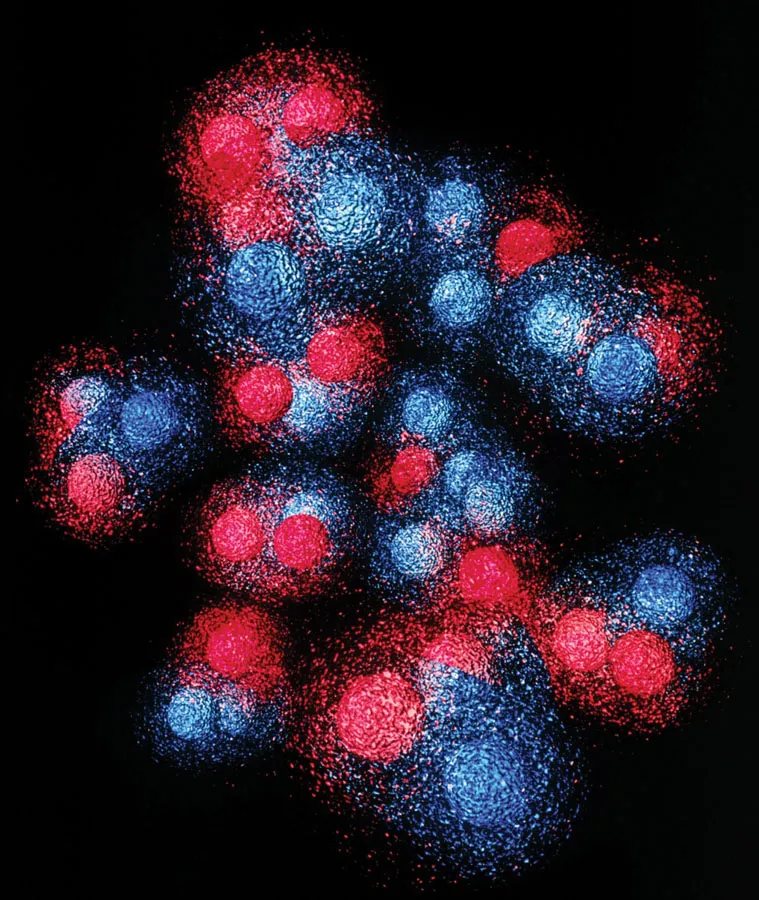
A carbon nucleus contains six protons and six neutrons, but these can be created from quarks. This computer rendering shows how the protons and neutrons are resolved into their constituent red “up” quarks and blue “down” quarks.
Another important feature of particles and their antiparticles is that, when they are brought together, they vanish in a burst of energy. Albert Einstein’s theory of special relativity states that matter and energy are equivalent physical properties, related by his iconic formula E=mc2. An electron and positron brought together produce exactly two gamma rays that each carry off an amount of energy equal to E=mc2 where m is the mass of an electron and c is the speed of light. It is also possible to create an electron-positron pair by using an “atom smasher” where the collision energy between particles can be used to create these pairs almost literally “out of nothing.” The essential contents of our universe can be neatly summarized by the six quarks, the six leptons and their antimatter twins, and are codified in what physicists call the Standard Model. But there is a fly in the ointment.
Since the 1990s, astronomers have studied the movements of galaxies and the rotation of our own Milky Way, uncovering a vast reservoir of unseen “dark” matter. Dark matter is not the same kind of matter that appears in the Standard Model. It appears to be invisible; it emits no light; nor does it seem to absorb or reflect light from more distant stars. Instead, it can only be detected by its gravitational influences on things we can see. The motions of galaxies near the Milky Way, as well as the speeds and movements of stars and gas clouds inside the Milky Way, reveal the extent of a vast halo of dark matter surrounding our own galaxy. Modern estimates suggest that about eight times more dark matter exists in our Milky Way than in the...
Table of contents
Title Page
Dedication
Other books by Sten Odenwald
Contents
Introduction
Part 1: How to Build a Universe
Part 2: Exploring the Big Bang
Part 3: Stellar Evolution
Part 4: The First Stars and Galaxies
Part 5: The Milky Way
Part 6: Planetary Systems
Part 7: Our Solar System
Part 8: Space Travel
Further Reading
Picture Credits
Copyright Page
Frequently asked questions
Yes, you can cancel anytime from the Subscription tab in your account settings on the Perlego website. Your subscription will stay active until the end of your current billing period. Learn how to cancel your subscription
No, books cannot be downloaded as external files, such as PDFs, for use outside of Perlego. However, you can download books within the Perlego app for offline reading on mobile or tablet. Learn how to download books offline
Perlego offers two plans: Essential and Complete
Essential is ideal for learners and professionals who enjoy exploring a wide range of subjects. Access the Essential Library with 800,000+ trusted titles and best-sellers across business, personal growth, and the humanities. Includes unlimited reading time and Standard Read Aloud voice.
Complete: Perfect for advanced learners and researchers needing full, unrestricted access. Unlock 1.4M+ books across hundreds of subjects, including academic and specialized titles. The Complete Plan also includes advanced features like Premium Read Aloud and Research Assistant.
Both plans are available with monthly, semester, or annual billing cycles.
We are an online textbook subscription service, where you can get access to an entire online library for less than the price of a single book per month. With over 1 million books across 990+ topics, we’ve got you covered! Learn about our mission
Look out for the read-aloud symbol on your next book to see if you can listen to it. The read-aloud tool reads text aloud for you, highlighting the text as it is being read. You can pause it, speed it up and slow it down. Learn more about Read Aloud
Yes! You can use the Perlego app on both iOS and Android devices to read anytime, anywhere — even offline. Perfect for commutes or when you’re on the go. Please note we cannot support devices running on iOS 13 and Android 7 or earlier. Learn more about using the app
Yes, you can access Discovering The Universe by Sten Odenwald in PDF and/or ePUB format, as well as other popular books in Scienze fisiche & Cosmologia. We have over one million books available in our catalogue for you to explore.