- 194 pages
- English
- PDF
- Available on iOS & Android
About this book
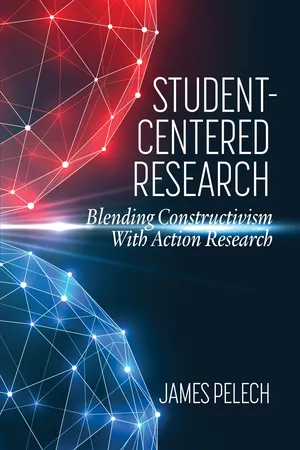
Teachers increasingly are being charged to conduct research on teaching and learning in their classes. Action research is an instrument that teachers can use for their particular classroom to meet this charge. While traditional research provides effective guidelines for teaching and learning, its generalized format does not take into consideration the multitude of variables that affect individual classrooms and students. Action research enables the teacher to improve the learning of the students in their particular context; this, in turn, improves the professional practice of the teacher.
The uniqueness of the model presented in this book is that this model is guided by specific constructivist principles. These principles are then transformed into learning strategies and applied to the action research cycle. Each stage of the action research process also is steered by prompts emanating from the constructivist philosophy. The prompts provide questions that the teacher can use to examine current practices and consider new approaches.
The blending of constructivism and action research enables the teacher to create a new cognitive framework for understanding and enhancing student learning . This book provides a guide for combining two important traditions resulting in a research platform which creates new knowledge about both students and teachers.
Trusted by 375,005 students
Access to over 1 million titles for a fair monthly price.
Study more efficiently using our study tools.
Information
Table of contents
- Cover
- Student-Centered Research
- Student-Centered Research: Blending Constructivism With Action Research
- Copyright
- Contents
- Foreword
- Acknowledgments
- 1: Introduction and Overview
- 2: Helping Students Learn
- 3: Reflection and Teacher Research
- 4: Examining Teacher Research
- 5: Cognitive Foundations
- 6: Organizing the Constructivist Principles
- 7: Important Prerequisites
- 8: Planning for the Area of Focus and the Learning Environment
- 9: Planning for Data, Data Interpretation, and Communication
- 10: Phase 1: Discussing Quiz Preparation
- 11: Phase 2: Introducing Active Processing
- 12: Phase 3: Affirming Themes and Restructuring
- 13: Phase 4: Making Mistakes and Learning
- 14: The Final Action Plan
- 15: Validity
- Index
- About the Author
Frequently asked questions
- Essential is ideal for learners and professionals who enjoy exploring a wide range of subjects. Access the Essential Library with 800,000+ trusted titles and best-sellers across business, personal growth, and the humanities. Includes unlimited reading time and Standard Read Aloud voice.
- Complete: Perfect for advanced learners and researchers needing full, unrestricted access. Unlock 1.4M+ books across hundreds of subjects, including academic and specialized titles. The Complete Plan also includes advanced features like Premium Read Aloud and Research Assistant.
Please note we cannot support devices running on iOS 13 and Android 7 or earlier. Learn more about using the app