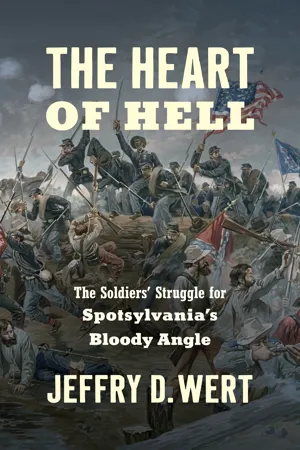
The struggle over the fortified Confederate position known as Spotsylvania’s Mule Shoe was without parallel during the Civil War. A Union assault that began at 4:30 A.M. on May 12, 1864, sparked brutal combat that lasted nearly twenty-four hours. By the time Grant’s forces withdrew, some 55,000 men from Union and Confederate armies had been drawn into the fury, battling in torrential rain along the fieldworks at distances often less than the length of a rifle barrel. One Union private recalled the fighting as a “seething, bubbling, soaring hell of hate and murder.” By the time Lee’s troops established a new fortified line in the predawn hours of May 13, some 17,500 officers and men from both sides had been killed, wounded, or captured when the fighting ceased. The site of the most intense clashes became forever known as the Bloody Angle.
Here, renowned military historian Jeffry D. Wert draws on the personal narratives of Union and Confederate troops who survived the fight to offer a gripping story of Civil War combat at its most difficult. Wert’s harrowing tale reminds us that the war’s story, often told through its commanders and campaigns, truly belonged to the common soldier.
eBook - ePub
The Heart of Hell
The Soldiers' Struggle for Spotsylvania's Bloody Angle
- 304 pages
- English
- ePUB (mobile friendly)
- Available on iOS & Android
eBook - ePub
About this book
Trusted by 375,005 students
Access to over 1.5 million titles for a fair monthly price.
Study more efficiently using our study tools.
Information
{1} We Must Whip Them
Major David W. Anderson of the 44th Virginia knew that the sounds coming toward him through the darkness of night might indicate enemy troops on the march. A farmer from Fluvanna County before the war, the thirty-five-year-old native Virginian had been in Confederate service for nearly three years. On this night of May 11–12, 1864, outside of Spotsylvania Court House, Virginia, the veteran major was serving as officer of the day and responsible for the command’s security. Experience told him that the “steady rumble” he heard meant something, perhaps an ill wind blowing in with a new day’s dawn.1
Fellow officers and enlisted men shared Anderson’s concern. A staff officer described the sound as a “subdued roar or noise, plainly audible in the still, heavy night air, like distant falling water or machinery.” Skirmishers from Colonel William A. Witcher’s brigade, posted along a farm lane roughly five hundred yards to the front, reported that there must be thousands of Yankees beyond the woods to the north. Music from Union bands drifted through the cold, steady rain into Confederate lines as if it were an advance requiem.2
The Confederate soldiers belonged to Major General Edward Johnson’s division of the Second Corps, Army of Northern Virginia. They manned a bulge or a salient in the army’s lines, which the men thought resembled a horse or mule shoe. Such a defensive formation invited attacks and, on the day before, May 10, a dozen Union infantry regiments, stacked in four lines, breached the salient’s western face, penetrating deeper into it and capturing prisoners and cannon. Confederate reserves repulsed the Federals and resealed the wide gash in the Confederate works.3
The Rebels and their foes, members of the Union Army of the Potomac, had been fighting each other in this new campaign for seven consecutive days. They were old enemies, killing and maiming each other at terrible places—the Cornfield at Antietam, along the stone wall below Marye’s Heights at Fredericksburg, and across the farmers’ fields and orchards at Gettysburg. But this past week of combat had had a different character to it, an unrelenting bloodletting that seemed to portend a darker road ahead.
Were the sounds then, as Anderson and his comrades increasingly believed, the massing of Federal infantry and artillery for another assault? With each passing hour toward dawn, the Confederates became more concerned that the Yankees would be coming. “There was,” recalled a Rebel skirmisher, “a nameless something in the air which told every man that a crisis was at hand.” This infantryman and his fellow veterans could not have known in the early morning’s darkness the magnitude of the crisis that would soon engulf them. More than a crisis, however, loomed over the salient, for a hellish fury was to be unleashed, the depths and duration of which had not been witnessed before in this fearful conflict.4
______
The Union Army of the Potomac and the attached Ninth Corps began crossing the Rapidan River in central Virginia on May 4, 1864, initiating a long-anticipated spring campaign. Altogether, the army was a powerful force, with 119,000 officers and men. An accompanying newspaperman called them “the Grand Army,” adding, “It is a compact, self-reliant, veteran host, conscious that it is able to deliver mightier blows than ever before, knowing that there will be blows to take as well as blows to give.”5
South of the river, awaiting them, were the 66,000 members of the Confederate Army of Northern Virginia. A certainty to the forthcoming campaign’s outcome imbued their ranks. “I think you may confidently expect a glorious issue in the impending campaign,” a lieutenant had assured his sister two days earlier, “a campaign between right and wrong, we are backed by an army of good and true men, the other by a bunch of lawless outcasts and mercenaries.” A fellow officer put it more bluntly in a letter home, “We only wish for a chance to slaughter” the Yankees.6
The approaching confrontation between the old nemeses had had an inevitability for weeks, if not months. As the Federals forded the Rapidan on May 4, it had been ten months to the day since the Confederates had undertaken their retreat from the battlefield at Gettysburg, Pennsylvania. The withdrawal ceased by the end of July 1863, in the region drained by the Rappahannock and Rapidan rivers. An interlude of sorts in active operations followed, extending through autumn 1863 and into winter and spring 1864.7
Before winter brought cold and inclement weather, however, both armies—General Robert E. Lee’s Rebels and Major General George G. Meade’s Yankees—undertook offensive movements. Lee advanced against the Federals in mid-October in the Bristoe Campaign, which brought the opposing forces to the outskirts of Washington, D.C. Prodded by the Union administration, Meade led his army across the Rapidan River in the Mine Run Campaign at the end of November. Both operations proved indecisive, with the armies settling into winter quarters for the next five months.8
Confederate winter camps sprawled across the countryside south of the Rapidan and Rappahannock rivers. Shortages of rations and fodder for animals plagued the army throughout the winter months. At one point, Lee admitted to a general, “The question of food for this army gives me more trouble and uneasiness than every thing else combined.” He was forced to disperse his cavalry units and artillery batteries across the various counties because of a lack of feed for the horses and mules.9
Letters by officers and men to home folks reflected the hardship in their camps. A Georgian informed readers in a newspaper, “Rations are short now, but there is little complaint made.” Occasionally, the men received coffee, sugar, and rice, which reminded “us of home before the war.” A Virginian told his wife, “The officers have been reduced down to same rations as the privates and it is issued to them just the same as it is issued to us.” Another soldier recalled: “Coffee and sugar were priceless luxuries. Bread and bacon were worth risking life for. A pair of shoes from a dead man.” Folks tried to alleviate the shortages with packages of foodstuffs and clothing items.10
Shortages in the army and stark conditions at home, related by loved ones in letters, drove many to desert. Loosened restrictions on furloughs lessened the problem but did not cease the outward flow. “Running away from the army is not fine work,” argued a member of the 11th North Carolina. “We are soldiers, and we have to stay as long as there is any war.” Thousands of men reenlisted, however, while recruits, or “new issue” as veterans dubbed them, joined the army.11
The tens of thousands who remained in the ranks, performing their soldiery duties, had been steeled by past hardships and adversity. The reasons they had enlisted earlier still held as motivation—duty, honor, God, defense of home and family, and the cause of independence. They had a shared legacy of battlefield prowess and an “unconquerable spirit.” Another reason in the estimation of a North Carolinian was “Determination” to see the war through to the end.12
Perhaps nothing kept them in the field with all the shortages and concern for families at home more than a profound belief in the army’s commander. “With unbounded confidence in Gen Lee, and men enough,” asserted a Virginian, “we fear not the issue.” Colonel Clement Evans of the 31st Georgia said of Lee and his men, “He is the only man living in whom they would unreservedly trust all power for the preservation of their independence.” The bond between Lee and the army’s rank and file had been forged at Second Manassas, Antietam, Fredericksburg, Chancellorsville, and even Gettysburg and remained unshakable.13
The men had always appreciated Lee’s concern for their welfare, and the lack of food and clothing during this winter tested their commander’s administrative abilities more than ever. It appears that the effects of an illness in March 1863 still lingered, weakening him. “I feel a marked change in my strength since my attack last spring at Fredericksburg, and am less competent for my duty than ever,” he confided to a son. Lee had suffered from some sort of heart problem, likely angina pectoris, the inflammation of the membrane around the organ.14
A Confederate officer returned to the army in the spring and recounted: “I was struck by the change in General Lee’s complexion. When I saw him the year before, his skin was a healthy pink. Now it was decidedly faded. He had aged a great deal more than a year in the past twelve months.” The officer noted, “But he sat on Traveller [the general’s favorite horse] as firmly as ever.”15
The burdens of army command, however, required Lee’s daily attention. Headquarters consisted of a handful of small tents pitched on a steep hill two miles northeast of Orange Court House. Lee relied heavily on a small personal staff of highly capable officers—lieutenant colonels Walter H. Taylor, Charles Marshall, and Charles S. Venable—to attend to the paperwork and myriad details of the administration of an army. Despite his words to his son about his stamina, Lee spent many hours at a desk, in meetings with subordinates, or examining on horseback the army’s defenses along the rivers.16
From headquarters Lee contemplated the strategic landscape before him, recognizing that the situation had changed since fall 1863. “We are not in a condition, & never have been, in my opinion, to invade the enemy’s country with a prospect of permanent benefit,” he informed President Jefferson Davis on February 3, 1864. “But we can alarm & embarrass him to some extent & thus prevent his undertaking anything of magnitude against us.” It was a frank assessment and, in turn, a subtle admission that Lee’s opponent might dictate the struggle’s future course.17
Since Lee had assumed command of the army on Sunday, June 1, 1862, outside of Richmond, with the Union army at the doorstep of the Confederate capital, he had adopted an aggressive offensive strategy. As Davis’s military adviser, Lee had witnessed the results of the government’s passive defensive strategy during the winter and spring of 1862. Union armies and navy had captured forts and cities—Nashville and New Orleans—had won battlefield victories, and stood poised to capture Richmond and thus end Confederate hopes for independence.18
By the war’s second spring, then, Lee understood that the conflict had become a struggle between two democratic societies. Each side’s war effort depended upon the support of its respective populaces, their willingness to accept the casualties and sacrifices necessary to achieve ultimate victory. Lee believed that the Confederacy’s limited resources could neither sustain a long conflict nor result in an overall military victory. Confederate independence could only be obtained in a political settlement with the Union administration. In turn, Lee directed his strategy against the consent and support of Northern civilians.19
In Lee’s judgment, a protracted conflict doomed the Confederacy. The North’s vast agricultural and industrial resources, combined with a deep reservoir of manpower and a network of railroads, could sustain its military forces in prolonged campaigns across the geographic vastness of the Confederacy. Time was a relentless enemy of the Confederates. If their opponents remained steadfast in support of the cause of the Union, the struggle’s outcome seemed inevitable.20
To stay that powerful and darkening shadow of Union military might from descending across the Confederacy, Lee acted, adopting an aggressive offensive strategy. If the Confederates were to break the will of the Northern populace to wage war, they had to win a series of battlefield victories, killing and maiming enemy soldiers. It was a matter of waging a...
Table of contents
- Cover
- Series Page
- Title Page
- Copyright
- Dedication
- Contents
- List of Maps
- Preface
- 1. We Must Whip Them
- 2. The Deeply Hated Wilderness
- 3. Sponsey Crania Burnt House
- 4. No Backward Steps
- 5. Near to Momentous Happenings
- 6. General, They Are Coming!
- 7. The Situation Was Critical
- 8. The Very Air Smelled of a Fight
- 9. The Death-Grapple of the War
- 10. Carnage Infernal
- 11. Such a Place
- Photographs
- Acknowledgments
- Notes
- Bibliography
- Index
Frequently asked questions
Yes, you can cancel anytime from the Subscription tab in your account settings on the Perlego website. Your subscription will stay active until the end of your current billing period. Learn how to cancel your subscription
No, books cannot be downloaded as external files, such as PDFs, for use outside of Perlego. However, you can download books within the Perlego app for offline reading on mobile or tablet. Learn how to download books offline
Perlego offers two plans: Essential and Complete
- Essential is ideal for learners and professionals who enjoy exploring a wide range of subjects. Access the Essential Library with 800,000+ trusted titles and best-sellers across business, personal growth, and the humanities. Includes unlimited reading time and Standard Read Aloud voice.
- Complete: Perfect for advanced learners and researchers needing full, unrestricted access. Unlock 1.5M+ books across hundreds of subjects, including academic and specialized titles. The Complete Plan also includes advanced features like Premium Read Aloud and Research Assistant.
We are an online textbook subscription service, where you can get access to an entire online library for less than the price of a single book per month. With over 1.5 million books across 990+ topics, we’ve got you covered! Learn about our mission
Look out for the read-aloud symbol on your next book to see if you can listen to it. The read-aloud tool reads text aloud for you, highlighting the text as it is being read. You can pause it, speed it up and slow it down. Learn more about Read Aloud
Yes! You can use the Perlego app on both iOS and Android devices to read anytime, anywhere — even offline. Perfect for commutes or when you’re on the go.
Please note we cannot support devices running on iOS 13 and Android 7 or earlier. Learn more about using the app
Please note we cannot support devices running on iOS 13 and Android 7 or earlier. Learn more about using the app
Yes, you can access The Heart of Hell by Jeffry D. Wert, Don Fehr in PDF and/or ePUB format, as well as other popular books in History & American Civil War History. We have over 1.5 million books available in our catalogue for you to explore.