eBook - ePub
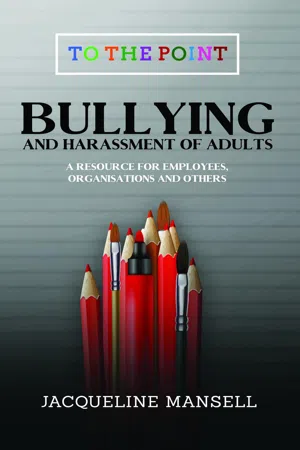
Bullying & Harassment of Adults
A Resource for Employees, Organisations & Others
- English
- ePUB (mobile friendly)
- Available on iOS & Android
eBook - ePub
Trusted by 375,005 students
Access to over 1.5 million titles for a fair monthly price.
Study more efficiently using our study tools.
Information
Part One. Understanding
Human Behaviour
We are a sum
of multiple identities

The facts and figures surrounding incidence of bullying, harassment and discrimination often reduce individuals to a single identity but adults are a complex sum of many identities related for example to:
- Position/role in the family
- Position/role in the community
- Age
- Ethnicity
- Sexuality
- Occupation
- Employment status
- Hobbies
- Interests
- Cultural values, standards and traditions
- Gender
- Marital status
- Religion
- Beliefs
- Values
- Abilities
- Tastes and preferences
- Able bodied / differently abled
- Origin and background
- Ancestry
- Heritage
- The desire for personal change
If you permutated any of the list shown above with the addition of your own unique characteristics and identities, it can be seen that that none of us is limited by the boundaries and labels of a single identity.
The mantle of identities that combine to envelop and create adults is probably immeasurable. We are a collection of multiple identities.
A general overview of the
factors that influence
behaviour
Behaviour is controlled and moderated due to a combination of many factors:
- Our human biology
- Mental state/capacity
- Our social world/experiences
- Motivating and restraining influences
- Group behaviours and the ‘evidence of the crowd’
- Our own sense and strength of moral agency (personal control in regulating and managing our own behaviour in a way that is ethical, right and humane)
- Our Human Biology. Some relevant aspects of the biological dimension
- The effects of chemical stimulants for example, alcohol or non-prescribed drugs
- The ‘Selfish Gene’ (survival of the fittest & competitiveness)
- Hormonal changes & imbalances (For example, levels of Testosterone in both men and women)
- Our Mental State/Capacity. Some relevant aspects related to the mental component:
- Level & types of intelligence – may not understand the consequences of actions
- Emotional intelligence
- Empathy - may lack the mental capacity to see how things are for other people
- Ability to contextualise, comprehend and rationalise
- Some examples of social/experiential factors:
- Upbringing/learned behaviour.
- Social class
- Race
- Religion
- Sexuality
- Marital status
- Generational aspect and where an individual is on the timeline in relation to others.
- Travel
- Life experiences. For example, may have experienced conflict and war
- Culture. For example, as a consequence of nationality, region, community, neighbourhood
- Experience, type and level of education
- Experience of work. For example
Position at work
Level of autonomy - Travel
- Life experiences. For example, may have experienced conflict and war
Factors that have a
motivating effect upon
behaviour
These are some factors related to those conditions that have a general motivating role:
- The timing of events
- The circumstances or situation in which events take place
- Beliefs:
- Beliefs are those opinions and convictions held to be true or real even without proof.
- People hold beliefs about the world and about themselves. For example, politics and religion
- Habits:
- Are largely formed as a result of past experience
- Become routine behaviour over time
- Are often carried out without conscious awareness, to the point that people are sometimes unaware that they have formed a habit or find it difficult to break the habit
- Learned behaviour:
- This is behaviour where we have the insight to apply something learned to new situations.
- Learned behaviour may also provide us with a reward. For example: Our behaviour provides pleasure or satisfies a need.
- The reward may also be the removal of negative circumstances such as mitigating against loneliness, fear of ‘losing face’ or fear of ‘being on the outside’ and not being part of a group (which, for example, is why people subject themselves to initiation ceremonies)
- Conversely, learned behaviour can help in avoiding ‘punishment’. For example: a fear of failure may prevent action or a fear of the consequences (punishment/pain). (The avoidance of punishment can be observed when people are driving, it is why traffic cameras slow us down).
- Factors related to satisfying biological and intrinsic needs (as identified by the psychologist Abraham Maslow who wrote A Theory of Human Motivation) This is behaviour in response to the environment and to meet our human needs. For example, to:
- Satisfy our basic needs such as keeping a roof over our head or having food to eat
- Protect ourselves from threats, physical attack and danger
- Maintain our sense of belonging. We may desire or seek out affection, friendship or love or have the need to feel a sense of connection to others by being part of a group. (In doing this we may ensure that we ‘don’t rock the boat’, ‘go along with the crowd’ or try to avoid ridicule or negative attention)
- Gain the esteem of other people (In doing this some people might ‘put others down’ manipulate others or misuse power)
- Achieve our highest potential
- Meet the needs that go beyond our own self-interest which includes achieving truth and justice (described by Maslow as ‘Meta Needs’)
- The ‘Evidence of the Crowd’
People may be motivated by ‘The Evidence of the Crowd’ which means that behaviour and ideas are shaped and moderated by the behaviours of oth...
Table of contents
- Introduction Resilience: A Choice for Everyday Living
- About To the Point
- Part One. Understanding Human Behaviour We are a sum of multiple identities
- Part Two. Seeing a bigger picture Prejudice and Stereotyping
- Part Three. Recognising Harassment & Bullying Definitions and differences
- Part Four. Understanding those who bully and harass and their wider impact Those who are disposed to bullying and harassment
- Part Five. Making sense of being bullied and harassed Those who are vulnerable to bullying and harassment
- Part Six. Overcoming the experience of being bullied and harassed Taking action Reclaiming your power
- About the Author
Frequently asked questions
Yes, you can cancel anytime from the Subscription tab in your account settings on the Perlego website. Your subscription will stay active until the end of your current billing period. Learn how to cancel your subscription
No, books cannot be downloaded as external files, such as PDFs, for use outside of Perlego. However, you can download books within the Perlego app for offline reading on mobile or tablet. Learn how to download books offline
Perlego offers two plans: Essential and Complete
- Essential is ideal for learners and professionals who enjoy exploring a wide range of subjects. Access the Essential Library with 800,000+ trusted titles and best-sellers across business, personal growth, and the humanities. Includes unlimited reading time and Standard Read Aloud voice.
- Complete: Perfect for advanced learners and researchers needing full, unrestricted access. Unlock 1.5M+ books across hundreds of subjects, including academic and specialized titles. The Complete Plan also includes advanced features like Premium Read Aloud and Research Assistant.
We are an online textbook subscription service, where you can get access to an entire online library for less than the price of a single book per month. With over 1.5 million books across 990+ topics, we’ve got you covered! Learn about our mission
Look out for the read-aloud symbol on your next book to see if you can listen to it. The read-aloud tool reads text aloud for you, highlighting the text as it is being read. You can pause it, speed it up and slow it down. Learn more about Read Aloud
Yes! You can use the Perlego app on both iOS and Android devices to read anytime, anywhere — even offline. Perfect for commutes or when you’re on the go.
Please note we cannot support devices running on iOS 13 and Android 7 or earlier. Learn more about using the app
Please note we cannot support devices running on iOS 13 and Android 7 or earlier. Learn more about using the app
Yes, you can access Bullying & Harassment of Adults by Jacqueline Mansell in PDF and/or ePUB format, as well as other popular books in Psychology & Workplace Culture. We have over 1.5 million books available in our catalogue for you to explore.