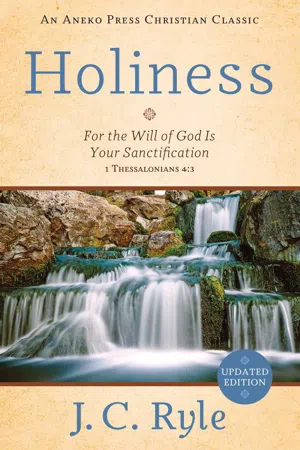
A thorough study of sin, salvation by faith, and the Christian's journey of sanctification.He who wants a correct understanding of holiness must first begin by examining the vast and solemn subject of sin. He must dig down very deep if he wants to build high. Wrong views about holiness are generally traceable to wrong views about human corruption. Practical holiness and entire self-consecration to God are not given adequate attention by modern Christians. The unsaved sometimes rightly complain that Christians are not as kind and unselfish and good-natured as those who make no profession of faith. Far too many Christians make a verbal proclamation of faith, yet remain unchanged in heart and lifestyle. But Scripture makes it clear that holiness, in its place and proportion, is quite as important as justification. Holiness, without which no one shall see the Lord (Hebrews 12: 14). It is imperative that Christians are biblically and truly holy. The aim of this book is to instruct you, equip you, and encourage you in the pursuit of holiness.
- English
- ePUB (mobile friendly)
- Available on iOS & Android
eBook - ePub
About this book
Trusted by 375,005 students
Access to over 1.5 million titles for a fair monthly price.
Study more efficiently using our study tools.
Information
Print ISBN
9781622455942
Topic
Theology & ReligionChapter 7
Assurance
For I am now ready to be offered, and the time of my release is at hand. I have fought a good fight, I have finished the race, I have kept the faith; from now on there is laid up for me a crown of righteousness, which the Lord, the righteous judge, shall give me at that day, and not to me only, but unto all those also that have loved his appearing (2 Timothy 4:6-8).
In the words of the Bible verses at the top of this page, we see the apostle Paul looking three ways: downward, backward, and forward. He is looking downward to the grave, backward to his own ministry, and forward to that great day – the day of judgment!
It will do us good to stand by the apostle’s side for a few minutes and pay attention to the words he uses. Happy is that soul who can look where Paul looked and then speak as Paul spoke!
He looks downward to the grave, and he does it without fear. Hear what he says: I am now ready to be offered. I am like an animal brought to the place of sacrifice and bound with cords to the very horns of the altar. The drink offering, which generally accompanies the offering, is already being poured out. The last ceremonies have been gone through. Every preparation has been made. Only the death blow remains, and then all is over.
The time of my release is at hand. I am like a ship about to unmoor and put to sea. Everything on board is ready. I only wait to have the moorings cast off that fasten me to the shore, and I will then set sail and begin my voyage.
These are remarkable words to come from the lips of a child of Adam like ourselves! Death is a solemn thing, and never so much so as when we see it close at hand. The grave is a chilling, heart-sickening place, and it is vain to pretend it has no terrors. Yet here is a mortal man who can look calmly into the narrow house appointed for all living (Job 30:23) and say, while he stands upon the brink, “I see it all, and am not afraid.”
Paul looks backward to his ministerial life, and he does it without shame. Hear what he says: I have fought a good fight. Here he speaks as a soldier. I have fought that good fight with the world, the flesh, and the devil from which so many retreat and draw back.
I have finished the race. Here he speaks as one who has run for a prize. I have run the race marked out for me. I have gone over the ground appointed for me, however rough and steep. I have not turned aside because of difficulties, nor have I been discouraged by the length of the course. I am at last in sight of the goal.
I have kept the faith. Here he speaks as a steward. I have held fast that glorious gospel that was committed to my trust. I have not mingled it with man’s traditions, nor spoiled its simplicity by adding my own inventions, nor allowed others to adulterate it without opposing them to the face. “As a soldier – a runner – a steward,” he seems to say, “I am not ashamed.”
The Christian is happy who, as he leaves the world, can leave such a testimony behind him. A good conscience will save no one. It will not wash away any sin or lift us one hair’s breadth toward heaven, yet a good conscience will be found to be a pleasant visitor at our bedside in a dying hour. There is a fine passage in Pilgrim’s Progress that describes Old Honest’s passage across the river of death. “The river,” says Bunyan, “overflowed its banks in some places; but Mr. Honest, in his lifetime, had spoken to one Good-conscience to meet him there, and there he was ready to lend him his hand and he helped him over. We may be sure there is a mine of truth in that passage.
The apostle Paul looks forward to the great day of judgment, and he does it without doubt. Notice his words:
From now on there is laid up for me a crown of righteousness, which the Lord, the righteous judge, shall give me at that day, and not to me only, but unto all those also that have loved his appearing. “A glorious reward,” he seems to say, “is ready and laid up in store for me – even that crown that is only given to the righteous. In the great day of judgment, the Lord will give this crown to me, and to all others who have loved Him as an unseen Savior and have longed to see Him face to face. My work on earth is over. This one thing now remains for me to look forward to, and nothing more.”
Let us observe that the apostle Paul speaks without any hesitation or distrust. He regards the crown as a sure thing, as his own already. He declares with unfaltering confidence his firm persuasion that the righteous Judge will give it to him. Paul was no stranger to all the circumstances and accompaniments of that solemn day to which he referred. The great white throne, the assembled world, the open books, the revealing of all secrets, the listening angels, the tremendous sentence, and the eternal separation of the lost and saved were all things with which he was well acquainted, but none of these things moved him. His strong faith looked past them all, and he only saw Jesus, his all-prevailing Advocate, the blood of sprinkling, and his sin washed away. “A crown,” he says, “is laid up for me. The Lord Himself will give it to me.” He speaks as if he saw it all with his own eyes.
These are the main things that these verses contain. I will not write about most of them, because I want to confine myself to the specific topic of holiness. I will only try to consider one point in the passage. That point is the strong fulfillment of your hope (Hebrews 6:11) with which the apostle Paul looks forward to his own prospects in the day of judgment.
I will do this the more willingly because of the great importance that is attached to the subject of assurance, and the great neglect with which it is often treated. I will do it at the same time with fear and trembling. I feel that I am treading on very difficult ground and that it is easy to speak rashly and unscripturally in this matter. The road between truth and error here is an especially narrow pass, and if I will be enabled to do good to some without doing harm to others, I will be very thankful.
There are four things I want to mention on the subject of assurance, and it might help if I list them now.
First, I will try to show that an assured hope, such as Paul here expresses, is a true and scriptural thing.
Secondly, I will make a broad concession that a person might never arrive at this assured hope and yet be saved.
Thirdly, I will give some reasons why an assured hope is greatly to be desired.
Lastly, I will try to point out some reasons why an assured hope is so seldom attained.
I ask special attention of all who take an interest in the main subject of this book. If I am not greatly mistaken, there is a very close connection between true holiness and assurance, and I want to show the nature of that connection. At present, I content myself with saying that where there is the most holiness, there is generally the most assurance.
An assured hope is a true and scriptural thing.
Assurance, such as Paul expresses in 2 Timothy 4:6-8, quoted at the beginning of this chapter, is not a mere opinion or feeling. It is not the result of much imagination or of hopeful and positive thoughts. It is a positive gift of the Holy Spirit, given without reference to one’s bodily frame or health, and it is a gift that every believer in Christ ought to aim at and seek after.
In matters like these, the first question should be, What does the Bible say? I answer that question without the least hesitation. The Word of God appears to me to teach distinctly that a believer can arrive at an assured confidence with regard to his own salvation.
I confidently say, as God’s truth, that a true Christian, a converted person, can reach such a comfortable degree of faith in Christ that he will generally feel entirely confident as to the pardon and safety of his soul. He is able to seldom be troubled with doubts, seldom be distracted with fears, and seldom be distressed by anxious uncertainties. Though bothered by many inward conflicts with sin, he will look forward to death without trembling and to judgment without dismay. This, I say, is the doctrine of the Bible. This is my account of assurance. I will ask my readers to notice it distinctly. I say neither less nor more than I have here laid down.
Such a statement as this is often disputed and denied. Many cannot see the truth of it at all. The Church of Rome denounces assurance in the most unmeasured terms. The Council of Trent declares sharply that a “believer’s assurance of the pardon of his sins is a vain and ungodly confidence,” and Cardinal Bellarmine, the well-known champion of Roman Catholicism, calls it “a prime error of heretics.”29
The vast majority of the worldly and thoughtless Christians among us oppose the doctrine of assurance. It offends and annoys them to hear of it. They do not like others to feel comfortable and sure, because they never feel that way themselves. Ask them if their sins are forgiven, and they will probably tell you that they do not know! It is certainly not a surprise that they do not accept the doctrine of assurance.
There are also some true believers who reject assurance or resist it as a doctrine filled with danger. They think that it borders on presumption. They seem to think that it is humble never to feel sure, never to be confident, and to live in a certain degree of doubt and suspense about their souls. This is to be regretted, and it does much harm.
I freely admit that there are some presumptuous people who profess to feel a confidence for which they have no scriptural basis. There are always some people who think w...
Table of contents
- Contents
- Foreword
- Introduction
- Sin
- Sanctification
- Holiness
- The Fight
- The Cost
- Growth
- Assurance
- Moses – An Example
- Lot – A Beacon
- A Woman To Be Remembered
- Christ’s Greatest Trophy
- The Ruler of the Waves
- The Church That Christ Builds
- Visible Churches Warned
- Lovest Thou Me?
- Without Christ
- Thirst Relieved
- Unsearchable Riches
- Needs of the Times
- Christ Is All
- J. C. Ryle – A Brief Biography
- Other Similar Titles
Frequently asked questions
Yes, you can cancel anytime from the Subscription tab in your account settings on the Perlego website. Your subscription will stay active until the end of your current billing period. Learn how to cancel your subscription
No, books cannot be downloaded as external files, such as PDFs, for use outside of Perlego. However, you can download books within the Perlego app for offline reading on mobile or tablet. Learn how to download books offline
Perlego offers two plans: Essential and Complete
- Essential is ideal for learners and professionals who enjoy exploring a wide range of subjects. Access the Essential Library with 800,000+ trusted titles and best-sellers across business, personal growth, and the humanities. Includes unlimited reading time and Standard Read Aloud voice.
- Complete: Perfect for advanced learners and researchers needing full, unrestricted access. Unlock 1.5M+ books across hundreds of subjects, including academic and specialized titles. The Complete Plan also includes advanced features like Premium Read Aloud and Research Assistant.
We are an online textbook subscription service, where you can get access to an entire online library for less than the price of a single book per month. With over 1.5 million books across 990+ topics, we’ve got you covered! Learn about our mission
Look out for the read-aloud symbol on your next book to see if you can listen to it. The read-aloud tool reads text aloud for you, highlighting the text as it is being read. You can pause it, speed it up and slow it down. Learn more about Read Aloud
Yes! You can use the Perlego app on both iOS and Android devices to read anytime, anywhere — even offline. Perfect for commutes or when you’re on the go.
Please note we cannot support devices running on iOS 13 and Android 7 or earlier. Learn more about using the app
Please note we cannot support devices running on iOS 13 and Android 7 or earlier. Learn more about using the app
Yes, you can access Holiness by J. C. Ryle in PDF and/or ePUB format. We have over 1.5 million books available in our catalogue for you to explore.