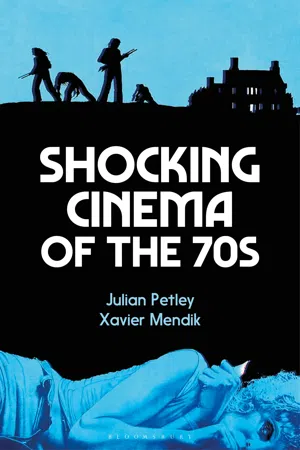
This collection focuses on 1970s films from a variety of countries, and from the marginal to the mainstream, which, by tackling various 'difficult' subjects, have proved to be controversial in one way or another. It is not an uncritical celebration of the shocking and the subversive but an attempt to understand why this decade produced films which many found shocking, and what it was that made them shocking to certain audiences. To this end it includes not only films that shocked the conventionally minded, such as hard core pornography, but also those that outraged liberal opinion – for example, Death Wish and Dirty Harry.
The book does not simply cast a critical light on a series of controversial films which have been variously maligned, misinterpreted or just plain ignored, but also assesses how their production values, narrative features and critical receptions can be linked to the wider historical and social forces that were dominant during this decade. Furthermore, it explores how these films resonate in our own historical moment – replete as it is with shocks of all kinds.
- 336 pages
- English
- ePUB (mobile friendly)
- Available on iOS & Android
eBook - ePub
Shocking Cinema of the 70s
About this book
Trusted by 375,005 students
Access to over 1.5 million titles for a fair monthly price.
Study more efficiently using our study tools.
Information
Part One
International Visions of the Extreme
1
Walerian Borowczyk: Seventies Sexploitation Through Sublimation
Aga Skrodzka
Introduction
Not quite as famous as other purveyors of European exploitation cinema, such as Jess Franco, Jean Rollin, Dario Argento or Mario Bava, Walerian Borowczyk worked hard to compete with his contemporaries to earn his reputation, in some quarters, as a peddler of artistic smut. But his professional journey is fascinating and it is well worth documenting, in particular, the film-maker’s tendency to cross cultural, geographical, stylistic and generic boundaries. The trajectory that emerges shows Borowczyk’s strategic transition from his rigorous early training in the academic arts, through the successful stage of making experimental animation, to his mature preoccupation with the sexploitation genre.
Born in the village of Kwilicz, Poland, on 21 October 1923 (and not 2 September 1932, as he would later claim in his official biography), Borowczyk studied painting at the prestigious Academy of Fine Arts in Kraków (where Andrzej Wajda was also briefly a student) before becoming a lithographer, specializing in poster art, and an animator. His father, a railway worker, was an amateur painter, who is said to have inspired his son’s early artistic inclinations. While carrying out his classical training in drawing and painting at the academy, Borowczyk acquired a 16mm camera and began his filmic experiments, soon making his first shorts Sierpień /Mois d’août/August (1946), Głowa/The Head (1949) and Tłum/Crowd (1950). Around this time, he met Ligia Brokowska, who soon becomes his wife and professional partner. Under the pseudonym Ligia Branice, she acted in many of Borowczyk’s early projects.
In his post-graduation animation work, Borowczyk collaborated with Jan Lenica (and later Chris Marker), producing animation that pioneered the collage technique (later popularized by Terry Gilliam) and used non-synchronic sound in aural/visual counterpoint to satirical effect. His most notable animated films were Byl sobie raz/Once Upon a Time (1957), Dom/House (1958), Szkola/School (1959), Les astronautes/The Astronauts (1959), Renaissance (1963), Les jeux des anges/The Games of Angels (1964) and Théâtre de Monsieur & Madame Kabal/The Theatre of Mr. and Mrs. Kabal (1967). After a number of trips to the West, mainly to acknowledge the accolades bestowed upon his experimental films by various festival juries, Borowczyk and his wife settled in France in 1959. Under a five-year exclusive contract, he made commercial shorts as well as experimental animation films for Les Cinéastes Associés, Jacques Forgeot’s animation company. Although his experimental animation continued to be appreciated at festivals and on art house circuits, Borowczyk gradually transitioned into live-action sexploitation film.
In the 1970s he made seven low-budget co-productions, many of which become instant box-office successes. Goto, l’île d’amour/Goto, Island of Love (1968) was his first full length live-action feature, and although not a sexploitation film per se, it contains certain sexploitation elements (such as scenes of voyeurism, and the fetishistic portrayal of the female body) that would be deployed, albeit in various ways and to differing degrees, in his subsequent films: Blanche (1972), Contes Immoraux/Immoral Tales (1974), Dzieje grzechu/The Story of Sin (1975, his only feature film made in Poland), La bête/The Beast (1975), La marge/The Margin (1976), Interno di un convento/Behind Convent Walls (1978) and Les heroines du mal/Immoral Women (1979).

Figure 1.1 Immoral Tales: The fetishistic portrayal of the female body.
During this decade, Borowczyk earned a scandalous reputation among film critics as someone who had abandoned his background in high art only to take up entertainment films featuring explicit sexual content. However, his work during the 1980s exploited sexual content to an even greater degree: Lulu (1980), Docteur Jekyll et les Femmes/Dr. Jekyll and His Women (1981), Ars amandi/The Art of Love (1983), Emmanuelle 5 (1987) and Cérémonie d’amour/Love Rites (1988). In some quarters, these films earned him the label of pornographer. While certain producers wanted to capitalize on this and increasingly pushed him to make soft core pornography, he resisted, and, eventually, was forced to walk away from some of his more compromised projects, such as Emmanuelle 5. Tired and disillusioned, Borowczyk withdrew from the film industry and devoted his last years to writing, painting and animation. Soon after his death of heart failure at a Paris hospital, on 2 February 2006, at the age of eighty-two, Borowczyk’s posthumous autobiography, What Do I Think When I See a Polish Woman in the Nude, was published. Its salacious title and challenging content reaffirmed his status as a master of exploitation.
The battle over Borowczyk’s good name
The cinema of Walerian Borowczyk entices as it offends. Every offence, typically staged as a sexual transgression, is carefully framed within a highly choreographed artistic spectacle, often using art objects to decorate the sexual content. In this sense, Borowczyk curates as he exploits. This strategy allows him to circulate graphic sexual images under the guise of artistic contemplation. The exhibition of art objects that so often punctuates his exploitation material functions in such a way as to enlighten and educate the viewer, thus resonating with Eric Schaefer’s theory of exploitation cinema’s origins in ‘respectable films made with the alleged “good intentions” ’.1 Critics have argued, and continue to argue, that Borowczyk’s ‘classy erotica’ does much more than titillate (although I have argued elsewhere that it successfully titillates the female viewer by engaging her gaze2). It has frequently been claimed that there is always ‘more to it’, and that the ‘more’ has an authentic artistic, even philosophical, value. Not surprisingly, Borowczyk’s early reputation as an award-winning experimental film-maker lends his sexploitation fare the kind of credibility that prompts certain critics to group him with Pier Paolo Pasolini, Luis Buñuel and Nagisa Ôshima. Yet, Borowczyk’s 1970s films, which are the topic of this chapter, also have an affinity with the work of Russ Meyer, Jess Franco and Ken Russell. So why is the sexploitation framework frequently pushed out of Borowczyk criticism?
Since his death in 2006, the director’s work has been re-appraised critically and continues to receive scholarly attention as his films are restored and re-released. For example, in 2008, Jeremy Mark Robinson published his monograph, Walerian Borowczyk: Cinema of Erotic Dreams; Pascal Vimenet and Alberto Pezzotta have each edited volumes of collected essays on the film-maker; Bertrand Mandico, Marina and Alessio Pierro, and Daniel Bird have made films about Borowczyk: Boro in the Box (2011), Himorogi (2012) and Obscure Pleasures (2014). In 2014, Arrow Films released a box set of six of Borowczyk’s greatest films, entitled Camera Obscura: The Walerian Borowczyk Collection. A plethora of exhibitions, books, retrospectives, documentaries and blogs have since celebrated Borowczyk as an experimental animator, a surrealist artist, a philosopher of sexuality, a cultural iconoclast and a technical innovator. While he undoubtedly deserves these labels, he was also a financially successful exploitation film-maker, an identity which is consistently and compulsively denied in the new accounts.
Many of the most recent critical texts are commemorative and adulatory in tone, disproportionally focused on Borowczyk’s experimental works, and written within the framework of auteur theory (often by self-proclaimed life-long fans of Borowczyk). For example, books like Boro, L’Île D’Amour (edited by Kamila Kuc, Kuba Mikurda and Michał Oleszczyk) or Kuba Mikurda and Jakub Woynarowski’s Corpus Delicti focus overwhelmingly on Borowczyk’s artistic influences and his investment in the European cultural heritage, particularly surrealism. Marcin Giżycki, whose essay appears in Boro, L’Île D’Amour, attempts to rehabilitate Borowczyk’s oeuvre ‘so that the obvious erotic traits of it don’t overshadow its other, noteworthy aspects’.3 This determination to elevate Borowczyk above and beyond his commitment to exploitation and entertainment is especially symptomatic of Polish film critics and scholars, who have reclaimed the expatriate Borowczyk as a Polish film-maker aligned with the venerable tradition of art cinema. This tradition, situated in opposition to commercial and genre cinema, reflects the specific value system that Polish film scholars continue to apply when evaluating film acco...
Table of contents
- Cover
- Half-Title Page
- Title Page
- Contents
- List of Figures
- Acknowledgements
- Introduction
- Part 1 International Visions of the Extreme
- Part 2 From the Vigilante to the Violated
- Part 3 State Sponsored Shocks
- Part 4 Family-sploitation and Threats to the Family
- Part 5 Porno Chic, Porno Shock
- List of Contributors
- Index
- Copyright
Frequently asked questions
Yes, you can cancel anytime from the Subscription tab in your account settings on the Perlego website. Your subscription will stay active until the end of your current billing period. Learn how to cancel your subscription
No, books cannot be downloaded as external files, such as PDFs, for use outside of Perlego. However, you can download books within the Perlego app for offline reading on mobile or tablet. Learn how to download books offline
We are an online textbook subscription service, where you can get access to an entire online library for less than the price of a single book per month. With over 1.5 million books across 990+ topics, we’ve got you covered! Learn about our mission
Look out for the read-aloud symbol on your next book to see if you can listen to it. The read-aloud tool reads text aloud for you, highlighting the text as it is being read. You can pause it, speed it up and slow it down. Learn more about Read Aloud
Yes! You can use the Perlego app on both iOS and Android devices to read anytime, anywhere — even offline. Perfect for commutes or when you’re on the go.
Please note we cannot support devices running on iOS 13 and Android 7 or earlier. Learn more about using the app
Please note we cannot support devices running on iOS 13 and Android 7 or earlier. Learn more about using the app
Yes, you can access Shocking Cinema of the 70s by Julian Petley, Xavier Mendik, Julian Petley,Xavier Mendik in PDF and/or ePUB format, as well as other popular books in Mezzi di comunicazione e arti performative & Film e video. We have over 1.5 million books available in our catalogue for you to explore.