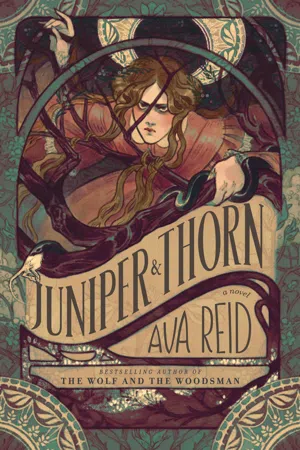
I checked under my bed, but the monster was gone. It had been gone since morning, when the pink fingers of dawn flushed it back to its favorite hiding place in Rose’s garden, spiny tail banded around the trunk of the juniper tree. It would lie there, belly-flat and hissing, until I or one of my sisters went to feed it our leftover chicken bones or give it a rub behind the ears. Of all the creatures that lived in our house, it was the most easily sated.
By evening, the garden was lucent with the speckle of fireflies, rustling with the susurration of wind through the willow branches, but otherwise quiet and still. From my bedroom I could see the whole brindled sweep of it, the stout, swollen hedges and the ivy that trawled over the rust-checkered gate. If anyone in Oblya walked down the road past our house, they might feel green tendrils curl around their ankles, or hear the whisper of ferns through the fence. The pedestrians whispered back: rumors about Zmiy Vashchenko and his three strange daughters.
When I was younger, their mean words made me cry. At twenty-three, I learned to close my ears to them, or even to relish them with a resigned, perverse bitterness, closing my fist around the old hurt. After all, the meaner their words, the better their business. The rumors deposited clients at our doorstep like a cat leaving its mangled prey at the feet of its master. The more jagged and gruesome the rumor’s shape, the more our clients gawked at my sisters, as if their beauty were a velvet carpet laid over a hole in the floor, something that might fall out from under them.
My sisters were beautiful without ruse or artifice, which was my curse, really, not my father’s. My father’s curse was never to be satisfied with anything, so to him my sisters were beautiful, but not beautiful enough. He had been cursed by Titka Whiskers, the last true witch in Oblya. My father had done all he could to run her out of business, to make himself the last true wizard in the city, so she’d repaid him the only way a witch knew how. Of course, then he was the last true wizard in the city, and he wasn’t satisfied with that either.
The clock gonged nine. I had heaped old throw pillows and a sack of scrolled autumn leaves under my quilt, molding them to a shape that approximated my sleeping body. Rose had cut a sheaf of dried wheat stalks for my hair, the color slightly too pale, and with none of my real hair’s untended frizz. But if, when, our father rose from his bed and stumbled half-dreaming past my room, I hoped he would not look closely enough to know the difference. The curse, too, meant he could sleep for hours and hours and still wake with the faint itch of exhaustion under his skin.
Outside, the sky darkened in increments, like an obsidian blade lowering over Oblya’s pale throat. The sound of footsteps, quick and light, on the wooden threshold. I turned around. My sister, Undine, stood in the doorway.
“Dear Marlinchen, no one will believe we’re anything but witches if you don’t put a comb through your hair.”
A flush crawled over my cheeks. I left my bed and sat down at my boudoir, scrutinizing my face in the mirror. My sallow cheeks now bore two splotches of red. My hair was a mess of coils that fell as heavy as a quilt over my shoulders.
“I don’t know what to do,” I said. “It’s too long.”
All of our hair was too long, and far too long for the current fashion, those slim curls like rolled tobacco that the other women in Oblya sported. Our father would not let us cut even an inch. The clients, he said, liked that there was something charmingly rustic about us, our untrimmed hair the relic of an older, simpler time. To them we might be sweet singing milkmaids, torn right out of some wealthy man’s pale pastoral wallpaper. I did not have a dulcet singing voice, but I smiled at our clients as sweetly as I could.
“Rose,” Undine called softly. “Come here and help. Quickly.”
My second sister swept through the threshold in a crinoline gown, her bared shoulders as sharp as kitchen knives. She took in my hair, and Undine’s angrily flared nostrils, and sighed. Our mother’s ivory-handled comb lay on our bureau, a bit of my dark-blond hair snarled in its teeth.
But Rose, being the second sister, was gentler. She began to work through my curls with the comb. The last time anyone had done so was my mother, and that was years ago.
Rose managed to tie up my hair with a ribbon, in some butchered emulation of the Oblyan women’s hair. The pink silk ribbon matched my dress, a crinkled cranberry with a neckline low enough to make me blush. Not that it mattered very much. Pinned between my beautiful sisters, I was little more than a piece of furniture, a particularly elaborate candle stand.
The clock gonged ten, and then we were off.
Through the garden, the damp soil sucking at our shoes. Arm in arm, we picked our way past the scrying pool, as bright as a tossed coin, through the thistles with their purple buds, careful to bypass Rose’s delicate meshwork of baby’s breath and feverfew. The flowering pear tree coughed white petals at us, but all the monsters were cowed or slumbering.
Still, we were quiet. We could not risk waking them, or worse, waking our father. We had risked tiny rebellions before—or at least, Rose and Undine had—but never something so large and illicit and wrong. This rebellion was like a book with all its pages torn out. I did not know its beginning, middle, or end.
The thought of Papa seeing us made me woozy with dread, and our very own garden began to feel terrible and strange.
To outsiders, it was always terrible and strange, even in the daylight; they were not accustomed to it the way we were. There were the glass apples, which tasted sweet and made you wine-flushed if you could bear to put those hard, sharp bits in your mouth. There were the black amber plums, fat as bruises, which were suffused with a fatal poison. Our father had nurtured an immunity in his daughters by feeding us slivers of the fruit from the time we were infants, and now we could bite into the plums and taste only the tang of their rotted bitterness, not the poison underneath.
But even we were warned never to touch the juniper tree, which bore berries of the most dangerous variety: both poisonous and sweet. Whatever sick thing was in them, we could not be inured to it.
In my twenty-three years, I had seen the garden come to be occupied by a number of other things, and I had come to consider these things ours. Our fiery serpent, which looked like a regular snake until it caught the sunlight, and then its black scales glimmered with a flame-bright sheen. It spoke in a human voice, without moving its mouth; the voice seemed to enter your head as if you were the one conjuring its words. It would promise you silken handkerchiefs or ceramic beads, and if you accepted, its gifts would materialize in your hand, spun out of nothing—for a price: the milk from your breast. But even if you paid, in the morning all the gifts would turn to straw and manure. I didn’t know what would happen if you asked it for something more than trinkets, or why it would be so terrible to give suck to a serpent. I watched it wind through our garden now like a slick of oil, leaving pale coils of shed skin in its wake.
There was also our goblin, the poor thing, who had lost its home when the Rodinyan land surveyors drained the marshes outside of Oblya. Its single eye shone like a lantern in the dark, its beard as long and white as lichen grown over a log. In its gratitude for our hospitality the goblin had become excessively protective of my sisters and me, and had taken to trying to bite our clients in the ankle when they crossed through the garden into the house. After the goblin cost us a hundred rubles and nearly brought the city’s Grand Inspector to our door, my father made sure it was always shut up in the garden shed whenever we had visitors. Last time when I’d gone to let it out, it had already chewed a hole through the wood and was sulking in Rose’s bed of tarragon.
We had patched the hole painstakingly, each taking turns keeping an eye out for Papa, and then shut the goblin in again. Undine had wanted to gag it, to make sure its tears didn’t wake him, but such a thing felt unspeakably cruel and I managed to convince her out of it. As we passed the shed I heard its cowed whimpering.
My least favorite of all our creatures was Indrik, a bare-chested man with the legs of a faun or a goat. He was forever bemoaning his fate as a refugee, as he had fled the mountain where he’d lived when Rodinyan miners had begun to plumb it for silver. He languished by Undine’s scrying pool, mournfully examining his reflection, claiming he’d once been a god and everyone in Oblya had worshipped him. They’d left him offerings of slain geese or painted eggs and their prettiest, bleating ewes—I shuddered to think what he had done with those ewes, given the lustful way he’d eyed our milking cow before she’d died. I didn’t know if he’d ever been a god at all, but it was no use trying to argue with him; he would only weep.
To make sure Indrik did not catch us as we left, Rose had fed him a sleeping draught. I saw the blurry shape of him beneath one of the pear trees, the coiled muscles of his back as huge as boulders. His snoring was a soft whistle, like the train that I could sometimes hear very distantly from my bedroom window.
There were other creatures that I could not name, ones that I could only refer to as monsters. Badger-looking things that snuffled the earth for roots and truffles; spiny-tailed weasels with beady red stares, such as the one that liked to hide under my bed; eyeless ravens that winged blindly through our rhododendrons. They ate the rabbits and squirrels that came to masticate Rose’s herbs, so we let them stay, and besides, we didn’t know what would happen if we chased them out. There were no stories about these types of monsters, or maybe the stories had been lost. Either way, my sisters and I were all afraid we might wake up cursed just like our father if we did them any harm.
But all precautions had been taken, and none of those creatures were roused tonight. When we reached the gate, Undine swung it open, and we brushed all the dirt from our shoes and the hems of our gowns. Like we were serpents shedding our skin, we swept the mustiness and sorcery of the house off of us.
While I stared down the cobblestone road that unspooled before us, my stomach knotted with fear.
“Come on, Marlinchen,” Undine said, looping our elbows and giving me a vicious tug. “We only have a quarter hour.”
We sprinted down the street, as quick as our crinolines and corsets would allow. I could feel the cobblestones through the soles of my slippers, all of their hard ridges that seemed to lurch up at me with every step. We passed the day laborers, dull-eyed men slouching toward the brothels and taverns, or back to their apartments above the shops. Whenever their gazes spun toward us, I felt another thread of panic loose in me, but Rose and Undine only pulled me along.
Kanatchikov Street bore us into the city plaza, a glorious facade of buildings that ringed the massive fountain. Dolphins leapt from the stone basin in arrested motion, water shooting from their spouts. A marble sea god sat in his chariot, thick brows drawn over his eyes, frozen and immortal. He was not a god that I recognized from my father’s codex; he had vague and hurried features, a...