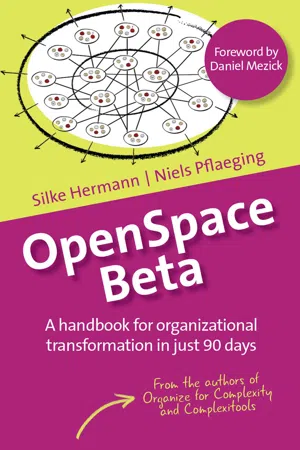
eBook - ePub
OpenSpace Beta
A handbook for organizational transformation in just 90 days
- English
- ePUB (mobile friendly)
- Available on iOS & Android
eBook - ePub
OpenSpace Beta
A handbook for organizational transformation in just 90 days
About this book
The practical guide to making the Beta organization happen. Anywhere- in just a few months. Sounds impossible? It isn´t anymore! This handbook spells out an all-hands, high-engagement approach to organizational transformation that is suitable for any kind of company - regardless of size, age, country/culture, legal form and industry! So obvious and yet groundbreaking, this is the way to make the Beta organization happen. Anywhere. Fast.
Tools to learn more effectively

Saving Books

Keyword Search

Annotating Text

Listen to it instead
Information
Part 1: Conceptual background to OpenSpace Beta (There is nothing as practical!)
Self-organization and assumptions on human nature
In his book “The Human Side of Enterprise”, published back in 1960, Douglas McGregor presented a key message: That we hold two images of human nature in our heads and in our hearts – Theory X and Theory Y. And that one of these images, Theory X, is a fraud. McGregor stressed, on every page of that book: Theory X people (which supposedly have to be motivated extrinsically) do not exist in the real world. They have never existed, do not exist and will never exist: They are merely a figment of our imagination. Theory X, by consequence, although common as an image of human nature we hold dear, is no more than an ugly prejudice about other people at work.
Even 60 years after McGregor’s book, however, most people claim and firmly believe, that “Theory Xers” exist around them. Inevitably, they act accordingly, making the world a worse place than it could be. We stubbornly adhere to a myth that McGregor tried to dispel back in 1960; we apply method that would only work with Xers. We are stuck in a world of Theory X delusion. Most of us are guilty of perpetuating the Theory X prejudice.
The good news: 100% of actual people are Theory Y people. The world is full of them, and they long to be treated as the self-motivated people they are. Humans strive on engagement, which is the fuel of rapid and lasting Beta transformation. Mandating of Beta practices, on the other hand, reduces the potential for genuine engagement, and it has the potential to ruin your Beta transformation. It is for “Xers”. Without an opt-in feature to the game, the game of transformation is not “well-formed” – which makes it less fun to play. Invitation is a far better approach, as it aligns with BetaCodex laws. Invitation increases engagement by offering options, as well as a sense of control and a feeling of belonging, which are sources of basic human happiness. Opting in or out of an Invitation increases the sense of control. Accepting an Invitation increases the sense of inclusion.
OpenSpace Beta is a “good game”, partly because of its opt-in nature. Invitation can engage the independent thinkers in your organization, so that they will create traction for Beta.
Org Physics: The 3 structures of organizations
Every organization has three structures. There is no decision to make about having all three of these structures, or not: None of the three structures is optional, or nice to have. They are part of what we call organizational physics – universal laws that apply to every organization, large or small, old or new, for profit or social, everywhere in the world.

The three structures of organizations are carriers of three kinds of power, and three kinds of leaderships that are present in every organization.
Formal Structure is the domain of compliance. Power held in this structure is referred to as hierarchy. This is the structure that is most commonly referred to as “our structure”, in most organizations. Sadly, it is often wrongly assumed that work or value creation can be organized, or improved, through formal structure. Even though this structure is useful only for organizing compliance, or “being within the law”. We call leadership in this structure “Compliance Leadership.”
Informal Structure is the domain of the social within the organization. Power held in this structure is commonly referred to as influence. It is social power held by those with social relationships inside the organization. Informal Structure is neither good, nor bad. It is. We call leadership in this structure “Social Leadership.”
Value Creation Structure is the domain of work, performance, competitiveness, and innovation. Power held in this structure is referred to as reputation. It is the power of those with mastery. Organizational performance can only emerge from this structure with its outside-in/inside-out relationships, and team constellations within Periphery and Center. It is here where “flow” happens. It is here where value creation can be strengthened, and waste fought against. We call leadership in this Structure “Value Creation Leadership.”
The three structures of organizations are interdependent. Every member of an organization is present in all structures. In Formal Structure, every person typically holds one position. In Informal Structure, that person operates a personal web of social relationships. In Value Creation Structure, that very same person holds several roles, within one or more team or cell constellations. Effectiveness of interventions within an organization´s system can be increased by examining in advance the structures in which these interventions will interfere, and by examining what reactions within the three structures are likely to occur. It is also useful to ask, for every flip, or intervention in the system, who from one or more structures is needed to increase the likelihood of a certain desired outcome.
Interventions in the system, or flipping, may impact one or more of the three structures – or none.
Decentralization & team autonomy
In complexity, organizations must be federative, or decentralized. When outside markets reign, it is the organization´s periphery that necessarily earns the money, learns from the market and adapts quickly and intelligently to external market forces. The center – isolated from the market by the periphery – loses its knowledge advantage. In these conditions, it can rarely give useful orders and the steering collapses. The linkage between periphery and center must be designed accordingly, so that it becomes possible to assimilate and process market dynamics. For that, the periphery must steer the center through internal pull, or demand-supply relationships.

The periphery must be the sovereign of the organization´s resources. In “decentralized mode”, the need for having a middle management disappears entirely. Here, self-organization and leadership from the outside-in become possible.
In the principle of decentralization, the devolution of autonomy and decision-making power to the periphery goes on and on. Decentralization never ends.
Learning, change and the neutral zone
Profound organizational change means that people must undergo a transitional state. William Bridges calls such transitional states the “Neutral Zone.“ The Neutral Zone, in itself, is neither good, nor bad. It cannot be avoided or skipped, though.
Even if profound change is approached with a lot of vigor and energy, the Neutral Zone, i.e. the phase of transition, is and remains a kind of no man’s land. There is a lack of definition here; you are no longer where you used to be and not yet where you want to be! The Neutral Zone can therefore temporarily irritate, confuse or unsettle people.
Since Beta transformation is about moving away from learned helplessness and towards entrepreneurial self-organization, a period of manageable duration is created, which will bestow intensive Neutral Zone experiences to all organization members. This can create some stress in the organization. But it also enables the members of the organization to blossom, to experience the development of potential in themselves and others, as well as to discover or rediscover identification with their organization and their work. This learning in change can be experienced as stimulating and as exhausting at the same time.
The Neutral Zone is a special condition: It is intense. There is no boredom. In Beta transformation all individuals have the opportunity to adopt new ways of thinking and acting. Everyone pretty much at the same time. These intertwined, individual experiences in the Neutral Zone can also lead to perceived uncertainty. As a solution to this, OpenSpace Beta uses tried and tested societal and social patterns, so-called “rituals of transition” or “rites of passage”. These rituals allow the actions and emotions of the Neutral Zone to be given a constructive structure.
Make no mistake: Ad...
Table of contents
- Acknowledgment: Daniel Mezick & OpenSpace Agility
- Foreword – by Daniel Mezick
- How to use this book
- Origins of OpenSpace Beta – and what you can do with it
- Bye-bye coercion, hello engagement! The Why of OpenSpace Beta
- Part 1: Conceptual background to OpenSpace Beta (There is nothing as practical!)
- Part 2: OpenSpace Technology: Roles & key ideas (With an introductory text by Harrison Owen)
- Part 3: OpenSpace Beta: Roles & key ideas (Foundations)
- Part 4: 60 days: Build-up (Set stage!)
- Part 5: OS 1: Beginning (Prepare!)
- Part 6: 90 days: Practicing – flipping – learning (Do!)
- Part 7: OS 2: Ending (Check!)
- Part 8: 30 days: Quiet period (Level up!)
- & more: Additional resources & more (Useful stuff for Beta work)
Frequently asked questions
Yes, you can cancel anytime from the Subscription tab in your account settings on the Perlego website. Your subscription will stay active until the end of your current billing period. Learn how to cancel your subscription
No, books cannot be downloaded as external files, such as PDFs, for use outside of Perlego. However, you can download books within the Perlego app for offline reading on mobile or tablet. Learn how to download books offline
Perlego offers two plans: Essential and Complete
- Essential is ideal for learners and professionals who enjoy exploring a wide range of subjects. Access the Essential Library with 800,000+ trusted titles and best-sellers across business, personal growth, and the humanities. Includes unlimited reading time and Standard Read Aloud voice.
- Complete: Perfect for advanced learners and researchers needing full, unrestricted access. Unlock 1.4M+ books across hundreds of subjects, including academic and specialized titles. The Complete Plan also includes advanced features like Premium Read Aloud and Research Assistant.
We are an online textbook subscription service, where you can get access to an entire online library for less than the price of a single book per month. With over 1 million books across 990+ topics, we’ve got you covered! Learn about our mission
Look out for the read-aloud symbol on your next book to see if you can listen to it. The read-aloud tool reads text aloud for you, highlighting the text as it is being read. You can pause it, speed it up and slow it down. Learn more about Read Aloud
Yes! You can use the Perlego app on both iOS and Android devices to read anytime, anywhere — even offline. Perfect for commutes or when you’re on the go.
Please note we cannot support devices running on iOS 13 and Android 7 or earlier. Learn more about using the app
Please note we cannot support devices running on iOS 13 and Android 7 or earlier. Learn more about using the app
Yes, you can access OpenSpace Beta by Silke Hermann,Niels Pflaeging in PDF and/or ePUB format, as well as other popular books in Business & Organisational Development. We have over one million books available in our catalogue for you to explore.