This military study of the air war in Vietnam offers a vividly detailed examination of the critical role played by unarmed photo recon aircraft.
While photo reconnaissance was a critical factor in the Vietnam War, its methods and operations remained a classified secret for many years. In
Eyes of the Fleet Over Vietnam, veteran and historian Kenneth V. Jack sheds light on the subject by examining the role of the unarmed supersonic RF-8A/G photo-Crusader throughout the war, as well as the part played by its F-8 and F-4 escort fighters. The historical narrative is brought to life through vivid first-hand details of dangerous missions over Laos and North Vietnam.
Jack pieces together a detailed chronology of photo recon in the Vietnam War between 1964 and 1972, describing all types of missions, including several Crusader vs. MiG dogfights and multiple RF-8 shootdowns with their associated, dramatic rescues. The narrative focuses on Navy Photo Squadron VFP-63, but also dedicates chapters to VFP-62 and Marine VMCJ-1.
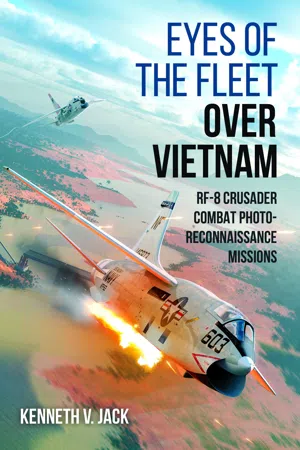
eBook - ePub
Eyes of the Fleet Over Vietnam
RF-8 Crusader Combat Photo-Reconnaissance Missions
- 272 pages
- English
- ePUB (mobile friendly)
- Available on iOS & Android
eBook - ePub
Eyes of the Fleet Over Vietnam
RF-8 Crusader Combat Photo-Reconnaissance Missions
About this book
Trusted by 375,005 students
Access to over 1.5 million titles for a fair monthly price.
Study more efficiently using our study tools.
Information
Subtopic
Military BiographiesIndex
HistoryCHAPTER 1
1964—66: VMCJ-1 Photo-Reconnaissance and Electronic Countermeasures
Marine Composite Reconnaissance Squadron 1 (VMCJ-1) was known for being the “Eyes and Ears” of the First Marine Aircraft Wing (1st MAW) with its RF-8A Crusaders being the eyes and the Korean War-era EF-10B Skyknight’s electronic sensors as the ears. The Marine Corps had a robust history of providing photo-reconnaissance and electronic surveillance during the Cold War, and on occasion augmented Navy RF-8A recon squadrons. In October—November 1962, its East Coast sister squadron, VMCJ-2, augmented VFP-62 during the Cuban Missile Crisis. They provided five pilots, four RF-8As, and maintenance personnel. They flew, both lead and wing positions, with VFP-62 during the low-level photo missions over the Soviet medium-range ballistic-missile sites in Cuba. For their skill and bravery, the Marine pilots received the Distinguished Flying Cross and, along with VFP-62, the squadron was awarded the Navy Unit Commendation.
Before and during the Cuban Missile Crisis, VMCJ-2 operated around Cuba capturing electronic signals and was credited with one of the first intercepts of Soviet early-warning radar in Cuba. The squadron also monitored the build-up of the Soviet-designed radar-controlled surface-to-air missile (SAM) defenses in the months before the crisis. No ground-based radar could search the sky without being monitored and recorded by the Skyknights’ electronic countermeasures (ECM) “black boxes.”
While VMCJ-1 was primarily stationed at land bases, its RF-8A pilots were carrier qualified for deployments with the Navy, but most of the enlisted maintenance and photo technicians had never served at sea. I remember one Marine fighter squadron coming aboard USS Shangri La (CVA-38) in 1961 for carrier qualifications (CARQUAL). It was very apparent they were Marines. They dressed sharper—“squared away” in Navy parlance—and the enlisted officer greeting followed military regulations more rigorously than we. For instance, when a pilot came to the flight deck to man his aircraft, he was greeted with a sharp salute from the enlisted plane captain.iii I don’t remember seeing that being rigorously followed by their Navy counterparts.
Retired Brigadier General Art Bloomer served three tours with VMCJ-1, the last as its commanding officer when it was decommissioned in 1975. He describes the squadron’s early history:
Three VMCJ squadrons were established to support our three active-duty Marine air wings (MAW). We actually had another, VMCJ-4, that supported our Reserve Air Wing, the 4th MAW. During the Korean War, the 1st MAW was deployed from MCAS [Marine Corps Air Station] El Toro to Korea. It had two recon squadrons, VMC-1 for Electronic Reconnaissance and VMJ-1 for Photo Recon…the VMC and VMJ squadrons were combined into Composite Squadrons and gave rise to the designation of VMCJ. I believe the first VMCJ squadrons had F9F-8P photo-Cougars and F3D-2Q electronic recon birds. Prior to that, the VMC had the propeller-engine AD-5N for electronic recon and VMJ had the F2H-2P Banshees as their photo aircraft.
VMCJ-1 supported 1st MAW and was commissioned at MCAS El Toro California on July 31, 1958. It was the last of the three VMCJs to standup and remained at El Toro when VMCJ-3 deployed to Japan in August 1958. Under the leadership of Lieutenant Colonel Albert James, who took command on August 31, the squadron transitioned to the F8U-1P (re-designated RF-8A in 1962) photo-reconnaissance aircraft and the F3D-2Q (re-designated EF-10B) ECM aircraft before departing CONUS [continental U.S.] to relieve VMCJ-3 in November 1959. The squadron took the new photo jets with them to Japan, but took custody of VMCJ-3’s ECM aircraft at MCAS Iwakuni Japan. It would remain forward deployed to MCAS Iwakuni until the start of the Vietnam war. Thereafter, each fall, the squadron’s personnel would be replaced by a cadre from VMCJ-3 under the leadership of a new commanding officer. The RF-8A pilots in each deploying cadre had undergone CARQUALs and maintained their proficiency during their year-long deployment. It would be the spring of 1964 before VMCJ-1 was tasked to provide a photo recon detachment to a carrier in the Pacific.
From November 1959 until April 1965 the squadron continued to fly the Sharkfin electronic reconnaissance missions with the EF-10Bs, under the National Peacetime Aerial Reconnaissance Program, that were begun by VMCJ-3 in 1958. These missions not only made vital contributions to the intelligence community on our Pacific adversaries during the Cold War, but provided invaluable training for the aircrews in a radar-signal environment similar to what the squadron would face in Vietnam.1
Colonel H. Wayne Whitten USMC (Ret.), a Naval flight officer and EF-10B electronic counter-measures officer (ECMO), provides a summary of VMCJ-1 organization in the years of the war:
In 1964 the situation in Indochina was heating up and long before the Tonkin Gulf incident, VMCJ-1 began to provide RF-8A detachments to Task Force 77 [TF-77] carriers augmenting the Navy’s VFP-63. They began flying missions over Laos during that secret war and continued to support TF-77 operations over North Vietnam until December 1965. The squadron lost its first RF-8A in combat on August 13, 1965 when Major P. A. Manning’s aircraft from USS Coral Sea (CVA-43) was hit by AAA [anti-aircraft artillery] on a photo run and losing fuel was forced to eject over water where he was recovered. [See Chapter 3 for more details.]
In the Spring of 1965, the Joint Chiefs of Staff [JCS] authorized the Rolling Thunder bombing campaign against selected targets in North Vietnam. The historic first U.S. Marine Corps (USMC) combat mission employing active ECM or jamming [thwarting] enemy radars was conducted by EF-10Bs on April 29, 1965, in support of a U.S. Air Force (USAF) strike mission. Another first occurred on July 27, 1965, when four of VMCJ-1’s EF-10Bs supported a massive USAF strike against one of the newly identified SAM sites near Hanoi. From that point on until the end of the war the focus of the squadron’s ECM support was against the SA-2 SAMs and associated radars.
On March 18, 1966, the squadron lost its first EF-10B and crew to enemy action, when 1stLts McPherson and Davis’s aircraft was shot down by a SA-2 missile northwest of Vinh. Before departing Vietnam, the squadron would lose four other EF-10Bs and crews to accidents or unknown causes.2
1964: VMCJ-1 Augments VFP-63’s Detachments on Task Force 77 Carriers
On May 22, 1964, VMCJ-1 First Lieutenant Denis “Deej” Kiely was stationed at MCAS Iwakuni in Japan and rudely awakened by a squadron member. He was told, “Get in your flight gear and get ready to launch.” In the ready room he and four other pilots were assigned their Crusaders. In a 2014 article, retired Colonel Kiely described how “he didn’t learn his destination from the division lead, Captain Russ French, until airborne and did not get more information on the purpose of the flight until they landed at NAS (Naval Air Station) Cubi Point in the Philippines. Upon landing, the Marine pilots met a Navy lieutenant commander and learned they all were going to fly to Kitty Hawk, led by Lieutenant Commander Bill Lott, officer in charge of VFP-63 Det. C on the carrier.”3
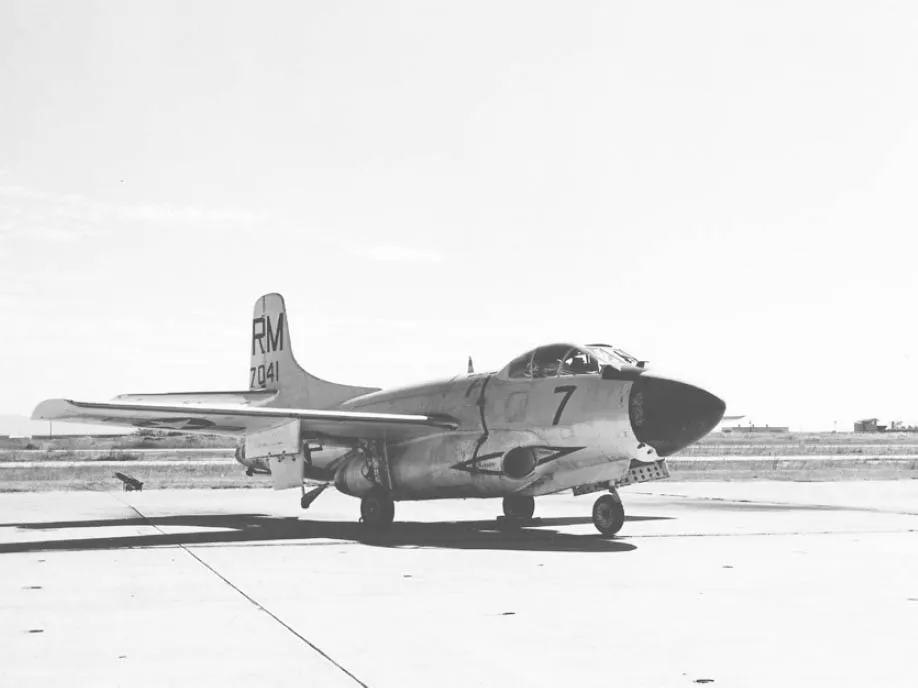
VMCJ-1’s F3D-2Q, the predecessor of the EF-10B electronic warfare jet. (USMC photo via Colonel Ed Love)
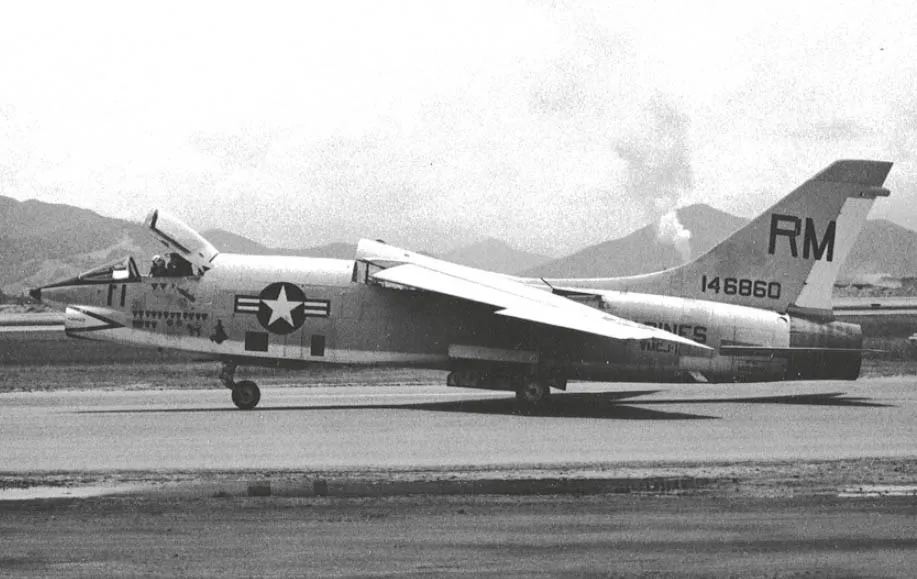
A VMCJ-1 RF-8A taxiing to the active runway. Note the raised wing and combat sortie markings of cameras on the fuselage. (Robert L. Lawson Collection, National Naval Aviation Museum, Pensacola, FL)
The Navy’s first modern aircraft carriers began with the USS Forrestal (CVA-59), the first supercarrier, named after the first Secretary of Defense James Forrestal and commissioned in 1955. Forrestal was followed by USS Saratoga (CVA-60), USS Ranger (CVA-61), and USS Independence (CVA-62), all known as the Forrestal-class carriers. Afterwards a new generation, USS Kitty Hawk (CVA-63) along with the USS Constellation (CVA-64), evolved with further advancements and set the stage for the first nuclear-powered carrier, USS Enterprise (CVAN-65), launched September 24, 1960. All of these modern carriers saw duty in the Vietnam War.

VMJ-1 (predecessor of VMCJ-1) saw a lot of action in the Korean War. An F2H-2P Banshee pictured on the ground in Korea on May 15 1953. Note the number of combat missions recorded on the fuselage. (National Naval Aviation Museum, Pensacola, FL)

USS Kitty Hawk (CVA-63) was commissioned in 1961. In this photograph taken the following year, the destroyers USS McKean (DDR 784) and USS Harry E. Hubbard (DD 748) steam alongside the carrier. The massive size difference from the 27C carriers is substantial. (National Naval Aviation Museum, Pensacola, FL)
The supercarriers were larger than the earlier Essex-class carriers in every way. Kitty Hawk’s length was 1,068.9ft vs. 880ft; the air wing had approximately 75 aircraft; and the ship had about 4,500 personnel aboard. Its size allowed the operation of the Navy’s larger aircraft such as the RA-5C Vigilante (discussed in Chapter 8). It also had better living accommodations, including air conditioning throughout the ship, and, most importantly for the pilots, it was easier to land aboard.

Seen here as a major, and the operations officer and XO of VMFA-122 in 1973, Denis Kiely flew some of the war’s earliest photo-reconnaissance missions as a member of VMCJ-1 on board USS Kitty Hawk (CVA-63). He later transitioned to the Marine’s F-8E and F-4 Phantom II fighters, flying many in country close-air-support missions with VMF(AW)-235. (Cmdr. Peter Mersky)

Demonstrating how huge aircraft carriers are, this photo shows USS Midway (CVA-41) in drydock, circa 1980. Note the gigantic propellers and rudders compared to the men working and climbing the stairs out of the drydock area. (Stephen Miller PH2 USN)
In March 1964, full-scale fighting broke out in Laos when North Vietnamese and Pathet Lao forces attacked across the Plain of Jars—literally a plain where there were ancient, massive stone jars. By mid-May, the communists had taken control of the strategic region, bringing an end to the shaky coalition government. President Lyndon B. Johnson’s administration, just six months old, reflected the national fear of communism and endorsed the prevailing “falling domino” theory that if one Southeast Asian country fell to communism, they all would—it had to be contained. There was no formal war mandate in Southeast Asia (SEA), only CIA clandestine operations. However, VFP-63 and VMCJ-1 pilots would soon be flying photo-recon missions off aircraft carrier decks supporting Operation Yankee Team (the campaign against the North Vietnamese infiltration of Laos). Their photographic film provided valuable intelligence otherwise unattainable. That intelligence supported an armed interdiction campaign to thwart the infiltration of North Vietnamese troops and supplies into South Vietnam (SVN). American foreign policy was “dipping its toe” into a conflict that would become part of the Vietnam War. Colonel Denis Kiely’s witty and detailed article is excerpted here to tell VMCJ-1’s involvement:
The time for greater pressure on the communists had arrived. The violation of Laotian neutrality by North Vietnam became a problem that required both, proof and once having documented that, a “graduated response” meant to dissuade Ho Chi Minh from further aggression by an American show of resolve. With Prince and Prime Minister Souvanna Phouma’s approval, the United States proceeded to plan for low-level reconnaissance of eastern Laos to ascertain the degree of communist army (NVA) build-up. U.S. reconnaissance efforts, both USAF and U.S. Navy, commenced on May 22, 1964.
Once aboard the Kitty Hawk, the Navy tried to figure out where to put us. After some shuffling around, the air group found spaces for us and the business prompting our presence occupied our time. We had yet to really know what the mission was, except that it involved a rather large number of photo birds, both VAP-61 (Heavy Photographic Squadron 61), RA-5Cs from Guam, RF-8As from VFP-63 Dets. C and E and five birds from VMCJ-1 (one spare would be kept at NAS Cubi Point).
CAG-11 had put almost all its attack and one squadron of fighters (VF-114) ashore, keeping the “Old Nicks” of VF-111, aboard and clearing the deck for the photo birds. Aft...
Table of contents
- Front Cover
- Half-Title Page
- Title Page
- Copyright Page
- Dedication
- Contents
- Acknowledgements
- “One More Roll”
- The Story Behind “One More Roll”
- Foreword
- Preface
- Introduction
- 1 1964—66: VMCJ-1 Photo-Reconnaissance and Electronic Countermeasures
- 2 1964: VFP-63 Photo-Reconnaissance Over Laos and First Prisoner of War
- 3 1965: VFP-63 Support of Operation Rolling Thunder Begins
- 4 1966: Operation Rolling Thunder Intensifies
- 5 1966—67: VFP-62 Enters the Vietnam War
- 6 1967—68: Dangerous Skies Over Hanoi and Haiphong
- 7 1969—72: The Final Years
- 8 Other Navy and Marine Corps Photo-Reconnaissance Aircraft
- 9 Summary and Conclusions
- Appendix 1: Analysis of the Bombing Effectiveness in Vietnam
- Appendix 2: Bombing as a Policy Tool in Vietnam: Effectiveness
- Terms and Acronyms
- Source Notes
Frequently asked questions
Yes, you can cancel anytime from the Subscription tab in your account settings on the Perlego website. Your subscription will stay active until the end of your current billing period. Learn how to cancel your subscription
No, books cannot be downloaded as external files, such as PDFs, for use outside of Perlego. However, you can download books within the Perlego app for offline reading on mobile or tablet. Learn how to download books offline
Perlego offers two plans: Essential and Complete
- Essential is ideal for learners and professionals who enjoy exploring a wide range of subjects. Access the Essential Library with 800,000+ trusted titles and best-sellers across business, personal growth, and the humanities. Includes unlimited reading time and Standard Read Aloud voice.
- Complete: Perfect for advanced learners and researchers needing full, unrestricted access. Unlock 1.5M+ books across hundreds of subjects, including academic and specialized titles. The Complete Plan also includes advanced features like Premium Read Aloud and Research Assistant.
We are an online textbook subscription service, where you can get access to an entire online library for less than the price of a single book per month. With over 1.5 million books across 990+ topics, we’ve got you covered! Learn about our mission
Look out for the read-aloud symbol on your next book to see if you can listen to it. The read-aloud tool reads text aloud for you, highlighting the text as it is being read. You can pause it, speed it up and slow it down. Learn more about Read Aloud
Yes! You can use the Perlego app on both iOS and Android devices to read anytime, anywhere — even offline. Perfect for commutes or when you’re on the go.
Please note we cannot support devices running on iOS 13 and Android 7 or earlier. Learn more about using the app
Please note we cannot support devices running on iOS 13 and Android 7 or earlier. Learn more about using the app
Yes, you can access Eyes of the Fleet Over Vietnam by Kenneth V. Jack,Kenneth V Jack in PDF and/or ePUB format, as well as other popular books in History & Military Biographies. We have over 1.5 million books available in our catalogue for you to explore.