- English
- ePUB (mobile friendly)
- Available on iOS & Android
eBook - ePub
Trusted by 375,005 students
Access to over 1.5 million titles for a fair monthly price.
Study more efficiently using our study tools.
Information
PART 1
PLAN YOUR
JOURNEY

Find Direction in Life
I often meet people who are struggling with their careers, and they all say very similar things. I don’t know what I’m doing. I feel like a rudderless ship bobbing around at sea. The variety of reasons people give for feeling confused is endless, and they all point to a common lack of direction in their lives.
I have coined a new expression: the I-dunno generation. Regardless of the questions I ask, I seem to get only one answer: I dunno. Where do you want to work? I dunno. What do you want from life? I dunno. What’s on your bucket list? I dunno.
I hope you gain some insight from reading this book and start coming up with a few other answers for yourself. This is your life; don’t waste it.
Firstly, let’s take a look at the average person’s take on their direction in life:
- Primary school: I want to be a fireman/actress/nurse.
- Secondary school: I have no idea what I want to be when I get older.
- End of secondary school: I like cars so I’ll become a mechanic. I did okay in maths and physics so I’ll study engineering. My mum and dad are lawyers so I’ll study law.
- Finishing university: I have no idea where I want to work so I’ll take the first job that’s offered to me.
- Throughout career: I have no idea where I want to get to or what I want to achieve.
- Retirement: I think I might go travelling and reminisce on all the lost opportunities.
A wasted life means not actually considering where you want to go, or what you want to achieve. It can also mean knowing what you want but not having the guts to go after it. This section of the book is all about contemplating the purpose of your life, who you are, where you want to go, what you want to be remembered for, and the legacy you want to leave behind. Using our travel metaphor from the introduction, you need to choose your destination and pick the routes you could take to get there.
As with any great adventure, you must set the scene by looking at where you are now. Who are you as a person? What is your personality type? What are your values? What makes you tick? What stresses you out? What are your fears? What motivates you? What drives you? Learn more about yourself, hone your mindset, and develop your resilience.
Even if you have already undertaken some of the following psycho-metric tests, I encourage you to repeat them. As with all psychometric testing, the results can change depending on your mindset, mood and environment at the time of testing. This variance should be less than ten percent, but it will change slightly over time.
There are some simple ways you can find out all about yourself, so follow along with the activities. Each of these taken in isolation is okay, but if you combine them, that’s when the results become really useful.
PERSONALITY TESTS
The Myers-Briggs personality-type indicator has been one of the go-to personality tests since it was invented by American mother/daughter duo Katherine Cook Briggs and Isabel Briggs Myers. The test itself was developed during World War Two and first published in 1944. Considering that neither Myers nor Briggs were trained psychologists (both were trained in psychometric testing) the test has attracted its fair share of criticism from psychology purists. Although I’m not a psychologist either, I think the test provides great personal insight and can help you understand who you are.
You can complete the personality test free online (www.16personalities.com). The results will tell you if your personality leans toward extroversion (E) or introversion (I), sensing (S) or intuition (N), thinking (T) or feeling (F), and judgment (J) or perception (P).

Use this QR code to access the 16 Personalities website.
What does all this really mean? For a start, you can learn a lot about yourself. It can show you if you’re more likely to be outspoken or shy in social environments—although that doesn’t mean that if you’re an introvert you won’t succeed at public speaking. After all, social confidence also plays a massive part.
I have had a lot of success with the 16 Personalities website (www.16personalities.com), which delivers a report that will help you understand more about your results. I believe the 16 Personalities test is useful and I encourage you to take it.
Personality types also have a great deal to do with energy levels. Introverts can become exhausted and drained by being in loud social environments. Extroverts, on the other hand, thrive in and get pumped up by these situations.
Does any of this sound familiar to you? Perhaps this will come in handy when you’re managing a team. Reflect on your own personality type and try to gather strategies to work to your strengths. If you’re introverted and are attending a busy all-day workshop, remember to take time to be alone occasionally and recharge your energy levels.
’I have learned I can survive just about anything so long as I am occasionally allowed a few quiet moments to myself—time to restore my spirit, to mend my wounds, to regroup. A little me time and I can deal with anything the world sends my way.’—BEAU TALPIN
VALUES
Now we’ll take a look at your personal values, a process that can give you insight into what you believe deep down at your core. The online tool on the Barrett Values Centre website (www.valuescentre.com/tools-assessments/pva/) will help you identify your personal values in a free values assessment. From this, you will gain insight into what your personal values are. There are some insightful activities to work through in the values-assessment report.

Use this QR code to access the values assessment tool.
Once you know what your values are you will find it much easier to understand why some things grate on you. For instance, you’ll be able to understand why you intuitively don’t trust someone you meet; chances are it’s because your values don’t align with the other person’s. I encourage you to use the values-assessment tools, check your results, and take a deep dive into changing or modifying any limiting values you identify. Completing this values assessment will help to define what is important to you at this point in your life.
You will have picked up many of your values during your childhood from your parents or primary caregivers. Your parents/ caregivers will have passed on their values and their idea of what is right or wrong. Undertaking a values assessment at this point in your life will allow you to assess which values have come from others, and which are yours alone. From this, you can assess which ones you want to hold onto, and which you want to work towards changing.
In early childhood you’re a blank slate and rely on your parents for survival; you accept their values and make them your own; however, when you become an adult you can make a conscious choice to either live by your parents’ values or choose values that are better suited to you. Unfortunately, a misalignment can occur if you continue to hold onto values that are no longer a good fit for your life.
For example, let’s say your parents had a strong work ethic. They valued hard work and didn’t believe in taking time off to relax. You, however, choose to work a regular workweek and employ a cleaner to help out around the house. In this scenario, you might experience an underlying feeling of guilt that you should always be doing something, and find it hard to relax on the weekends.
If you can recognise that there is a mismatch between your own and your parents’ work values, this understanding will reduce any feelings of guilt, or what psychologists refer to as cognitive dissonance (doing something that conflicts with your values).
Many people’s values are determined by both the culture in which they live and the circumstances of their lives. Your parents’ values are likely to be a combination of how they were brought up and societal influences on their lives. The world has changed dramatically over the past thirty years or so, and not all previous values are as important now. Take, for example, the generation that lived through the Great Depression. The attitude of this generation towards work and life will be very different from your view of work and life.
Early in your career, it’s perfectly natural for you to have quite a few values in the survival zone. This is a reflection of the values you have when you’re in the process of establishing yourself and seeking security. However, once you’ve become successfully established, you will probably find that your confidence and self-esteem grow, and your values shift.
The goal is for you to shift the balance of your values from the survival zone towards transformation, ending with a healthy spread across the board. While it’s totally acceptable to have some values in the survival zone, you need to identify the potentially limiting values in this area and make a conscious choice not to embody them.
Ultimately, values are all about what matters to you. They may change over time, maybe even significantly, and you may even find them changing as you work through this book.
Before doing the test, I encourage you to take a deep breath and try to relax as much as possible. Don’t overthink your answers, and don’t try to second-guess them, trying to figure out what will look good or bad. The more honest your answers are, the more you can learn from the experience. You are the only one who needs to see the results. What you do with these results is up to you.
Knowing your core values will...
Table of contents
- Cover Page
- Phrase
- Title Page
- Copyright
- CONTENTS
- PREFACE
- ACKNOWLEDGEMENTS
- PART 1 PLAN YOUR JOURNEY
- CHAPTER 1 Find Direction in Life
- CHAPTER 2 Four Pillars
- CHAPTER 3 Sticky-Note Planner
- CHAPTER 4 Discovering Your Purpose
- CHAPTER 5 Phased Attention
- PART 2 PACK YOUR BAGS
- CHAPTER 6 Preparation
- CHAPTER 7 Confidence
- CHAPTER 8 Strengths
- CHAPTER 9 Mental Strength
- CHAPTER 10 Stress
- CHAPTER 11 Learning to Prioritise
- CHAPTER 12 Adapting to Change
- PART 3 ACCELERATE YOUR JOURNEY
- CHAPTER 13 The Execution
- CHAPTER 14 Routines and Habits
- CHAPTER 15 Flow States
- CHAPTER 16 Multitasking
- CHAPTER 17 Procrastination
- CHAPTER 18 Asking the Right Questions
- CHAPTER 19 Learning to Read Faster
- CHAPTER 20 Career Progression
- CHAPTER 21 From Technician to Manager to Leader
- CHAPTER 22 Becoming a Prominent Person in Your Industry
- CHAPTER 23 Negotiating Like a Pro
- CHAPTER 24 Performance Reviews
- CONCLUSION
- MAKE MORE OUT OF YOUR LIFE AND CAREER IN LESS TIME
- THE SCRIPT
- REFERENCES, RESOURCES AND FURTHER READING
Frequently asked questions
Yes, you can cancel anytime from the Subscription tab in your account settings on the Perlego website. Your subscription will stay active until the end of your current billing period. Learn how to cancel your subscription
No, books cannot be downloaded as external files, such as PDFs, for use outside of Perlego. However, you can download books within the Perlego app for offline reading on mobile or tablet. Learn how to download books offline
Perlego offers two plans: Essential and Complete
- Essential is ideal for learners and professionals who enjoy exploring a wide range of subjects. Access the Essential Library with 800,000+ trusted titles and best-sellers across business, personal growth, and the humanities. Includes unlimited reading time and Standard Read Aloud voice.
- Complete: Perfect for advanced learners and researchers needing full, unrestricted access. Unlock 1.5M+ books across hundreds of subjects, including academic and specialized titles. The Complete Plan also includes advanced features like Premium Read Aloud and Research Assistant.
We are an online textbook subscription service, where you can get access to an entire online library for less than the price of a single book per month. With over 1.5 million books across 990+ topics, we’ve got you covered! Learn about our mission
Look out for the read-aloud symbol on your next book to see if you can listen to it. The read-aloud tool reads text aloud for you, highlighting the text as it is being read. You can pause it, speed it up and slow it down. Learn more about Read Aloud
Yes! You can use the Perlego app on both iOS and Android devices to read anytime, anywhere — even offline. Perfect for commutes or when you’re on the go.
Please note we cannot support devices running on iOS 13 and Android 7 or earlier. Learn more about using the app
Please note we cannot support devices running on iOS 13 and Android 7 or earlier. Learn more about using the app
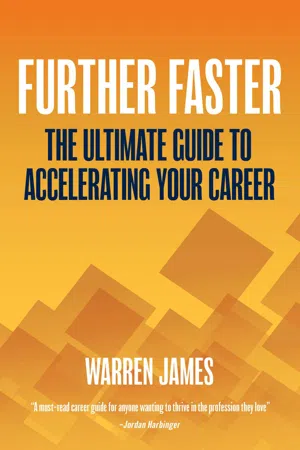
Yes, you can access Further Faster by Warren James in PDF and/or ePUB format, as well as other popular books in Didattica & Carriera. We have over 1.5 million books available in our catalogue for you to explore.