An up-close account of how Nigerians’ self-reliance in the absence of reliable government services enables official dysfunction to strengthen state power
When Nigerians say that every household is its own local government, what they mean is that the politicians and state institutions of Africa’s richest, most populous country cannot be trusted to ensure even the most basic infrastructure needs of their people. Daniel Jordan Smith traces how innovative entrepreneurs and ordinary citizens in Nigeria have forged their own systems in response to these deficiencies, devising creative solutions in the daily struggle to survive.
Drawing on his three decades of experience in Nigeria, Smith examines the many ways Nigerians across multiple social strata develop technologies, businesses, social networks, political strategies, cultural repertoires, and everyday routines to cope with the constant failure of government infrastructure. He describes how Nigerians provide for basic needs like water, electricity, transportation, security, communication, and education—and how their inventiveness comes with consequences. On the surface, it may appear that their self-reliance and sheer hustle render the state irrelevant. In reality, the state is not so much absent as complicit. Smith shows how private efforts to address infrastructural shortcomings require regular engagement with government officials, shaping the experience of citizenship and strengthening state power.
Every Household Its Own Government reveals how these dealings have contributed to forms and practices of governance that thrive on official dysfunction and perpetuate the very inequalities and injustices that afflict struggling Nigerians.
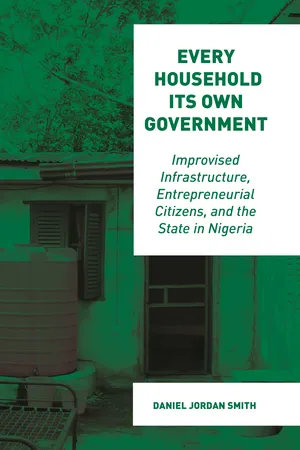
eBook - ePub
Every Household Its Own Government
Improvised Infrastructure, Entrepreneurial Citizens, and the State in Nigeria
- 216 pages
- English
- ePUB (mobile friendly)
- Available on iOS & Android
eBook - ePub
Every Household Its Own Government
Improvised Infrastructure, Entrepreneurial Citizens, and the State in Nigeria
About this book
Trusted by 375,005 students
Access to over 1.5 million titles for a fair monthly price.
Study more efficiently using our study tools.
Information
Print ISBN
9780691229898
9780691229904
Subtopic
Infrastructure1
Empty Pipes and H2O Entrepreneurs
BOREHOLES, CART PUSHERS, AND “PURE WATER”
When I began twenty months of ethnographic research in May 1995 in the community of Ubakala, one of the first tasks was to figure out how to arrange a regular supply of water. At the time, Ubakala was like a lot of places in Nigeria: the government-run water infrastructure had deteriorated significantly over the past several years. In the backyard of the house where I lived, there was a tap next to the kitchen in which my then-mother-in-law cooked over a three-stone fire. The tap was connected to pipes that had supplied running water throughout the community in the 1980s. But water had not flowed for several years. A huge—now empty—water tank loomed over the community, a monument to the government’s failure to maintain basic infrastructure. The creation of Abia State with Umuahia as its capital city brought great hopes for economic and infrastructural development to the denizens of nearby suburbs like Ubakala. By the time I started fieldwork, those hopes had already been frustrated.
My parents-in-law managed to obtain the relatively modest quantity of water they needed each day with the help of a schoolgirl, Obiageri, who lived with them. Obiageri was a relative on my mother-in-law’s side, more or less their foster child. My in-laws paid her school fees and fed, clothed, and housed her. In exchange, she performed many basic household chores such as sweeping, running errands to the nearby market, and helping my mother-in-law with preparations for cooking. By far her most onerous task was the daily fetching of water. Most mornings before school, and many afternoons after school, she pushed a wheelbarrow to a nearby stream to fill two fifty-liter plastic jerrycans that would be used for all the household’s water-related needs except drinking and cooking. Because of the distance to the stream, her chore was even more taxing than that of Ogechi, whose household I highlighted in the introduction. But at least the wheelbarrow enabled Obiageri to fill and fetch two containers simultaneously. Many of her water-fetching peers from households that did not have a wheelbarrow carried one container at a time on their heads. The water from the stream was free. For drinking water, every two or three days my mother-in-law gave Obiageri money to buy from a neighbor who had set up a borehole business.
When my then-wife, Ada, and I arrived, we more than doubled overall household water consumption. The system my in-laws had in place proved untenable. We had built a one-room addition to the house that included a bathroom with a shower and a toilet. As a result, our water consumption per capita was significantly higher than that of my in-laws. They used a latrine that required little water and they each managed a single bucketful for bathing. Though Ada and I were very conscious about not wasting water, the luxuries of a shower and a flush toilet used a lot.
To accommodate our consumption, we followed the practice of many elite Nigerians, which was to buy a couple of huge plastic tanks and periodically pay to have a tanker truck fill them with water. My brother-in-law helped contract a welder to build a permanent scaffold upon which to place one of the tanks so that the shower, sink, and toilet all had gravity-fed running water. The other tank was placed at the back of the house on a slightly elevated concrete platform near the kitchen, where anyone in the household could fill a bucket or a cooking pot. We also purchased an electric water pump because during the rainy season (approximately May through September) the larger ground-situated tank could be filled from rainwater gathered through gutters that guided it from the house’s metal roof. When there was electricity (which was very sporadic), the pump could be used to push rainwater from the lower tank up to the one on the scaffold. But for most Nigerians, this system was well beyond their means. For average citizens, procuring enough water for essential household needs posed a daily challenge and added up to a significant expense.

FIGURE 1.1. Households in Nigeria commonly rig up a combination of tanks, pumps, pipes, gutters, barrels, buckets, and scaffolding to assure a regular supply of water (photo by author).
In this chapter, I examine how individuals, households, and small businesses assemble and manage a patchwork of water infrastructure when confronted with the government’s failure to provide it. Whether one looks to centuries-old sayings, such as the local Igbo expression that “water is life,” Nigerian musician Fela Kuti’s famous 1975 song “Water No Get Enemy,” or to the much more recent global discourse that asserts that “water is a human right,” it is clear that few, if any, infrastructural domains are more crucial for human welfare than those that deliver water.1 No doubt partly because it is necessary for sustaining life, water and its infrastructures are highly political. Water is a particularly apt example of Nikhil Anand, Akhil Gupta, and Hannah Appel’s point that “ethnographic attention to infrastructure … forces us to rethink governance and citizenship not at a distance but pressing into flesh, through questions of intimacy and proximity” (2018: 22). What von Schnitzler observes about water in South Africa is equally true in Nigeria: “Infrastructures, and the technologies deployed with them, are invested with and productive of social and political relations” (2008: 900). Nigeria’s “hydrosocial processes” (Wutich et al. 2018) reveal not only people’s struggle for water, but also the ways that infrastructure is central to how they experience and understand politics and inequality.
Politics, Inequality, and Water Infrastructure
The importance of reliable water infrastructure—and the challenges posed when that infrastructure is deficient or absent—is magnified in the context of urbanization. In cities, people cannot usually depend on natural water sources like streams, rivers, lakes, springs, and so on. Ellis Adams, Daniel Sambu, and Sarah Smiley note in a recent overview of urban water supply in sub-Saharan Africa that “water access is woefully inadequate, mainly because population growth and urbanization are outstripping the already inadequate infrastructure” (2019: 240). Nigeria, Africa’s most populous nation, is rapidly urbanizing. By 2020, about half of the country’s 200 million people lived in cities or towns. Urban centers like Umuahia will keep growing for the foreseeable future, and surrounding communities like Ubakala are becoming increasingly urbanized.
While there is no doubt that rapid urbanization and the accompanying population growth have exacerbated the challenges of providing sufficient and safe water, the demographic trends should not obscure the historical and present-day political underpinnings of Nigeria’s deficient water infrastructure. Many of the country’s current urban water woes have roots in infrastructural disparities bequeathed by colonialism. This history of unequal access to safe water spanned the continent, as Hilary Hungerford and Sarah Smiley document in their comparison of French and British colonial water provision in Africa. They demonstrate that during colonialism, “ultimately, what emerged were socio-spatially stratified water systems and exclusionary water policies that discriminated against indigenous residents and spaces” (2016: 75). They further conclude that “water, for colonial planners, was more than a resource to provide to different populations. Water was a tool of commerce, pacification, and a way to mediate urban boundaries” (2016: 82).
As Matthew Gandy’s (2005, 2006a, 2006b) work on Lagos demonstrates, water infrastructure was integral to colonial rule in Nigeria in these same ways, both adding to inequality and being emblematic of it. Indeed, Gandy (2006b) shows that the history of the city itself can be revealingly narrated and incisively analyzed through the history of its water systems. Charisma Acey (2012) has described comparable colonial legacies in her work on water infrastructure in Benin City, another major metropolis in southern Nigeria. Both Acey and Gandy trace these historical inequalities to the present and argue that in postcolonial Nigeria the state has been similarly implicated in the inequality resulting from its water policies and practices, albeit reflecting and reproducing disparities based on class rather than race (Gandy 2006a; Acey 2008, 2011, 2016).
One of the brutal ironies of Nigeria’s water infrastructural deficiencies is that inequality is manifested not only in disparate access to public water systems, but also in dramatic differences in cost. The poor pay many times more for their water than those who are better off (Acey 2011: 21–22), in part because they typically rely on private vendors whereas the wealthy are more likely to be served by public infrastructure. This is true across Africa (Bontianti et al. 2014: 290; Adams, Sambu, and Smiley 2019). As Gandy notes, while the rich and powerful in Lagos (and throughout Nigeria) generally benefit from the best infrastructure, for ordinary citizens “a self-service city has emerged in which little is expected from municipal government and much social and economic life is founded on the spontaneous outcome of local negotiations” (2006a: 383).
Gandy’s description accurately portrays the practical consequences of the state’s failure to provide and maintain adequate water supplies—leaving people to rely on their own ingenuity and entrepreneurialism. But as both Gandy and Acey also show, the government’s apparent absence masks a more complex reality in which seemingly private and informal economic enterprises to address local water needs inevitably entail significant interaction with and regulation by the state. Elaborating on what she calls “hybrid infrastructure” (“where state and non-state services connect, overlap, and transform each other”) (2016: 29), Acey argues that “categorizing service providers as state and non-state obscures the nature of how such systems operate” (2016: 32).
Using Umuahia as a case study that represents common practices in Nigeria—and across Africa—I describe below the main means by which Nigerians address their daily needs for water. I present ethnographic examples of neighborhood borehole businesses, individual water cart pushers, and the recently flourishing “pure-water” (five-hundred-milliliter sachets) industry. In documenting the quotidian struggle to get water, in addition to the work of individual entrepreneurs and small-scale, so-called informal economic enterprises to provide it, I explore how ostensibly nonstate efforts to address water insecurity in fact require regular interactions with the state.
Further, I show how, despite their reliance on private entrepreneurial efforts to provide a quintessential public good like water, Nigerian citizens nonetheless maintain high expectations for their government. As Nikhil Anand (2017) has persuasively demonstrated in his book about water and the urban poor in Mumbai, India, everyday efforts to secure access to water can themselves be strategic and aspirational political acts. Focusing on Dar es Salaam, Tanzania, Sarah Smiley makes a similar observation: “For those living at the margins in informal areas, connecting to a network and paying for water is a way to gain recognition, respect, benefits from the state, and citizenship and belonging” (2020: 12). To understand these processes, it is necessary to trace how the politics of infrastructure straddles conventional divides such as formal/informal, public/private, and state/nonstate—and in many ways challenges these very categories. Rather than signaling the demise of the state and the meaninglessness of citizenship, these blurry, hybrid, intersecting phenomena are in fact part of their substance. Analytically, the challenge is to determine what all this adds up to for Nigerians—politically, economically, and socially.
“Every System Needs a Backup”: Connections and Constraints in the Borehole Water Vending Business
Like my former in-laws, many Nigerians purchase some or all of their daily water from neighborhood borehole businesses. In Umuahia, a metro area with approximately 774,000 people, and a population growing by about 5 or 6 percent every year (Macrotrends 2020), many neighborhoods have boreholes that are run as private businesses. Thousands of the city’s households rely on these enterprises for their most reliable—and often primary—source of water. This is true even in neighborhoods and households that are connected to the municipal water supply. While the public water system in Umuahia has not collapsed completely, as it did in Ubakala, water runs unpredictably and infrequently. As a result, on most days, at dawn and dusk, children (and sometimes women, but rarely men) can be seen fetching water from a nearby borehole.
As part of my research, I interviewed several borehole entrepreneurs in Umuahia. While each case was slightly different, most borehole businesses shared many similarities. To illustrate the business model, the relationship of these entrepreneurial ventures to the state, and the experience of customers, I describe in detail the water-vending enterprise of a man named Chima, whose borehole operates on a street in one of the oldest residential areas of Umuahia. It is a densely populated neighborhood. Most structures have several flats that are home to multiple large families. In this part of the city, the majority of dwellings are connected to the municipal water supply. As a result, when taps flow there are few customers at Chima’s borehole. But because the city water supply fails to function more often than it succeeds, demand for Chima’s water is generally high.
Starting a borehole business requires a significant amount of capital—something in the range of five thousand dollars, a large amount of money in Nigeria for all but the rich. The main expense is contracting a borehole-drilling rig to dig the well. Once the borehole is constructed, before opening for business a vendor also needs an electric water pump, a couple of large overhead tanks and the scaffolding to support them, as well as a generator, because, as already noted, the national power grid distributes electricity as unreliably and infrequently as the municipality provides water.
By and large, Nigerian banks do not provide significant credit to small-business entrepreneurs, especially those without significant collateral (Uzonwanne 2015). Indeed, Nigerian banks are notorious for lending huge sums to political elites, often with little chance of repayment. Nigeria’s recent banking history includes many scandals and bank failures (Abiola 2009; Okereke and Kurotamunobaraomi 2016). In these circumstances, aspiring small-scale entrepreneurs like Chima must acquire capital for start-up costs in some other way.
Typically, Nigerian small-business entrepreneurs obtain capital from family, friends, or patrons. Credit can take the form of an investment, such that the person(s) providing the capital will own an agreed-upon portion of the business and take a prearranged share of the profits; a loan, sometimes with interest, sometimes not, depending on the relationship of the lender and the recipient; or a gift, most commonly among kin. In Chima’s case, the capital came in the form of a hybrid investment/gift from his eldest brother, who lived in London.
Since migrating to London in the early 1980s, Chima’s brother, Nnamdi, had grown weary of the incessant demands from relatives at home in Nigeria. These included entreaties from his younger siblings to help them financially, as well as a presumption that he would cover almost every cost associated with taking care of their aging parents. Nnamdi didn’t expect or need a share of the small profits from the borehole in Umuahia. Instead, the agreement was that Chima would use the revenue not only to help support his own immediate family, but also to look after the needs of their elderly parents who still lived in their natal village. In exchange for the money to construct the borehole, Nnamdi expected—or at least hoped—that Chima would take over much, if not all, of the regular support for their parents.
It didn’t entirely work out as planned. Chima always asserted that the profit margin from the borehole was too small to enable him to fulfill his duties as a provider for his own children, much less assume full responsibility for his parents. But he tried. Although there were occasional spats between Nnamdi and Chima about the money needed for their parents’ care, the fact that the borehole succeeded as a small business made it less...
Table of contents
- Cover Page
- Title Page
- Copyright Page
- Dedication
- Contents
- List of Illustrations
- Introduction
- 1. Empty Pipes and H2O Entrepreneurs: Boreholes, Cart Pushers, and “Pure Water”
- 2. “Problem Has Changed Name”: Electric Power and Consumer Citizenship
- 3. Okada and Danfo: “Public Transportation” in Nigeria
- 4. “Be What You Want to Be”: Cell Phones and Social Inequality
- 5. “They Don’t Know What I Have Not Taught Them”: The Privatization of Public Schooling
- 6. “Sleeping with One Eye Open”: Infrastructural Insecurity
- Conclusion
- Acknowledgments
- Notes
- References
- Index
Frequently asked questions
Yes, you can cancel anytime from the Subscription tab in your account settings on the Perlego website. Your subscription will stay active until the end of your current billing period. Learn how to cancel your subscription
No, books cannot be downloaded as external files, such as PDFs, for use outside of Perlego. However, you can download books within the Perlego app for offline reading on mobile or tablet. Learn how to download books offline
Perlego offers two plans: Essential and Complete
- Essential is ideal for learners and professionals who enjoy exploring a wide range of subjects. Access the Essential Library with 800,000+ trusted titles and best-sellers across business, personal growth, and the humanities. Includes unlimited reading time and Standard Read Aloud voice.
- Complete: Perfect for advanced learners and researchers needing full, unrestricted access. Unlock 1.5M+ books across hundreds of subjects, including academic and specialized titles. The Complete Plan also includes advanced features like Premium Read Aloud and Research Assistant.
We are an online textbook subscription service, where you can get access to an entire online library for less than the price of a single book per month. With over 1.5 million books across 990+ topics, we’ve got you covered! Learn about our mission
Look out for the read-aloud symbol on your next book to see if you can listen to it. The read-aloud tool reads text aloud for you, highlighting the text as it is being read. You can pause it, speed it up and slow it down. Learn more about Read Aloud
Yes! You can use the Perlego app on both iOS and Android devices to read anytime, anywhere — even offline. Perfect for commutes or when you’re on the go.
Please note we cannot support devices running on iOS 13 and Android 7 or earlier. Learn more about using the app
Please note we cannot support devices running on iOS 13 and Android 7 or earlier. Learn more about using the app
Yes, you can access Every Household Its Own Government by Daniel Jordan Smith in PDF and/or ePUB format. We have over 1.5 million books available in our catalogue for you to explore.