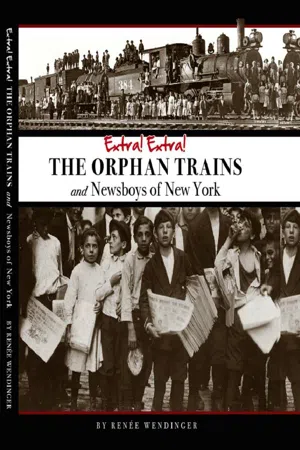
The Orphan Trains and Newsboys of New York is a nonfiction American history composition about the trains that departed New York City carrying more than 250,000 children from various East Coast orphanages. During a span of seventy-five years, these trains traveled to all points West across the United States in an effort to find the children families and homes. The placing out in America became known as the largest mass migration of children ever to take place in US history never to be duplicated again. The collection of stories effectively communicates little known details about the children who faced nearly insurmountable odds. From agonizing letters written by desperate mothers, to news stories of the latest train, or of newsboys looking out for each other, the humanity of individuals caught up in the sweep of history is unmistakable. Over 200 hauntingly good photographs lend authenticity to these fascinating stories of kindhearted benefactors and the irrepressible youngsters they served.
- English
- ePUB (mobile friendly)
- Available on iOS & Android
eBook - ePub
THE ORPHAN TRAINS and Newsboys of New York
About this book
Trusted by 375,005 students
Access to over 1.5 million titles for a fair monthly price.
Study more efficiently using our study tools.
Information
PART I

THE ORPHAN TRAINS

HOW THE ORPHAN TRAINS BEGAN
IMMIGRATION
In 1853 the United States began evaluation of railroad routes to the Pacific, sending mapping announcements to Europe and the rest of the world. Praises went forth, inviting people to come to America and obtain “free land.” As a result, the United States received a large number of immigrants. Steamship agents and railroad companies attracted the rest with descriptions of “the land of opportunity.” Port cities became overcrowded, with assorted jobs filled by cheap labor. New York City had the largest influx of immigrants. Many made long overland journeys, but countless others stayed in the city. A host of urban ills, including poverty, disease, alcoholism, job competition, and lack of resources led to instability and desperation.
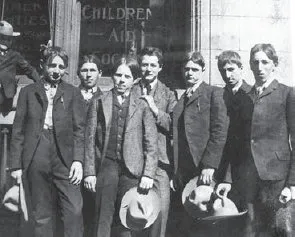
Ready to be sent west, this company of boys stand in front of the Children’s Aid Society office at 105 East 22nd Street.
The Children’s Aid Society Collection
Sometimes families were left with little choice but to abandon their children to the city streets.
THE NEW YORK CHILDREN’S AID SOCIETY
The Children’s Aid Society was under the auspices of the Brace Farm School, the Industrial Schools, and Newsboys Lodging Homes. Charles Loring Brace and friends founded the Children’s Aid Society in 1853–54. Brace saw orphaned, half-orphaned, and runaway children become waifs of the city. Envisioning new lives for these destitute youngsters, Brace devised a plan to send them away from overpopulated city streets to find family homes in the West. He believed the West had “many spare places at the table of life” and a wholesome atmosphere in which to raise children. This excellent plan was not totally satisfactory for all children. Some went to good homes, but others were instead mistreated.
Upon arrival, children were grouped upon stages, on station platforms, in town halls, or on wooden boxes, and prospective parents were asked to choose a child by personal viewing. Thus the phrase put up for adoption became known. Boys may have had their muscles examined as potential farm laborers. Similarly, teeth, stature, and visible medical issues were considered.
THE NEW YORK FOUNDLING HOSPITAL
In 1869 Sister Mary Irene Fitzgibbons and the Sisters of Charity founded the New York Foundling Hospital. Crime seemed to follow poverty, and the most monstrous crime of all was infanticide. The Sisters were child savers, too, but reserved safekeeping to infants and young children. The Foundling Hospital’s children usually aged between one and six years, though some were preteen, rode on trains affectionately called “baby trains,” “mercy trains,” or “baby specials.” This organization sent nearly as many children West as did the Children’s Aid Society. The New York Foundling Hospital and the Children’s Aid Society were two of the largest East Coast agencies placing children in the West.
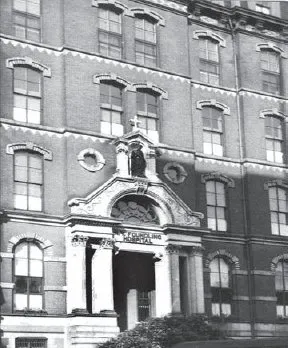
The New York Foundling Hospital on Sixty-eighth and Lexington Street.
The New York Foundling Hospital Collection
INDENTURED APPLICATION
The New York Foundling Hospital commissioned prospective parents to apply for a child in advance. Clergy and city officials announced the need for family homes to local parishes and citizens. Prospective parents could specify the age, gender, and hair and eye color they sought in a child. The New York Foundling Hospital carried an indenture system formulating a contract requiring parents needed to clothe, educate, and provide financially for the child until the age of eighteen. The form essentially guaranteed room and board in exchange for labor. A child could be sent back to New York if placement proved unsatisfactory. The expectation was that the contract could be dismissed in favor of adoption.
SEVENTY FIVE YEARS OF ORPHAN TRAINS
Between 1854 and 1929 over 250,000 children from the urban East Coast, predominantly New York, were placed on what became known as “the orphan trains.” This one-way trip was designed to relocate homeless, neglected, and abandoned children to points west across America. It was the largest mass migration of children to take place in American history.
THE CHILDREN’S AID SOCIETY OF NEW YORK
Charles Loring Brace was born in Litchfield, Connecticut, on June 19, 1826, later in life becoming an educated ordained Methodist minister and changing direction to become a social worker. In 1852, at age twenty six as Brace ministered to the poor of Blackwell’s Island (now known as Roosevelt’s Island) and to the poor at the Five Points Mission, he decided he wanted to fulfill his humanitarian efforts in the streets rather than in the churches. He was aware of the impoverished lives of children in New York City, and he concentrated on improving their futures. A year later, in 1853, he established the Children’s Aid Society.
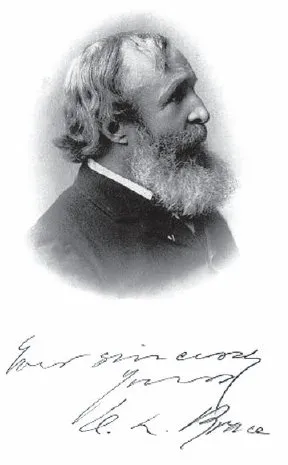
Charles Loring Brace.
The Children’s Aid Society Collection
Brace witnessed many children living their lives in poverty, their parents abusing alcohol, engaging in criminal activity, and seemingly unfit. He detected children whose dedicated parents were too poor to care for their off-spring. He observed children begging for money, selling newspapers or matches on street corners, and stealing for survival.
These children became known as “street Arabs,” “waifs of the city,” or “the dangerous classes.” The area around Tenth Avenue, referred to as Misery Row, was the hotbed for crime and poverty, where orphans and runaways found themselves drifting into destitution. The old shed of Eighteenth and Nineteenth Streets was worse. Such was the severity of child poverty in 1854 that the estimated number of homeless children in New York City soared to 34,000.
Brace focused on finding jobs and training for the destitute children so that they could help themselves. His efforts brought forth social reforms...
Table of contents
- Cover
- Copyright
- Contents
- Acknowledgements
- Preface
- Dedication
- Part I - Extra! Extra! The Orphan Trains
- Part II - Extra! Extra! The Newsboys of New York
- About the Author
- Adieu
Frequently asked questions
Yes, you can cancel anytime from the Subscription tab in your account settings on the Perlego website. Your subscription will stay active until the end of your current billing period. Learn how to cancel your subscription
No, books cannot be downloaded as external files, such as PDFs, for use outside of Perlego. However, you can download books within the Perlego app for offline reading on mobile or tablet. Learn how to download books offline
Perlego offers two plans: Essential and Complete
- Essential is ideal for learners and professionals who enjoy exploring a wide range of subjects. Access the Essential Library with 800,000+ trusted titles and best-sellers across business, personal growth, and the humanities. Includes unlimited reading time and Standard Read Aloud voice.
- Complete: Perfect for advanced learners and researchers needing full, unrestricted access. Unlock 1.5M+ books across hundreds of subjects, including academic and specialized titles. The Complete Plan also includes advanced features like Premium Read Aloud and Research Assistant.
We are an online textbook subscription service, where you can get access to an entire online library for less than the price of a single book per month. With over 1.5 million books across 990+ topics, we’ve got you covered! Learn about our mission
Look out for the read-aloud symbol on your next book to see if you can listen to it. The read-aloud tool reads text aloud for you, highlighting the text as it is being read. You can pause it, speed it up and slow it down. Learn more about Read Aloud
Yes! You can use the Perlego app on both iOS and Android devices to read anytime, anywhere — even offline. Perfect for commutes or when you’re on the go.
Please note we cannot support devices running on iOS 13 and Android 7 or earlier. Learn more about using the app
Please note we cannot support devices running on iOS 13 and Android 7 or earlier. Learn more about using the app
Yes, you can access THE ORPHAN TRAINS and Newsboys of New York by Renee Wendinger in PDF and/or ePUB format, as well as other popular books in History & World History. We have over 1.5 million books available in our catalogue for you to explore.