eBook - ePub
Available until 7 Jul |Learn more
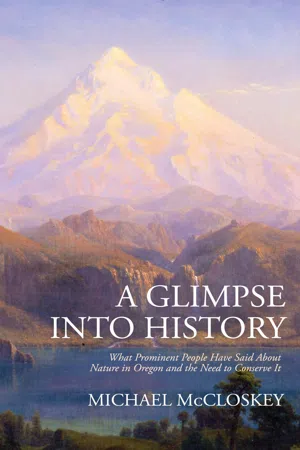
A Glimpse Into History
What Prominent People Have Said About Nature in Oregon and the Need to Conserve It
This book is available to read until 7th July, 2026
- English
- ePUB (mobile friendly)
- Available on iOS & Android
eBook - ePub
Available until 7 Jul |Learn more
A Glimpse Into History
What Prominent People Have Said About Nature in Oregon and the Need to Conserve It
About this book
A Glimpse Into History: What Prominent People Have Said About Nature in Oregon and the Need to Conserve It features the words of over ninety figures who turned Oregon into the premier "green" state. They were explorers, pioneers, settlers, ministers, climbers, scientists, poets, politicians, writers, ranchers, activists, lawyers, and businessmen.
They shaped the culture that saw value in nature and demanded policies to protect it. Through their inspiring words, their presence is still felt. Oregon was blessed in being shaped by such talented people.
Tools to learn more effectively

Saving Books

Keyword Search

Annotating Text

Listen to it instead
Information

Contents
Introduction
Foreword
Acknowledgements
- Exploration and Settlement
- The Early Years
- Oregon Becomes a Developing State
- Oregon in the Early 20th Century
- Oregon in the Midst of the 20th Century
- Oregon in the Latter Part of the 20th Century
- Oregon in the Environmental Era
- Oregon as Environmentalism Becomes the Norm
- Oregon in Contemporary TimesSourcesCopyright
Introduction
I had thought that history dealt with people who were dead and silent. But in doing research, I ran across quotes from historical figures that awakened me to the fact that this was not entirely true. As I read their words, I began to get a feeling for their personalities, passions, and times. To me, it was almost like listening to a recording of their voices. History began to come alive. This was a feeling that I did not get by just reading about them.
As I read their words, I began to see patterns in history and how much of their perspectives we still share. I also learned how one promoted another as the older ones helped the younger ones get ahead; their careers were often tied together. I saw their similarities and differences, and how the issues evolved.
Some were so moved by their experiences in nature that they spoke in language that was almost poetic. In the nineteenth century, it was common to link the beauties of nature with the handiwork of the Creator. Others expressed outrage and didn’t shy away from strong language, for instance denouncing “greed” and those who “looted the public domain.” Some hammered away at themes that gripped them, while others ranged widely. Even in tense times and moments of peril, humor could emerge in their words. Some were almost lyrical in praising our progress, while others were fearful of sliding back. Some were driven, some were reverential, and others were angry.
As I became almost addicted to digging out the words of those who had gone before and shaped Oregon’s environmental programs, I began to see that the quotes I was extracting from their works might constitute a book—one that had not been done before. This is that book.
The leaders quoted in this book all shaped our values and programs. They shaped the culture that made nature a public value and made its conservation an important concern. They all deserve our gratitude. Their words are still with us, and in one sense, so are they.
Michael McCloskey
Foreword
This book focuses on two related topics: appreciation of nature in Oregon and emerging efforts to conserve nature. The book shows how a “green” culture developed in the state that laid the groundwork for the many public policies that followed. The culture was embraced by a wide variety of public personalities, in many lines of work.
In selecting passages to quote, I looked for language with certain qualities—language that was evocative, provocative, or that introduced new concerns of conservation. I left out passages that dealt with technical matters, obscure concerns, and matters of little interest today.
I often edited wording that was unclear or awkward.
In the text that follows, I have used typography to indicate passages of different kinds. Profiles of the figures are quoted are put in boxes; the topics being addressed are in bold.
This work can be used in varied ways. It can be read straight through, it can be used as a text in environmental history courses on Oregon, or it can be used a reference work. Happy reading!
Michael McCloskey
Acknowledgements
Many people helped me dig out these quotes from figures who have shaped Oregon’s environmental programs. Alice LaViolette of the Oregon State Library in Salem stands out; she helped me find writings by many people I might have missed. Dave Hegeman there was also helpful. Kylie Pine, the curator of the Willamette Heritage Center in Salem, also helped me find things that Sen. Charles McNary had written.
Various people at the reference desk of the central Multnomah County Library also helped me find documents, as did specialists in the library of the Oregon Historical Society, such as Scott Daniels, and those at the Reed College Library. Reference specialists in the law library of Lewis & Clark College also helped me pursue notions I had.
I want to thank my brother, David McCloskey, for reviewing this work in draft form and leading me to poetry suitable for inclusion. Alice LaViolette also gave the draft a careful and helpful reading. Ron Eber was also helpful in reviewing the text. As always, Chris Williams kept my computer going properly. And Jim McMullin has been instrumental in handling the process of getting the illustrations ready for publication. And I am grateful to all those who offered supporting statements: Alice LaViolette, Kim Stafford, and Ramona Rex.
In doing this research, I also learned more about the difficulties one faces in doing research of this kind. For instance, documents from the Congressional Record have only been digitized for the last twenty-five years. And the Oregon Historical Society has not had the money to prepare guides to many of the materials in its archives. And most of the documents from the career of Senator McNary are not in Oregon but are instead held in the archives of the Smithsonian Institution in Washington, DC, and are held at remote sites.
But the wonder is that so much has been digitized in just a few short years. The Oregon Encyclopedia is very helpful, as is Wikipedia. This kind of a book could not have been written a few decades ago. I am grateful to all who made it possible.
Michael McCloskey
Chapter One
Exploration and Settlement
When Captain George Vancouver sailed up the Oregon coast in 1792, the cliffs north of Cape Blanco made a deep impression. In his journals, he said:
This cape … is a conspicuous one, particularly when seen from the north—being formed by a round hill on high perpendicular cliffs, some of which are white, [rising...
Table of contents
- 9781087927978
Frequently asked questions
Yes, you can cancel anytime from the Subscription tab in your account settings on the Perlego website. Your subscription will stay active until the end of your current billing period. Learn how to cancel your subscription
No, books cannot be downloaded as external files, such as PDFs, for use outside of Perlego. However, you can download books within the Perlego app for offline reading on mobile or tablet. Learn how to download books offline
Perlego offers two plans: Essential and Complete
- Essential is ideal for learners and professionals who enjoy exploring a wide range of subjects. Access the Essential Library with 800,000+ trusted titles and best-sellers across business, personal growth, and the humanities. Includes unlimited reading time and Standard Read Aloud voice.
- Complete: Perfect for advanced learners and researchers needing full, unrestricted access. Unlock 1.4M+ books across hundreds of subjects, including academic and specialized titles. The Complete Plan also includes advanced features like Premium Read Aloud and Research Assistant.
We are an online textbook subscription service, where you can get access to an entire online library for less than the price of a single book per month. With over 1 million books across 990+ topics, we’ve got you covered! Learn about our mission
Look out for the read-aloud symbol on your next book to see if you can listen to it. The read-aloud tool reads text aloud for you, highlighting the text as it is being read. You can pause it, speed it up and slow it down. Learn more about Read Aloud
Yes! You can use the Perlego app on both iOS and Android devices to read anytime, anywhere — even offline. Perfect for commutes or when you’re on the go.
Please note we cannot support devices running on iOS 13 and Android 7 or earlier. Learn more about using the app
Please note we cannot support devices running on iOS 13 and Android 7 or earlier. Learn more about using the app
Yes, you can access A Glimpse Into History by Michael McCloskey in PDF and/or ePUB format, as well as other popular books in History & North American History. We have over one million books available in our catalogue for you to explore.