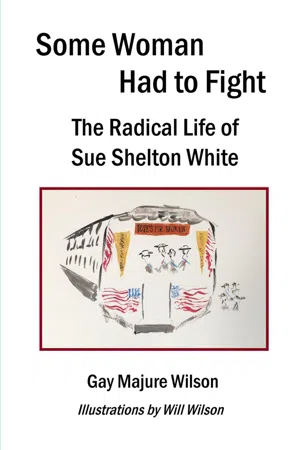
- English
- ePUB (mobile friendly)
- Available on iOS & Android
eBook - ePub
Trusted by 375,005 students
Access to over 1 million titles for a fair monthly price.
Study more efficiently using our study tools.
Information
Topic
DirittoSubtopic
Biografie in ambito giuridicoCHAPTER 1
Rowdyism About to Break Loose
In 1915 the world heaved under the strain of war and tragedy. World War I raged in Europe. The British ocean liner Lusitania was attacked and sunk by a German U-boat’s torpedo. A deadly hurricane struck Galveston for the second time in the new century, taking hundreds of lives and devastating the Texas coastline, while the menace of Typhoid Mary struck in New York.
There were moments of distraction and optimism. Babe Ruth hit his first home run. Americans witnessed the first coast-to-coast phone call, between Alexander Graham Bell in New York and his assistant Thomas Watson in San Francisco.
The year also brought suffrage gains for women in Denmark and Iceland.1,2 But women in the United States of America still were fighting for recognition of their right to vote.
In October 1915 the Tennessee Equal Suffrage Association held its state convention in Jackson, Tennessee, where 28-year-old Sue Shelton White worked as a stenographer, a job she had inherited from her older sister Lucy. Lucy had left behind small-town life for the glamor of being a newspaper reporter in San Francisco.
White was born 20 miles away in Henderson, Tennessee on May 25, 1887. Her father was a lawyer and preacher. Her mother taught music lessons to local children. Both died when White was young, thrusting the burdens of self-sufficiency upon young Sue and her siblings at an early age.3
White was named recording secretary of the Tennessee suffrage association at the 1915 convention. The local suffragists urged Tennessee state legislators to vote for equal suffrage, but also expressed appreciation to President Woodrow Wilson for endorsing voting rights for women.4 How things would change just two years later.
In November 1917 nationally known and often reviled suffragists Maud Younger and Mrs. Howard Gould drove across the American South on a lecture tour. Calling it the Dixie Tour, Younger and Gould lectured in the Southern states to promote the causes of the National Woman's Party (NWP). As they traveled, they were caught in the political crossfire over the NWP’s public protests in Washington, D.C. The Dixie Tour sought to defend the defiant protests, which were under attack as being unpatriotic during the crisis and horror of World War I.5
Younger was from California. Gould was from New York. Upon arriving in the South, they were strangers in a strange land. After stops in Alabama and Georgia, Younger and Gould headed to Tennessee.
Becky Hourwich Reyher was a young college student from New York who had married earlier that year. As an organizer for the NWP, she was one of several women sent ahead of Younger and Gould to the Southern states. This was Reyher’s first long trip away from home. Anger toward the NWP’s militant suffragists was mounting as she traveled through each state. “And now it was getting hot and sharp in Tennessee,” she reported.
Reyher arrived in Jackson, Tennessee to meet officials and arrange permission for the lecture stop in this small city in West Tennessee surrounded by cotton fields. “We had no Committee women in Jackson. . .I was entirely alone.”
Reyher had an appointment to meet the Jackson mayor. She stopped on a downtown street and asked “a nice, sweet looking woman” for directions. The local newspaper had carried Reyher’s photo and a story of her arrival. The woman recognized her: “You are one of the suffragists, aren’t you?” Reyher confirmed yes. The woman replied, “Good luck to you.”
Reyher later needed to dictate a report of her work and send it to renowned NWP leader Alice Paul. She went to the office of a public stenographer who the hotel staff had recommended: “Miss Sue, the best one in town.”
When Reyher arrived at the stenographer’s office, she was surprised to find that it was the same sweet, helpful woman she had spoken with earlier on the street — Sue Shelton White.
Reyher confided to White that the mayor was having doubts about allowing the lecture. Rumors were swirling that local residents were threatening trouble, with some demanding that the suffragists be run out of town. “Sue listened, her eyes flashing.”
White called the mayor and police chief. She demanded that the suffragist leaders be allowed to speak and that city officials protect them from harm. White assured the mayor that she could vouch for the suffragists and their message. She argued that these women simply were asking for the vote, and nothing about that could be called unpatriotic.
City officials relented and gave their permission.
Younger and Gould arrived in Jackson on November 22, 1917. Younger sported a flowing chiffon dress and decorative, wide-brimmed hat. Reyher later recalled, “The whole town was agog.”
That evening White spoke first to the audience of 250. Reyher recalled, “I was surprised to hear the deep rumble that came from that slender frame, or the passion and oratory with which her words rolled out.” White reminded the audience to show their Southern hospitality to the visitors. Two burly men walked the aisle ready to arrest troublemakers, with “the atmosphere of rowdyism about to break loose.”6
Younger spoke passionately about the federal suffrage amendment and defended the NWP’s tactic of picketing the White House.
After Younger’s lecture, the Jackson audience passed a resolution asking the mayor of Nashville, Tennessee to grant Younger permission to speak in his city. The resolution vouched that Younger had said nothing unpatriotic or disloyal about the United States or the President. It was signed by five leading citizens of Jackson: a banker, a newspaper owner and secretary of the Jackson Association of Commerce, an attorney, the chief of police, and meeting chairman Sue Shelton White.7
White is credited by Reyher with transforming the atmosphere of that controversial meeting. “She spellbound that hostile audience. The rumblings stopped, the atmosphere became friendly. . .We hated to leave Jackson.”
After the meeting, White told the suffragists she would accompany them and smooth the way on their tour through Tennessee. “And everywhere, thanks to her, the hostility vanished.”8
White relied on her work as a stenographer to make her living as a single woman in the early 20th century. By closing her office to join the suffragist tour, she knew that she was sacrificing the financial stability her job brought. It was the first of many risky career moves, of which White would say, “I am not afraid of starving.”9
When Reyher returned to Washington, she and Younger both told Alice Paul about White. “It was then Miss Paul began badgering Sue to come to Washington, and you know the rest,” Reyher wrote years later.10
That tense, unpredictable evening in her hometown marked White’s debut on the national suffragist stage.
CHAPTER 2
Every Mother’s Daughter
In 1917, during World War I, the National Woman’s Party was reviled by many for daring to stage militant protests in Washington, D.C. in a time of war.
Writing to a Tennessee newspaper in November 1917, White defended the White House pickets by the NWP, arguing that women of gentle breeding and high ideals were picketing on behalf of “their leader, Alice Paul, who is dying in the Occoquan Workhouse,”1 an odious place known for its brutal treatment and forced feedings of suffragist prisoners.
The newspaper editor replied, insisting that the NWP’s militant methods were costing the suffrage movement the empathy of the nation, at a time when the country faced its greatest crisis. The editor pointed to the ability of the other, quieter faction of the suffragists — the National Woman’s Suffrage Association — to “present their cause without ill feeling.”2
Less than two years later, on February 9, 1919, White was center stage in the protests. She was among almost 100 women who marched to the White House and gathered shoulder to shoulder around an urn. A curious crowd of several thousand people had gathered, standing for two hours, listening and watching the spectacle in anxious anticipation of what may come next.
A fire was lit. Flames leapt skyward. White held high the words of an unfulfilled pledge by President Wilson to extend democracy to women — then dropped the pledge in the fire — her anger burning at his empty promises. A cartoon three-foot paper effigy of Wilson also went up in flames.3
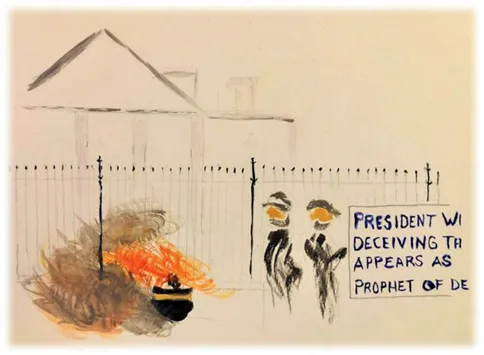
White and 64 other women were arrested by civil and military police. After the principal speaker Mrs. Henry O. Havemeyer was arrested, more women dashed to the podium to speak in her place. Each was grabbed and arrested as she made her desperate attempt. The women kept up their protests and shouted at spectators as they were shoved into patrol wagons.4
At the police station, the women refused to post bond and were jailed. White served five days in the filthy, harsh conditions of the Lorton Women’s Workhouse in Virginia.
The arrests of the suffragists brought mixed reactions in White’s hometown. The editor of a neighboring small-town newspaper complained:
The female nuisances who made themselves conspicuous and offensive by picketing the White House for the purpose of annoying the President and members of his cabinet are just where they ought to be—in jail—and should be allowed to remain there until they promise, and make bond if necessary, to go to their homes, where they are doubtless of minimum use—and God pity the men they go back to.5
The Tennessee Suffrage Association — the moderate faction of the suffragists — opposed the White House pickets, claiming they were unpatriotic.6

After her release, White joined other former prisoners aboard the Prison Special train tour in February and March 1919. It was a cross-country speaking tour by 26 former suffragist prisoners to publicize their brutal, unjust experience and recruit supporters for the NWP...
Table of contents
- Cover
- Title Page
- Copyright Page
- Dedication
- Contents
- Chapter 1: Rowdyism about to Break Loose
- Chapter 2: Every Mother’s Daughter
- Chapter 3: Some Woman Had to Fight
- Chapter 4: Not Such a White Elephant
- Chapter 5: A Full Partnership without Embarrassment
- Chapter 6: Two Mules
- Chapter 7: Determined to Foment a Rebellion
- Chapter 8: Lady Warrior
- Chapter 9: World at War
- Chapter 10: Finding Home
- Chapter 11: The Final Battle
- Chapter 12: Whatever the Cost
- Epilogue: Gaiety and Grief
- Acknowledgements
- Notes
Frequently asked questions
Yes, you can cancel anytime from the Subscription tab in your account settings on the Perlego website. Your subscription will stay active until the end of your current billing period. Learn how to cancel your subscription
No, books cannot be downloaded as external files, such as PDFs, for use outside of Perlego. However, you can download books within the Perlego app for offline reading on mobile or tablet. Learn how to download books offline
Perlego offers two plans: Essential and Complete
- Essential is ideal for learners and professionals who enjoy exploring a wide range of subjects. Access the Essential Library with 800,000+ trusted titles and best-sellers across business, personal growth, and the humanities. Includes unlimited reading time and Standard Read Aloud voice.
- Complete: Perfect for advanced learners and researchers needing full, unrestricted access. Unlock 1.4M+ books across hundreds of subjects, including academic and specialized titles. The Complete Plan also includes advanced features like Premium Read Aloud and Research Assistant.
We are an online textbook subscription service, where you can get access to an entire online library for less than the price of a single book per month. With over 1 million books across 990+ topics, we’ve got you covered! Learn about our mission
Look out for the read-aloud symbol on your next book to see if you can listen to it. The read-aloud tool reads text aloud for you, highlighting the text as it is being read. You can pause it, speed it up and slow it down. Learn more about Read Aloud
Yes! You can use the Perlego app on both iOS and Android devices to read anytime, anywhere — even offline. Perfect for commutes or when you’re on the go.
Please note we cannot support devices running on iOS 13 and Android 7 or earlier. Learn more about using the app
Please note we cannot support devices running on iOS 13 and Android 7 or earlier. Learn more about using the app
Yes, you can access Some Woman Had to Fight by Gay Majure Wilson in PDF and/or ePUB format, as well as other popular books in Diritto & Biografie in ambito giuridico. We have over one million books available in our catalogue for you to explore.