This book is available to read until 6th July, 2026
- English
- ePUB (mobile friendly)
- Available on iOS & Android
eBook - ePub
Available until 6 Jul |Learn more
About this book
Living in a world with autoimmune diseases or food allergies is too often like walking out onto a battlefield without knowing who your opponents are or where the next attack will come from.
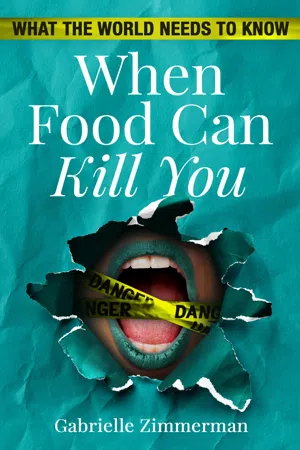
When Food Can Kill You provides a constructive framework for managing and dealing with food allergies in different contexts and, with such, to help improve the quality of life for those who suffer with them daily.
Author Gabrielle Zimmerman explores:
- How food industry innovations and trends have positively and negatively impacted the food allergy community
- What life is like pre- and post-diagnosis of autoimmune diseases, like celiac disease, and multiple food allergies
- How common misconceptions impact food allergy sufferers and why they keep their diagnoses private at times
With uncertainty comes fear and with a lack of understanding comes frustration. The world of food allergies has enough of both in it already. With just a bit of knowledge we can have a world that is healthier and safer for all.
Tools to learn more effectively

Saving Books

Keyword Search

Annotating Text

Listen to it instead
Information
Part One:
Introduction
My life did not always revolve around my proximity to gluten. It did not always scare me to have a bread crumb within an inch—heck, even twelve inches away from me. It’s funny how a daily basic human need can surprisingly become so much more complex than ever imagined. Maybe you can say that when life hits you hard for the first time, there’s no going back except to realize that the things you take for granted can be short-lived. I’m still amazed at how one instance could change my entire life forever; how easily things could suddenly be taken away from me, like legs going numb and no longer able to support me.
***
Do you spend most of your days and nights thinking about food?
What meals you’re going to eat the next day?
What restaurants are safe for you to eat at?
What places are open after midnight during finals week?
Perhaps, you’re on a road trip with your friends and they want to grab a quick-bite to eat at a nearby pizza place, but you know it will be too risky for you.
What do you do? Maybe, you’re going out on a first date with someone, and they pick a restaurant that you can’t eat at, but you’re afraid of telling them the truth. What do you tell them? Similarly, maybe you’re traveling outside of the country for a family vacation, but the airlines typically serve on-board snacks that you can’t have, or possibly, be near at all.
How do you handle this? Perhaps, it’s your turn to bring in snacks for your school’s sport team, but you don’t know what foods everyone else will like that you can have too.
What do you decide to bring?
***
In recent years, the United States has particularly seen a growing number of families facing daily challenges and anxieties that come with having food allergies. Today, an estimated thirty-two million Americans suffer with them, including one in thirteen children, or about two students per classroom, and more than one in ten adults. Currently, there are eight common foods or food groups (often referred to as “The Big 8”) identified by the law that account for approximately ninety percent of all food allergy reactions in the US. They are: milk, eggs, fish (e.g., bass, flounder, cod), Crustacean shellfish (e.g., crab, lobster, shrimp), wheat, soy, peanuts, and tree nuts (e.g., almonds, walnuts, pecans).1
But first, what is a food allergy? What are the symptoms? Food allergy is an adverse response to a certain food, particularly to the protein found in the specific food, that is triggered by the body’s immune system. While the immune system normally functions to protect the body from foreign invaders, such as harmful bacteria and viruses which can lead to various illnesses, it mistakenly identifies a certain food in the same way and produces symptoms.
The symptoms and severity of food allergic reactions can differ between individuals and can also be different for one person over time. For some, an allergic reaction to a specific food may be uncomfortable but not severe, also known as mild symptoms shown in Figure 1.

For others, an allergic food reaction can be serious and potentially life-threatening, as shown in Figure 2.

Similarly, one or more of the symptoms provided in Figure 2 can be indicative as some of the early signs of anaphylaxis. Anaphylaxis is a severe and potentially life-threatening allergic reaction involving at least two or more systems in the body, such as the skin and the lungs. It often begins within minutes or even seconds after a person has been exposed to an allergen or problem food. Less commonly, symptoms can also arrive hours later. Anaphylaxis requires immediate attention and emergency treatment. If left untreated, it can cause a coma or even death.
Administration of intramuscular epinephrine at the onset of anaphylaxis is essential. Epinephrine works by preventing or reversing airflow obstruction and protecting against cardiovascular collapse (the sudden loss of blood flow due to cardiac or vascular factors), which are the chief causes of death from anaphylaxis. Currently, all patients at risk for recurrent anaphylaxis are advised to carry an injectable epinephrine with them at all times. Typically, this comes in an auto injector device, such as the EpiPen, which is available by prescription. It is recommended that patients carry two of these devices in case one malfunctions.
In addition, up to twenty percent of patients can have a second wave of symptoms hours or even days after their initial symptoms have subsided. This is called biphasic anaphylaxis. In these instances, administering injectable epinephrine is once again needed.
Considering that there is no cure for food allergy except the strict avoidance of specific allergens, this surely puts food allergy suffers at greater risk for experiencing undesirable consequences, such as accidental exposure to the problem ingredient or food. Indeed, with a growing prevalence of people with food allergy in the US, this has become an increasing and inevitable food safety and public health concern.
However, considering the severity and prevalence of food allergies in this country, it is profoundly important that everyone—not just those with food allergies—understand how to deal with them. Increased education and awareness about these allergies will, in turn, lead to fewer avoidable health emergencies.
1 “What You Need to Know,” U.S. Food and Drug Administration, March 2017.
Part Two:
Introduction
What if you don’t spend most of your days and nights thinking about food in the way that food allergy sufferers do?
In other words, perhaps you have no problem going to that nearby pizza place with all your friends or eating out at that restaurant your date picked out...
Table of contents
- Part One: Introduction
- Part Two: Introduction
- Chapter 1: Overview of Food & Diet Trends
- Chapter 2 – Part One: Personal Story
- Chapter 2: Part Two
- Chapter 3: Defining Important Terms
- Chapter 4: Food Allergies & Dating
- Chapter 5: Food Allergies & Education
- Chapter 6: Food Allergies & Travel
- Chapter 7: Food Allergies & Community
- Chapter 8: Food Allergies & Nutrition
- Chapter 9: Conclusion
- Acknowledgements
- Appendix
Frequently asked questions
Yes, you can cancel anytime from the Subscription tab in your account settings on the Perlego website. Your subscription will stay active until the end of your current billing period. Learn how to cancel your subscription
No, books cannot be downloaded as external files, such as PDFs, for use outside of Perlego. However, you can download books within the Perlego app for offline reading on mobile or tablet. Learn how to download books offline
Perlego offers two plans: Essential and Complete
- Essential is ideal for learners and professionals who enjoy exploring a wide range of subjects. Access the Essential Library with 800,000+ trusted titles and best-sellers across business, personal growth, and the humanities. Includes unlimited reading time and Standard Read Aloud voice.
- Complete: Perfect for advanced learners and researchers needing full, unrestricted access. Unlock 1.4M+ books across hundreds of subjects, including academic and specialized titles. The Complete Plan also includes advanced features like Premium Read Aloud and Research Assistant.
We are an online textbook subscription service, where you can get access to an entire online library for less than the price of a single book per month. With over 1 million books across 990+ topics, we’ve got you covered! Learn about our mission
Look out for the read-aloud symbol on your next book to see if you can listen to it. The read-aloud tool reads text aloud for you, highlighting the text as it is being read. You can pause it, speed it up and slow it down. Learn more about Read Aloud
Yes! You can use the Perlego app on both iOS and Android devices to read anytime, anywhere — even offline. Perfect for commutes or when you’re on the go.
Please note we cannot support devices running on iOS 13 and Android 7 or earlier. Learn more about using the app
Please note we cannot support devices running on iOS 13 and Android 7 or earlier. Learn more about using the app
Yes, you can access When Food Can Kill You by Gabrielle Zimmerman in PDF and/or ePUB format, as well as other popular books in Medicine & Medical Law. We have over one million books available in our catalogue for you to explore.