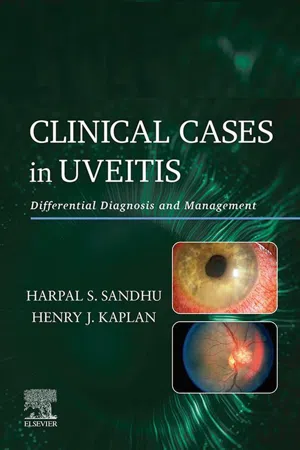
Intraocular inflammation is particularly difficult to diagnose and treat, often resembling a complex puzzle of patient history, symptoms, imaging, and laboratory test results. Clinical Cases in Uveitis: Differential Diagnosis and Management is a unique, case-based resource designed to help you navigate the range of challenging manifestations and presentations that often mimic other diseases. More than 90 real-world uveitis cases are presented in a highly templated, easy-to-follow format, along with step-by-step guidance on the right patient questions, assessment, differential diagnosis, testing, management, and follow-up care.- Provides a variety of patient presentations and scenarios and unique clinical situations that mirror day-to-day practice.- Covers current diagnostic imaging modalities, including optical coherence tomography (OCT), optical coherence tomography angiography, fluorescein angiography (FA), and indocyanine green angiography (ICG).- Features diagnostic and management algorithms that assist in differential diagnosis and decision making for even the most complex cases, including those in which the patient does not improve as expected, prompting a reassessment of diagnosis and management.- Contains approximately 250 high-quality images, including color anterior segment photographs, color fundus photographs, OCT images, and angiograms.- Discusses distinguishing infectious from non-infectious inflammation; when and how to start systemic immunosuppressive therapy; diagnostic criteria and management of "white dot syndromes; pediatric uveitis; masquerade syndromes, including inherited retinal degenerations, malignancies, and paraneoplastic syndromes; and much more.- Includes the authors' specific thought processes and approach in particularly challenging cases.- An excellent resource and study tool for ophthalmology residents and fellows, those studying for oral boards, general ophthalmologists, retina specialists, and more.
eBook - ePub
Clinical Cases in Uveitis E-Book
Differential Diagnosis and Management
- 400 pages
- English
- ePUB (mobile friendly)
- Available on iOS & Android
eBook - ePub
Clinical Cases in Uveitis E-Book
Differential Diagnosis and Management
About this book
Trusted by 375,005 students
Access to over 1.5 million titles for a fair monthly price.
Study more efficiently using our study tools.
Information
Topic
MedicineSubtopic
Opthalmology & OptometryChapter 1
Introduction to Uveitis
Harpal S. Sandhu and Henry J. Kaplan
Abstract
A discussion of uveitis as a specialty with reference to epidemiology of the disease, diagnostic criteria, classification criteria, immune privilege, and new diagnostic approaches.
Keywords
uveitis; diagnostic criteria; classification criteria; immune privilege
Uveitis refers to inflammation in the uvea, a Latin word for grape, and specifically the vascular middle layer of the eye that involves the iris anteriorly, the ciliary body in the middle, and the choroid posteriorly (Fig. 1.1). It was recognized as a disease entity as early as 1500 BC during the era of Egyptian medicine, and several medicinal extracts were used for treatment of uveitis at that time.1 Today, uveitis remains a major cause of ocular morbidity, causing approximately 10% of the cases of visual disability in the United States each year. It is estimated to cause 30,000 cases of new-onset legal blindness annually, with an annual prevalence of 58 to 115 per 100,000 population.2

Intraocular inflammation is frequently referred to as “uveitis,” even when other structures of the eye are primarily involved—for example, the retina (i.e., retinitis) and sclera (i.e., scleritis). Many uveitic entities are caused by infection, trauma, or neoplasia, but the majority are of unknown etiology and thought to be autoimmune. Some autoimmune uveitic cases are associated with systemic immune-mediated diseases, such as HLA-B27–associated spondyloarthropathies, sarcoidosis, and Behçet disease, whereas others are limited only to the eye without any systemic manifestation—for example, pars planitis and serpiginous choroiditis. The patient’s ocular complaints do not usually suggest a specific anatomic diagnosis; the exception is acute anterior uveitis, which is frequently associated with pain, redness, and photophobia. Most other uveitic entities present with blurred vision, floaters, a blind spot, or cloudiness.
Attempts have recently been made to standardize the nomenclature of uveitis, as well as its description and response to treatment. In 2005 the Standardization of Uveitis Nomenclature (SUN) Working Group (WG), consisting of 79 uveitis experts from 18 countries and 62 clinical centers, published a standardized and internationally accepted terminology for the uveitides, as well as recommendations for the grading of inflammation and development of disease outcomes.3 Most recently (December 1, 2019), this group met again to adopt and confirm a set of classification criteria for specific uveitic entities, and the results of their work will be published in the near future.
It is important to understand the difference between classification and diagnostic criteria.4 Classification criteria are standardized definitions that are primarily intended to enable clinical studies with uniform cohorts for research. Consequently, they need to define homogeneous groups that can be compared across studies and geographic areas. In contrast, diagnostic criteria are a set of signs, symptoms, and tests developed for use in routine clinical care to guide the treatment of individual patients. They need to be broad and reflect all the possible different features and sensitivity of a disease that is characteristically heterogeneous. Thus, testing specificity and sensitivity for diagnostic criteria need to be very high, approaching 100%, whereas classification criteria require very high specificity, even with some loss in sensitivity. A detailed discussion of this issue is provided by the American College of Rheumatology3 and suggests that the difficulty in establishing uniform diagnostic criteria lends support to the proposals of the SUN WG for diagnostic criteria using standard nomenclature, terminology, and testing even though further refinements in diagnostic criteria will undoubtedly be forthcoming.
Because the eye is an extension of the central nervous system (CNS), it makes unique demands on the immune system; it cannot tolerate the full array of immune responses available to other organs. The eye has only one function, to provide sight by the transmission of light to the photoreceptors of the retina, where the light is processed by a complex neural network, and from there, to the visual cortex. This remarkable neurologic function is critical to the survival of the host so that destructive inflammation, even in protection of the eye from infection, is not tolerable. Thus a complex immunoregulatory network to protect the eye from destructive inflammation evolved to prevent immune-mediated injury. This immunologic phenomenon is referred to as immune privilege and is a feature of the CNS and only a few other organs in the body. For example, destruction of a quarter of the liver combating infection would be harmful to the host but would not threaten functional survival of that organ or the host; in contrast, destruction of the fovea (300 to 500 μ) within the center of the retina will cause legal blindness.
A basic understanding of immune privilege is important to appreciate the presentation of intraocular inflammatory diseases such as uveitis. As ophthalmologic specialists, we have the unique ability to observe tissues within an organ (i.e., the eye) during active inflammation; consequently, our specialty has described many different clinical presentations of uveitic entities that are linked to the novel regulation of immunity. Both anatomic and functional factors contribute to the development of immune privilege within the eye, including the blood–retina barrier, absence of lymphatic drainage, soluble immunomodulatory factors, immunomodulatory ligands on the surface of ocular parenchymal cells, chronic activation of the complement system, and tolerogenic parenchymal antigen-presenting cells (APCs). The maintenance of immune privilege involves many different regulatory mechanisms, the details of which are too numerous to discuss in this chapter. Instead, we will briefly mention just three major strategies used by the eye to modify innate and adaptive immune responses within the organ: (1) tissue-associated immunologic ignorance (e.g., the decreased immunogenicity of retinal photoreceptors compared with retinal pigment epithelium [RPE] because of reduced expression of major histocompatibility complex [MHC] antigens on photoreceptors); (2) peripheral tolerance to ocular antigens (e.g., microglia, perivascular macrophages, and dendritic cells within the retina and uvea that can act as tolerogenic APCs); and (3) immunosuppressive microenvironment (e.g., maintained by multiple immunosuppressive soluble factors, surface immune modulators on parenchymal cells, and complement regulatory components). Excellent reviews of ocular immune privilege have recently been published for those interested in further reading on this subject.5,6
Each of the following book chapters present and discuss a different uveitis case. The incidence and prevalence of uveitis differs based on age, sex, anatomic location within the eye, gender, genetic factors, and etiology. Fortunately, although the etiology of a specific uveitic entity is frequently unknown, the characteristic clinical presentation allows a specific diagnosis, frequently confirmed by diagnostic testing, which is important because it provides insight into the likely course of the disease and response to treatment. The large number of idiopathic uveitic entities is partly the result of the fragile nature of ocular tissue, which has hindered the aggressiveness of tissue biopsy, and the value patients place on preservation of sight. However, interventional diagnostic techniques into the anterior chamber, vitreous cavity, and fine needle aspiration biopsy of intraocular tumors are now routinely available, although the limited quantity of fluid or tissue removed limits extensive studies. The recent advances in diagnostic imaging of the eye using optical coherence tomography (OCT) and the advent of new diagnostic laboratory techniques like polymerase chain reaction (PCR), genetic profiling (DNA), and single-cell transcriptomics (RNA) hold promise in providing understanding of the cause of many cases of uveitis that are now considered idiopathic.
The incidence and prevalence of uveitis differ based on age, gender, anatomic location of the inflammatory process (anterior, intermediate, posterior uveitis, panuveitis), type of inflammatory process (acute, chronic, recurrent), geographic location, and etiology (infectious, noninfectious). Anterior uveitis is the most common form, and the underlying cause is usually not identified (30% to 60%), with the disease referred to as idiopathic anterior uveitis. With our newer diagnostic techniques, the etiology of many cases will be determined in the future.7
It is our hope that you will find the subsequent case chapters both informative and interesting. They are designed to provide the reader with insight into the fascinating diagnostic and therapeutic field of uveitis.
Chapter 2
Approach to Diagnostic Testing
Harpal S. Sandhu and Henry J. Kaplan
Abstract
Diagnostic testing is an important part of the evaluation of uveitis. Targeted testing based on clinical features of the presentation is strongly recommended over a broad, standardized testing for every case of intraocular inflammation. A set of first-line tests for anterior, intermediate, and panuveitis, as well as retinal vasculitis and scleritis, is presented.
Keywor...
Table of contents
- Cover image
- Title page
- Table of Contents
- Copyright
- Dedication
- List of Contributors
- Preface
- Acknowledgments
- Chapter 1. Introduction to Uveitis
- Chapter 2. Approach to Diagnostic Testing
- Chapter 3. Approach to Therapy
- Chapter 4. First Episode of Acute Iritis
- Chapter 5. Keratouveitis Secondary to Retained Lens Fragments
- Chapter 6. Cytomegalovirus (CMV) Anterior Uveitis
- Chapter 7. Chronic Anterior Uveitis
- Chapter 8. Hypopyon Uveitis
- Chapter 9. Herpetic Keratitis and Iritis
- Chapter 10. Juvenile Idiopathic Arthritis (JIA)
- Chapter 11. Tubulointerstitial Nephritis and Uveitis Syndrome (TINU)
- Chapter 12. Blau-Jabs Syndrome (Granulomatous Arthritis, Dermatitis and Uveitis)
- Chapter 13. Postoperative Uveitis
- Chapter 14. Bilateral Pigment Dispersion
- Chapter 15. Episcleritis
- Chapter 16. Refractory Scleritis in an Older Woman
- Chapter 17. Necrotizing Scleritis
- Chapter 18. Ebola Uveitis
- Chapter 19. Iris Mass and Panuveitis in a Child
- Chapter 20. Toxic Anterior Segment Syndrome
- Chapter 21. Pars Planitis
- Chapter 22. Lyme Disease
- Chapter 23. Amyloidosis
- Chapter 24. Retinoblastoma
- Chapter 25. Intraocular Foreign Body and Uveitis
- Chapter 26. Eales Disease
- Chapter 27. Posterior Scleritis
- Chapter 28. Multifocal Choroiditis with Panuveitis
- Chapter 29. Common Variable Immunodeficiency with Granulomatous Panuveitis
- Chapter 30. Sarcoidosis
- Chapter 31. Punctate Inner Choroidopathy (PIC)
- Chapter 32. Acute Posterior Multifocal Placoid Pigment Epitheliopathy (APMPPE)
- Chapter 33. Multiple Evanescent White Dot Syndrome (MEWDS)
- Chapter 34. Serpiginous Choroidits
- Chapter 35. Relentless (Ampiginous) Placoid Chorioretinitis
- Chapter 36. Uveitis with Subretinal Fibrosis Syndrome (USF)
- Chapter 37. Birdshot Retinochoroidopathy (BRC)
- Chapter 38. Autoimmune Retinopathy
- Chapter 39. Melanoma-Associated Retinopathy
- Chapter 40. Hemorrhagic Occlusive Retinal Vasculitis
- Chapter 41. Syphilitic Posterior Placoid Chorioretinitis
- Chapter 42. Syphilitic Uveitis and Outer Retinopathy
- Chapter 43. Tuberculous Uveitis
- Chapter 44. Diffuse Unilateral Subacute Neuroretinitis (DUSN)
- Chapter 45. Exudative Retinal Detachment
- Chapter 46. Endogenous Endophthalmitis
- Chapter 47. Acute Retinal Necrosis (ARN)
- Chapter 48. Progressive Outer Retinal Necrosis (PORN)
- Chapter 49. Toxoplasmosis
- Chapter 50. Severe, Atypical Toxoplasmosis
- Chapter 51. Toxocariasis
- Chapter 52. Systemic Lupus Erythematosus with Retinal Vasculitis
- Chapter 53. Cytomegalovirus (CMV) Retinitis
- Chapter 54. Vogt-Koyanagi-Harada Disease
- Chapter 55. Neuroretinitis
- Chapter 56. Acute Exudative Polymorphous Vitelliform Maculopathy
- Chapter 57. MEK Inhibitor-Associated Retinopathy (MEKAR)
- Chapter 58. Immune Checkpoint Inhibitor-Induced Panuveitis
- Chapter 59. Cysticercosis
- Chapter 60. Leptospirosis
- Chapter 61. Granulomatosis with Polyangiitis
- Chapter 62. Frosted Branch Angiitis
- Chapter 63. Susac Syndrome (Retinal Vasculitis, Hearing Loss, and Encephalopathy)
- Chapter 64. IRVAN Syndrome (Idiopathic Retinal Vasculitis, Aneurysms and Neuroretinitis)
- Chapter 65. Retinal Degeneration with Coats-Like Fundus
- Chapter 66. Congenital Zika Syndrome
- Chapter 67. West Nile Retinopathy
- Chapter 68. Dengue Retinopathy
- Chapter 69. Primary Vitreoretinal Lymphoma (PVRL)
- Chapter 70. Leukemia Metastatic to the Retina
- Chapter 71. New-Onset Macular Edema
- Chapter 72. Cystoid Macular Edema After Infectious Uveitis
- Chapter 73. Polypoidal Choroidal Vasculopathy (PCV) in SLE
- Chapter 74. Chronic Hypotony with Metastatic Melanoma and Checkpoint Inhibitor
- Chapter 75. Uveitic Cataract
- Chapter 76. Advanced, Undetected Steroid-Induced Glaucoma
- Chapter 77. Corneal Decompensation After Dexamethasone Implant
- Chapter 78. Epiretinal Membrane and Panuveitis
- Chapter 79. Globe Perforation After Sub-Tenon's Injection
- Chapter 80. Sterile Endophthalmitis
- Chapter 81. Contralateral Retinitis in a Patient on Systemic Immunomodulatory Therapy
- Chapter 82. Rhegmatogenous Retinal Detachment in Intermediate Uveitis
- Index
Frequently asked questions
Yes, you can cancel anytime from the Subscription tab in your account settings on the Perlego website. Your subscription will stay active until the end of your current billing period. Learn how to cancel your subscription
No, books cannot be downloaded as external files, such as PDFs, for use outside of Perlego. However, you can download books within the Perlego app for offline reading on mobile or tablet. Learn how to download books offline
Perlego offers two plans: Essential and Complete
- Essential is ideal for learners and professionals who enjoy exploring a wide range of subjects. Access the Essential Library with 800,000+ trusted titles and best-sellers across business, personal growth, and the humanities. Includes unlimited reading time and Standard Read Aloud voice.
- Complete: Perfect for advanced learners and researchers needing full, unrestricted access. Unlock 1.5M+ books across hundreds of subjects, including academic and specialized titles. The Complete Plan also includes advanced features like Premium Read Aloud and Research Assistant.
We are an online textbook subscription service, where you can get access to an entire online library for less than the price of a single book per month. With over 1.5 million books across 990+ topics, we’ve got you covered! Learn about our mission
Look out for the read-aloud symbol on your next book to see if you can listen to it. The read-aloud tool reads text aloud for you, highlighting the text as it is being read. You can pause it, speed it up and slow it down. Learn more about Read Aloud
Yes! You can use the Perlego app on both iOS and Android devices to read anytime, anywhere — even offline. Perfect for commutes or when you’re on the go.
Please note we cannot support devices running on iOS 13 and Android 7 or earlier. Learn more about using the app
Please note we cannot support devices running on iOS 13 and Android 7 or earlier. Learn more about using the app
Yes, you can access Clinical Cases in Uveitis E-Book by Harpal Sandhu,Henry J. Kaplan, Harpal Sandhu, Henry J. Kaplan in PDF and/or ePUB format, as well as other popular books in Medicine & Opthalmology & Optometry. We have over 1.5 million books available in our catalogue for you to explore.