Prevent, evaluate, and manage diseases that can be acquired in tropical environments and foreign countries with The Travel and Tropical Medicine Manual. This pragmatic resource equips medical providers with the knowledge they need to offer effective aid, covering key topics in pre- and post-travel medicine, caring for immigrants and refugees, and working in low-resource settings. It's also the perfect source for travelers seeking quick, easy access to the latest travel medicine information.- Dynamic images illustrate key concepts for an enhanced visual understanding.- Evidence-based treatment recommendations enable you to manage diseases confidently.- Expert Consult eBook version included with purchase. This enhanced eBook experience allows you to search all of the text, figures, images, and references from the book on a variety of devices.- Evidence-based appendix, available at Expert Consult, helps to validate treatments.- Highlights new evidence and content surrounding mental health and traveling.- Covers emerging hot topics such as Ebola virus disease, viral hemorrhagic fevers, the role of point-of-care testing in travel medicine, and antibiotic-resistant bacteria in returning travelers and students traveling abroad.- Includes an enhanced drug appendix in the back of the book.
eBook - ePub
The Travel and Tropical Medicine Manual E-Book
- 682 pages
- English
- ePUB (mobile friendly)
- Available on iOS & Android
eBook - ePub
The Travel and Tropical Medicine Manual E-Book
About this book
Trusted by 375,005 students
Access to over 1.5 million titles for a fair monthly price.
Study more efficiently using our study tools.
Information
Topic
MedicineSubtopic
DermatologySection 1
Pre-Travel Advice
Chapter 1
Approach to Travel Medicine and Contents of a Personal Travel Medicine Kit
Elaine C. Jong
A new medical specialty, travel medicine, emerged in the 1980s in response to the health needs of increasing numbers of international travelers—a phenomenon resulting from the rapid expansion and growing accessibility of commercial jet transportation. In 1990, the World Tourism Organization (WTO) reported approximately 457 million international arrivals per year. In 2014, the WTO reported 1138 million international arrivals per year, and just under half of these involved countries outside Europe. The upward trend in international travel is projected to continue.
When travel involves geographic translocations of people going from relatively sanitary and industrialized countries in northern temperate zones to destinations in countries with developing economies and tropical environments, potential exposures to exotic diseases and exacerbations of chronic health conditions during travel create unique health concerns for both individuals and societies. Travel medicine is interdisciplinary: it involves a spectrum of knowledge across the health specialties of epidemiology, preventive medicine, primary care, emergency medicine, infectious diseases, tropical medicine, gastroenterology, dermatology, and others. Travel health providers apply a heightened geographic awareness of destination-specific diseases and environmental conditions, as well as considerations of personal safety and well-being to individuals and their journeys.
As international travelers pursue their exploration of the world for recreational, educational, business, religious, and humanitarian purposes, physicians and other healthcare providers need to know how to counsel their traveling patients with regard to a wide variety of health issues. It has been reported that only 1-3.6% of deaths in travelers are due to infectious diseases; however, the risks for acute and chronic morbidity in the individual traveler and the potential for global spread of common as well as exotic human pathogens means that continued attention to transmission, treatment, prevention, and control of communicable diseases are essential considerations for international travelers (Chapters 3-9). Travel health issues involving environmental factors, from time zone changes to air pollution, temperature extremes, and barometric influences at high altitude and undersea are covered in Chapters 2 and 9-11. The psychological and emotional well-being of international travelers is increasingly recognized as a factor contributing to travelers' health (Chapters 2 and 17).
Personal safety has emerged as another important issue in travelers' health. Studies have shown that motor vehicle accidents (25%) and other injuries and accidents (15%, including drownings and falls from height) accounted for more deaths in American travelers than infectious diseases and other illnesses (10%). Heart attacks and other cardiovascular problems in male travelers over 60 years of age accounted for 50% of reported deaths but probably do not represent a preventable consequence of travel. Recommendations for travelers with special needs are given in Chapters 12-19.
Approach to Travel Medicine
Travel medicine practice involves the “travel medicine triad” consisting of the traveler, the trip, and the proposed health interventions (Fig. 1.1). The health status of the traveler is the starting point: the very young and the very old are at increased risk from certain infectious diseases due to age-related changes in the immune system; travelers with underlying medical conditions may need more assistance in the health maintenance strategies during travel and may even need to alter their desired itineraries based on access to healthcare at the destination.
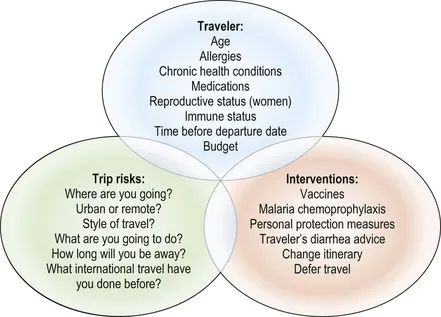
Fig. 1.1 The travel medicine triad.
Assessment of trip risks is related to the destination(s), with travel to rural tropical areas, communities with high prevalence or outbreaks of diseases that are not preventable by vaccine, extreme environments, and remote regions presenting more challenges than trips on standard tourist routes. Updated information on outbreaks, epidemics, and health conditions abroad are posted on the websites of the Centers for Disease Control and Prevention (CDC, www.cdc.gov) in Atlanta, Georgia, and the World Health Organization (WHO, www.who.int) in Geneva, Switzerland. In addition to the CDC and WHO, regional health agencies and public and private health information services also issue periodic guidelines and health information for international travelers. However, many guidelines are by necessity very general; the optimal practice of travel medicine calls for individualized recommendations for each traveler and trip based on the travel health assessment described by the “travel medicine triad” above. Whenever possible, international travelers should seek medical advice 4-6 weeks in advance of their departure date. This allows adequate time for immunizations to be scheduled, for advice and prescriptions to be given, and for special information to be obtained when needed.
The medical approach to travel becomes even more complex when the traveler plans a long-term trip lasting months to years, often involving multiple destinations. Such travelers may need to start 3 or more months in advance of anticipated trip departure in order to complete vaccine series and other health examinations needed for issuance of visas, permits, school registrations, and other required documents. Table 1.1 summarizes the steps for pre-travel medical preparation.
TABLE 1.1
Pre-Travel Medical Recommendations
1. Consult personal physician, local Public Health Department, or travel clinic about recommendations for immunizations and malaria chemoprophylaxis after selection of the travel itinerary, preferably 4-6 weeks in advance of departure. 2. Prepare a Traveler's Health History (Table 1.2) and a Traveler's Personal Medical Kit (Table 1.7). 3. Carry a satellite phone or a telephone credit card that can be used for international telephone calls or make sure that the friends or relatives listed in the health history would accept an international collect call in case of an emergency. 4. Make sure to have the telephone number of your personal physician, including office and after-hours numbers and a fax number, if available. 5. Check medical insurance policy or health plan for coverage for illness or accidents occurring outside the country of origin (home country). 6. Specifically inquire if the regular insurance policy or health plan will cover emergency medical evacuation by an air ambulance. 7. Arrange for additional medical insurance coverage or for a line of credit as necessary for a medical emergency situation. |

All travelers should be advised to assemble the information listed i...
Table of contents
- Cover image
- Title Page
- Table of Contents
- Copyright
- Preface
- List of Contributors
- Section 1 Pre-Travel Advice
- Section 2 Advice for Special Travelers
- Section 3 Fever
- Section 4 Diarrhea
- Section 5 Dermatology
- Section 6 Sexually Transmitted Diseases
- Section 7 Helminths
- Evidence Synopsis
- Evidence Synopsis
- Evidence Synopsis
- Evidence Synopsis
- Evidence Synopsis
- Quick Evidence Synopsis
- Evidence Synopsis
- Evidence Synopsis
- Appendix
- Index
Frequently asked questions
Yes, you can cancel anytime from the Subscription tab in your account settings on the Perlego website. Your subscription will stay active until the end of your current billing period. Learn how to cancel your subscription
No, books cannot be downloaded as external files, such as PDFs, for use outside of Perlego. However, you can download books within the Perlego app for offline reading on mobile or tablet. Learn how to download books offline
Perlego offers two plans: Essential and Complete
- Essential is ideal for learners and professionals who enjoy exploring a wide range of subjects. Access the Essential Library with 800,000+ trusted titles and best-sellers across business, personal growth, and the humanities. Includes unlimited reading time and Standard Read Aloud voice.
- Complete: Perfect for advanced learners and researchers needing full, unrestricted access. Unlock 1.5M+ books across hundreds of subjects, including academic and specialized titles. The Complete Plan also includes advanced features like Premium Read Aloud and Research Assistant.
We are an online textbook subscription service, where you can get access to an entire online library for less than the price of a single book per month. With over 1.5 million books across 990+ topics, we’ve got you covered! Learn about our mission
Look out for the read-aloud symbol on your next book to see if you can listen to it. The read-aloud tool reads text aloud for you, highlighting the text as it is being read. You can pause it, speed it up and slow it down. Learn more about Read Aloud
Yes! You can use the Perlego app on both iOS and Android devices to read anytime, anywhere — even offline. Perfect for commutes or when you’re on the go.
Please note we cannot support devices running on iOS 13 and Android 7 or earlier. Learn more about using the app
Please note we cannot support devices running on iOS 13 and Android 7 or earlier. Learn more about using the app
Yes, you can access The Travel and Tropical Medicine Manual E-Book by Christopher A. Sanford,Elaine C. Jong,Paul S. Pottinger,Paul Pottinger in PDF and/or ePUB format, as well as other popular books in Medicine & Dermatology. We have over 1.5 million books available in our catalogue for you to explore.