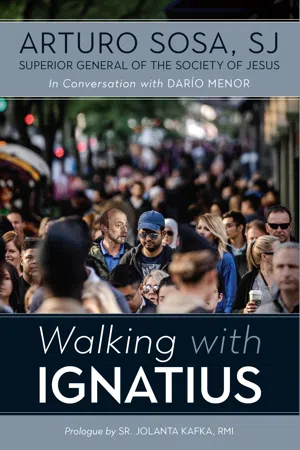
Walking with Ignatius is a celebration of 500 years of the Society of Jesus, as seen through the eyes of its first Latin American Father General, Arturo Sosa. Comprised of interviews with Father General conducted over a period of two years by Dario Menor, Walking with Ignatius retraces the ‘inner tension’ – both personal and communal – that defines the quest for meaning over the ages: from the time when St Ignatius begged for alms to sustain his studies to a world transformed by globalisation. Menor’s questions reflect the spirit of the Ignatian practice of discernment: unafraid to ask questions and to face up to the challenges of the present, Menor and Sosa engage in a spiritual conversation that covers such topics as the life of Ignatius, the life story of Sosa, the challenge of the unsettling twenty-first century, and the future of the Church. With great care Sosa sifts through the past, present, and future of the Society of Jesus and of the Church. The reader is invited in the Ignatian spirit into a conversation about the future direction of the Church in which the question of being a Catholic is replaced with the question of how we become Catholics. Included is a section-by-section guide – complete with bible references, pointers for prayer, and tips for spiritual conversation – that encourages the reader to embark on a spiritual journey of their own. Intended for those within and outside the Ignatian family, Walking with Ignatius is both an exemplar of spiritual conversation in action and a response to Pope Francis’s call for Jesuits to bring the practice of discernment to the world.
- 272 pages
- English
- ePUB (mobile friendly)
- Available on iOS & Android
eBook - ePub
About this book
Trusted by 375,005 students
Access to over 1 million titles for a fair monthly price.
Study more efficiently using our study tools.
Information
Topic
Theology & ReligionSubtopic
Christian Church
Five hundred years ago, on May 20th, 1521, Íñigo López de Loyola was wounded in a battle in Pamplona. As his leg was hit by a cannon ball, his dreams of fame and fortune were smashed to smithereens. During a long convalescence, he learnt to see the world with fresh eyes: his encounter with Christ changed his life.
1 St. Ignatius of Loyola: Becoming a Pilgrim

Saint Ignatius Loyola. Oil painting by Monserrat Gudiol at the cave in Manresa.
In your opinion, what is St. Ignatius’s greatest contribution to the Church and to society in general?
The universal and long-term nature of his vision. He was able to see beyond immediate events and look forward in time. Today, we’d call that having strategic vision. Ignatius’s ability to do this was intimately linked to his experience of God. He knew how to forget himself so that he could see everything from the perspective of the Trinity. Ignatius truly became “Catholic,” no easy feat as it involves adopting a long-term universal outlook, encompassing the whole of humankind.
Experiencing God does not limit you. Instead he widens your understanding of yourself, of humanity, and of history. Ignatius’s universal vision became the basic criteria for the discernment process that precedes decision making in the Society of Jesus, as it seeks continually to render greater and better service to the Church and the world. This always involves choosing the greatest universal good. This approach is, I think, a huge contribution from Ignatius.
Experiencing God does not limit you. Instead, he widens your understanding of yourself, of humanity, and of history.
What can Catholics today learn from the person of Ignatius and emulate, in particular, from his process of conversion?
How to become Catholics. We should not assume someone is Catholic just because they have been baptised. Baptism is a sacrament, desired by the adult who receives it or by the parents or Godparents when the person to be baptised is a child. It marks the starting point of a process which must continue, as we allow ourselves to be profoundly transformed and shift our focus away from self and towards others. The key is to put Jesus at the centre. This cannot be separated from our mission.
That was the process undertaken by Ignatius, who suggested a style of religious life in which communal living was founded on fraternal communication rather than being shaped by the walls of a monastery or by living under the same roof. This was a type of lifestyle for religious quite different from that which had prevailed previously. Ignatius used the phrase, “friends in the Lord,” which reveals the centrality of the Eucharist and the importance of communication in the life of the Society of Jesus. Both were essential for the creation of this body, which offers a fundamentally apostolic style of consecration, at whose heart is prayer.
Jerónimo Nadal, in his analysis of Ignatius, said that we needed to be contemplatives in action, able to find the Lord in our daily lives. That’s the basis for our activities never being confined to one sphere. Any activity that helps make the Word of Jesus present is valid for a Jesuit religious.
In your opinion, which is the key Ignatian text? The Spiritual Exercises? The Constitutions? Or something else?
To a reader who knows nothing about Ignatius I’d give the Autobiography, which is fascinating. He didn’t want to write it, but eventually gave in to his companions’ requests. He was already an old man when he ended up dictating this account of his life. The Autobiography is an examen of his life, in which Ignatius relays God’s action throughout his life, in the form of an examen. Then there are his Letters, which provide endless information about the practical decisions taken in the Society, which was then being founded and in a phase of growth. They sketch out how the Society functioned, up until the writing of the Constitutions, another amazing text.
After the Pope had approved the Formula of the Institute, a relatively brief declaration of intent, the Society began to grow. That was why Ignatius’s companions asked him to write the Constitutions. Initially, he was not convinced of the need for this because he maintained that the Society should have enough spiritual energy to govern itself, depending on the degree to which each Jesuit fully lived out his charism, without requiring a regulatory framework. It took him quite a while to prepare the Constitutions, but after a process of discernment he managed to present a very original framework for a rule of religious intimately linked to his spiritual experience. Nearly five centuries later, it remains an inspirational text for the Jesuit community.
He was also reluctant to write the Spiritual Exercises. Why was that?
Ignatius was no writer. He wrote only when he had no other alternative. The Spiritual Exercises are notes reflecting his experience, but if you give them to someone without an explanatory guide, they won’t make it past page five. Ignatius wrote because he wanted to communicate. He wanted to speak to people about God and present them with a spiritual experience, but he also had to communicate with his brethren and others: benefactors, monarchs, and those who helped him to found a school. He maintained this network of relationships from a room that you can still visit in the Gesù in Rome. It is striking to think of someone with delicate health, enclosed there for so many years, yet who found the energy to achieve all that he did. Another significant, although little-known work by Ignatius is his Spiritual Diary. These were notes that he made about what he sensed spiritually during a specific time of his life. They are a practical example of his spiritual discernment.
Would Ignatius’s conversion have happened at all without the trauma of his wound in Pamplona?
Who knows what might have happened if he had not been wounded. Whatever the case, in the life of any individual there are many instances that offer us the chance to open up to the transcendent, as happened in the conversion of Ignatius. For him, it all began as he recovered from his wound, but similar experiences can arise in other contexts, e.g., being in lockdown, in prison, going travelling, or facing the unknown. There are times in life that shake you up and kick-start this process. In Scripture, we have the example of St. Paul, who fell to the ground, heard the voice of Jesus, and was temporarily blind, and Peter, for whom the cock crowing opened up a new way to love and follow the Lord, or Zacchaeus, who climbed up a tree to see Jesus.
In any case, conversion never really happens in one fell swoop but is really a life-long process. Ignatius, for instance, never saw himself as having converted but as being a pilgrim. He never believed that he’d reached his goal. Christian life is a pilgrimage in which you put aside your plans to set out on a journey, allowing yourself to be guided, accompanied, open to surprises. However much of a strategic vision you have, you can never totally control your life if you’re really open to being guided by the Spirit.
There is one particular moment in the conversion of St. Ignatius which I find striking. While he was on the way to Montserrat, he met a Muslim who said he didn’t believe in the virginity of Mary. Ignatius wondered afterwards whether he should let the Muslim go or follow him and kill him. He left the decision to the direction taken by his donkey, according to whether the animal led him along the road to the village where the Muslim had gone or in another direction. How do you interpret this incident referred to in the Autobiography?
This happened at a point where Ignatius was beginning to recognise his interior movements, and no longer gave in automatically to his instincts, which previously would have led him without any hesitation to kill the Muslim. His cultural and family baggage and knightly training pushed him to not allow anyone to insult Our Lady. But here Ignatius, who must have been a very impulsive kind of man, managed to control himself by drawing on his faith: he considered what he should do and turned to another creature—in this instance, the donkey, as he was on the road and had no other companion. This scene reveals his conversion process at a very early stage.
Ignatius went through very deep and at times very long crises during his conversion process. What did he learn from them? How do you interpret the temptation to commit suicide that he felt at one point?
The greatest temptation for any human being is to take their own life rather than surrender it. Suicide is the greatest act of taking one’s own life any individual can take consciously and freely, as though saying, “My life is mine to the point where I’ll kill myself.” Today, however, we know that the vast majority of suicides are caused by profound states of depression, in which an individual loses all self-control. In contrast, if you give your life to another, you shift your focus outwards. That other person might kill you, but it will be because you are freely giving them your life. That doesn’t prevent you going through deep crises, which are part of the interior life. The transformation that conversion involves can’t be experienced without times of deep crisis, as the Gospels demonstrate. In this context, the most dramatic depiction of this is the agony in the garden where Jesus completely abandons what Ignatius might well have described as “his self-love, will, and interest.” Everyone faces crises that can be understood in spiritual or psychological terms, in which the greatest temptation may be to take one’s own life. This is something that is so much part of contemporary culture and reveals its limitations.
The transformation that conversion involves can’t be experienced without times of deep crisis.
Have you ever been through this kind of crisis?
I’ve never felt like throwing myself out of a window, but I have certainly been through those times of crisis when you think, “What am I doing here?” These are crises about meaning, which relates to faith and the choices you’ve made in life. It’s hard when you question the big decisions and can’t see any meaning in your life choices. But these can also be times of validation. What is the Cross? It’s the moment when you ask yourself if the path you’ve chosen makes any sense. The key thing is how you come out of the crisis and if you validate the decisions you have taken previously.
During his time in Manresa, Ignatius underwent a mysterious experience by the banks of the Cardoner River. It wasn’t a vision but he insisted that there he learnt much about the faith and the world and left with the clear objective of helping souls. How do you understand this incident? Did it shape in some way Ignatius’s life and the future of the Society?
I understand this as a very normal human experience. We go through processes until we reach a new state of consciousness. There are times when we become aware of what we’ve been going through previously via our experiences, relationships, or reading. Those moments are like when suddenly you’re able to put everything together like the pieces in a jigsaw puzzle, or as happened to Ignatius near the Cardoner River, everything comes together through the grace of God. This can occur in small or large matters.
This brings to mind something that happened to me, and that, details aside, may help to explain this. I was in charge of moving the Gumilla Centre in Caracas into a much smaller building. It looked like it wouldn’t fit into the smaller building, but one day I woke at 3 a.m. and, sprawling out on the floor, sketched out on a piece of paper how we could resolve the problem. Perhaps that’s a silly example, but it does illustrate what happens sometimes when the pieces randomly fit together and complex processes become easy to understand. Something similar happened in regard to my understanding of my country’s journey through history. After many experiences, much reading, and many conversations… at a particular point in time, I suddenly “got” the process. What Ignatius experienced by the banks of the Cardoner was something similar. Previously, he’d felt, heard, and experienced things randomly, but it was only there that he managed to make sense of and finally grasp the whole picture. Some situations take time for us to fully understand. It’s a bit like what happens when you are making a recipe. Making sancocho, for example (a popular beef stew dish in Latin America), might seem easy, but each of the ingredients requires a different cooking time, and if the preparation is not right, the result won’t be good. God and his action within us also take time.
Although spiritual discernment is a core element of Ignatius’s process, as the Exercises and the basic decision-making process of the Society make clear, it wasn’t something he invented. What did Ignatius learn about discernment from the Church’s existing tradition and what did he contribute to it?
Unlike many other Christians, Ignatius took seriously the idea that receiving the Holy Spirit was crucial. We should trust in the Holy Spirit’s presence alongside us throughout our lives. For Ignatius, Jesus was to be followed through discernment, in the presence of the Holy Spirit. When someone sets out on the Christian journey, they don’t know where they will end up. The answer lies in Pentecost, without which neither the Church nor the Christian life would exist. Jesus promised us he would be with us always, through the Holy Spirit, until the end of the world. That is what Ignatius received and worked on. He was able to perceive how the Spirit moved both in his own life and in the lives of others. That is why he devised rules for spiritual discernment to help others do this. But the rules are not an instruction manual. They are a light to guide us so we may perceive whatever it is we need to experience.
At what point do you perceive God’s presence most strongly in the life of Ignatius? Is it possible for everyone to understand his visions and mystical experiences?
I’m sure they were hard for Ignatius to understand too. Some experiences can be spoken of long only after they occur, when you understand them or they no longer harm you. With mystical experiences, things are even more complicated because they are always bewildering. Ignatius was striving to find God in all things. That’s how his daily life gradually filled with God, but not in an artificial way. It was rather that, bit by bit, ...
Table of contents
- Cover
- Title
- Copyright
- Contents
- Prologue by Sr. Jolanta Kafka, RMI
- Introduction: A Hopeful Future
- 1 St. Ignatius of Loyola: Becoming a Pilgrim
- 2 Arturo Sosa: A Pilgrim Today
- 3 Bold Living in Today’s World
- 4 A New Dream for the Church
- 5 The Society of Jesus Today
- 6 Showing the Way to God
- 7 Walking Alongside the Poor, the World’s Outcasts
- 8 Accompanying Young People in the Creation of a Hope-Filled Future
- 9 Growing in Awareness of Our Common Home
- 10 Jesuit Education: A Source of Freedom and Hope
- 11 The Shared Mission: Lessons in Dialogue and Openness
- Final Thoughts by Darío Menor
Frequently asked questions
Yes, you can cancel anytime from the Subscription tab in your account settings on the Perlego website. Your subscription will stay active until the end of your current billing period. Learn how to cancel your subscription
No, books cannot be downloaded as external files, such as PDFs, for use outside of Perlego. However, you can download books within the Perlego app for offline reading on mobile or tablet. Learn how to download books offline
Perlego offers two plans: Essential and Complete
- Essential is ideal for learners and professionals who enjoy exploring a wide range of subjects. Access the Essential Library with 800,000+ trusted titles and best-sellers across business, personal growth, and the humanities. Includes unlimited reading time and Standard Read Aloud voice.
- Complete: Perfect for advanced learners and researchers needing full, unrestricted access. Unlock 1.4M+ books across hundreds of subjects, including academic and specialized titles. The Complete Plan also includes advanced features like Premium Read Aloud and Research Assistant.
We are an online textbook subscription service, where you can get access to an entire online library for less than the price of a single book per month. With over 1 million books across 990+ topics, we’ve got you covered! Learn about our mission
Look out for the read-aloud symbol on your next book to see if you can listen to it. The read-aloud tool reads text aloud for you, highlighting the text as it is being read. You can pause it, speed it up and slow it down. Learn more about Read Aloud
Yes! You can use the Perlego app on both iOS and Android devices to read anytime, anywhere — even offline. Perfect for commutes or when you’re on the go.
Please note we cannot support devices running on iOS 13 and Android 7 or earlier. Learn more about using the app
Please note we cannot support devices running on iOS 13 and Android 7 or earlier. Learn more about using the app
Yes, you can access Walking with Ignatius by Arturo Sosa in PDF and/or ePUB format, as well as other popular books in Theology & Religion & Christian Church. We have over one million books available in our catalogue for you to explore.