Using the Schoolwide Enrichment Model With Technology
eBook - ePub

Using the Schoolwide Enrichment Model With Technology

  1. 292 pages
  2. English
  3. ePUB (mobile friendly)
  4. Available on iOS & Android
eBook - ePub

About this book

Using the Schoolwide Enrichment Model With Technology is an extension of a talent development model implemented in more than 2,500 schools across the U.S. and widely used internationally. More than 40 years of research and development have documented the effectiveness of the SEM approach to promoting higher level thinking skills and creative productivity.

This solution-oriented book, unlike other books focused on using technology in the classroom, recognizes that digital technologies are changing and evolving at lightning speeds. Our effective skills for using technology transcend time by focusing on how to find and use digital resources and tools rather than listing the resources that already exist. Focusing on the skills that support critical thinking and problem solving, decision making, and communication, the authors seamlessly merge technology to launch students toward independent productivity. This accessible and highly practical guide is rich with examples that will change the way you think about education while providing hands-on "how-to" guidance for creating a culture of excellence and innovation in your school and classroom.

Frequently asked questions

Yes, you can cancel anytime from the Subscription tab in your account settings on the Perlego website. Your subscription will stay active until the end of your current billing period. Learn how to cancel your subscription.
No, books cannot be downloaded as external files, such as PDFs, for use outside of Perlego. However, you can download books within the Perlego app for offline reading on mobile or tablet. Learn more here.
Perlego offers two plans: Essential and Complete
  • Essential is ideal for learners and professionals who enjoy exploring a wide range of subjects. Access the Essential Library with 800,000+ trusted titles and best-sellers across business, personal growth, and the humanities. Includes unlimited reading time and Standard Read Aloud voice.
  • Complete: Perfect for advanced learners and researchers needing full, unrestricted access. Unlock 1.4M+ books across hundreds of subjects, including academic and specialized titles. The Complete Plan also includes advanced features like Premium Read Aloud and Research Assistant.
Both plans are available with monthly, semester, or annual billing cycles.
We are an online textbook subscription service, where you can get access to an entire online library for less than the price of a single book per month. With over 1 million books across 1000+ topics, we’ve got you covered! Learn more here.
Look out for the read-aloud symbol on your next book to see if you can listen to it. The read-aloud tool reads text aloud for you, highlighting the text as it is being read. You can pause it, speed it up and slow it down. Learn more here.
Yes! You can use the Perlego app on both iOS or Android devices to read anytime, anywhere — even offline. Perfect for commutes or when you’re on the go.
Please note we cannot support devices running on iOS 13 and Android 7 or earlier. Learn more about using the app.
Yes, you can access Using the Schoolwide Enrichment Model With Technology by Angela Housand,Brian Housand,Joseph Renzulli,Angela M. Housand,Brian C. Housand,Joseph S. Renzulli in PDF and/or ePUB format, as well as other popular books in Education & Education General. We have over one million books available in our catalogue for you to explore.

Information

Publisher
Routledge
Year
2021
Print ISBN
9781618215932
eBook ISBN
9781000490367
Edition
1

PART 1 Getting Started

DOI: 10.4324/9781003239468-1

CHAPTER 1 The Schoolwide Enrichment Model (SEM)

DOI: 10.4324/9781003239468-2

Introduction

This book is designed to provide teachers with specific strategies and resources for infusing technology into any and all aspects of the curriculum. The approaches discussed in the chapters that follow are based on a general model for talent development entitled The Schoolwide Enrichment Model (SEM; Renzulli & Reis, 2014). The SEM (Renzulli & Reis, 1985, 1997, 2014) is designed to challenge and meet the needs of high-potential, high-ability, and gifted students, while providing challenging learning experiences for all students. This is the primary difference between the SEM and other models in gifted education: The SEM advocates enriched learning opportunities for all students and advanced-level follow-up for students who show high levels of interest, ability, and motivation that may result from positive reactions to general enrichment experiences, the regular curriculum, or nonschool experiences. The three major goals of the SEM are to:
  1. maintain and expand a continuum of special services that will challenge students with demonstrated superior performance or the potential for superior performance in any and all aspects of the school and extracurricular program;
  2. infuse into the general education program a broad range of activities for high-end learning that will challenge all students to perform at advanced levels, and allow teachers to determine which students should be given extended opportunities, resources, and encouragement in particular areas where superior interest and performance are demonstrated; and
  3. preserve and protect the positions of gifted education specialists and any other specialized personnel necessary for carrying out these goals.

The SEM Identifies Potential and Talent
Every learner has potential strengths that can be used as a foundation for learning. Within the SEM approach, potentially high-performing students are recognized and provided with advanced opportunities, resources, and encouragement based on their aptitudes, motivation, and creative behaviors. In addition to or in replacement of traditional test-based assessment, teachers and content-area specialists can observe students using technology tools, conducting research on the Internet, interacting with concepts, and creating products for authentic audiences in any subject or extracurricular area. This provides opportunities for performance-based assessment and allows educators to make instructional decisions about individuals and small groups accordingly. In a performance-based identification system, classroom observations play an equal part in selecting students for advanced services. Utilizing a performance-based approach is critical in locations where students experience disadvantages that may limit their achievement on standardized tests (Cooper, Baum, & Neu, 2004). By recognizing and developing the unique strengths of children, students can develop a sense of self-efficacy that promotes a growth mindset (Dweck, 2006), which often carries over to higher success rates in other areas.
DID YOU KNOW?
Delcourt (2008) found that students who participated in specific content-area lessons designed to promote engagement and enhance inquiry skills, like the SEM approach, were more successful in advanced follow-up pursuits. These activities focused on recognizing potential and aptitude in a specific area rather than measuring the amount of training already acquired, and allowed teachers to rate student performance using criteria such as "displays complexity of ideas,” "uses materials effectively,” "recognizes patterns in the content,” and "utilizes specialized vocabulary.”
In the SEM, a talent pool of approximately 10%-15% of above-average ability and high-potential students is identified through a variety of measures, including achievement tests, teacher nominations, assessment of potential for creativity and task commitment, as well as alternative pathways of entrance (e.g., self-nomination, parent nomination, etc.). High achievement test scores or high IQ scores automatically include a student in the talent pool. This enables educators to focus the majority of their talent search efforts on finding those students who are underachieving in their academic schoolwork.
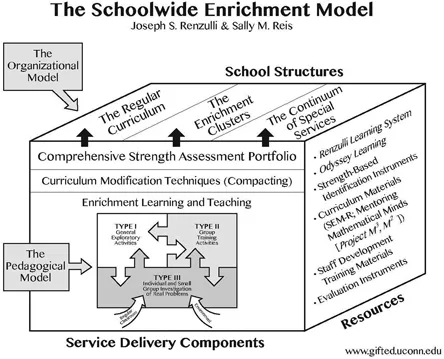
The structure of the SEM, outlined in Figure 1, has three service delivery components: The Total Talent Portfolio, Curriculum Modification and Differentiation, and Enrichment Pedagogy, These three services are delivered through the regular curriculum, a continuum of special services, and a series of enrichment clusters. First, a comprehensive strengths and interest assessment portfolio, The Total Talent Portfolio, is created for each student to inform the kinds of learning opportunities that students will be encouraged to pursue. With interests and learning style preferences tracked in equal measure to cognitive abilities, a strong foundation for effective learning and creative productivity is identified for each student. A second service delivery component is curriculum compacting. This differentiation strategy identifies the parts of the regular curriculum that talent pool students have already mastered and then eliminates or streamlines the curriculum, enabling these students to avoid repetition of previously mastered work. The curriculum compacting strategy guarantees mastery while simultaneously finding time for more appropriately challenging activities (Reis, Burns, & Renzulli, 1992; Reis, Renzulli, & Burns, 2016; Renzulli, Smith, & Reis, 1981). Once students have been identified for talent development and arrangements have been made that free up time for students to work on something different, advanced learning opportunities can begin.
These opportunities are organized around the Enrichment Triad Model, which is the curricular foundation at the heart of the SEM and the primary focus of this book, Using the Schoolwide Enrichment Model With Technology (SEM:Tech). The Enrichment Triad Model provides the framework for teaching and learning within the broader components of the SEM and is comprised of three indivisible parts called Type I, Type II, and Type III. These three types of experiences function interdependently to create learning that engages students using their interests and passions to drive instruction.
This chapter discusses the theory and practices of the SEM, which has been used in schools for decades and is the basis for Using the Schoolwide Enrichment Model With Technology (SEM:Tech).
Figure 1. The Schoolwide Enrichment Model.

The Total Talent Portfolio

In the SEM, teachers help students better understand three dimensions of their learning: their abilities, interests, and learning styles. This information, focusing on their strengths rather than deficits, is compiled into a management form called the Total Talent Portfolio, The portfolio can be used to make decisions about talent development opportunities in general education classes, enrichment clusters, and in the continuum of special services. The major purposes of the Total Talent Portfolio are to:
  1. collect information about students' strengths on a regular basis;
  2. classify this information into the general categories of abilities, interests, and learning styles;
  3. periodically review and analyze the information in order to make decisions about providing opportunities for enrichment experiences in the general education classroom, the enrichment clusters, and the continuum of special services; and
  4. use this information to make decisions about acceleration and enrichment in school and in later educational, personal, and career decisions.
This expanded approach to identifying talent potentials is essential if we are to make genuine efforts to include a broader, more diverse group of students in enrichment programs. This approach is also consistent with the more flexible conception of developing gifts and talents that has been a cornerstone of the SEM, addressing concerns for promoting more equity in special programs.

Curriculum Modification and Differentiation Techniques

The second service delivery component of the SEM is a series of curriculum modification techniques that: (a) adjust levels of required learning so that all students are challenged, (b) increase the number of in-depth learning experiences, and (c) introduce various types of enrichment into regular curricular experiences. Essentially, these curriculum modification techniques help to ensure that all students’ needs are being met within instructional settings. The procedures that are used to carry out curriculum modification include curriculum differentiation strategies, such as curriculum compacting, and increased use of greater depth into regular curricular material (Reis et al., 1993; Renzulli, 1994).
Curriculum compacting, for example, is an instructional differentiation technique that allows students to skip or be accelerated through content that has already been mastered. The process allows teachers to make appropriate curricular adjustments for students in any curricular area and at any grade level, through (a) defining the goals and outcomes of a particular unit or segment of instruction, (b) determining and documenting which students have already mastered most or all of a specified set of learning outcomes, and (c) providing replacement strategies for material already mastered through the use of instructional options that enable a more challenging and productive use of the students’ time. An example of how compacting is used is best represented in the form, The Compactor, which serves as both an organizational and record-keeping tool (see Figure 2). Curriculum compacting provides a unique opportunity for teachers. Instead of simply replacing compacted regular curriculum work with more advanced material that is solely determined by the teacher, students interests can and should be considered. If, for example, a student loves designing video games or smartphone apps, that option may be used to replace material that has been
Figure 2. The Compactor.
compacted from the regular curriculum. With curriculum compacting, we can ensure that the challenge level of the material being substituted is sufficiently rigorous. This helps us ensure that gifted students understand the nature of effort and challenge.

Enrichment Learning and Teaching

The third service delivery component of the SEM, based on the Enrichment Triad Model, is enrichment learning and teaching, which has roots in the ideas of a small but influential number of philosophers, theorists, and researchers such as Jean Piaget (1976), Jerome Bruner (1960,1966), andjohn Dewey (1913,1916), The work of these theorists, coupled with research and program development activities, has given rise to the concept of enrichment learning and teaching. The best way to define this concept is in terms of the following four principles:
  1. Each learner is unique, and therefore, all learning experiences must be examined in ways that take into account the abilities, interests, and learning styles of the individual.
  2. Learning is more effective when students enjoy what they are doing, and therefore, learning experiences should be constructed and assessed with as much concern for enjoyment as for other goals.
  3. Learning is more meaningful and enjoyable when content (i.e., knowledge) and process (i.e., thinking skills, methods of inquiry) are learned within the context of a real and present problem; and therefore, attention should be given to opportunities to personalize student choice in problem selection, the relevance of the problem for individual students at the time the problem is being addressed, and authentic strategies for addressing the problem.
  4. Some formal instruction may be used in enrichment learning and teaching, but a major goal of this approach to learning is to enhance knowledge and thinking skill acquisition that is gained through formal instruction with applications of knowledge and skills that result from students’ own construction of meaning (Renzulli, 1994).
The ultimate goal of learning guided by these principles is to replace dependent and passive learning with independent and engaged learning. Although all but the most conservative educators will agree with these principles, much controversy exists about how these (or similar) principles might be applied in everyday school situations. Truly, a danger exists that principles and theories developed in the ivory towers of academe often do not translate into real classroom settings, but the SEM and the Enrichment Triad Model were not only developed in classrooms, but they have been implemented in thousands of schools across the county and around the world. We do not present an idealized list of glittering generalities, but rather concrete strategies and processes that can and will enrich the lives of students in any school setting. Developing a school program based on these principles is not necessarily an easy task, but with the clear and easily understandable structures within the Enrichment Triad Model and subsequently the SEM, the implementation becomes accessible for any school willing to take the time to make an even better learning environment for their students. Example after example demonstrate how schools have achieved success by gaining faculty, administrative, and parental consensus on a small number of easy-to-understand concepts and related services, and by providing resources and training on the Enrichment Triad and SEM processes and service delivery procedures. Additionally, numerous research studies and field tests have shown that the SEM can be implemented in a wide variety of settings with various populations of students, including high-ability students with learning disabilities and high-ability students who underachieve in school (Renzulli & Reis, 1994).

School Structures of the SEM

There are several school structures that, when in place, support the implementation of the Schoolwide Enrichment Model. These structures work in harmony to ensure students’ experiences are connected to life that occurs beyond the school walls while still providing rich, meaningful, and appropriately challenging learning opportunities.

Th...

Table of contents

  1. Cover Page
  2. Half Title Page
  3. Title Page
  4. Copyright Page
  5. Table of Contents Page
  6. Part I: Getting Started
  7. Part II: Technology Enhancements for the Enrichment Triad Model
  8. Part III: Putting the Pieces Together
  9. Appendix A Taxonomy of Type II Enrichment Process Skills
  10. Appendix B SEM: Tech Templates
  11. References
  12. About the Authors