eBook - ePub
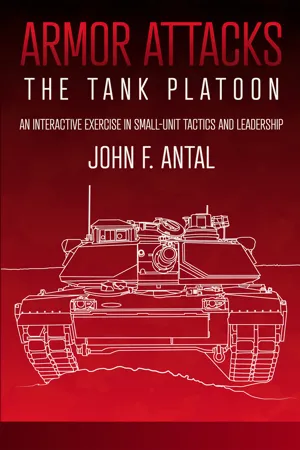
Armor Attacks: The Tank Platoon
An Interactive Exercise in Small-unit Tactics and Leadership
- 552 pages
- English
- ePUB (mobile friendly)
- Available on iOS & Android
eBook - ePub
Armor Attacks: The Tank Platoon
An Interactive Exercise in Small-unit Tactics and Leadership
About this book
"Extremely clever . . . part tactical decision game (TDG), part combat adventure page turner, and part
The Defense of Duffer's Drift." —Capt. Randall P. Newman, USMC
In this unique, interactive story, you are the leader of a U.S. Army M1 Abrams tank platoon. Throughout the text, you'll have an opportunity to make life-or-death decisions, and the events that unfold will be dictated by the choices you make. As you progress through the book, you'll learn important tactical and operational lessons. Whether or not you are—or want to be—a tank platoon leader, you'll find this book both highly entertaining and instructive.
There are two operations to survive—an assault and a counter-reconnaissance mission. In each you must bring your knowledge and judgment to bear on the scenario in order to achieve the objective. If you choose wrong, defeat and even death may be your fate. If you succeed, you can savor the taste of victory and live to fight another day. The scenarios are highly realistic, and there are maps and appendices with detailed specifications of the hardware involved to help you make informed decisions.
Written before Operation Desert Storm and published in 1991, Armor Attacks may feature military technology that's dated by today's standards—but the need for human leadership and effective, rapid decision-making has not changed. Armor Attacks was recognized as an invaluable teaching tool by United States Military Academy, West Point and was used to teach cadets the essential skills of leadership, decision-making, and tactics—a decade of USMA leaders trained with this book. To supplement the original text, this new edition includes the West Point instructor reference guide, which explains and amplifies the teaching points of each scenario encountered.
In this unique, interactive story, you are the leader of a U.S. Army M1 Abrams tank platoon. Throughout the text, you'll have an opportunity to make life-or-death decisions, and the events that unfold will be dictated by the choices you make. As you progress through the book, you'll learn important tactical and operational lessons. Whether or not you are—or want to be—a tank platoon leader, you'll find this book both highly entertaining and instructive.
There are two operations to survive—an assault and a counter-reconnaissance mission. In each you must bring your knowledge and judgment to bear on the scenario in order to achieve the objective. If you choose wrong, defeat and even death may be your fate. If you succeed, you can savor the taste of victory and live to fight another day. The scenarios are highly realistic, and there are maps and appendices with detailed specifications of the hardware involved to help you make informed decisions.
Written before Operation Desert Storm and published in 1991, Armor Attacks may feature military technology that's dated by today's standards—but the need for human leadership and effective, rapid decision-making has not changed. Armor Attacks was recognized as an invaluable teaching tool by United States Military Academy, West Point and was used to teach cadets the essential skills of leadership, decision-making, and tactics—a decade of USMA leaders trained with this book. To supplement the original text, this new edition includes the West Point instructor reference guide, which explains and amplifies the teaching points of each scenario encountered.
Tools to learn more effectively

Saving Books

Keyword Search

Annotating Text

Listen to it instead
Information
PART I
Armor Attacks

Section 1
“God, it’s hot!” 2d Lt. Sam Jaeger grumbled out loud. He licked his dry lips, reached for his canteen, and unscrewed the black plastic cap. The warm water that tumbled into his dry mouth was a welcome relief, in spite of the strong, bitter taste caused by the iodine purification tablets.
Jaeger wondered if he would ever get used to this god-awful desert. The days were fire and the nights were too cool to enjoy. The burning sun bore down on everything, making any type of shade a precious commodity. The dust was everywhere—coating your uniform, your skin, in your hair, your food. There was no escaping the dust.
To the north, buzzards circled ominously, searching for the day’s meal. Jaeger quickly ducked into the shade of a tarp that had been rigged to the side of his company commander’s M1 Abrams tank.
Madsen, a tall, good-looking young lieutenant, shrugged, answering Jaeger’s unfocused question. “You’ll get used to it. Just keep drinking plenty of water.” Madsen paused for a few quiet moments. “I think we attack tomorrow.”
Madsen’s comment hung in the air, unanswered. Jaeger replied with a silent glance, trying to look confident. Jaeger had joined Alpha Company only seven days ago … a lifetime ago. In that time he had developed a strong respect for 2d Lt. John Madsen. You could count on him. Solid. No nonsense. Madsen’s platoon had led the company road march for the past two days. You didn’t get to lead in Alpha Company unless you knew your stuff.
The road march had been dusty, hot, and monotonous. Thirteen of the company’s tanks had arrived at their designated assembly area position. One had broken down due to a faulty engine fuel pump. The road march had been conducted over 100 tiring kilometers of dust and sun, interrupted by an occasional strafing enemy aircraft. Luckily, no one had been hurt. The company’s air defense team had even managed to hit and destroy one enemy aircraft with a Stinger missile. So far, things were looking good.
Jaeger’s mind went blank as he leaned against the side of the big M1 tank and stared out at the desert landscape. He was tired. The desert was so different from anything he had ever experienced. The heat took a lot out of you. He thought about his home in Stillwater, Minnesota. He dreamed of ice water. Gallons and gallons of ice water.
Captain Russell, the company commander, and three lieutenants and an NCO walked up to the lean-to and joined Jaeger and Madsen. For a few moments no one said a word. All eyes were on Russell. Bleary eyed, dust streaked, and sweaty, the young officers waited for their commander to begin his briefing.
“OK. Take a seat. Get out your maps and listen,” the captain announced. The five officers and one NCO quickly took their places and opened their notebooks.
Jaeger unfolded his map, which was protected by a shiny acetate map case, and prepared to receive tomorrow’s attack order. He looked at the faces of the men around him. All except Captain Russell and the first sergeant were his age. The executive officer (XO), 1st Lt. Rick Shields, was a capable twenty-six-year-old who had been with the company since it deployed from the States. Shields had worked well as Russell’s second in command and was a veteran of the battle of the Valley of Tears.
Madsen, who had personally destroyed three enemy T-72 tanks in that battle, was in charge of 1st Platoon. Second Lieutenant Joseph Williams, a tall, black ROTC graduate, was in command of 2d Platoon. Williams was also new to the unit and, like Jaeger, had not yet experienced combat.
Lieutenant Rogers, an artilleryman, was the company’s new addition. Rogers was the company fire support officer, in charge of field artillery support and coordination. “Top,” 1st Sgt. “Wild Bill” Brock, the epitome of the tough, leather-faced, professional noncommissioned officer, rounded off the group. He was Russell’s right arm and handled all the company’s logistical and supply needs.
“First let me introduce Lieutenant Rogers,” Russell said, his gaze at Rogers full of firmness and expectation. “He is our new fire support officer, and I expect a lot of accurate artillery fire support from him. He will monitor the company command frequency and will call for fire from battalion mortars and 155mm artillery automatically, based upon your spot reports and his best judgment. Don’t waste time calling for artillery and don’t tie up my command frequency asking for mortar fire.” Russell then opened up his map, clipped it to a wooden board with metal clips, and continued.
“I received the operations order from battalion a few hours ago. I will now issue you the company order. As you should know, we are now located in our assembly area at grid LK892462. Save your questions for the end of my briefing and follow with me on your maps as I talk you through tomorrow’s mission.” Captain Russell’s tone left no mistaking that he was serious and demanded everyone’s complete attention.
“Situation: We are up against elements of an enemy motorized rifle division. We will be attacking into the enemy’s security zone. The security zone, for those of you who haven’t seen it in real life, is the first belt in the enemy’s defenses. The enemy is defending in our battalion’s zone of attack with a reinforced motorized rifle company. He seems pretty well spread out, and we anticipate that he is trying to delay us until their reinforcements arrive from the east. We can expect to see at least a reinforced motorized rifle platoon in our company zone of attack: approximately three BMPs and one T-72 tank.” Captain Russell paused to let that piece of information sink in.
“The battalion intelligence officer says that we may be up against the T-72M1, the best tank the enemy has sent against us so far. The T-72M1 has the same 125mm gun as the original T-72 but has a TPD-2-49 laser range finder instead of the older coincidence range finder found on earlier versions. The gunner’s sight is a passive image intensification sight, which will allow them to fire at night without artificial illumination. The T-72M1 also sports improved laminated armor and a triple stack reactive armor array. This reactive armor will defeat our antitank missiles, and our tank HEAT (high explosive antitank), but you still can take them out with tank main gun sabot rounds.”
Russell looked at his tank platoon leaders as if searching for a reaction. Jaeger, Madsen, and Williams, focused on the details of Russell’s briefing, made notes in their combat notebooks without any sign of emotion.
“Their BMP infantry fighting vehicles are probably BMP-2s,” Russell continued. “Each BMP has a 30mm cannon and carries the AT-4 or AT-5 antitank missile. That gives the enemy a reach of about four kilometers with the AT-5, so take that into account. The BMPs are also reported to have improved appliqué armor, which makes them tougher to kill but should be no problem for our 105mm guns. One BMP has already been spotted on the eastern edge of Objective Eagle at grid coordinates LK943538. That is the only location I have right now on the enemy.
“Doctrinally, the enemy will deploy a reinforced motorized rifle platoon approximately five kilometers forward of the motorized rifle company strongpoint. Depending on the terrain and time constraints, the Threat security zone commander will position squads ten to fifty meters apart in dug-in positions with connecting trenches. You can expect dummy positions and alternate firing positions prepared for each vehicle.
“They are usually pretty well spread out in the security zone, so there is a good chance that we can flank them and get them to move,” Russell said as he paced in front of his map. “When faced with encirclement or decisive engagement, the forces of the security zone are often ordered to withdraw under cover of artillery fire and return to the main defensive area. Our job is to see that this doesn’t happen.
“The Friendly Situation: Battalion will attack across Phase Line August tomorrow at 0425 to clear enemy forces up to Phase Line December. The battalion’s mission is to destroy all enemy forces between these phase lines so that 2d Brigade can exploit our success and continue the attack north. Before morning nautical twilight (BMNT) starts at 0530, so we will begin the attack in the dark.” Captain Russell paused to let his lieutenants observe the map. “We have Task Force 2-7 to our left and Team Charlie, Task Force 3-69, to our right.
“Mission: Alpha Company attacks 020425 June to destroy enemy forces in zone and to prevent the enemy from withdrawing past Phase Line December,” Russell explained. “I want you to orient on the enemy, not the terrain. Objective Eagle is for orientation only. Seizing Objective Eagle, seizing the ground, is not necessary. My intent is to find the enemy platoon, pin it down with the supporting fires from 1st and 2d Platoons, and let 3d Platoon roll up their flank, before they can escape to the north. I want to find the enemy’s flank and attack him one enemy vehicle at a time. I don’t want to see any mad cavalry charges, but when you move, move fast.

“Execution:” Captain Russell paused as his lieutenants carefully scanned their maps and took notes (see Map 1). “First let me talk you through the terrain for tomorrow’s attack. The ground is dominated by three key terrain features: Hill 766 (LK895503), Hill 740 (LK940880), and Hill 790 (LK960540). A deep wadi, wide enough to move at least one tank through, goes southwest to northeast in the eastern portion of the company zone. The small hill at LK935535 is designated as Objective Eagle.
“The company will move out of this assembly area at 0400. First Platoon will lead, followed by 2d Platoon and then 3d Platoon. Two kilometers south of Phase Line August the company will deploy to company “V” formation. First Platoon will be on the left, 2d Platoon on the right, and 3d Platoon trailing. We will continue to move due north. First Platoon will move to Checkpoint Four and then to Checkpoint Six. Second Platoon will move to Checkpoint One, then Checkpoint Seven. Third Platoon will follow 2d Platoon and occupy Checkpoint One and then Checkpoint Four, on order. When I give the signal, 3d Platoon will follow me and swing around the enemy’s weakest flank, left or right, depending on how the situation develops. First and 2d Platoons will provide support fire for 3d Platoon’s assault. All this can change depending on the enemy situation, so remain flexible when you plan your platoon operation.
“Lieutenant Rogers,” the captain said, looking straight into his fire support of...
Table of contents
- Cover
- Title
- Copyright
- Contents
- Preface to the 2020 Edition
- Acknowledgments
- Foreword by Gen. Richard E. Cavazos, USA (Ret)
- Preface
- Introduction
- Map Symbols
- Part 1: Armor Attacks
- Appendix A Weapons Data
- Appendix B U.S. Unit Organizations
- Appendix C Threat Unit Organizations
- Appendix D Troop-Leading Procedures
- Appendix E Tank Fighting Positions
- Appendix F Order Formats
- Part 2: United States Military Academy Instructor Manual
- Glossary
- Decision Chart
Frequently asked questions
Yes, you can cancel anytime from the Subscription tab in your account settings on the Perlego website. Your subscription will stay active until the end of your current billing period. Learn how to cancel your subscription
No, books cannot be downloaded as external files, such as PDFs, for use outside of Perlego. However, you can download books within the Perlego app for offline reading on mobile or tablet. Learn how to download books offline
Perlego offers two plans: Essential and Complete
- Essential is ideal for learners and professionals who enjoy exploring a wide range of subjects. Access the Essential Library with 800,000+ trusted titles and best-sellers across business, personal growth, and the humanities. Includes unlimited reading time and Standard Read Aloud voice.
- Complete: Perfect for advanced learners and researchers needing full, unrestricted access. Unlock 1.4M+ books across hundreds of subjects, including academic and specialized titles. The Complete Plan also includes advanced features like Premium Read Aloud and Research Assistant.
We are an online textbook subscription service, where you can get access to an entire online library for less than the price of a single book per month. With over 1 million books across 990+ topics, we’ve got you covered! Learn about our mission
Look out for the read-aloud symbol on your next book to see if you can listen to it. The read-aloud tool reads text aloud for you, highlighting the text as it is being read. You can pause it, speed it up and slow it down. Learn more about Read Aloud
Yes! You can use the Perlego app on both iOS and Android devices to read anytime, anywhere — even offline. Perfect for commutes or when you’re on the go.
Please note we cannot support devices running on iOS 13 and Android 7 or earlier. Learn more about using the app
Please note we cannot support devices running on iOS 13 and Android 7 or earlier. Learn more about using the app
Yes, you can access Armor Attacks: The Tank Platoon by John F. Antal in PDF and/or ePUB format, as well as other popular books in History & Military & Maritime History. We have over one million books available in our catalogue for you to explore.