Streets make up more than 80 percent of all public space in cities, yet street space is often underutilized or disproportionately allocated to the movement of private motor vehicles. Excess impervious surface contributes to stormwater runoff, posing a threat to the environment and human health, and often overwhelming sewer systems. This excess asphalt also poses a threat to public safety, encouraging faster speeds and dangerous conditions for people walking and biking.
The Urban Street Stormwater Guide begins from the principle that street design can support—or degrade—the urban area’s overall environmental health. By incorporating Green Stormwater Infrastructure (GSI) into the right-of-way, cities can manage stormwater and reap the public health, environmental, and aesthetic benefits of street trees, planters, and greenery in the public realm. With thoughtful design, GSI can bolster strategies to provide a safe and pleasant walking and biking experience, efficient and reliable transit service, and safer streets for all users.
Building on the successful NACTO urban street guides, the Urban Street Stormwater Guide provides the best practices for the design of GSI along transportation corridors. The authors consider context-sensitive design elements related to street design, character and use, zoning, posted speed, traffic volumes, and impacts to non-motorized and vehicular access. The Guide documents and synthesizes current practices being developed by individual agencies and recommends design guidance for implementation, as well as explores innovative new strategies being tested in cities nationwide. The guidance will focus on providing safe, functioning and maintainable infrastructure that meets the unique needs and requirements of the transportation corridors and its various uses and users.
The state-of-the-art solutions in this guide will assist urban planners and designers, transportation engineers, city officials, ecologists, public works officials, and others interested in the role of the built urban landscape in protecting the climate, water quality, and natural environment.

- 155 pages
- English
- ePUB (mobile friendly)
- Available on iOS & Android
eBook - ePub
Urban Street Stormwater Guide
About this book
Trusted by 375,005 students
Access to over 1.5 million titles for a fair monthly price.
Study more efficiently using our study tools.
Information

Fairmount Avenue & N 3rd Street, PHILADELPHIA, PA
1
Streets as Ecosystems
Green Street Principles
Streets are Ecosystems
Why Sustainable Stormwater Management Matters
The Role of Streets
Complete Streets are Green Streets
Green Street Principles
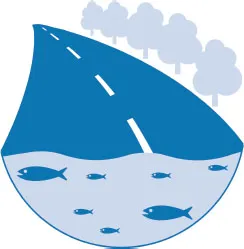
PROTECT AND RESTORE NATURAL RESOURCES
Capturing, filtering, and infiltrating stormwater is critical in urban environments where impervious surface covers 60% or more of all land area. Sustainable stormwater infrastructure filters pollutants from water and restores the natural hydrological cycle, protecting water resources.1 Green infrastructure also improves air quality, mitigates the urban heat island effect, and increases species habitat, from small oases for birds and insects to the large water bodies that eventually receive stormwater runoff.
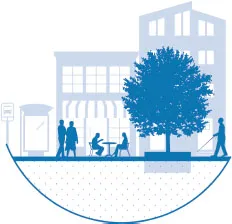
PROMOTE HEALTH, EQUITY, & HUMAN HABITAT
Green streets are part of healthy, equitable urban design that views streets as vital public spaces. Incorporating green elements into streets improves mental and physical health through better air quality, valuable shade, beautification, and contact with nature in areas where access to parks is limited. Ensure that the benefits of green stormwater infrastructure are provided equitably, especially in neighborhoods that have historically borne disproportionate air and water pollution or that lack green space.

DESIGN FOR SAFETY & MOBILITY
Street reconstruction projects that incorporate green infrastructure should be aligned with citywide traffic safety and mobility efforts, especially where opportunities arise to move curbs and reallocate street space for people walking and biking. Green infrastructure can be leveraged in conjunction with other street design projects to realize complementary goals, including transit access and safe mobility, providing greater value from city projects.

DESIGN FOR LIFE CYCLE
Green stormwater infrastructure is an asset for cities, providing quantifiable financial benefits. Stormwater management strategies should be planned and implemented with consideration for life-cycle costs and benefits, including the potential impacts of climate change and storm events. Green street elements that are properly designed, operated, and maintained extend the useful life of other infrastructure, especially graywater systems and pavement surfaces.

DESIGN FOR RESILIENCE
As the intensity and frequency of storms increases in many cities, and as drought conditions intensify in other cities, sustainable stormwater management is critical for climate change mitigation and adaptation. Incorporating natural systems into the built environment promotes ecosystem health and urban resilience.

OPTIMIZE FOR PERFORMANCE
Green stormwater infrastructure should be implemented at a network scale, but must be tailored to the specifics of its site. Use an understanding of topography and microclimates, available space, accessibility needs and the many human functions of a street, and desirable infiltration capacity to design appropriate green stormwater systems. Use the street to restore connections to the natural water cycle, and make comprehensive, citywide investments to see watershed-level benefits.
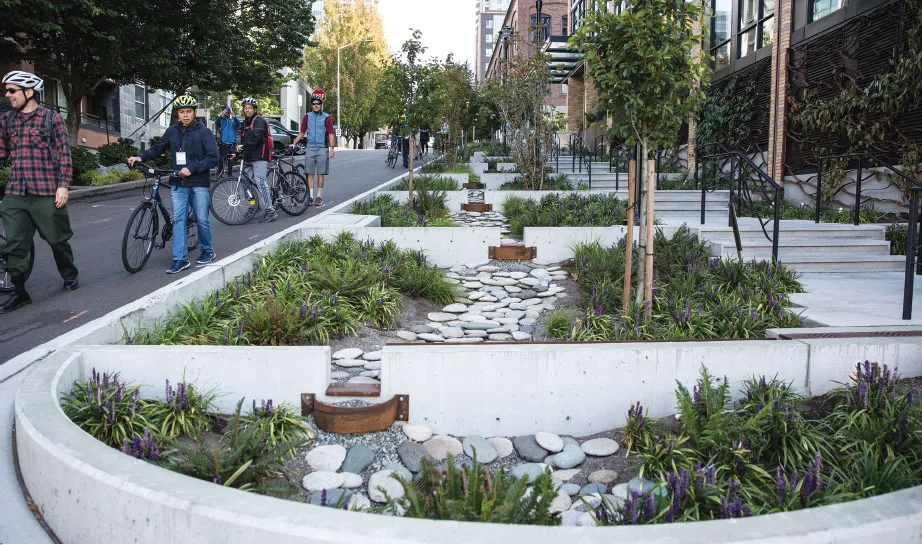
Vine Street, SEATTLE, WA
Streets are Ecosystems
The opportunity is ripe to reimagine how streets function in cities, not just as mobility corridors and public spaces, but as part of the natural ecosystem. With re-urbanization, aging infrastructure, and a changing climate, sustainable stormwater management is a core challenge for resilient cities.
Historically, streets have formed an impermeable paved layer on top of green space, disrupting hydrological cycles and requiring expensive stormwater infrastructure to manage stormwater runoff and protect ground and surface water quality. As cities face storm events of increasing frequency, duration, and intensity, as well as more persistent drought conditions, it is time to ask more of our streets.
Urban streets can reconnect rainfall to the environmental life of the city. Forward-thinking planners, engineers, and designers are treating streets as part of the ecological fabric of cities, integrating green infrastructure into the street alongside transit infrastructure and safe places for people walking and biking. By thinking of streets as ecosystems, we can build cities that are more resilient, sustainable, and enjoyable places to live.
Why Sustainable Stormwater Management Matters
Cities are defined by water. Waterways define city edges and bou...
Table of contents
- Cover
- Title Page
- About Island Press
- Copyright
- Contents
- Foreword
- About the Guide
- 1. Streets as Ecosystems
- 2. Planning for Stormwater
- 3. Stormwater Streets
- 4. Stormwater Elements
- 5. Partnerships & Performance
- 6. Resources
Frequently asked questions
Yes, you can cancel anytime from the Subscription tab in your account settings on the Perlego website. Your subscription will stay active until the end of your current billing period. Learn how to cancel your subscription
No, books cannot be downloaded as external files, such as PDFs, for use outside of Perlego. However, you can download books within the Perlego app for offline reading on mobile or tablet. Learn how to download books offline
Perlego offers two plans: Essential and Complete
- Essential is ideal for learners and professionals who enjoy exploring a wide range of subjects. Access the Essential Library with 800,000+ trusted titles and best-sellers across business, personal growth, and the humanities. Includes unlimited reading time and Standard Read Aloud voice.
- Complete: Perfect for advanced learners and researchers needing full, unrestricted access. Unlock 1.5M+ books across hundreds of subjects, including academic and specialized titles. The Complete Plan also includes advanced features like Premium Read Aloud and Research Assistant.
We are an online textbook subscription service, where you can get access to an entire online library for less than the price of a single book per month. With over 1.5 million books across 990+ topics, we’ve got you covered! Learn about our mission
Look out for the read-aloud symbol on your next book to see if you can listen to it. The read-aloud tool reads text aloud for you, highlighting the text as it is being read. You can pause it, speed it up and slow it down. Learn more about Read Aloud
Yes! You can use the Perlego app on both iOS and Android devices to read anytime, anywhere — even offline. Perfect for commutes or when you’re on the go.
Please note we cannot support devices running on iOS 13 and Android 7 or earlier. Learn more about using the app
Please note we cannot support devices running on iOS 13 and Android 7 or earlier. Learn more about using the app
Yes, you can access Urban Street Stormwater Guide by National Association of City Transportation Officials in PDF and/or ePUB format, as well as other popular books in Technology & Engineering & Sustainability in Architecture. We have over 1.5 million books available in our catalogue for you to explore.