There has been a revolution in urban transportation over the past five years—set off by start-ups across the US and internationally. Sleek, legible mobility platforms are connecting people to cars, trains, buses, and bikes as never before, opening up a range of new transportation options while improving existing ones. While many large city governments, such as Chicago, New York, and Washington, D.C., have begun to embrace creative forms and processes of government, most still operate under the weight of an unwieldy, risk-averse bureaucracy.
With the advent of self-driving vehicles and other technological shifts upon us, Gabe Klein asks how we can close the gap between the energized, aggressive world of start-ups and the complex bureaucracies struggling to change beyond a geologic time scale. From his experience as a food-truck entrepreneur to a ZipCar executive and a city transportation commissioner, Klein’s career has focused on bridging the public-private divide, finding and celebrating shared goals, and forging better cities with more nimble, consumer-oriented bureaucracies.
In Start-Up City, Klein, with David Vega-Barachowitz, demonstrates how to affect big, directional change in cities—and how to do it fast. Klein's objective is to inspire what he calls “public entrepreneurship,” a start-up-pace energy within the public sector, brought about by leveraging the immense resources at its disposal. Klein offers guidance for cutting through the morass, and a roadmap for getting real, meaningful projects done quickly and having fun while doing it.
This book is for anyone who wants to change the way we live in cities without waiting for the glacial pace of change in government.
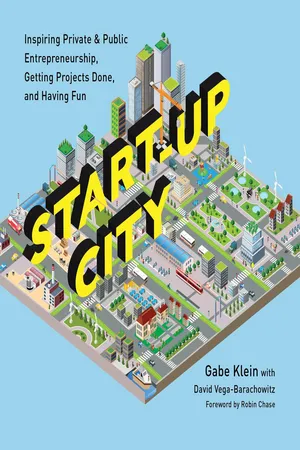
eBook - ePub
Start-Up City
Inspiring Private and Public Entrepreneurship, Getting Projects Done, and Having Fun
- 225 pages
- English
- ePUB (mobile friendly)
- Available on iOS & Android
eBook - ePub
Start-Up City
Inspiring Private and Public Entrepreneurship, Getting Projects Done, and Having Fun
About this book
Trusted by 375,005 students
Access to over 1.5 million titles for a fair monthly price.
Study more efficiently using our study tools.
Information
Topic
ArchitectureSubtopic
Architecture GeneralLesson #1

(Elvert Barnes, Flickr)
Don’t Be Afraid to Screw Up and Learn
It is necessary to make mistakes. Just make them as quickly as possible, learn from them, and try not to repeat.
When I was announced as director early on New Year’s Eve at the DDOT headquarters with the mayor and D.C. press present, it seemed as if the whole of the agency was standing on the balconies overlooking the atrium. Even as I gave my opening speech, I could sense the skepticism amongst some in the crowd of transportation employees. Who was this smart aleck from the private sector they’d brought in to shake things up? Why did things need to change?
When the announcement came to a close and the DDOT ranks began to form a line to shake hands with their new director, a middle-aged woman with a familiar face approached. She held a firm regulatory grip in her role as program manager for public space for DDOT and had proven to be somewhat of a nemesis while my food-truck company, On the Fly, struggled to survive on the streets of Washington.
“Should I just pack up my desk now?” she asked half-jokingly under her breath as she shook my hand.
“Absolutely not,” I said. “I’m going to make you my food-truck czar.” I smiled, half serious.
This person wasn’t the problem, but her approach was symptomatic of an ingrained culture of risk aversion and an antagonistic attitude toward the private sector. I knew that something, probably a lot of things, had to change at DDOT, and that her actions were a partial reflection of issues throughout the agency, and government as a whole.
For the next few years, I worked with this manager and many of the others in the agency to change not only their attitude about their sometimes adversarial role in relation to the public and businesses, but also to set a new open-minded tone internally and externally for their teams, and their teams’ teams, as they interacted with the public.
Within the first few weeks, I took stock of a few fundamental problems at DDOT:
•Saying “yes” meant more work, especially in an era of dwindling resources. This meant that there was very little incentive to innovate or to say “yes” when someone within the agency, or a customer of the agency, wanted to do something different from the status quo.
•Stepping out on a limb meant increasing risk of failure. The aversion to failure was unlike anything I had seen before, and, as I learned later, was actually even higher in many other cities.
•There was a prevailing attitude that businesses and the private sector in general were “on the other side” and were exploiting our city resources for personal gain. All businesses—small or large—were seen as the same by many managers.
•Government defaulted to a black box and was often opaque and uncommunicative in general, and especially when project problems became public or convoluted.

I was taught to iterate and fail fast as a survival instinct in business.
This last issue surprised me. If I was going to try to sell change to the public, how could we resist giving information to people? It just wouldn’t work. But this was the standard way that things were done at DDOT, and at many government agencies. Right off the bat, I realized that the best effort that I could make would be to lead by example: the director of the agency, like the mayor, sets the tone for embracing change and risk. I personally had to show that I was willing to embrace the future now and take on risk. Otherwise, we would never accomplish anything and would be stuck in a cycle of uninspiring, incremental change.

In the start-up world, “failure is not only invoked, but celebrated.”
Coming from the start-up world, the idea that I was supposed to be risk averse and instinctively say “no” made no intuitive sense to me. I was taught to iterate and fail fast as a survival instinct in business. We never would have ended up with convertibles or pickup trucks at Zipcar without this philosophy. In the start-up world, “failure is not only invoked, but celebrated.”1 This has been a basic tenet of technology startups for decades. In Walter Isaacson’s book on Steve Jobs, he tells the story of the iPhone launch event, where the thing literally did not work and was sporadic at best, an amalgam of iPod, phone, and computer, with nothing quite functioning as it should, even minutes before the event. Jobs held the unveiling anyway, and miraculously, when he made that first call from the stage, it went through. If he had given up because the product at that time was unreliable and a borderline failure, where would Apple be now?
So I set the expectation that we were going to experiment, make mistakes, and then make more responsible long-term decisions for the taxpayers as a result. This became the new modus operandi and freed up our teams to take risks.
My first week on the job, I went to work meeting with stakeholders inside and outside of local government in D.C., as well as in other big cities. Mayor Fenty had spent time in New York City meeting with Mayor Bloomberg, and emulated quite a few things he learned there. He mimicked Bloomberg’s bullpen office layout, in which he sat in an open cubicle with all of the mayoral staff, setting a dramatically different tone for government business (cobwebs literally grew in his sixth-floor official office, he used it so little).
New York City was doing the most interesting public space and active transportation projects in the nation at that time, and had one of the most progressive and energized teams. I met Janette Sadik-Khan, Mayor Bloomberg’s transportation commissioner, at the end of 2008. Janette had already made a name for herself as a change agent by making much of Times Square into a pedestrian zone. Janette and I shared a lot of ideas, both during this meeting and after, but perhaps the most important thing she told me was to think of many of our projects as “pilots,” if not in name then by approach. This strategy of experimentation and trial-and-error resonated with me. Moreover, it was cost-effective, because we could use cheap materials and fast action by internal teams to show a project’s worth and build a constituency, and then find the funds to make it permanent later on. This also meshed perfectly with my “fail fast” start-up philosophy, and also with my life philosophy more broadly: It’s okay to make mistakes, just make them as quickly as possible and learn from them. We also discussed the importance of documenting your work and publicly stating your goals in a way that government traditionally shied away from: short-term, milestone-based targets to measure against. Again, this was a perfect fit with the private-sector yearly strategic and budget plans that I was used to.

Gabe Klein, Secretary Ray LaHood, and Mayor Adrian Fenty opening the Pennsylvania Avenue bike lanes (Vikrum Dave Aiyer)
As a new guy with no experience in government, planning, or engineering, I set about asking a lot of questions, many of them “dumb” questions that would have seemed obvious to anyone who had spent time in municipal transportation. I got different reactions from people. The technical “experts” gave me an eye roll and must have thought, “Who hired this guy who doesn’t even understand the federal funding formulas?” Others were delighted at the prospect of a refreshing, energized, and youthful director who didn’t mind baring his lack of knowledge about the bureaucracy he had walked into, but was also asking everyone for input on his agenda. I had hundreds of conversations, with my assistants, the heads of the divisions, and everyone in between, asking, “What do you think is important that we do, that we don’t currently do?” I gathered small groups that cut across the agency and presented my rapidly growing vision for the next two years. People seemed to really appreciate being heard as well as the idea of increasing the pace of change. When I started talking to people about the detriment of saying “no” to new ideas and instead encouraging staff, and the public, to float any idea they saw as worthwhile, I got a bifurcated response: excitement at this attitude from the planning group and the communications and government relations folks, and then an “ugh” from the engineers and civil technicians. I knew that some of the best ideas were going to come from laypeople, those who live, work, and play in their own neighborhood. We needed to engage and empower them.
The combination of trying new ideas, failing fast, and doing low-cost pilot projects was a lot for some people to stomach, even for me as I tried to learn all of the government protocols. In my first few months, I bungled a few things (following my own philosophy as much as possible). At one point, shortly after starting, I accidentally contradicted the mayor in the Washington Post regarding the funding ...
Table of contents
- Cover
- About Island Press
- Title Page
- Copyright
- Dedication
- Contents
- Foreword by Robin Chase
- Preface
- Introduction
- 1. Lesson #1: Don’t Be Afraid to Screw Up and Learn
- 2. Lesson #2. Manage S.M.A.R.T.
- 3. Lesson #3. Where There’s a Will, There’s a Way
- 4. Lesson #4. Sell Your City
- 5. Lesson #5. Fund Creatively
- 6. Lesson #6. Bridge the Public-Private Divide
- 7. Lesson #7. Prepare for Disruption
- 8. Lesson #8. Drive Change
- Conclusion: The Big Picture and You
- Acknowledgments
- About the Authors
- Island Press | Board of Directors
Frequently asked questions
Yes, you can cancel anytime from the Subscription tab in your account settings on the Perlego website. Your subscription will stay active until the end of your current billing period. Learn how to cancel your subscription
No, books cannot be downloaded as external files, such as PDFs, for use outside of Perlego. However, you can download books within the Perlego app for offline reading on mobile or tablet. Learn how to download books offline
Perlego offers two plans: Essential and Complete
- Essential is ideal for learners and professionals who enjoy exploring a wide range of subjects. Access the Essential Library with 800,000+ trusted titles and best-sellers across business, personal growth, and the humanities. Includes unlimited reading time and Standard Read Aloud voice.
- Complete: Perfect for advanced learners and researchers needing full, unrestricted access. Unlock 1.5M+ books across hundreds of subjects, including academic and specialized titles. The Complete Plan also includes advanced features like Premium Read Aloud and Research Assistant.
We are an online textbook subscription service, where you can get access to an entire online library for less than the price of a single book per month. With over 1.5 million books across 990+ topics, we’ve got you covered! Learn about our mission
Look out for the read-aloud symbol on your next book to see if you can listen to it. The read-aloud tool reads text aloud for you, highlighting the text as it is being read. You can pause it, speed it up and slow it down. Learn more about Read Aloud
Yes! You can use the Perlego app on both iOS and Android devices to read anytime, anywhere — even offline. Perfect for commutes or when you’re on the go.
Please note we cannot support devices running on iOS 13 and Android 7 or earlier. Learn more about using the app
Please note we cannot support devices running on iOS 13 and Android 7 or earlier. Learn more about using the app
Yes, you can access Start-Up City by Gabe Klein,David Vega-Barachowitz in PDF and/or ePUB format, as well as other popular books in Architecture & Architecture General. We have over 1.5 million books available in our catalogue for you to explore.