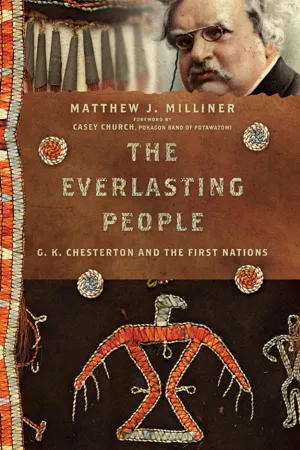
"This book is filled with contemplative insights, soul-searching questions, and generous footnotes for further reading. It is my hope that books like this will create cultural bridges that will foster further conciliatory opportunities."
– Terry M. Wildman, lead translator and general editor of the First Nations Version
What does the cross of Christ have to do with the thunderbird? How might the life and work of Christian writer G. K. Chesterton shed light on our understanding of North American Indigenous art and history?
This unexpected connection forms the basis of these discerning reflections by art historian Matthew Milliner. In this fifth volume in the Hansen Series, Milliner appeals to Chesterton's life and work—including
The Everlasting Man, his neglected poetry, his love for his native England, and his own visits to America—in order to understand and appreciate both Indigenous art and the complex, often tragic history of First Nations peoples, especially in the American Midwest.
About the Series
The Hansen Series celebrates the literary and spiritual contributions of seven British authors whose works have captivated readers across generations: Owen Barfield, G. K. Chesterton, C. S. Lewis, George MacDonald, Dorothy L. Sayers, J. R. R. Tolkien, and Charles Williams. These seven authors were all deeply involved in the friendships and intellectual exchanges that shaped the Inklings, a mid-twentieth-century group of Christian writers and thinkers in Oxford, England. This series invites readers to deepen their engagement with these timeless voices and their enduring influence on literature, faith, and the life of the imagination.
The majority of these people, the Native American survivors of ethnic cleansing, were Christian.
STEVEN CHARLESTON (CHOCTAW)
Metaphor is largely in use among these Peoples; unless you accustom yourself to it, you will understand nothing.
REVEREND FATHER PAUL LE JEUNE, NEW FRANCE, 1636
All men live by tales.
G. K. CHESTERTON
CONTINENTAL POWERS
Toward the end of the 1900s, in a town called Haddonfield in southern New Jersey, a group of mostly White high school students heard the good news of the Christian gospel. God, we discovered in a top-floor recreation room filled with secondhand couches, was for us, not against us. I wasn’t sure the friends I had managed to string together were for me, nor was I necessarily for them. I’m not even sure I was for myself. But Christ, we learned through this youth group attached to a mainline Methodist church, was for us. The cosmos we inhabited, hitherto puzzling and possibly hostile, suddenly became hospitable and radiant. Thanks to intensive Bible study, the considerable gaps in my nominal understanding of Christianity were rectified in a matter of months. The older adults in the church to which our youth group was appended may have looked at the fervor of our youth group with some concern. We knew this but did not care. We feasted on the books and cassette tapes on offer at the Good News Bible bookstore, we handed out tracts of the Four Spiritual Laws on the Jersey Shore boardwalk, and we canvassed door to door for the 1992 Billy Graham Crusade in Philadelphia. Seeking a deeper spirituality, we were introduced to Quaker books like Thomas Kelly’s Testament of Devotion.1 Seeking a name for what happened to us, we learned somewhere along the way it was called evangelicalism, but the name was not that important.
Over two centuries before that youth group, in the same land, there was a similar series of conversions. These converts would have known the land not as New Jersey but as Turtle Island,2 and they called themselves the Lenni Lenape.3 It is a term of humility that simply means “common people.”4 They were also called the Delaware, after an English politician, the third Baron De La Warr. The Lenape, or Delaware, also learned that God was for them. They were not sure the neighboring Haudenosaunee (a.k.a. Iroquois) were for them, still less the colonists. But Christ, they learned through the Quakers, and later through missionaries like David and John Brainerd and the Moravian David Zeisberger, was for them.5 These missionaries became primary recorders of their lifeways.6 Some historians have a word for the successful tactics employed by these ministers, and it is the same word used to describe my youth group: evangelicalism.7 The catechetical efforts of some previous missionaries, insufficiently connected to Lenape lifeways and thought, were rectified in a matter of months.8 Establishment Presbyterians looked at these missionaries and their new converts with suspicion.9 The Lenape knew this but did not care. The cosmos they inhabited, presided over by the one they called “The Master of Life” but by malevolent forces as well, became more hospitable and radiant. These Lenape did not need to become English in receiving Christianity any more than I, when choosing Christ for myself, needed to become Lenape.10 The missionaries defended the Lenape from settler hostilities,11 until at last “the relentless forces of colonialism undermined [their] village world and Christian Indian community.”12 In high school and graduate school in New Jersey I was educated right next to the successful Brotherton (1746) and Bethel (1758) Lenape missions established by David and John Brainerd, respectively. Though I learned all about Christian missions in Europe, nary a word was breathed about the efforts that took place just miles away.
Christianity for me meant considerable success. My new faith took me halfway across the United States, through Pennsylvania, Ohio, and Indiana (where I was born), to a place called Wheaton College in Illinois. While at Wheaton, I went north to Wheaton’s campus in the Wisconsin wilderness, where I sought God in solitary prayer. The beauty of this land hosted my newfound faith without hindrance or obstacle. I married a woman from Ontario and learned a new branch of the Great Lakes landscape. After a stint at ministry in Pennsylvania and more graduate school in New Jersey, I ended up back at Wheaton College, where I am today. Christianity has been good for me.
Figure 1.1. Lenape (Delaware) “Penn” wampum belt (c. 1682) presented by Lenape leaders to William Penn as part of a land agreement and treaty of friendship
But Christianity was not as good for the Delaware converts. Lenape conversion to evangelical Christianity offered no protection from the tide of settlement. The Lenape had already learned that the sons of William Penn were not as kind as their father. Though they had made a covenant of friendship with Penn, sealed with crosses no less (see fig. 1.1), in 1737 the Lenape were deceived out of more land than they could have imagined in the Walking Purchase.13 The Lenape leader and Moravian convert Teedyuscung (c. 1700–1763) remarked, “This very ground that is under me was my land and inheritance, and is taken from me by fraud.”14 I enjoyed the same land as a playground for Christian ski weekends. In Easton, Pennsylvania, the same area where David Brainerd first preached to the Lenape, I attended a 1992 retreat to build up my newfound faith. Also in Easton, the Delaware made a 1758 agreement with the English to cede more land, but the promises made there were broken as well.15 I drove happily and obliviously through Ohio on my way to college. The Moravian Lenape were pushed there, where they were caught between British and American military forces. In 1782 the Pennsylvania militia met them at their settlement known as Gnadenhutten, “tents of grace.” American militiamen, falsely believing these Christian Indians had taken part in raids, voted to execute them.16 This was not the fever pitch of battle. The Americans thought it over. The Christian Lenape, mostly women, children, and elderly men, requested the night for prayer, which was granted. And in the morning ninety-six of them “were beaten to death with mallets and hatchets, and scalped” as they sang Christian hymns.17 What was left of them was buried in a mound reminiscent of the great Ohio Native mounds from centuries before (see fig. 1.2).
Figure 1.2. Site of the 1782 Gnadenhutten Massacre, Gnadenhutten, Ohio
As settlers moved in, the Christian Delaware were pushed farther out. At the Treaty of Greeneville in 1795 they were deprived of their place in southern Ohio and moved to the White River in Indiana.18 Understandably, Christianity was growing less popular among the Lenape in these distressed times, yet one Mohican convert among them named Joshua managed to hold onto his faith—even though two of his teenage daughters had been killed at the Gnadenhutten massacre. But whereas the White man had gone after his fellow Christian believers at Gnadenhutten, it was the Lenape themselves who came after Joshua. A series of Indian prophets arose that preached a gospel of racial separation. Demanding a return to Native lifeways, they sought to purge Delaware culture of Christian influence. But Joshua was not deterred. After professing his faith in Christ, the sixty-four-year-old Joshua, along with several other Christian Indians, was killed and burned.19 Even then, many Christian Delaware held onto their faith. The descendants of these Moravian “praying Indians,” the Stockbridge-Munsee Mohicans, many of them still proudly Christian, have taken up residence along the road that I had happily traveled on my way to camp in Wisconsin. They were granted American citizenship in 1843.20 Not surprisingly, the prize object on display in their heritage center is an eighteenth-century Bible, finally returned to them by a Massachusetts museum in 1991. “While they held the big Book in one hand, in the other they held murderous weapons,” complained one Delaware chief, referring to the Bible and to the tactics of colonization.21 And yet others among the same Delaware embraced this book “to oppose forces of destruction, to defend Native American communities, and to strengthen Native American sovereignty, in spite of the odds.”22
Also on my way to camp I drove past the headquarters of the Brothertown Indian Nation (sometimes spelled Brotherton), whose members were granted US citizenship in 1839. They also descend from the evangelical “praying Indians.”23 Another settlement of the Christian Lenape diaspora barely survives in Ontario: the Delaware Nation at Moraviantown near Thamesville. My wife and I unknowingly passed it many times as we drove from Wheaton to visit her family home. I say it barely survives because in 1813, after the Battle of the Thames, William Henry Harrison and his troops burned this Moravian Indian village (Fairfield) to the ground, almost as if to suggest that America’s beef with evangelical Indians was personal.24 Still, these Indians remain.
I hope it is clear by now that my autobiographical comments are not an excuse for self-indulgence but a means of self-examination. The la...
Table of contents
Cover
Title Page
Dedication Page
Contents
Foreword by Casey Church
Preface by G. Walter Hansen
Acknowledgments
Introduction: From the Holy Mountain to Spirit Island
1 The Sign of Jonah
2 The Cost of Chicago
3 Mother of the Midwest
Conclusion: Returning a Pipe
Contributors
Figures Credits
Name Index
Subject Index
Notes
Praise for The Everlasting People
About the Author
More Titles from InterVarsity Press
Copyright
Frequently asked questions
Yes, you can cancel anytime from the Subscription tab in your account settings on the Perlego website. Your subscription will stay active until the end of your current billing period. Learn how to cancel your subscription
No, books cannot be downloaded as external files, such as PDFs, for use outside of Perlego. However, you can download books within the Perlego app for offline reading on mobile or tablet. Learn how to download books offline
Perlego offers two plans: Essential and Complete
Essential is ideal for learners and professionals who enjoy exploring a wide range of subjects. Access the Essential Library with 800,000+ trusted titles and best-sellers across business, personal growth, and the humanities. Includes unlimited reading time and Standard Read Aloud voice.
Complete: Perfect for advanced learners and researchers needing full, unrestricted access. Unlock 1.4M+ books across hundreds of subjects, including academic and specialized titles. The Complete Plan also includes advanced features like Premium Read Aloud and Research Assistant.
Both plans are available with monthly, semester, or annual billing cycles.
We are an online textbook subscription service, where you can get access to an entire online library for less than the price of a single book per month. With over 1 million books across 990+ topics, we’ve got you covered! Learn about our mission
Look out for the read-aloud symbol on your next book to see if you can listen to it. The read-aloud tool reads text aloud for you, highlighting the text as it is being read. You can pause it, speed it up and slow it down. Learn more about Read Aloud
Yes! You can use the Perlego app on both iOS and Android devices to read anytime, anywhere — even offline. Perfect for commutes or when you’re on the go. Please note we cannot support devices running on iOS 13 and Android 7 or earlier. Learn more about using the app
Yes, you can access The Everlasting People by Matthew J. Milliner in PDF and/or ePUB format, as well as other popular books in Theology & Religion & Art General. We have over one million books available in our catalogue for you to explore.