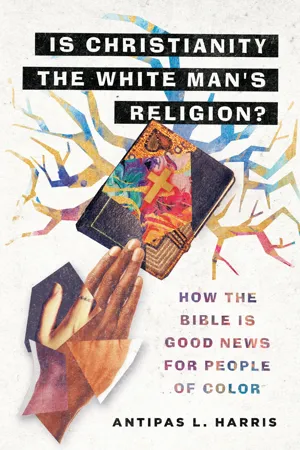
I was teaching a graduate course on ministry leadership when a twenty-two-year-old student interrupted my lecture with a bizarre question: “What do you say to your friends who are leaving the church and arguing that Christianity is the white man’s religion?”
I was taken aback by the question. First, it was unrelated to the topic of the day. Second, I wondered who in the world would argue such a thing.
The class discussion that ensued opened up a world of discovery. I couldn’t shake the conversation out of my mind for several weeks. Since then, I’ve learned that many young people of color across North America, all over Europe, and throughout Africa are often wary of Christianity because of current religious alignments with divisive politics, not to mention the global history of pain already associated with branches of Christianity. Many Christians (like I was) are unaware of the current conversations about this on the streets. My concern and subsequent research led me to write this book.
The question of whether Christianity is a trustworthy religion for everyone is not new. Over the years, many people and groups have asked this question. For example, the Nation of Islam was convinced that Christianity was the white man’s religion, dating back to the Jim Crow era of racial segregation. It is deeply concerning that since then, after all the changes that have taken place, this question has resurfaced. A new wave of religious skeptics has arrived with serious questions about faith, identity, and the struggles of everyday life. From followers of the Nation of Islam and the Five Percent Nation to students of Science and Consciousness and others, there is a circumspection regarding oppressive attitudes and beliefs associated with the history of Western Christian practice. Times have changed, but similar observations that provoked the question years ago are provoking skepticism today.
The student’s question brought to mind three distinct situations, one of which occurred in 2002 when I was a student at Yale Divinity School. Just outside the barbershop on Dixwell Avenue in New Haven, Connecticut, a group of self-identified black, Jewish men sold kosher hot dogs. One day, one of them stopped me and asked who I was, where I was from, and what I did. My interest in theological studies caught his attention. He felt the need to share with me that black people are the true Jews. To be honest, the conversation was rather intriguing; it was my first encounter with an African American who claimed to have found his true identity. His serious and intelligent conversation kept my attention for longer than I intended. Before this point, my only point of reference to black Jews was Ethiopian Jews. It was clear, however, that the brother in New Haven was not talking about the Jews who are native to Ethiopia. He was saying that African Americans are Israelites and don’t know it.
Several years later, I was invited to speak on urban evangelism for the Solid Rock Church Conference at the Founder’s Inn in Virginia Beach. A pastor from Washington, DC, expressed concern about a group of African Americans who seemed to connect well with the young black men in Washington’s distressed areas. He explained that these men wore yarmulkes, called themselves Israelites, and sought to convince other young men that Christianity is the white man’s religion and that black people are the true Israelites. It was an earful! Immediately, I made the connection with the “black Israelite” I had previously met in New Haven.
In 2011, I went with a group of college students to New York for an Urban Plunge Excursion. We partnered with the New York School of Urban Ministry (NYSUM). Students interested in urban evangelism joined us on 125th Street to pray with passersby. Energized by the pedestrians’ openness to spontaneous prayer, some of the students wandered a bit further down 125th Street to a bus stop near the Apollo Theater. More people to pray with, they thought.
From a distance I noticed that a few of the students were having a lively conversation, so I went to join them. As I approached, I realized that the young seminarians were in an intense theological conversation with brothers from the Nation of Islam. With a quick-talking New York style, the Nation of Islam brothers were trying to persuade our slower-talking Virginian seminarians that Christianity is the white man’s religion.
The brothers from the Nation of Islam were quite versed in the tenets of their own faith as well as Christian Scripture. However, I noticed how they misquoted the Scriptures to suit their own agenda. While I do not remember the specific passage, I recall inserting myself into the conversation and calling them out on the misquotation. I then abruptly invited my students to return to the rest of our colleagues on the other end of the street. As I left the brothers from the Nation of Islam, I remember thinking, “Our students have got to know the Scriptures!”
In 2017, Bishop T. D. Jakes shared with me that he was planning to host a Global Think Tank on the African seedbed of Christianity at that year’s International Pastors and Leadership Conference. Ironically, the conversation with the bishop was only a few days after my seminary student shared his concern about the growing skepticism that many urban youth and young adults have about Christianity.
I soon learned that pastors all over the Western world are concerned about the foothold the Black Hebrew Israelite movement and other religious groups are gaining in urban areas. Eight thousand pastors and leaders gathered at Bishop Jake’s global think tank that addressed the African presence in the Bible. They wanted tools to prepare their congregations to defend the faith in everyday conversations, such as around dinner tables, on street corners, and in barber shops and beauty salons.
As a whole, millennials are more educated than previous generations. The combination of the “more educated” and “undereducated” creates a tension of knowledge in society and raises a lot of questions. Some of those questions are about religion. In an internet age where information is rampant, it is hard to distinguish valid information from what is invalid. People are getting information from everywhere. Much of it is laced with uninformed opinions. We are often caught in a maze of uncertainty, trying to determine what is trustworthy.
For this generation, religion must touch the heart and not simply mandate rules. Touching the heart goes beyond cozy emotions and speaks to practical dynamics of faith. In other words, genuine religion touches the streets. It champions causes and advocates for justice. It helps people gain a moral compass, discover their identity, and develop gifts—which is exactly what my family and church provided for me at a young age.
GROWING UP IN THE BLACK, SANCTIFIED CHURCH
I grew up in a small Pentecostal church in Manchester, Georgia. Pentecostal churches were often called “sanctified churches” because they placed a heavy emphasis on “living holy.” While the sanctified church emphasized personal piety, it also drew on Scripture to cultivate our moral conscience, illuminate our personal identity, and strengthen us in our gifts. My dad and mom started our church in the early 1970s, and most of our members were African American. My formative years of faith were rooted and grounded in my experience with God.
Our church was a place of refuge, encouragement, and empowerment. We had a community made up of everyone from single-parent families to two-parent families with tons of children. My parents had eight kids and another couple had fourteen. We were like one big family who loved God and each other. Church was everything for us. We worshiped up to four times a week. Our faith taught us that Jesus understands our social and personal situations—a truth that became so deeply rooted in our faith orientation that, for us, Jesus was black like us. Don’t get me wrong—our church did not preach that Jesus is African American. What I mean is that when we read the Bible, we interpreted Jesus through the lens of our experience.
For black people, blackness is more than a color. It is a rich heritage, a contribution to the world. For blacks with a history of slavery, to be black involves a history of pain and social struggle. Black Christian history, the one that framed the origins of black churches, passed down a grassroots understanding that Jesus loves us amid a hateful world. Jesus journeys with us through life’s ups and downs. He is with us when down in the dumps just like God was with Israel during their time in Egypt. Just as God imputed identity to Israel and made a people of them, our identity was formed in Christ. We are “Jesus people.” For centuries, millions of black people have relied heavily on that identity. More than two hundred years of slavery and almost a century of Jim Crow honed a common faith in black churches that our hope must be in God. We have believed that he would make a way when none was visible. And in our little church in Manchester we witnessed the Lord do just that, time after time.
We experienced God as a father for the fatherless, a mother for the motherless, a friend for the friendless, water for the thirsty, and food for the hungry. Jesus sided with us amid pain, frustration, agony, and loss. The redeeming Christ saved us from sin. The crucified Christ acquainted himself with black suffering. The loving God would help us succeed against all odds. Again and again, my life story confirmed such a God!
My dad even established a school at our church. It was a place to deepen our faith through a Christian education curriculum, provided an escape from youthful vices, and helped the children of the church navigate the contours of southern racism. Even in the 1990s, the black experience in the Deep South was tough, but for most of my young life I didn’t realize it. When I discovered the reality of racism, I was shocked out of my mind!
We had very friendly relationships with white Pentecostal congregations. We visited their churches, and they came to ours. But there were nagging reminders that the two churches were different. Partly, the black orientation to church differed from the way white people experienced church in the Deep South. For example, one time our church took a youth group to a skating rink in Griffin, Georgia, because it was the closest location to Manchester with a weekly Christian music skate night. While at the skating rink, my dad (our pastor) and a white pastor developed a friendship. Each week, they would chat about the faith, church life, and vision for their ministries. At one Christian skate night, the white pastor told my dad that a black man was coming to his church, but he didn’t really know how to relate to him. So he suggested that the man come to our church. Never mind the distance from Griffin to Manchester is about forty miles, which is an hour drive time.
Conversely, our church’s focus on helping black people succeed in Christ was not always an inviting experience for white people. For example, during one of my dad’s practical sermons on the necessity of personal responsibility, he paused and asked the congregation a question something like, “Why does God want us to be responsible and work?” Forgetting that we had a white visitor that day, a brother in the church responded, “So we can pay these white folks their money!” Only after he spoke did he remember the visitor and quickly say, “Oh, excuse me!” Many of us laughed, including the visitor, but this story illustrates how our faith was formed within a context of the black experience against a dominate white society that we viewed as indifferent to black people.
One traditional feature of African American churches was that they helped blacks synthesize their faith within the broader context of white economic and ideological superiority. The way we learned about God, Jesus, and the Bible helped us succeed in the white world. However, in a predominately white society, most white people can’t relate to being in a situation where they are the minority. Most could probably live their lives without ever experiencing a majority black context.
Black churches in the Deep South not only constituted a majority of black people, they also preserved some of the qualities passed down from the slave and Jim Crow era religious traditions. This is probably the case because there was really no theological or liturgical model to which to subscribe; it was just the way black people did church. Their spirituality was inextricably formed alongside their experience. Princeton religion professor Albert J. Raboteau points out, “The slaves’ historical identity as a unique people was peculiarly their own. In the spirituals the slaves affirmed and reaffirmed that identity religiously as they suffered and celebrated their journey from slavery to freedom.” One must not dismiss cultural identity too quickly. African American spirituality was formed through the pressures of oppression. Black human and Christian identity were shaped in spite of a society that rejected both. Black families and churches safeguarded young minds and lives from mainstream identity adversity.
THE SHADOW OF JIM CROW
I was blessed with parents and grandparents who, in some ways, continued the historic African American approach to childrearing. Although nearly a hundred years had passed since the abolition of slavery, my grandparents grew up in Georgia during Jim Crow’s segregation. My parents caught the tail end of it as well. The attitudes that permeated Jim Crow and the structural systems set in place from the nation’s inception, in many ways, continue until this day. So my parents invested a lot of time and support in my siblings and me. At the time, I did not realize how much they shielded us from the ugly experiences they had endured.
Now that I am an adult, some of the funny but serious...