"Jon knows, better than most, what it means to battle anxiety and how to forge a path to victory. He also treats it with care, and pushes the conversation to places that it hasn't often gone in the church."
--Kirk Cameron
In the aftermath of the pandemic, even those who have never struggled with mental health have found themselves reeling, looking for answers they don't know how to find. For Christians, especially those who've despaired of help from a church that has too often stigmatized poor mental health as a lack of faith, the way forward can be particularly difficult to see.
Jonathon Seidl aims to fix that. Having fought his own way through crippling anxiety, life-altering OCD, and suicidal thoughts, he knows the value of concrete advice grounded in strong biblical truth. Instead of the trite or unsympathetic counsel that's too often given,
Finding Rest is practical, personal, and productive. Full of compelling stories, humor from a guide who's still on his journey, and scriptural truths, this book offers real hope and help. It also provides a lifeline for friends and family who long for ways to help relieve the suffering of their loved ones. And it calls to account the church for its historical treatment of mental health and lays out thoughtful, needed paths for the body of Christ to become a refuge of hope for the anxious.
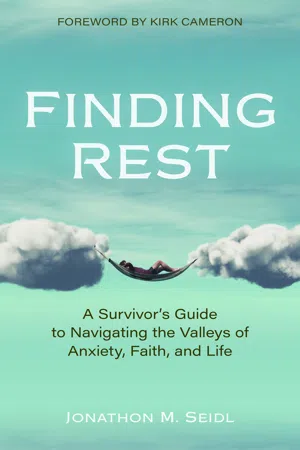
eBook - ePub
Finding Rest
A Survivor's Guide to Navigating the Valleys of Anxiety, Faith, and Life
- 192 pages
- English
- ePUB (mobile friendly)
- Available on iOS & Android
eBook - ePub
About this book
Information
Topic
Personal DevelopmentSubtopic
Mental Health & WellbeingCHAPTER 1
CALL IT BY ITS NAME
A FEW YEARS AGO MY wife, Brett, and I had brunch with a group of friends from our small group at our church in Texas. It was the first time we had gotten together in a while, since kids and babies had started replacing game nights and cocktails.
As we sat there wrangling our children and making ridiculous deals with the toddlers to get them to take one more bite of their food, one of the women broke the news: “We’re pregnant!”
Cheers went up and hearty congratulations poured out. I’m not sure I have ever heard so many high-pitched “Ahhhhhs” in my life. Then something interesting happened. After someone asked the inevitable questions of “When are you due?” and “Do you know what it is?” a third question quickly followed: “Have you picked out a name?”
The couple had, but they slyly refused to tell us. It drove everyone nuts. We asked if we could guess, and when they said yes, it began a twenty-minute interrogation with every name possible being thrown against the wall to see if it would stick. (Think of a classic version of the game Guess Who breaking out in the middle of a packed restaurant. “Does this little person start with a D?”) I even went deep into the Bible and threw out Tryphaena and Tryphosa. No dice. Finally, after a few hints we coaxed out of the couple’s two-year-old, I guessed it: Charlotte. The screams for us figuring out the name were just as loud as when we got the baby news earlier. The tables near us cheered a little too, as by then they had become secretly invested in figuring out the name as well.
So here’s the question: why is that? Why are we driven, seemingly inherently, to ask about a name? Why do we have to know what something or someone is called? The answer, in true Beauty and the Beast fashion, is as old as time.*
For starters, it gives us control. In ancient Jewish culture, there’s an idea that if you can name something, you have power over it. Think back to the garden of Eden. After God gave Adam dominion over the earth, Adam took on the task of naming every living thing. By naming them, he was in a position of control over them. When we name something, we own it. We take responsibility for it. We even protect it.
But names have another purpose beyond ownership and control. They allow us to communicate properly about whatever the thing or person is. They allow us to categorize it. They allow us to understand it. There’s an exponential level of knowledge that comes with knowing someone or something’s name. It can tell us so much. It’s why our group of friends wanted to know the baby’s name. Knowing her name would open up a whole new world of insight. In this instance, it would lead to a deeper understanding of the parents by then talking about why they chose that name, asking why it was important to them, and discussing things like family heritage.
We see this emphasis on names throughout the Bible. Moses longed to know the name of whom he was talking to in the burning bush. Jacob, while struggling with the stranger on the shore of the Jabbok River, asked for the assailant’s name. The angel gave Mary Jesus’s name—Emmanuel—when he appeared to her and announced the coming of the Son of God. Matthew spends seventeen verses on the names in Jesus’s genealogy, while Luke spends fifteen doing the same thing. That’s a lot of names.
We want to name, and we want to know names. Only then, it seems, can we properly appreciate whatever it is. Only then can we understand it. Only then can we face it. The absence of a name—the unknown—is not only a powerless place but also a place of deep confusion.
That’s how you could categorize a lot of my teen and young adult years. For twenty-seven years of my life, I had no idea what was going on inside of me—I didn’t have a name for it. I was confused. I was angry. I was upset. I was frustrated. I had feelings I couldn’t put into words. And I could never seem to turn off my mind.
Why do I feel this way? Why can’t I stop thinking about this? What am I so worried about? What’s the worst that could happen? (Don’t answer that!)
My brain always seemed to be racing. Like a dog chasing its tail, it would go around and around and around … and around some more. Only, in those earlier days, I think a dog had a better chance of catching its tail than I did of slowing the exhausting cycle in my head.
My first “episode,” as I recall it, happened when I was twelve. My mom, one of my sisters, and I were in our white Dodge Caravan pulling up to our country home in Wisconsin. Our house was set back about three hundred yards from the road, and the routine we had for getting the mail looked like Mom stopping at the end of the winding gravel driveway and one of us kids hopping out and walking to the mailbox situated right off the shoulder. Because of the Badger State’s perpetual cold, my siblings and I would always argue over who had to make the mail run. On this day, I drew the short straw.
I pulled open the sliding door and ran toward the mailbox. After I grabbed the letters and various magazines, I brought them back and started thumbing through them. As the result of adding my name into some spammy internet pop-up, it wasn’t odd for me to come across something with my name on it. But as I surveyed the mail I didn’t see anything for me. That’s when the thought, like one of those time-lapse videos of a flower opening in the morning, began slowly spreading in my head.
You aren’t important. No one seems to care. You’re not even special enough to receive a piece of junk mail.
I remember it vividly. I can still feel the depths of defeat and woefulness that welled up inside, all over a lack of mail. It all came out of nowhere, like some dark, secret part of my brain had just been unlocked. I can still hear the voices. And I can remember the conversation as those voices traveled from my head to my throat along some invisible highway of lies.
I turned to my sister. “Well, Jenny, it looks like you got something. I didn’t. No one seems to care about me. No one seems to think I’m special enough to even send me something. When’s the last time you even got something for me, Mom?”
Where is this coming from? I remember thinking. I had no idea, but it just kept coming. If I close my eyes, I can still see the perplexed looks on both Mom’s and Jenny’s faces.
“Jonny, what are you talking about?” my mom said.
“Well, I just don’t seem to matter to anyone. Sometimes I don’t seem to matter to anyone here either,” I replied.
“Jonny, stop it,” my mom said somewhat dismissively. That only fueled the thoughts even more.
“I’m serious,” I said. “Everyone else gets things in this family, but everyone forgets about me.”
We pulled up to the house and all got out.
“Jonny, you know that’s not true,” my mom said as she shut the door.
Deep down I did. But by that point it was too late to pull myself out of it. The dog had darted from his kennel and was in full tail-chasing mode. I spent the rest of the night unable to convince myself to stop thinking the thought I didn’t want to be thinking. It was that night that I first remember turning to a coping mechanism I would use for years in order to shut off my mind. I imagine you’ve probably found some sort of method too.
That mechanism involved a long-held dream of mine. I have always wanted to be in the FBI. The idea of being a federal agent chasing serial killers, criminals, and terrorists still excites me. I even took the FBI entrance exam several years back and passed, and if not for an injury to my shoulder that required surgery, you might not be reading this book right now.
On the night of that first episode, I lay in bed unable to think of anything but the “no one cares about me” lies in my head. It was exhausting. I was so tired but unable to sleep. That’s when I reached into the only part of my brain that didn’t seem to be controlled by the uncontrollable thoughts: my future glory with the FBI. To tune everything else out, I started creating a movie in my head where I was the star special agent. Where I mattered. I imagined what it would look like for me to burst through the door of some serial drug dealer and lead a raid that brought him to justice. It granted me the relief I so desperately needed. That scene—and a few more after it—played in my head until I fell asleep. Soon it became one of the only ways for me to find relief at night from my own mind. In other words, the only way to get a reprieve from my racing thoughts was to replace the unwanted ones with others that were just as furious but more palatable. Go figure.
But finding a way to cope was different than understanding what was going on inside of me. From that day on, I remember easily getting fixated on things. A girl, an idea, a thought, a comment from someone else, a fear, and especially a worry. Those thoughts would consume me. I remember looking at classmates in high school who lived more carefree lives than I did and it made me jealous. Not in an “I hate them” kind of way but in an “I want the relief you seem to have” kind of way. Imagine how confusing that was for a young Christian who was always told that if I followed Jesus and did the right things, others would want what I had.
Secretly, I never understood why anyone would want whatever this was.
For twenty-seven years of my life, to varying degrees, that was my reality. I never knew why. I never could figure out why I just couldn’t “get over it,” whatever “it” was. That continued on through the early years of my marriage. Brett would do or say something and I would stew on it, replaying it in my head like some slow-motion, high-definition video and dissecting it into a million little pieces. It was slowly driving a wedge between us as I turned to other coping mechanisms like work, alcohol, and porn to try to find relief from the unceasing thoughts.
Then in 2014, the epiphany happened. It produced a name.

At the time, Brett and I were living in a loft in downtown Dallas. The bottom floor included a hip coffee shop we frequented, complete with reclaimed wood tables, concrete pillars, local art, and a stage in the corner for open mic nights and B-list musical acts. You know the type.
But for everything the coffee shop had going for it, there was one big deficiency. See, I like Sweet’N Low in my coffee (the pink stuff), not real sugar, not stevia, and especially not Splenda. The coffee shop stocked the pink packets from time to time but not on a regular basis. It was more of a Splenda place, which to me tastes a little like bitter sock water. I just gagged a little.
On this day, a Saturday I think, we decided to go on a walk around downtown. But first we needed our coffee. Brett took care of the drinks while I ran to the bathroom. I went out of my way to remind her that I wanted Sweet’N Low in it. If they didn’t have any, I wanted it black. When I returned, I took a sip of the coffee and I almost spit it out. It was disgusting. It was awful. It was full of Splenda. I can’t describe what happened in my brain. I didn’t get enraged and lose it like a madman. But a rush of anger, disappointment, and “Why couldn’t you do this one simple thing?” flooded over me. I didn’t want to feel that way. I remember even telling myself, “This is not a big deal!”
But it was.*
My wife told me to get over myself. That’s always been a trigger for me, so it just made it worse and threw me into a bad cycle, like when my mom told me to just “stop it” that day in our driveway. I walked out and left her alone in the coffee shop. Our day was ruined. Seriously. For the rest of the day I couldn’t get over her putting the wrong sweetener in my coffee and then telling me to get over it. It was awful.
We didn’t talk about it for the rest of the day. In fact, we didn’t talk at all. The next morning, she expressed how helpless she felt. She was confused and hurt. The term “walking on eggshells” got used a lot as she reminded me this wasn’t the first time. There were frustrated tears.
“Jon, your reaction was not normal,” she said. She was right. It was my normal, but it shouldn’t have to be hers. I apologized and told her I thought I needed to get help. I knew this wasn’t right. It wasn’t something she should have to endure. There were more tears, not just from her but from me. And even though she forgave me, she made me commit to getting some sort of help.
That’s when I called my sister, who I knew had sought help for her mental heal...
Table of contents
- Cover
- Title Page
- Copyright
- Dedication
- Contents
- Foreword by Kirk Cameron
- Introduction: Telling the World My Secret
- 1. Call It by Its Name
- 2. The Most Important Book of the Bible
- 3. The Four Deaths
- 4. The Little White Pill
- 5. The Physical Battle
- 6. The Spiritual Battle
- 7. A Prescription for the Church
- 8. An Ongoing Battle
- 9. Help Me Understand
- 10. The Fourteen Truths
- Epilogue: This Isn’t the End
- Acknowledgments
- Further Resources
- Notes
Trusted by 375,005 students
Access to over 1.5 million titles for a fair monthly price.
Study more efficiently using our study tools.
Frequently asked questions
Yes, you can cancel anytime from the Subscription tab in your account settings on the Perlego website. Your subscription will stay active until the end of your current billing period. Learn how to cancel your subscription
No, books cannot be downloaded as external files, such as PDFs, for use outside of Perlego. However, you can download books within the Perlego app for offline reading on mobile or tablet. Learn how to download books offline
Perlego offers two plans: Essential and Complete
- Essential is ideal for learners and professionals who enjoy exploring a wide range of subjects. Access the Essential Library with 800,000+ trusted titles and best-sellers across business, personal growth, and the humanities. Includes unlimited reading time and Standard Read Aloud voice.
- Complete: Perfect for advanced learners and researchers needing full, unrestricted access. Unlock 1.5M+ books across hundreds of subjects, including academic and specialized titles. The Complete Plan also includes advanced features like Premium Read Aloud and Research Assistant.
We are an online textbook subscription service, where you can get access to an entire online library for less than the price of a single book per month. With over 1.5 million books across 990+ topics, we’ve got you covered! Learn about our mission
Look out for the read-aloud symbol on your next book to see if you can listen to it. The read-aloud tool reads text aloud for you, highlighting the text as it is being read. You can pause it, speed it up and slow it down. Learn more about Read Aloud
Yes! You can use the Perlego app on both iOS and Android devices to read anytime, anywhere — even offline. Perfect for commutes or when you’re on the go.
Please note we cannot support devices running on iOS 13 and Android 7 or earlier. Learn more about using the app
Please note we cannot support devices running on iOS 13 and Android 7 or earlier. Learn more about using the app
Yes, you can access Finding Rest by Jon Seidl in PDF and/or ePUB format, as well as other popular books in Personal Development & Mental Health & Wellbeing. We have over 1.5 million books available in our catalogue for you to explore.